To make this very simple, cognitive learning theory explains how people learn by processing and storing information in the brain. It mainly focuses on your mental processes, like thinking and mental representation. Unlike cramming, cognitive learning theories consider learning as an active construction of knowledge built on prior understanding.
A study states that low-scoring students from the pharmacology department gained accurate knowledge through structured learning, without having to re-read or highlight. Improving their rankings significantly.
So, if you’re a student who prepares a lot before the exam, only to forget half of it the very next day, then that’s your doorway into cognitive learning theory.
We shall be going through its importance, origins, comparison with behavioural approaches, and both its benefits & limitations when applying them in realistic scenarios.
Why Understanding Learning Theories Matters in Education
Learning theories are far from just academic concepts in psychology books, they’ll shape how you function every day during lectures. They also influence how information is presented and how understanding is measured in the classroom. When you get the hang of how learning works, education becomes something you’ll actively pursue.
Self Awareness
When you understand how learning theories work, you’ll recognise how your own mind works when you process and store information effectively. This will help you to study smarter and take better control of your academic growth.
Improves Memorisation
Once you get the hang of how your attention and thinking functions, you can apply them to increase your memory to store information. All you’re going to do is reflect and practice retention instead of rereading aimlessly.
Reduces Self Doubts
Not trying to exaggerate, but you’ll transform from a frail, underconfident student to an underdog that shatters everyone’s expectations. This will build resilience and confidence in front of challenging and technical problems.
Active Participation
These theories will make you realise that education is not about memorising facts but about mentally engaging with them. When you see yourself as an active participant, you’ll ask questions and take ownership of understanding.
Builds Lifelong Skills
The most valuable skills you’ll gain from these theories are critical thinking and reflection on your understanding, beyond what you’re taught at your institution. These skills will turn you into someone with great problem-solving skills and grant you endless growth.
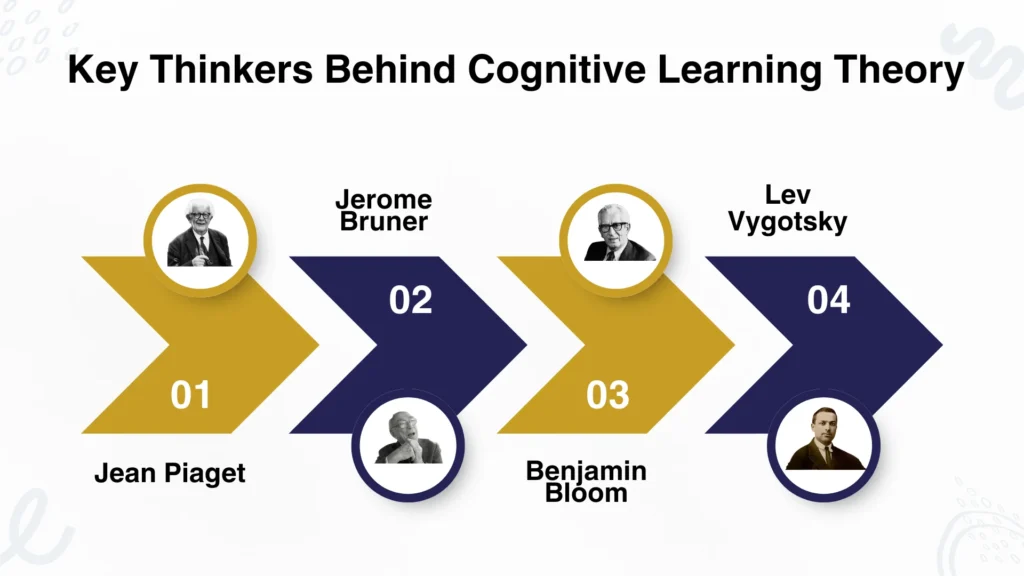
Key Thinkers Behind Cognitive Learning Theory
Whether you agree with this or not, every single thing on this planet has an origin. Cognitive learning theory originated from psychologists who challenged the idea that learning is just behavior change. They shifted the entire focus to the human mind and how it processes information.
Jean Piaget
He is considered the primary founder of cognitive learning theory. Jean Piaget transformed education by showing changes in the thought process of children at different stages of development. He stated the idea that learners actively construct knowledge rather than passively absorb it.
Jerome Bruner
He emphasised discovery learning and believed students learn best when they uncover ideas themselves. He argued that complex topics can be taught at any age if they’re structured properly.
Benjamin Bloom
Benjamin Bloom organised thinking into levels, from remembering to creating concepts, as it encourages deeper intellectual engagement. His framework also helped teachers design lectures that develop exceptional thinking abilities.
Lev Vygotsky
What Lev Vygotsky stated was that learning happens best when guidance creates a bridge between current abilities and potential growth. His concept of support showed how a structured approach can strengthen thinking over time.
A Complete Breakdown of Cognitive Learning Theory
Cognitive learning theory is defined as the idea that learning happens inside the mind and not just through apparent behaviour. So, your thinking, remembering, and most of all understanding are what matter. The primary purpose of this theory is to explain how you store knowledge, connect it to something relatable, and store it in your memory to solve problems later on.
Branches of Cognitive Learning Theory
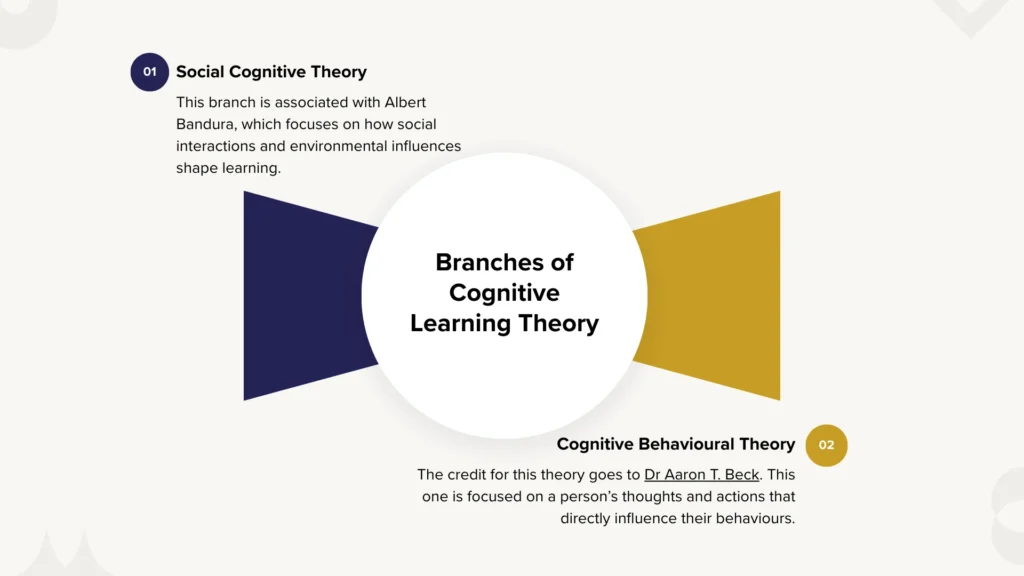
Cognitive learning theory isn’t just straight. It’s like a tree with several branches that explore different parts of how the mind works. Surely, they revolve around mental processes, but they focus on different angles of thinking and development. Its two branches consist of:
1. Social Cognitive Theory
This branch is associated with Albert Bandura, which focuses on how social interactions and environmental influences shape learning.
- It’s primarily focused on new behaviours and knowledge attained by observing apparent actions.
- It signifies how learning is not one-way but a constant, interactive process between an individual and its environment.
- Additionally, it’s also focused on an individual’s ability to succeed that affects their effort in learning new tasks.
2. Cognitive Behavioral Theory
The credit for this theory goes to Dr Aaron T. Beck. This one is focused on a person’s thoughts and actions that directly influence their behaviours.
- It primarily focuses on finding and challenging negative thought processes to improve performance.
- Considers the mind as a human computer that stores and organises information in its memory.
- Additionally, it also focuses on the way you think about your own thought process, so you can identify internal issues.
Types of Cognitive Learning Theory
There are several ways in which you can access cognitive learning. It consists of different types depending on how you learner process and interact with information.
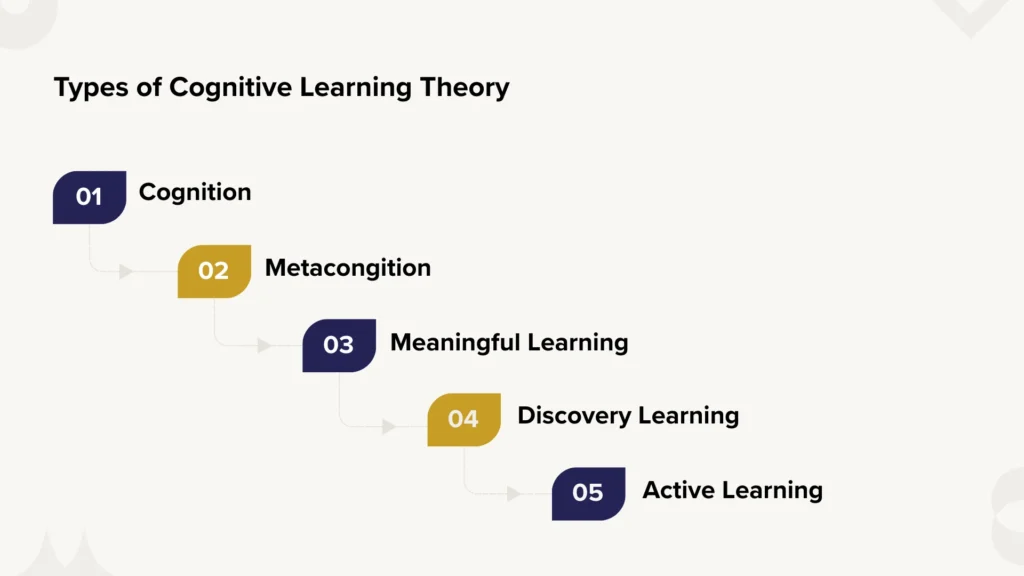
1. Cognition
Cognition is all about your mental processes involving how you acquire knowledge, think, understand and analyse your problems. Basically, it’s the driving force that takes care of your learning.
Example
When you’re watching a documentary, you’re not just gonna keep on looking at it. You’ll notice how the shots were taken, facial expressions, and analyse the words coming out of their mouths.
2. Metacognition
Basically, it’s the advanced level of cognition where you literally think about your own “thinking”. This might seem crazy, but it improves your overall thought process and reflects what strategies work for you.
Example
You’ll notice how you struggle to remember information from simply reading, but this isn’t the case when you write summary notes.
3. Meaningful Learning
This happens when you acquire new information and connect it to something you already know. Instead of memorising random facts, your brain stacks up ideas like building blocks.
Example
A biology student who has learned about the human heart connects it to what they already know about blood circulation. Instead of memorising parts randomly
4. Discovery Learning
You access this type of learning by figuring things out on your own instead of getting an answer from someone else. You’re basically driven by curiosity to explore and test different ideas.
Example
You’re on your bicycle and suddenly decide to ride without holding the handles. You experiment and notice the patterns. Gradually you end up mastering this skill, and now you’re able to wave at others while talking on the phone on your bicycle (don’t).
5. Active Learning
You’re gonna hate this one if you don’t like interactions. In this one, you’re required to actively participate not just through listening but also through writing, discussing and analysing.
Example
You’re a director who’s cooperating with the cameraman, actor, video and sound editors to make a perfect short film. All give suggestions and justify their reasons.
Real-World Examples in Educational Settings
Cognitive learning theory is more noticeable in classrooms when teaching is about more than just memorising information. It doesn’t only show up in students, but also in professors. Some of these examples can also be applied in workplace settings. Here are a few examples:
1. Concept Mapping
Think of a professor who’s about to start a complex topic like environmental & biological systems. Instead of giving a long boring lecture, he asks you to imagine and visually connect to something relatable. This can help you in storing information at your own pace.
- This will help in creating diagrams linking climate and its effects on the human body.
- You’ll easily identify the causes of such effects instead of manually memorising.
- This will form a roadmap of connections that improves your knowledge.
2. Problem-Based Learning
Pretend you’re back in high school, attending your science class, and you’re told that a lake in your community is losing fish. Instead of giving you an explanation, the teacher challenges you to figure out the cause. You’ll have no choice but to look into the matter and discuss possibilities.
- You’ll figure out the causes, like pollution or temperature changes.
- You will connect concepts that are closely linked to the ecosystem
- At the end, you’ll understand the whole situation through reasoning instead of memorisation
3. Collaborative Learning (Group Discussions & Peer Teaching
Working solo might feel reassuring, but students gain a better understanding of any topic when they discuss, question and solve problems together. Teachers help instead of dominating the discussion, which assures students that they can learn concepts meaningfully.
- Students explain concepts to their classmates and reinforce their own understanding.
- Teachers oversee group discussions and make corrections if necessary.
- Learns develop their comprehension and critical thinking through dialogue.
4. Scaffolding Techniques
Just like how workmen use wood and metal poles to build and repair buildings, gradually removing them once they’re done. Teachers also provide the same structured support to help students understand complex topics, and gradually walk away once they’re capable enough.
- Teachers will divide lessons into simple steps based on the students’ capacity to learn.
- Students will be confident enough to take on complex challenges.
- Learning becomes a lot more meaningful through step-by-step guidance.
5. Reflective Learning Activities
Reflecting on how students think and what they learn can upgrade their thinking process. Teachers can emphasise metacognition by asking students to question their own progress. This improves the storage of information and enhances long-term understanding.
- Teachers ask open-end question to see how students answer based on their analytical thinking.
- Students write their own diaries where they reflect on their assessments.
- Self-reflection will help students identify their own strengths and areas for improvement.
Cognitive Learning Theory vs. Behavioural Learning Theory
These theories are two foundational approaches in educational psychology. They focus on how learning occurs, but differ in their use of methods and assumptions about the learner. Knowing their differences can help you determine which approach is best for your academic growth.
| Aspect | Cognitive Learning Theory | Behavioural Learning Theory |
|---|---|---|
| Focus of Learning | Internal Mental Processes | Apparent behaviours |
| Role of the student | Someone who processes & interprets information | Someone who responds to stimuli |
| Role of the teacher | Someone who shapes understanding | Someone who reinforces |
| Learning method | Critical thinking, problem solving & concept mapping | Drillsm repetition, rewards & consequences |
| Motivation | Mostly internal, like motivation & curiosity | Mostly external, like praising and rewarding |
| Assessment style | Based on reasoning & understanding | Based on behaviour changes |
To sum this all up, cognitive learning theory has everything to do with internal processes, whereas behavioural learning theory has more to do with external stimuli. Both influence education, but with different methods.
Benefits and Limitations of Cognitive Learning Theory
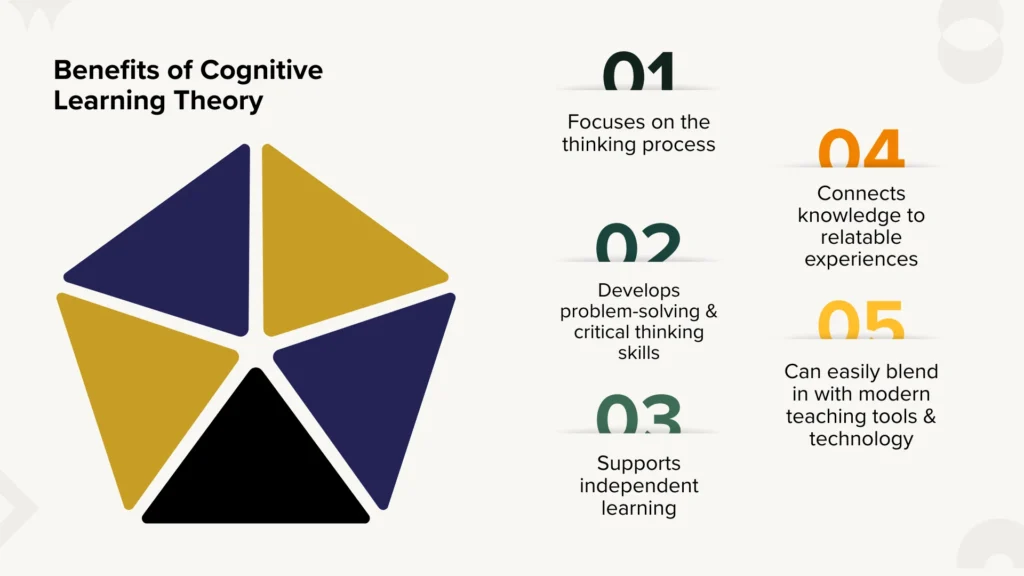
By the end of it, you probably now have a solid idea of what Cognitive learning theory is all about. It’s certainly a very powerful psychological framework. However, not every great framework is completely flawless.
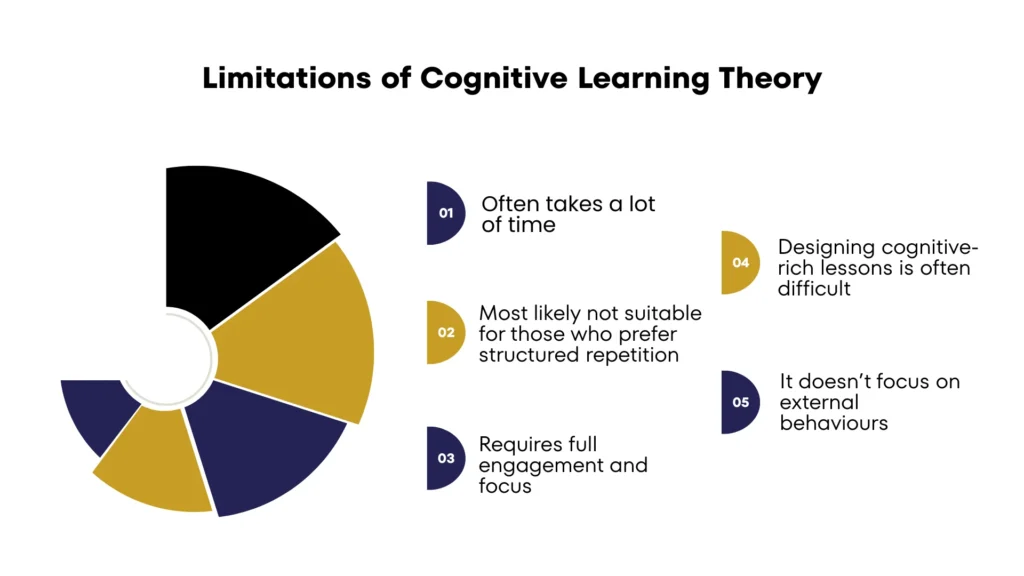
| Key Advantages | Potential Drawbacks |
| Focuses on the thinking process | Often takes a lot of time |
| Develops problem-solving & critical thinking skills | Most likely not suitable for those who prefer structured repetition |
| Supports independent learning | Requires full engagement and focus |
| Connects knowledge to relatable experiences | Designing cognitive-rich lessons is often difficult |
| Can easily blend in with modern teaching tools & technology | It doesn’t focus on external behaviours |
In the long run, cognitive learning theory offers meaningful benefits when applied thoughtfully. It requires a lot of engagement, but its focus on mental processing makes it a powerful framework.
FAQs
According to Piaget, there are about four stages consisting of the sensorimotor, preoperational stage, concrete operational stage and formal operational stage.
A schema is like a mental framework that helps you organise and interpret information based on prior knowledge.
Memory is the central point in cognitive learning since your mind is something that stores and decodes information.
It is applied in similar ways to those in an educational setting. Such as problem-based learning, scenario training, reflective feedback sessions and enhanced sessions for critical thinking/decision-making.
It certainly is, especially in educational institutes and corporate settings. You may not see its effects in the beginning. But gradually, you’ll start seeing its benefits.