If you’ve found yourself here, then you’re most likely reminiscing about your school days and realised that you shouldn’t have missed or paid more attention to your English class.
Punctuation marks are what make a writing clear and understandable. Without them, you’re simply gonna make a reader confused.
A few studies have stated that improper punctuation is highly prevalent (35.6%), even among English majors, and content without proper punctuation will confuse your reader a lot, and they won’t get anything out of it.
But fret not, there’s always room for improvement, even if you’re from an English-speaking majority country. We will walk through what punctuations are, their most common & uncommon types and the mistakes you must avoid so you can improve your grammar.
What are Punctuation Marks and Their Functions?
Punctuation marks silently guide your verbal language, telling readers when to pause or connect. They replace tone and expressions that naturally exist in speech. Not knowing how to use them is gonna make your sentence sound misleading.
Separators
They create a breathing space between sentences so they don’t get stuffed together. This helps in organising their context without making their meanings sound similar to one another. Commas (,) are very commonly used for this purpose.
Terminators
To put it simply, they mark the end of a sentence. They act as borders that keep sentences in check and prevent them from jumping over more than necessary. Full stops (.) are commonly used as terminators. Additionally, Exclamation marks (!) and Question marks (?) can be used for the same purpose too.
Enclosers
This is for when you’ll be adding a sidenote within your sentences to give further context of its meaning. Even if your sentence sounds complex, they’ll help simplify it. Parenthesis “()” and brackets “[]” are very common
Connectors
These help in showing the relation between ideas and words. Combining meanings and forming compound terms. Hyphens (-) and Slash (/) often act as connectors
Tone markers
If you want to show emotions in your sentences, tone markers can help you with that. Your readers will be able to feel every single word, enhancing your storytelling. Common tone markers include exclamation marks (!) and question marks (?).
List of Common and Uncommon Punctuation Marks
Punctuation may look small, but it can shape how your sentences are read by your audience. Even in informal settings, text messages require proper punctuation. However, there exist both beginner and expert levels of punctuation that you probably didn’t know about.
Common Punctuation Marks
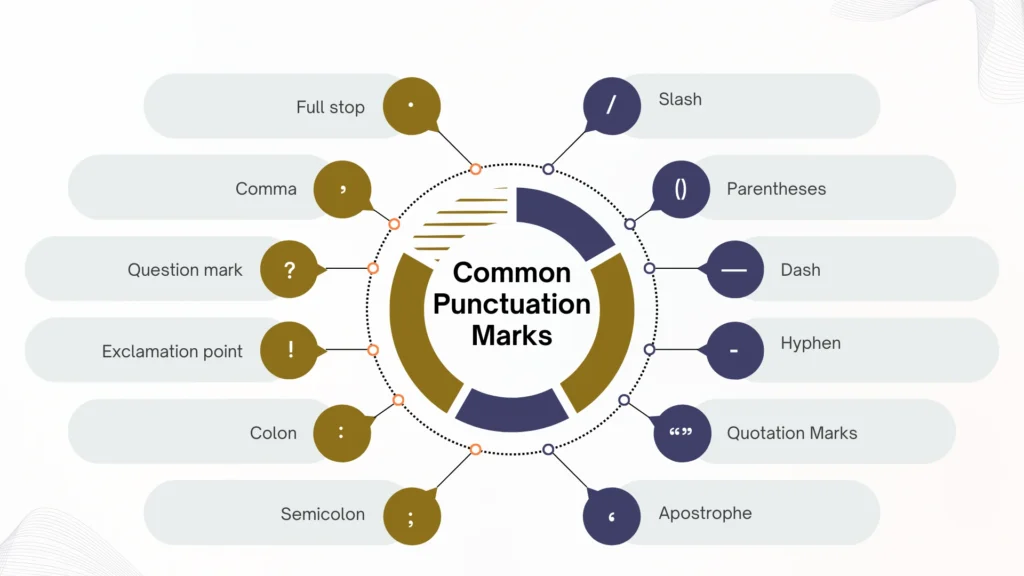
Let’s begin with the beginner-friendly ones that we use and notice daily. They are most commonly used in informal and slightly professional settings. Mastering even the beginner level will be enough for you to get by in your personal and professional life.
.
| Punctuation Marks | Symbols |
| Period/Full stop | . |
| Comma | , |
| Question Mark | ? |
| Exclamation Point | ! |
| Colon | : |
| Semi Colon | ; |
| Apostrophe | ‘ |
| Inverted Commas/Quotation marks | “” |
| Hyphen | – |
| Dash | –/- |
| Parentheses | () |
| Slash | / |
1۔ Period/Full stop (.)
This symbol works as a terminator and indicates that a sentence or a paragraph has completed. This closure is required for not unnecessarily dragging out your information and to prevent your reader from getting bored.
Example
I’m finally graduating by the end of this month.
2. Comma (,)
If you’re wondering about a separator, then this is what commas do. They give proper pauses and separate words to avoid a sentence from getting stuffed.
Example
I came back from the grocery store and bought milk, eggs and bread.
3. Question mark (?)
This one’s pretty self-explanatory. This is commonly used for asking information, but it can also be used for awaiting confirmation from someone. This can also be used to emphasise emotion.
Example
Man, is it really necessary for me to learn about punctuation?
4. Exclamation point (!)
A question mark can also emphasise emotion, but it’s nowhere near the level of an exclamation point. This can be used to emphasise anger, excitement or urgency. However, you must use it in small quantities.
Example
I can’t believe this explanation is so easy to understand!
5. Colon (:)
You must use this one for pausing a sentence for a brief moment and then start writing down a list or some further information to properly understand the context of your heading.
Example
Don’t forget this: Clarity comes first.
6. Semicolon (;)
This one can be confusing to use. This one gives a slightly longer pause than a comma and is often used for those words that are closely related to one another, rather than writing them separately.
Example
Meet Mr Gascoigne; CEO of Gascoigne Group
7. Apostrophe (‘)
You’ll be using this one to shorten words in your sentences so they can sound more casual and natural when being read. It’ll make it like you’re talking to a friend rather than a high-level senior in your workplace.
Example
You’re really planning on skydiving?
8. Quotation Marks (“”)
If you’re writing a novel or film script, then you’ll be using quotation marks a lot. They are used for writing dialogues, but they can highlight a word or phrase that’s being used sarcastically.
Example
No way, you just came back from “shopping”?
9. Hyphen (-)
A hyphen works as a connecting cable for words that belong together and form a single meaning to avoid making them sound awkward.
Example
I need step-by-step instructions on how to wash dishes.
10. Dash (—)
A dash is yet another separator as it pauses a sentence for a while and adds additional info. It works very similarly to parenthesis but this would be its relatively relaxed version.
Example
Now that you’ve mentioned it— the movie really was scary.
11. Parentheses ()
These are used for adding side notes that give further context to your sentence. It is often not an obligation to mention sidenotes, but they can be very helpful for the readers who want extra details.
Example
A person who works hard can overcome anyone (even an inherent genius)
12. Slash (/)
While this can be used as a separator too, you can also use it to suggest alternatives or a relation between two terms. This is commonly used in technical writing and URLs.
Example
This position is open to full-time/part-time applicants.
Uncommon Punctuation Marks
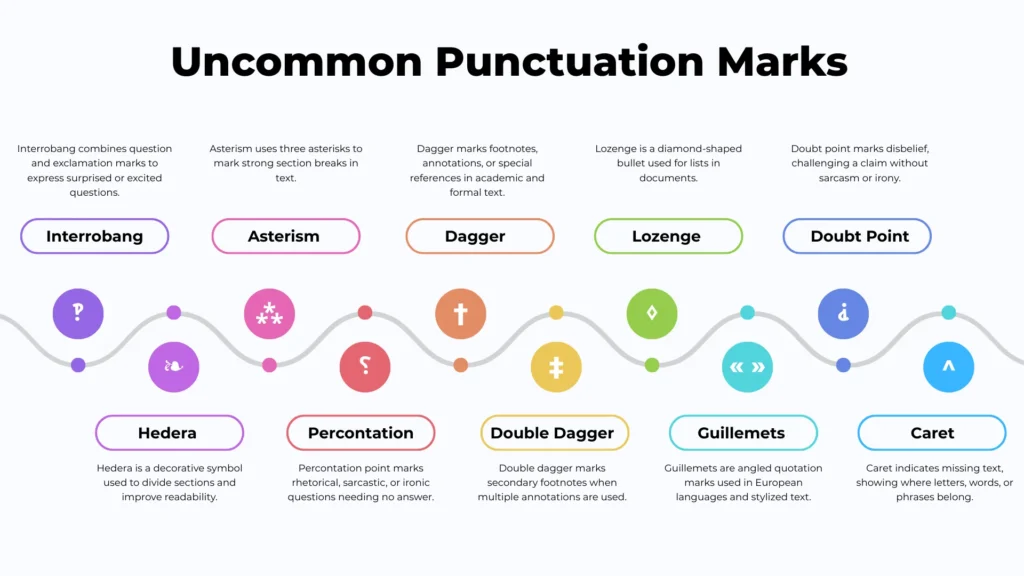
In a nutshell, most are just fancy versions of their common counterparts. Regardless of how technical they might look, they’re able to solve actual communication problems. If you get a grasp of them as well, you’ll have a range of symbols to choose from that can evolve your grammar.
| Punctuation Marks | Symbols |
| Interrobang | ‽ |
| Hedera (Fleuron) | ❧ |
| Asterism | ⁂ |
| Percontation Point | ⸮ |
| Dagger/Obelisk | † |
| Double Dagger | ‡ |
| Lozenge | ◊ |
| Guillemets | « » |
| Doubt Point | ⸘ |
| Caret | ^ |
1. Interrobang (‽)
When an exclamation point and question mark fuse, you get an interrobang. You’ll be using this symbol if you want to state a question that’s loaded with a lot of emotion.
Example
You really finished the project on time‽
2. Hedera (❧)
This is also called a fleuron and is probably the most stylish of all the symbols. It is used as a decorative mark that divides sections of text. It improves the visual flow, which means that reading long documents becomes easier.
Example
It’s more commonly used in story novels for cutting a scene like
..The dragon was finally slain, and peace came at last.❦Rain poured down like a mercy from heaven..
3. Asterism (⁂)
It’s also known as a triple asterisk. It consists of three asterisks formed in a triangle, and like hedera, it also separates sections, but it is used for more structural purposes instead of style.
Example
The boy finally mounted the griffin and started to ascend safely.
⁂
The bloodthirsty hounds below him did not stop barking.
4. Percontation Point (⸮)
The percontation point is shaped like a backward question mark, which is designed to signal the end of a rhetorical question in sceptic, sarcasm or ironic way. Additionally, it also signals that a question does not require an answer.
Example
You really thought that plan would succeed⸮
5. Dagger / Obelisk (†)
The dagger is more commonly used in academic writing as a reference to annotations or footnotes. It’s usually mentioned when numbered footnotes are constantly used.
Example
This data was revised back in 2025†
6. Double Dagger (‡)
This one works very similarly to the dagger. However, it marks additional notes to maintain understanding when multiple footnotes are needed. It is also known as diesis.
Example
This sort of amendment is applied to specialised cases‡
7. Lozenge (◊)
Basically, it’s a fancy version of bullet points where you can write down lists and options. They’re commonly used in technical documents and typography.
Example
Checklist for camping
◊ Tents
◊ Cooking Pots
◊ Match sticks
8. Guillemets (« »)
Yet another fancy version, but this time it’s of quotation marks. They’re commonly used in European languages and sometimes in English too, for aesthetic purposes.
Example
The aged woman came close and whispered, «It’s dangerous to go outside, these creatures hunt in the dark»
9. Doubt Point (⸘)
This one works similarly to the percontation point. The only catch is that it directly challenges claims without having any hint of irony or sarcasm.
Example
You’re telling me that he managed to complete the entire project all by himself⸘
10. Caret (^)
This one is also commonly used in academic writing, where it works as a proofreading mark. Highlighting missing letters, words or text in your sentence.
Example
She entered the store ^to buy some groceries.
Common Mistakes in Using Punctuation Marks
Most punctuation mistakes often come from overconfidence rather than ignorance. This is because punctuation marks are small, which is why their errors often go unnoticed. Keep these five mistakes in mind so you can avoid them later on.
Overusing Commas
There’s no way your reader will remain engaged with your content if there are too many commas. You’re basically making them pause more and read less. This will break the natural flow of your sentence.
Using Apostrophes for Plurals
The purpose of Apostrophes is to indicate contractions, not plurals. Writing “video game’s” instead of “video games” is a very common punctuation error. Just a single “s” often gets the job done.
Confusing Hyphens and Dashes
They look very similar and are often used for interruptions. However, mixing them up is very common, and they’re gonna make your sentences look messy.
Ending Sentences with Question Marks
The purpose of question marks is to address questions instead of using them to end statements. This will ruin the whole structure of your sentence, and your reader will be left without any clarity.
Overuse of Exclamation Points
Surely, exclamation points work really well when expressing emotion, but on the downside, they’re often abused. Using too many of them will make your writing unprofessional.
FAQs
It’s a lot more important since formal writing often requires undivided focus and precision when writing them.
All you have to do is read a lot of books and articles on the internet. Practice in short sentences and learn one punctuation mark at a time.
They’re used in fictional novels but are more prevalent in academic writing for proofreading, footnotes and citations.
A hyphen joins words together, whereas a dash causes an interruption.
It is possible, but it must be very sparingly. Using them frequently will make your sentences sound more emotional than professional.