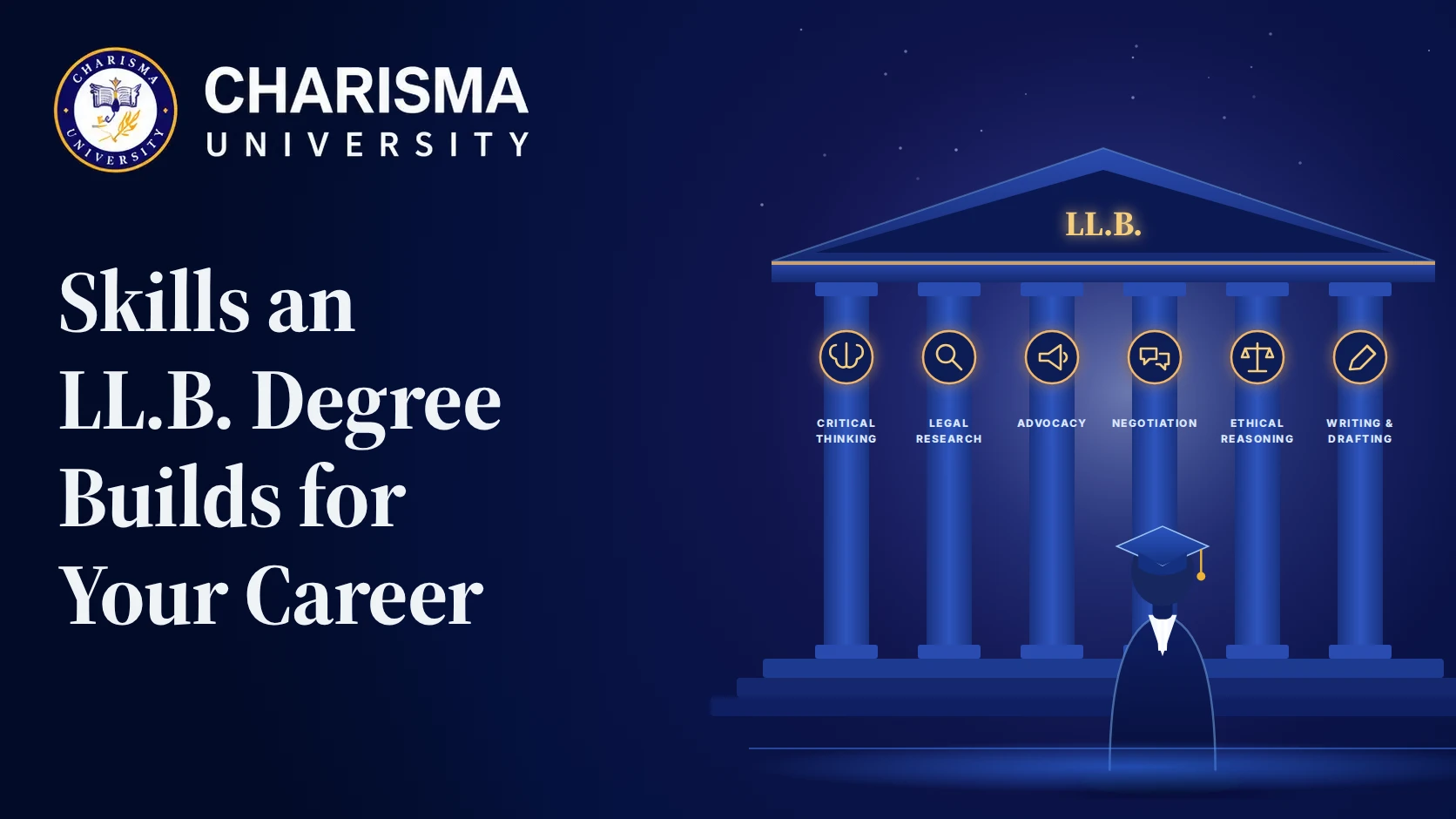
An LL.B. does more than teach you the law. It builds a set of professional skills that employers across industries rank among the most valuable in the workforce. The World Economic Forum’s Future of Jobs 2025 report found that analytical thinking is the top core skill for employers globally, with nearly 70% of organizations rating it as essential. Resilience, flexibility, and agility ranked second at 67%, followed by leadership and social influence at 61%.
Every one of those skills sits at the center of a legal education. Law students analyze complex problems under pressure, construct arguments from incomplete information, communicate persuasively in writing and in person, and manage competing deadlines. These are not abstract qualities. They are practiced, tested, and refined over the course of the degree.
The legal profession itself reflects the demand for these skills. The global legal services market reached $1.15 trillion in 2025 and is projected to grow to $1.86 trillion by 2034 at a 5.4% compound annual rate (GM Insights). The BLS reports that lawyers earned a median annual wage of $159,670 (May 2025), with approximately 754,500 jobs and 31,500 openings expected annually.
This guide covers the specific skills a Bachelor of Laws develops, how they apply across careers, and why legal training produces some of the most versatile graduates in higher education.
Analytical Thinking and Critical Reasoning
Analytical thinking is the foundation of legal education. Every law course requires students to break complex situations into components, identify relevant facts, apply legal principles, evaluate competing arguments, and reach reasoned conclusions. Case analysis, statutory interpretation, and problem-based assessments train this skill repeatedly across the curriculum.
The WEF found that nearly 70% of employers worldwide consider analytical thinking the most important core skill, and that number is expected to rise through 2030. A survey of over 1,000 legal professionals by Business Name Generator found that attention to detail (26%) and problem-solving (22%) were the most important soft skills in the legal industry. Both are direct applications of analytical thinking.
This skill transfers well beyond law. Compliance officers, policy analysts, management consultants, financial advisors, and corporate strategists all rely on the same structured reasoning that legal training develops. Graduates who pursue careers in business administration or consulting bring a level of analytical rigor that sets them apart.
Legal Research and Information Literacy
LL.B. programs teach students how to find, evaluate, and apply legal authorities efficiently. This includes searching legislation databases, reading and interpreting case law, cross-referencing statutes, verifying that cited authorities are still valid, and synthesizing findings from multiple sources into coherent arguments.
Legal research is more than a technical skill. It develops a broader information literacy, the ability to locate reliable sources, assess their credibility, identify bias, and distinguish between primary and secondary authorities. In a world where information is abundant but verification is rare, this skill is increasingly valuable across industries.
Graduates apply legal research skills in compliance, regulatory affairs, public policy, journalism, and academic research. The discipline of verifying claims before relying on them is a habit that legal training embeds deeply.
Legal Writing and Drafting
Clear, precise writing is one of the most marketable skills any degree can produce. LL.B. programs develop this through legal opinions, case briefs, memoranda, contracts, statutory analyses, and research papers. Every assignment demands structured arguments, accurate terminology, logical organization, and concise language.
Legal writing differs from other forms of professional writing in its emphasis on precision. A poorly worded contract clause can cost millions. An ambiguous statutory interpretation can change the outcome of a case. This standard of care produces graduates who write with unusual clarity and attention to detail.
These skills apply directly to corporate communications, policy drafting, regulatory compliance, grant writing, and technical documentation. Employers in human resource management particularly value the ability to draft clear employment policies, contracts, and compliance documents.
Oral Advocacy and Communication
Law students develop oral communication skills through moot courts, presentations, tutorials, and classroom debates. Moot court competitions simulate real courtroom proceedings, requiring students to present structured oral arguments, respond to judicial questioning, and think on their feet under pressure.
The BARBRI and Above the Law survey of over 300 legal professionals found that communication and emotional intelligence were among the most valued skills in the profession. Experienced attorneys reported wishing they had developed client communication and negotiation skills earlier in their careers.
Oral advocacy builds more than courtroom skills. It develops the ability to present complex information clearly, adapt language for different audiences, and persuade decision-makers. These skills apply in sales, management, public relations, teaching, consulting, and any role that requires influencing others. Graduates interested in public-facing roles can explore how these skills align with different types of advocacy.
Negotiation and Conflict Resolution
Negotiation is central to legal practice. Lawyers negotiate settlements, contracts, plea agreements, business terms, and dispute resolutions daily. LL.B. programs introduce negotiation theory and practice through coursework, simulations, and clinical programs.
Effective negotiation requires active listening, empathy, strategic thinking, risk assessment, and the ability to find solutions that serve multiple parties. The WEF ranks empathy and active listening as essential skills for 50% of employers, reinforcing the cross-industry value of this training.
Alternative dispute resolution (ADR), including mediation and arbitration, is a growing field. The BLS reports a median annual wage of $75,530 for arbitrators, mediators, and conciliators (May 2025), with 5% projected growth. LL.B. graduates with strong negotiation skills are well positioned for careers in dispute resolution, contract management, and labor relations.
Hard Skills vs. Soft Skills From an LL.B.
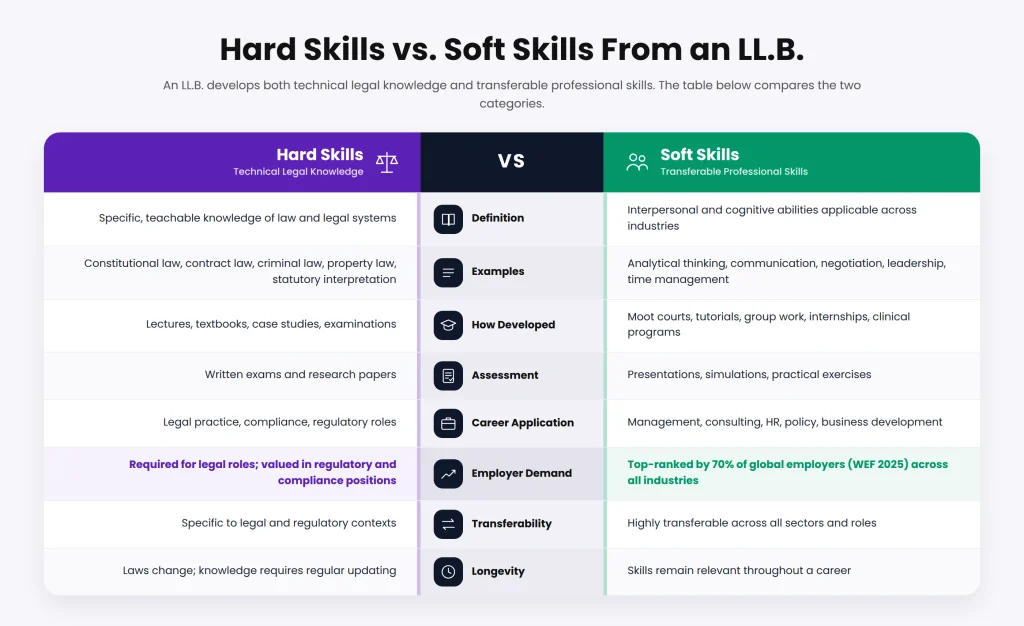
An LL.B. develops both technical legal knowledge and transferable professional skills. The table below compares the two categories.
| Dimension | Hard Skills (Technical Legal Knowledge) | Soft Skills (Transferable Professional Skills) |
|---|---|---|
| Definition | Specific, teachable knowledge of law and legal systems | Interpersonal and cognitive abilities applicable across industries |
| Examples | Constitutional law, contract law, criminal law, property law, statutory interpretation | Analytical thinking, communication, negotiation, leadership, time management |
| How Developed | Lectures, textbooks, case studies, examinations | Moot courts, tutorials, group work, internships, clinical programs |
| Assessment | Written exams and research papers | Presentations, simulations, practical exercises |
| Career Application | Legal practice, compliance, regulatory roles | Management, consulting, HR, policy, business development |
| Employer Demand | Required for legal roles; valued in regulatory and compliance positions | Top-ranked by 70% of global employers (WEF 2025) across all industries |
| Transferability | Specific to legal and regulatory contexts | Highly transferable across all sectors and roles |
| Longevity | Laws change; knowledge requires regular updating | Skills remain relevant throughout a career |
The most effective LL.B. graduates develop both categories. Hard skills qualify them for legal practice. Soft skills make them competitive for leadership and cross-functional roles in any industry.
Time Management and Working Under Pressure
Law students manage heavy reading loads, multiple deadlines, moot court preparation, and examination schedules simultaneously. This builds the capacity to prioritize tasks, allocate time effectively, and deliver quality work under pressure.
The legal profession is known for demanding schedules. The ability to function effectively under time pressure is not optional. It is a core professional requirement that LL.B. programs develop through sustained practice over the duration of the degree.
Time management ranked as the third most important soft skill for legal professionals at 21% (Business Name Generator survey). Employers across industries, from finance to healthcare, consistently identify time management as a critical hiring criterion.
Ethical Reasoning and Professional Responsibility
Legal education places significant emphasis on professional ethics, codes of conduct, confidentiality, and the responsibilities that come with representing clients and handling sensitive information. Courses in jurisprudence and professional responsibility examine the moral foundations of legal systems and the ethical obligations of practitioners.
This training produces graduates who approach decisions with an awareness of ethical implications, conflicts of interest, and the balance between client advocacy and public duty. Ethical reasoning is valued in compliance, corporate governance, healthcare administration, public service, and financial regulation.
Organizations increasingly need professionals who understand the ethical frameworks governing their operations. The rise of AI in the legal profession has added new ethical dimensions, from algorithmic bias to data privacy, that legally trained professionals are uniquely equipped to navigate.
Digital Literacy and Legal Technology
Modern LL.B. programs increasingly integrate technology into the curriculum. Students learn to use legal research databases, document management systems, e-discovery platforms, and case management software. As the legal technology market grows, projected to reach $46.7 billion by 2030 at a 10.2% CAGR (Research and Markets), digital literacy is becoming a baseline expectation for legal professionals.
The BARBRI survey found that nearly three-quarters of law students rated their school’s support for leveraging AI and technology as “fair” or “poor.” This gap presents an opportunity for graduates who actively develop technology skills alongside their legal training. Understanding contract automation, data analytics, and AI-assisted research adds significant value in both legal and non-legal roles.
Teamwork and Collaboration
Law is often perceived as a solitary profession, but effective legal practice requires extensive collaboration. Lawyers work in teams on complex cases, coordinate with clients and expert witnesses, and collaborate across departments in corporate settings. LL.B. programs develop teamwork through group projects, moot court teams, law review boards, and clinical programs.
The WEF identifies leadership and social influence as essential for 61% of employers. Collaboration skills are equally important. The ability to contribute to a team, manage interpersonal dynamics, and work toward shared outcomes under pressure is a skill that legal training develops consistently.
Building on Your LL.B. Skills
The skills developed during an LL.B. create a foundation for both legal practice and broader professional success. Graduates who want to deepen their legal expertise can pursue a Master of Laws (LLM) or a PhD in Law. Those interested in combining legal skills with business strategy may consider an MBA.
A structured professional development plan helps graduates identify which skills to strengthen, which certifications to pursue, and how to position their legal training for the career path they want.
Explore Charisma University’s Bachelor of Laws (LL.B.) to build the analytical, communication, and professional skills that employers across industries value most. Apply today and invest in a degree that prepares you for more than one career.
Frequently Asked Questions
An LL.B. builds analytical thinking, legal research, persuasive writing, oral advocacy, negotiation, ethical reasoning, time management, digital literacy, and teamwork. These skills apply across legal practice, business, compliance, consulting, public policy, and many other fields.
Yes. The WEF’s Future of Jobs 2025 report ranks analytical thinking, resilience, and leadership among the top skills employers value globally. All three are core components of legal training, making LL.B. graduates competitive across industries.
Research shows that attention to detail (26%), problem-solving (22%), and time management (21%) are the top soft skills in the legal profession. Analytical thinking and clear communication are also consistently ranked among the most critical competencies.
Through moot courts, oral presentations, tutorials, client simulations, and legal writing assignments. Students learn to present complex arguments clearly, adapt their language for different audiences, and communicate persuasively in both written and spoken formats.
Modern LL.B. programs increasingly cover legal research databases, document management, e-discovery tools, and case management software. However, the BARBRI survey found that most students feel their schools underinvest in technology training, making self-directed learning an important complement.
Yes. The analytical, research, writing, and negotiation skills an LL.B. develops are valued across compliance, HR, consulting, public policy, corporate governance, and business management. Many LL.B. graduates build successful careers outside of traditional legal practice.