Professional development is the ongoing process of building the skills, knowledge, and competencies a career requires. This guide gives you a 6-step plan to write your own professional development plan, a ready-to-copy example, a 5-stage cycle to repeat every year, and 5 mistakes to avoid.
Career advisors use frameworks like this one every semester to help students, and working professionals turn vague ambitions into a document they actually follow. The steps below reflect that same coaching approach.
What Is Professional Development?
Professional development means building the skills, knowledge, and competencies your role requires, on an ongoing basis. It includes formal training, certifications, mentorship, and on-the-job learning. Unlike a single course or workshop, professional development never really ends. It evolves as your role, industry, and goals change.
What Is a Professional Development Plan?
A professional development plan (PDP) is a written document that records your current skills, your target skills, and the actions you’ll take to close that gap. It connects your personal goals to the skills your role, industry, or employer actually rewards. If you’re not sure which skill to prioritize first, academic advising can help map the gap before you write anything down.
A complete professional development plan contains 3 core parts:
- Goal: Set a target such as a certification, a promotion, or a new technical skill.
- Resources: List the training programs, mentors, courses, or professional associations you need.
- Timeline: Break the goal into smaller tasks with real deadlines.
Professional Development Plan vs. Related Plans
Mixing up a professional development plan with a similar-sounding plan creates confusion for employees and managers alike. Here’s how to tell them apart.
PDP vs. Personal Development Plan
A professional development plan targets role-related skills your employer will fund and recognize. A personal development plan covers non-work goals, such as fitness or a new language, that fall outside your employer’s scope.
PDP vs. Performance Improvement Plan
A performance improvement plan (PIP) corrects underperformance and usually runs under HR oversight. A professional development plan builds capability for employees who already meet expectations.
PDP vs. Career Development Plan
A career development plan maps a longer path, often through stretch roles or job rotations toward a position you don’t hold yet. A professional development plan targets a shorter horizon and focuses on skills you can build in your current role.
PDP vs. Individual Development Plan (IDP)
An individual development plan (IDP) is the term many large organizations use for the same document a PDP describes, usually tied to a formal performance-review cycle. Ask your manager which term your company uses before you submit one, since the format and approval process can differ.
Why Do You Need a Professional Development Plan?
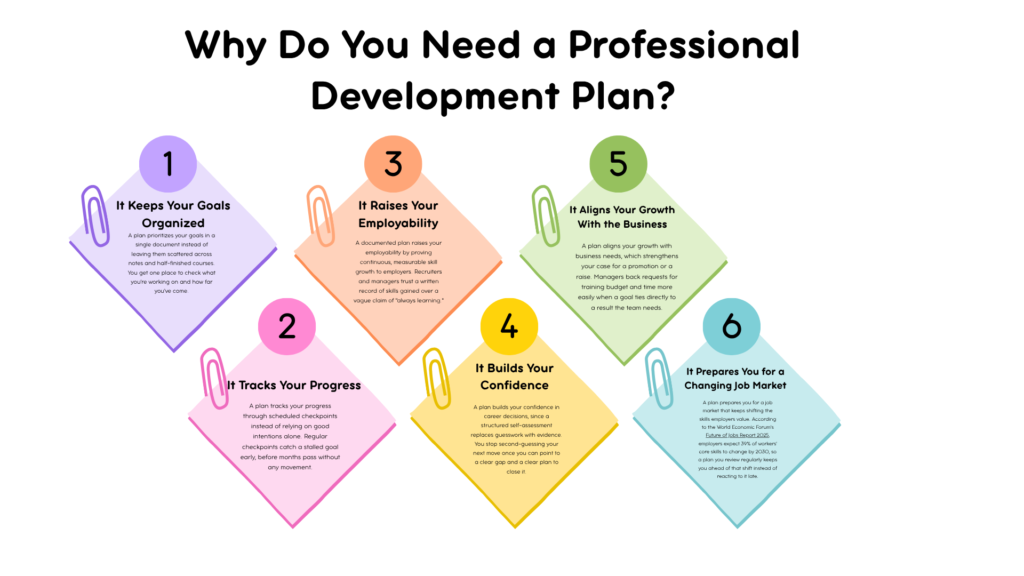
You need a professional development plan because it turns career growth from a vague hope into a tracked, resourced project. Without one, skill-building stays scattered across random courses and good intentions. A written plan delivers 6 measurable advantages over that unplanned approach.
It Keeps Your Goals Organized
A plan prioritizes your goals in a single document instead of leaving them scattered across notes and half-finished courses. You get one place to check what you’re working on and how far you’ve come.
It Tracks Your Progress
A plan tracks your progress through scheduled checkpoints instead of relying on good intentions alone. Regular checkpoints catch a stalled goal early, before months pass without any movement.
It Raises Your Employability
A documented plan raises your employability by proving continuous, measurable skill growth to employers. Recruiters and managers trust a written record of skills gained over a vague claim of “always learning.”
It Builds Your Confidence
A plan builds your confidence in career decisions, since a structured self-assessment replaces guesswork with evidence. You stop second-guessing your next move once you can point to a clear gap and a clear plan to close it.
It Aligns Your Growth With the Business
A plan aligns your growth with business needs, which strengthens your case for a promotion or a raise. Managers back requests for training budget and time more easily when a goal ties directly to a result the team needs.
It Prepares You for a Changing Job Market
A plan prepares you for a job market that keeps shifting the skills employers value. According to the World Economic Forum’s Future of Jobs Report 2025, employers expect 39% of workers’ core skills to change by 2030, so a plan you review regularly keeps you ahead of that shift instead of reacting to it late.
How to Write a Professional Development Plan in 6 Steps
Follow these 6 steps to build a plan that drives real skill growth instead of sitting unused in a folder.
Step 1: Run a Self-Assessment
List your current strengths, weaknesses, and professional standing first. Ask yourself 3 questions: What do you do well? Where do you struggle? What feedback have colleagues or managers already given you? A 360-degree feedback request from 3 to 5 coworkers sharpens this step, since an outside view cuts personal bias.
Step 2: Set SMART Goals
Turn a vague ambition into a SMART goal: specific, measurable, achievable, relevant, and time-bound. “Improve leadership skills” fails this test, since no one can measure it. “Lead a 5-person project team by Q3” passes, because you can check whether it happened.
Step 3: Match Goals to Learning Methods
Pair each goal with a concrete learning method, such as a certification course, a mentorship program, or a stretch assignment. Choose the format that fits how you learn best: structured courses, hands-on practice, or one-on-one coaching. The School of Business is one example of what a structured option looks like.
Step 4: Resource Your Action Plan
List the exact resources each goal needs: budget, time, tools, and manager support. Build a timeline with weekly, monthly, or quarterly checkpoints, depending on the size of the goal. Many teams track this inside an LMS (learning management system) so managers can see progress without a separate spreadsheet.
Step 5: Review and Adjust
Check your plan on a fixed schedule instead of leaving it untouched for a year. Ask 3 questions at each checkpoint: Are you closer to the goal? Have new resources become available? Has your role changed enough to revise the plan?
Step 6: Measure Results
Compare your milestones against what actually happened and adjust from there. Note the wins, even small ones, since recognizing progress keeps the plan alive past the first month.
Professional Development Plan Example
A sample plan makes the 6 steps concrete. Here’s what one entry-level goal might look like once it’s filled in:
| Goal | Resources | Timeline |
| Lead a 5-person project team | Project-management mentor, internal leadership workshop | 3 months |
| Earn a data-analytics certificate | Online certificate course, 4 study hours per week | 10 weeks |
| Present at 1 industry event | Public-speaking coach, a local professional association | 6 months |
Copy this format into a spreadsheet or an LMS, then add your own goals, resources, and dates.
The 5-Stage Professional Development Cycle
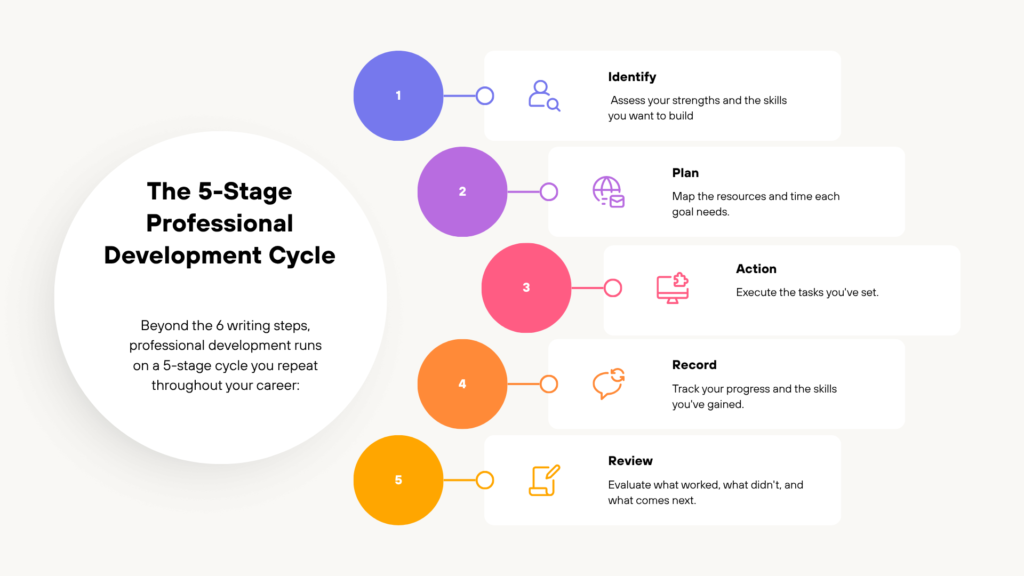
Beyond the 6 writing steps, professional development runs on a 5-stage cycle you repeat throughout your career:
- Identify: Assess your strengths and the skills you want to build.
- Plan: Map the resources and time each goal needs.
- Action: Execute the tasks you’ve set.
- Record: Track your progress and the skills you’ve gained.
- Review: Evaluate what worked, what didn’t, and what comes next.
This cycle treats development as ongoing rather than a one-time project, which matches how most careers actually unfold across multiple roles.
When to Create a Professional Development Plan
Certain moments signal that informal learning isn’t enough anymore.
Individual Triggers
Write a professional development plan when any of these 3 situations applies to you:
- New role: You’ve decided to move into a role that needs skills you don’t have yet.
- Manager feedback: A manager has flagged a skills gap that’s limiting your contribution.
- New responsibility: A new responsibility demands a capability you haven’t built yet.
Organizational Triggers
Teams benefit from coordinated plans, often through Career Services, when several people need the same training at once, for example, a new software rollout, a strategy shift, or a skills-gap analysis showing a shortage in a critical function.
How to Measure a Professional Development Plan
Track your plan against real evidence, not intentions. Measure it at 3 levels:
- Activity completion: Did the planned training or coaching actually happen?
- Skill growth: Has a manager or mentor observed the skill improving?
- Outcome impact: Did the new skill lead to a promotion, a project win, or a measurable performance gain?
A study published in Vocations and Learning found that how people actually use a development plan shapes whether it drives real learning and job performance, not just whether the plan exists on paper. That finding supports the review step above: a plan you never revisit adds little value regardless of how well it’s written.
5 Professional Development Plan Mistakes to Avoid
Avoid these 5 mistakes if you want your plan to survive past the first month:
- Vague goals: Avoid goals like “get better at communication” instead of an observable outcome, such as “run 3 client presentations without notes by Q2.”
- No timeline: Don’t leave deadlines open-ended.
- No manager buy-in: Secure manager support, since skipping it cuts off access to budget and time.
- No review cycle: Revisit the plan regularly, since it goes stale within a few months otherwise.
- Generic goals: Run a real skills-gap analysis against your own role instead of copying generic goals.
How Charisma University Supports Your Professional Development
Charisma University pairs each step of this framework with direct support. A career consultant through Career Services can help align your goals with real opportunities, while Academic Advising guides your course and skill choices as your plan takes shape.
Once your goals are set, Charisma University’s schools build the role-specific capabilities that match your target position. If your plan eventually calls for a higher-level credential, the Master’s Programs extend that growth even further.
Frequently Asked Questions
Review it every quarter for a fast-changing role, or every 6 months for a stable one. A shorter cycle catches a stalled goal before it derails the whole plan.
No. OKRs (objectives and key results) track team or company output over a quarter, while a professional development plan tracks your individual skill growth over months or years. Many people use both together.
Your direct manager, since they control the budget, time, and stretch assignments a plan usually needs, if your goal depends on any of those.
A professional development plan should include 3 core parts: a goal, the resources needed, and a timeline. A goal without a resourced timeline stays a wish, not a plan you can track.
A professional development plan should run 3 to 12 months per goal, depending on how complex the skill is. A certification might take 10 weeks, while a leadership goal like managing a team often needs 6 months or more.
A strong professional development goal reads like “lead a 5-person project team by Q3” or “earn a data-analytics certificate within 10 weeks.” Each example names a specific outcome and a deadline, which separates it from a vague ambition like “get better at leadership.”
No, a training plan and a professional development plan are not the same. A training plan covers a single course, workshop, or certification, while a professional development plan tracks skill growth across multiple goals over months or years.
Set SMART goals by making each one specific, measurable, achievable, relevant, and time-bound. “Lead a 5-person project team by Q3” meets all 5 criteria, while “improve leadership skills” fails the test since no one can measure it.