A Bachelor of Laws (LLB) is one of the most versatile undergraduate degrees available. It qualifies graduates for careers inside and outside the courtroom, from litigation and corporate counsel to compliance, human resources, public policy, and dispute resolution. The legal profession itself is massive. The global legal services market was valued at approximately $1.03 trillion in 2024 and is projected to reach $1.47 trillion by 2032, growing at a 4.6% compound annual rate.
The job market for law graduates reflects that growth. According to the National Association for Law Placement (NALP), 93.4% of U.S. law graduates from the Class of 2024 secured employment, the highest rate in nearly four decades of tracking. The median salary for that class reached $95,000, up 5.6% from the prior year. Bar-required positions accounted for 84.3% of all jobs, the highest share since NALP introduced the classification in 2001.
These numbers point to strong and growing demand for legal professionals across sectors. This guide covers the most common career paths available with an LLB, salary data from the Bureau of Labor Statistics (BLS), the skills employers value, and how to choose the right direction.
Practicing Lawyer
The most direct career path for LLB graduates is practicing law. After completing the LLB and passing the bar examination in their jurisdiction, graduates can practice as solicitors, barristers, or attorneys depending on the legal system. Common specializations include criminal law, corporate law, family law, tax law, environmental law, labor and employment law, intellectual property, and litigation.
The BLS reports that lawyers earned a median annual wage of $159,670 as of May 2025, with 863,700 jobs in the U.S. The lowest 10% earned less than $78,360, while the highest 10% earned more than $351,600. Employment is projected to grow 5% from 2025 to 2035, with about 28,700 openings expected annually.
Private practice remains the largest employer. NALP data shows that 58.9% of the Class of 2024 entered private practice, the highest share since 1992. Salaries in private practice ranged from $80,000 at firms with 1 to 10 lawyers to $225,000 at firms with more than 500 lawyers.
A Bachelor of Laws provides the foundational legal knowledge required for bar preparation and legal practice across multiple jurisdictions.
Corporate Counsel
Corporate counsel, also known as in-house counsel, work directly for companies rather than law firms. They advise on contracts, regulatory compliance, intellectual property, employment law, mergers and acquisitions, and litigation risk. Every major corporation, from tech companies to healthcare systems to financial institutions, employs in-house legal teams.
Salaries for corporate counsel typically range from $140,000 to $171,000 annually, depending on the industry, company size, and level of seniority. Senior roles such as General Counsel and Chief Legal Officer command significantly higher compensation, often exceeding $250,000 at large companies.
This career path appeals to LLB graduates who prefer a predictable schedule and a business-oriented environment over the adversarial nature of courtroom litigation. Strong foundations in business administration alongside legal training make candidates particularly competitive for in-house roles.
Judge or Magistrate
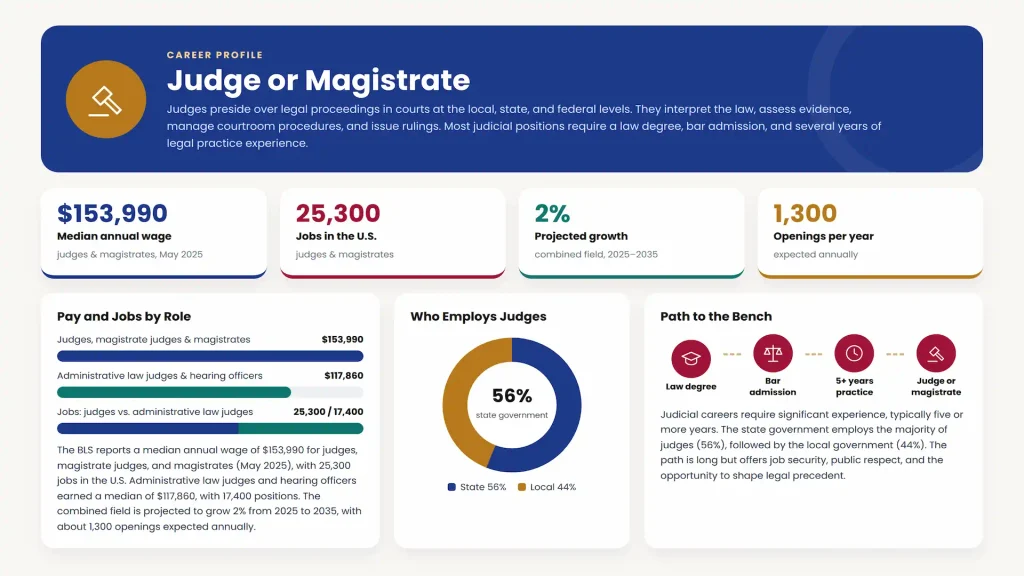
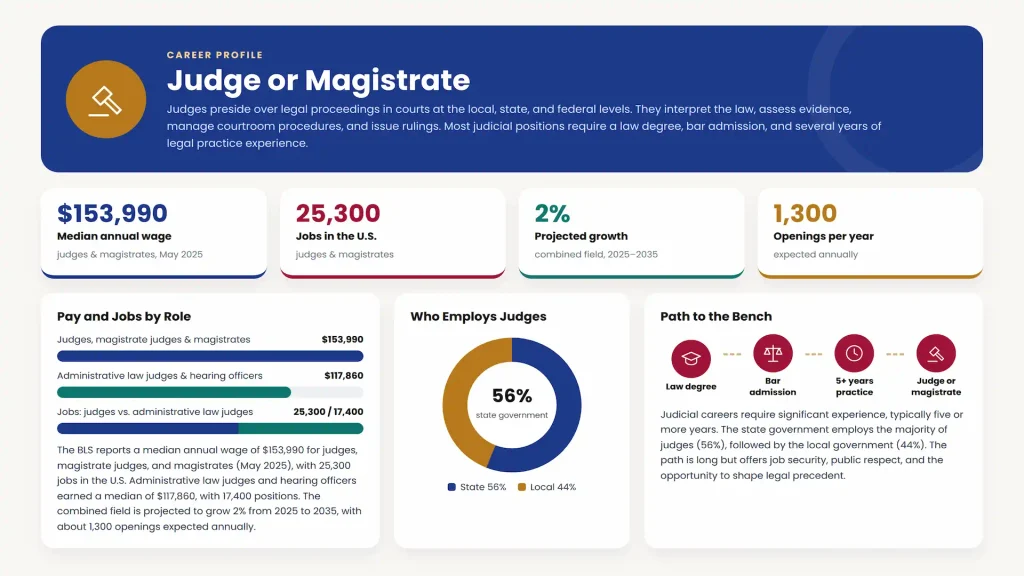
Judges preside over legal proceedings in courts at the local, state, and federal levels. They interpret the law, assess evidence, manage courtroom procedures, and issue rulings. Most judicial positions require a law degree, bar admission, and several years of legal practice experience.
The BLS reports a median annual wage of $153,990 for judges, magistrate judges, and magistrates (May 2025), with 25,300 jobs in the U.S. Administrative law judges and hearing officers earned a median of $117,860, with 17,400 positions. The combined field is projected to grow 2% from 2025 to 2035, with about 1,300 openings expected annually.
Judicial careers require significant experience, typically five or more years. The state government employs the majority of judges (56%), followed by the local government (44%). The path is long but offers job security, public respect, and the opportunity to shape legal precedent.
Compliance Officer
Compliance officers ensure that organizations follow laws, regulations, and internal policies. They work across industries including finance, healthcare, manufacturing, government, and technology. Responsibilities include developing compliance programs, conducting audits, training staff, investigating violations, and reporting to regulators.
The BLS reports a median annual wage of $80,730 for compliance officers (May 2025), with 436,400 jobs in the U.S. Employment is projected to grow 4% from 2025 to 2035, with about 32,700 openings expected annually. The highest-paying sectors include professional and technical services ($91,960 median) and manufacturing ($89,290 median).
LLB graduates are well suited for compliance roles because legal training develops the regulatory knowledge, analytical thinking, and attention to detail that the work demands. This career path does not require bar admission, making it accessible to graduates who want to apply legal knowledge without practicing law.
Mediator and Arbitrator
Mediators and arbitrators help resolve disputes outside the courtroom. Mediators facilitate negotiation between parties to reach a voluntary agreement. Arbitrators hear both sides and issue binding or non-binding decisions. Both roles are used in business disputes, employment conflicts, family law, insurance claims, and international trade.
The BLS reports a median annual wage of $75,530 for arbitrators, mediators, and conciliators (May 2025), with 10,500 jobs in the U.S. Employment is projected to grow 5% from 2025 to 2035. Local government positions pay the highest median ($92,790), followed by state government ($81,330).
Alternative dispute resolution (ADR) is growing as courts and organizations seek faster, less expensive methods for resolving conflicts. LLB graduates with training in negotiation and conflict resolution are well positioned for this field.
Practicing Lawyer vs. Corporate Counsel
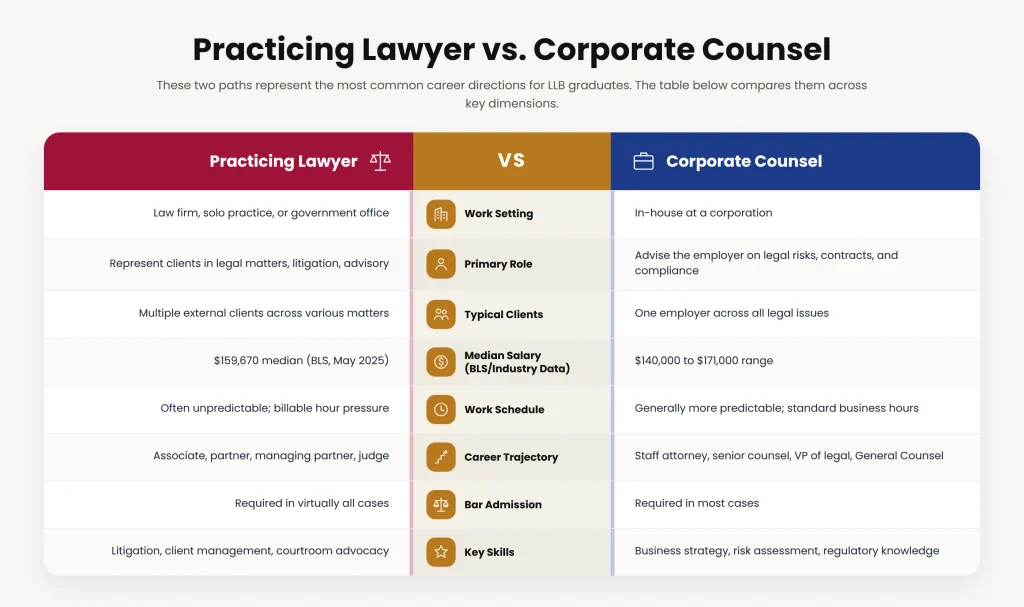
These two paths represent the most common career directions for LLB graduates. The table below compares them across key dimensions.
| Dimension | Practicing Lawyer | Corporate Counsel |
|---|---|---|
| Work Setting | Law firm, solo practice, or government office | In-house at a corporation |
| Primary Role | Represent clients in legal matters, litigation, advisory | Advise the employer on legal risks, contracts, and compliance |
| Typical Clients | Multiple external clients across various matters | One employer across all legal issues |
| Median Salary (BLS/Industry Data) | $159,670 median (BLS, May 2025) | $140,000 to $171,000 range |
| Work Schedule | Often unpredictable; billable hour pressure | Generally more predictable; standard business hours |
| Career Trajectory | Associate, partner, managing partner, judge | Staff attorney, senior counsel, VP of legal, General Counsel |
| Bar Admission | Required in virtually all cases | Required in most cases |
| Key Skills | Litigation, client management, courtroom advocacy | Business strategy, risk assessment, regulatory knowledge |
Both paths offer strong earning potential and career growth. Practicing lawyers build expertise across a wide range of clients and matters, while corporate counsel develop deep knowledge of a single industry and its regulatory landscape.
Paralegal or Legal Assistant
While many paralegal positions require only an associate degree or certificate, LLB graduates who enter paralegal or legal assistant roles gain practical experience that can serve as a stepping stone toward legal practice or management positions in law firms.
The BLS reports a median annual wage of $62,890 for paralegals and legal assistants (May 2025), with 404,900 jobs in the U.S. Federal government paralegals earn the highest median ($81,470), followed by finance and insurance ($80,120). The field is expected to see little change in employment over the 2025 to 2035 period, with about 40,800 openings annually from replacement demand.
Charisma University also offers an Associate in Paralegal Studies for students who want a focused entry point into the legal field before pursuing a full law degree.
Human Resources Management
LLB graduates bring valuable expertise to human resources, particularly in areas such as employment law, workplace compliance, labor relations, anti-discrimination policy, and contract negotiation. HR managers handle recruitment, employee relations, benefits administration, and organizational development.
The BLS reports a median annual wage of $149,280 for human resources managers (May 2025), with 224,900 jobs in the U.S. Employment is projected to grow 6% from 2025 to 2035, with about 16,800 openings expected annually.
Organizations increasingly need HR professionals who understand the legal frameworks governing employment practices. LLB graduates who move into HR management combine legal knowledge with people management skills, making them strong candidates for leadership roles. Students interested in this path can also explore a Bachelor of Science in Human Resource Management or the HR management guide for additional context.
Government and Public Service
Government agencies at every level hire LLB graduates for legal, policy, and regulatory roles. Prosecutors and public defenders handle criminal cases. Government attorneys advise agencies on regulatory matters, draft legislation, and represent the state in civil litigation. Policy analysts and legislative aides use legal training to evaluate proposed laws and regulations.
NALP reports that 12.9% of the Class of 2024 took government positions, while 9.7% entered public interest roles, matching the prior record high. Combined, public service accounted for 32.7% of all employed graduates, the second-highest share in NALP history.
Federal government lawyers earned a median of $178,380 (BLS, May 2025), making it one of the highest-paying sectors for legal professionals. State government lawyers earned $115,330, and local government lawyers earned $131,390.
Legal Consulting and Writing
Legal consultants advise businesses, organizations, and individuals on specific legal issues without representing them in court. They provide opinions on contracts, regulatory compliance, risk management, and dispute strategies. Legal writers and editors produce articles, briefs, legal opinions, policy papers, and educational content for law firms, publishers, and media organizations.
The rise of legal technology (legaltech) has created new roles for law graduates in areas such as legal operations, contract automation, and AI in the legal profession. Graduates who combine legal knowledge with technology skills can access a fast-growing segment of the market.
Skills LLB Graduates Bring to the Workplace
Analytical Thinking
Legal training builds the ability to break complex problems into components, evaluate evidence, and construct logical arguments. This skill is essential in law, compliance, consulting, and any role that requires structured decision-making.
Research and Writing
LLB programs develop rigorous research skills and the ability to communicate findings in clear, precise written form. Legal research and writing transfer directly to roles in policy analysis, consulting, academia, and corporate communications.
Negotiation
Lawyers negotiate settlements, contracts, plea deals, and business terms daily. Strong negotiation skills are equally valuable in HR, procurement, sales management, and executive leadership.
Ethical Reasoning
Legal education places significant emphasis on professional ethics and codes of conduct. This training prepares graduates for roles where integrity, confidentiality, and compliance are critical, including finance, healthcare, and public advocacy.
Building a structured professional development plan early in your career helps you target the skills and certifications that align with your chosen path.
Advancing Your Legal Career
A Bachelor of Laws opens doors across the legal profession and beyond. For graduates who want to deepen their expertise, a Master of Laws (LLM) provides advanced specialization in areas such as international law, tax law, or human rights law. Those pursuing academic or research careers may consider a PhD in Law. An MBA is another strong complement for LLB holders moving into corporate leadership, consulting, or entrepreneurship.
Start Your Legal Career
The legal profession offers strong salaries, consistent demand, and career paths that span private practice, government, corporate settings, and emerging fields like legal technology. With a record 93.4% employment rate for the Class of 2024 and a median salary of $95,000, an LLB degree remains one of the most reliable investments in your professional future.
Explore Charisma University’s Bachelor of Laws (LLB) to build the foundation employers across industries are looking for. Apply today and take the first step toward a career in law.
Frequently Asked Questions
What careers can you pursue with an LLB degree?
An LLB opens doors to careers as a practicing lawyer, corporate counsel, judge, compliance officer, mediator, paralegal, HR manager, government attorney, legal consultant, and legal writer. The analytical, research, and negotiation skills it builds are valued across virtually every industry.
How much do LLB graduates earn?
Salaries vary by role and experience. According to the BLS (May 2025), lawyers earn a median of $159,670, judges earn $153,990, HR managers earn $149,280, and compliance officers earn $80,730. NALP reports a median salary of $95,000 for the Class of 2024 across all employment sectors.
Is an LLB degree worth it?
Yes. The Class of 2024 achieved a record 93.4% employment rate (NALP), and the global legal services market is projected to reach $1.47 trillion by 2032. Legal skills transfer across industries, giving graduates flexibility to pursue traditional and non-traditional career paths.
Can LLB graduates work outside of law?
Yes. Many LLB graduates work in compliance, human resources, corporate management, public policy, consulting, and legal technology. The critical thinking, writing, and negotiation skills developed in an LLB program are highly transferable to business and public service roles.
Do I need a master’s degree after an LLB?
An LLB is sufficient for legal practice after passing the bar examination. A Master of Laws (LLM) provides advanced specialization, while an MBA is valuable for graduates pursuing corporate leadership or consulting. Graduate study is optional but can accelerate career advancement.
What is the job outlook for lawyers?
The BLS projects 5% employment growth for lawyers from 2025 to 2035, with about 28,700 openings expected annually. NALP data confirms that the job market for law graduates is the strongest in decades, with unemployment at an all-time low of 5.1% for the Class of 2024.