The short answer is yes. An associate degree in business administration delivers measurable returns in earnings, employability, and career mobility. But the long answer depends on your goals, your timeline, and how you plan to use the degree after graduation.
BLS data for 2025 shows that workers with an associate degree earned median weekly wages of $1,135, compared to $966 for high school diploma holders. That is $169 more per week, or roughly $8,788 more per year. Over a career, the gap compounds significantly. Georgetown University’s Center on Education and the Workforce found that associate degree holders earn a median of $2 million in lifetime earnings, $400,000 more than the $1.6 million median for workers with only a high school diploma.
These numbers matter because the investment is relatively small. The College Board reports that average tuition and fees at public two-year colleges reached $4,150 for 2025-26, compared to $11,950 for public four-year institutions. A degree that costs under $8,300 in total tuition and adds $400,000 in lifetime earnings is one of the highest-return investments available in higher education.
This guide breaks down exactly what an associate degree in business administration covers, the careers it qualifies you for, salary data from the Bureau of Labor Statistics, and how it compares to a bachelor’s degree so you can decide if it fits your career plan.
What an Associate Degree in Business Administration Covers
An associate degree in business administration is a two-year program, typically requiring 60 credit hours, that covers the fundamentals of how businesses operate. The curriculum includes courses in accounting, marketing, management, business law, economics, business communications, and information technology.
The degree blends general education requirements (English, mathematics, social sciences) with core business courses. This combination builds both the technical business knowledge and the communication skills that employers look for in entry-level candidates.
Business is the third most popular field for associate degrees in the United States. According to the National Center for Education Statistics (NCES), 113,100 business associate degrees were conferred in 2021-22, representing 11% of all associate degrees awarded that year. Only liberal arts (38%) and health professions (18%) produced more graduates.
That popularity reflects employer demand. The BLS projects roughly 1.1 million management job openings annually from 2025 to 2035, driven by both growth and replacement of retiring workers. Many of those entry-level and mid-level management positions accept candidates with an associate degree and relevant experience.
Career Paths With an Associate Degree in Business
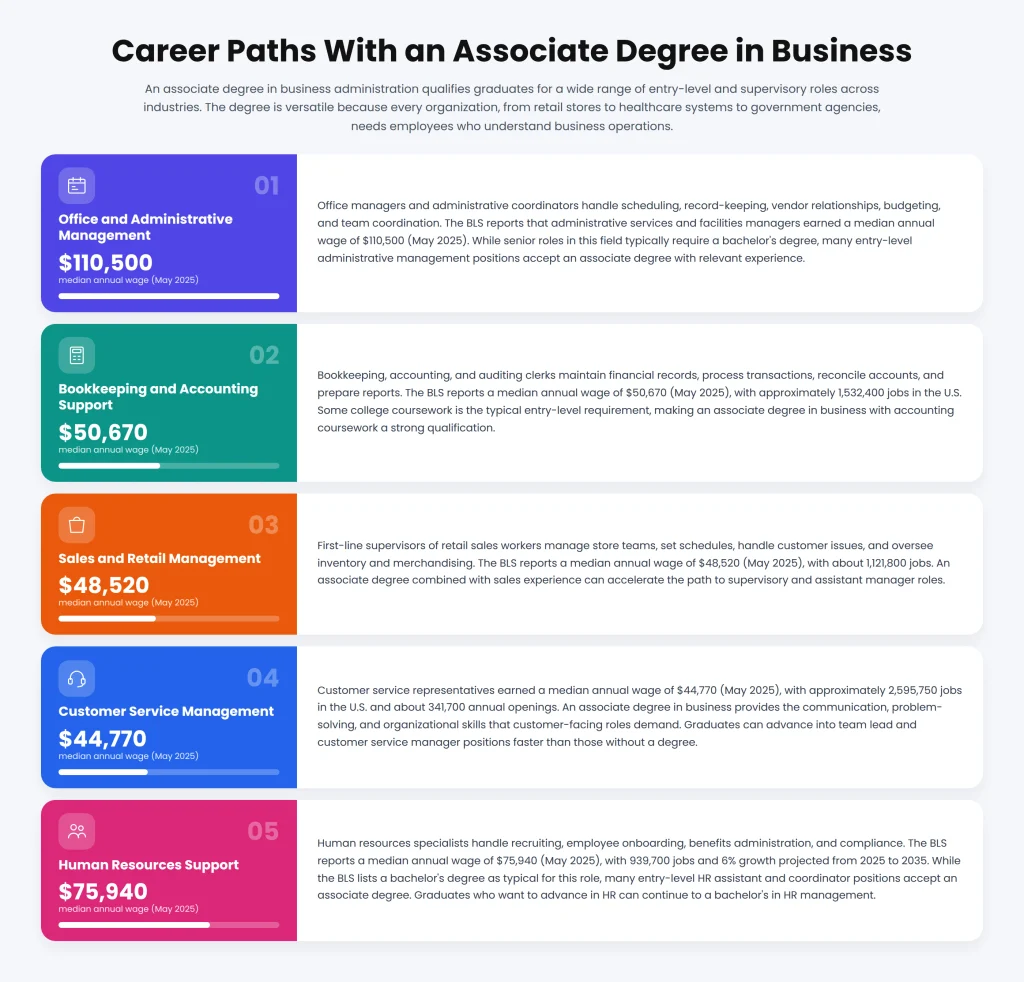
An associate degree in business administration qualifies graduates for a wide range of entry-level and supervisory roles across industries. The degree is versatile because every organization, from retail stores to healthcare systems to government agencies, needs employees who understand business operations.
Office and Administrative Management
Office managers and administrative coordinators handle scheduling, record-keeping, vendor relationships, budgeting, and team coordination. The BLS reports that administrative services and facilities managers earned a median annual wage of $110,500 (May 2025). While senior roles in this field typically require a bachelor’s degree, many entry-level administrative management positions accept an associate degree with relevant experience.
Bookkeeping and Accounting Support
Bookkeeping, accounting, and auditing clerks maintain financial records, process transactions, reconcile accounts, and prepare reports. The BLS reports a median annual wage of $50,670 (May 2025), with approximately 1,532,400 jobs in the U.S. Some college coursework is the typical entry-level requirement, making an associate degree in business with accounting coursework a strong qualification.
Sales and Retail Management
First-line supervisors of retail sales workers manage store teams, set schedules, handle customer issues, and oversee inventory and merchandising. The BLS reports a median annual wage of $48,520 (May 2025), with about 1,121,800 jobs. An associate degree combined with sales experience can accelerate the path to supervisory and assistant manager roles.
Customer Service Management
Customer service representatives earned a median annual wage of $44,770 (May 2025), with approximately 2,595,750 jobs in the U.S. and about 341,700 annual openings. An associate degree in business provides the communication, problem-solving, and organizational skills that customer-facing roles demand. Graduates can advance into team lead and customer service manager positions faster than those without a degree.
Human Resources Support
Human resources specialists handle recruiting, employee onboarding, benefits administration, and compliance. The BLS reports a median annual wage of $75,940 (May 2025), with 939,700 jobs and 6% growth projected from 2025 to 2035. While the BLS lists a bachelor’s degree as typical for this role, many entry-level HR assistant and coordinator positions accept an associate degree. Graduates who want to advance in HR can continue to a bachelor’s in HR management.
The Earnings Advantage
The financial case for an associate degree in business is built on three data points: the weekly earnings premium, the unemployment rate advantage, and the lifetime earnings difference.
BLS 2025 data shows:
Associate degree holders earned $1,135 per week at the median, with a 3.0% unemployment rate. High school diploma holders earned $966 per week at the median, with a 4.3% unemployment rate. Workers with some college but no degree earned $1,062 per week, with a 3.8% unemployment rate.
The associate degree delivers a 17.5% weekly earnings premium over a high school diploma and a 6.9% premium over some colleges with no degree. It also reduces unemployment risk by 1.3 percentage points compared to a high school diploma, meaning associate degree holders are roughly 30% less likely to be unemployed.
Georgetown CEW puts the lifetime earnings difference at $400,000. At an average total cost of around $8,300 for a community college associate degree, the return on investment is roughly 48 to 1. Few other two-year investments produce returns of that magnitude.
Associate Degree vs. Bachelor’s Degree in Business
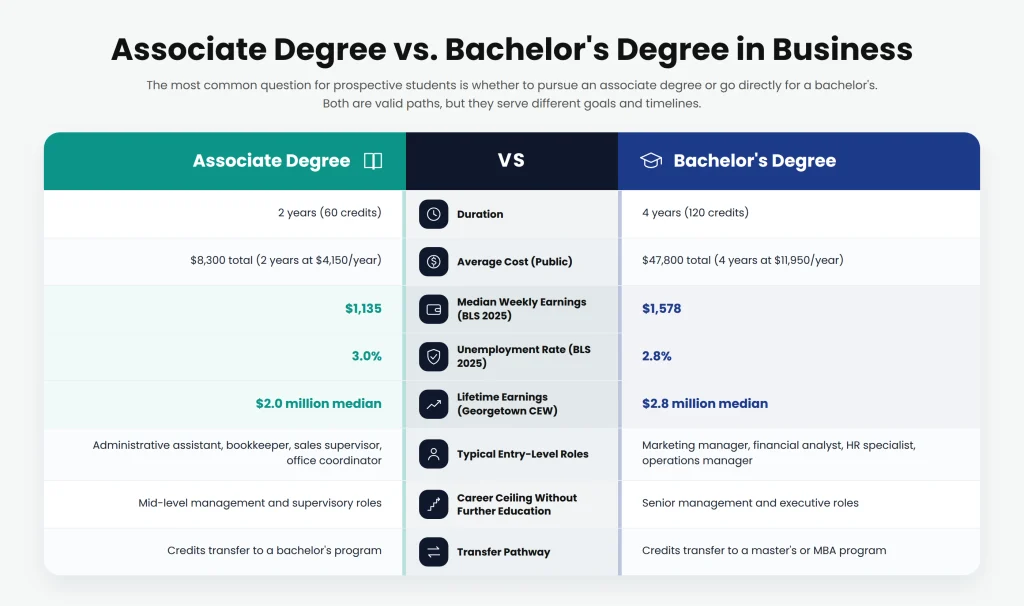
The most common question for prospective students is whether to pursue an associate degree or go directly for a bachelor’s. Both are valid paths, but they serve different goals and timelines.
| Dimension | Associate Degree | Bachelor’s Degree |
|---|---|---|
| Duration | 2 years (60 credits) | 4 years (120 credits) |
| Average Cost (Public) | $8,300 total (2 years at $4,150/year) | $47,800 total (4 years at $11,950/year) |
| Median Weekly Earnings (BLS 2025) | $1,135 | $1,578 |
| Unemployment Rate (BLS 2025) | 3.0% | 2.8% |
| Lifetime Earnings (Georgetown CEW) | $2.0 million median | $2.8 million median |
| Typical Entry-Level Roles | Administrative assistant, bookkeeper, sales supervisor, office coordinator | Marketing manager, financial analyst, HR specialist, operations manager |
| Career Ceiling Without Further Education | Mid-level management and supervisory roles | Senior management and executive roles |
| Transfer Pathway | Credits transfer to a bachelor’s program | Credits transfer to a master’s or MBA program |
The associate degree wins on speed, cost, and time-to-employment. The bachelor’s degree wins on earning potential, career ceiling, and specialization depth. Many students use the associate degree as a stepping stone, earning the two-year degree first to enter the workforce and then completing a bachelor’s in business while working.
This transfer pathway is one of the strongest arguments for starting with an associate degree. Students save thousands in tuition on general education courses at a community college, then transfer those credits to a four-year institution to complete the bachelor’s degree. The combination of lower upfront cost and earlier entry into the workforce can reduce or eliminate student debt while still leading to a bachelor’s degree.
Who Should Consider an Associate Degree in Business
An associate degree in business administration is a strong fit for several types of students.
Working adults who need a credential quickly will benefit from the two-year timeline. The degree provides immediate access to better-paying roles without the four-year commitment. Career changers transitioning from unrelated fields gain foundational business knowledge that applies across industries. High school graduates who are unsure about committing to a four-year program can test their interest in business at a lower cost before deciding whether to continue.
Entrepreneurs also benefit. The coursework in accounting, marketing, management, and business law covers the practical skills needed to start and run a small business. Not every business owner needs a bachelor’s degree, but every business owner needs to understand financial statements, marketing fundamentals, and basic legal compliance.
Students who plan to eventually earn a bachelor’s or an MBA can use the associate degree as the first step. Many four-year institutions accept transfer credits from accredited two-year programs, allowing students to complete the bachelor’s in two additional years.
What Employers Actually Look For
A common concern is whether employers value an associate degree. The answer depends on the role and the industry.
For entry-level positions in office administration, retail management, customer service, and bookkeeping, an associate degree meets or exceeds typical requirements. Many job postings in these fields list “associate degree preferred” or “some college required.” The degree signals that a candidate has completed a structured program, developed business knowledge, and demonstrated the commitment to finish what they started.
For mid-level and senior roles, employers increasingly look for a combination of education and experience. An associate degree holder with five years of relevant experience may be competitive for positions that typically list a bachelor’s degree. However, for roles in finance, marketing management, or strategic planning, a bachelor’s degree is usually the minimum requirement.
The key takeaway is that an associate degree is not a ceiling. It is a foundation that supports career entry, professional development, and further education. A clear professional development plan helps graduates map out which additional credentials and experience they need to reach their long-term career goals.
Potential Limitations
An associate degree in business has real limitations that prospective students should understand.
Some roles require a bachelor’s degree regardless of experience. Marketing managers ($166,790 median, BLS May 2025) and human resources managers ($149,280 median) typically need at least a bachelor’s degree for entry. Associate degree holders can work toward these roles through a combination of experience and continued education, but the degree alone will not qualify them.
Credit transfer is not guaranteed. Not all four-year institutions accept all associate degree credits. Students who plan to transfer should verify articulation agreements between their community college and their target bachelor’s program before enrolling. Accreditation matters. Degrees from regionally accredited institutions transfer more reliably than those from nationally accredited or unaccredited programs.
Specialization is limited in a two-year program. Associate degree curricula cover business fundamentals broadly rather than deeply. Students who want to specialize in areas like economics or international business will need a bachelor’s or graduate degree to develop that expertise.
Making the Decision
The value of an associate degree in business administration comes down to what you plan to do with it.
If you need to enter the workforce quickly, want to minimize student debt, or need a credential that improves your earning power immediately, the associate degree delivers strong, measurable returns. The $8,788 annual earnings premium over a high school diploma, combined with the 30% lower unemployment risk and the $400,000 lifetime earnings advantage, makes the financial case clear.
If your long-term goal is a senior management or executive role, the associate degree is best used as a stepping stone to a bachelor’s degree and eventually an MBA or specialized master’s program. Starting at a two-year college and transferring saves significant money while keeping the bachelor’s degree within reach.
Explore Charisma University’s Bachelor of Business Administration to see how a four-year degree builds on the business fundamentals that an associate degree provides. Apply today and take the next step in your business career.
Frequently Asked Questions
Yes. BLS 2025 data shows associate degree holders earn $1,135 per week at the median, compared to $966 for high school graduates. Georgetown University research puts the lifetime earnings premium at $400,000. At an average cost of $8,300, the return on investment is substantial.
Common roles include office manager, bookkeeping clerk, sales supervisor, customer service representative, administrative coordinator, and HR assistant. Many of these positions offer advancement opportunities into mid-level management with experience.
The College Board reports average tuition and fees of $4,150 per year at public two-year colleges for 2025-26. A full associate degree typically costs around $8,300, compared to roughly $47,800 for a bachelor’s at a public four-year institution.
Yes, most regionally accredited four-year institutions accept transfer credits from accredited community colleges. Students should verify articulation agreements with their target school before enrolling to ensure credits transfer smoothly.
Most full-time students complete an associate degree in two years (60 credit hours). Part-time students may take three to four years depending on their course load.
A bachelor’s degree offers higher median earnings ($1,578 vs. $1,135 per week) and access to more senior roles. However, it costs significantly more and takes twice as long. Many students earn the associate degree first, enter the workforce, and then complete the bachelor’s while working.