Few degrees open doors across as many industries as hospitality and tourism management. The sector behind it is enormous. According to the World Travel and Tourism Council (WTTC), travel and tourism contributed $10.9 trillion to global GDP in 2024, roughly 10% of the world’s total economic output. The WTTC projects that figure will reach $11.7 trillion in 2025 and $16.5 trillion by 2035, when the sector will support over 460 million jobs worldwide.
That scale creates demand for trained professionals far beyond hotels and restaurants. Hospitality and tourism graduates work in event management, healthcare, real estate, cruise lines, airlines, sports and entertainment, corporate services, and government agencies. The skills they build, including operations management, guest experience, financial planning, and cross-cultural communication, transfer across industries that depend on delivering high-quality service.
This guide breaks down the industries actively hiring hospitality and tourism management graduates, the roles available in each, salary data from the Bureau of Labor Statistics, and how to position yourself for the strongest career paths.
Hospitality Careers vs. Tourism Careers
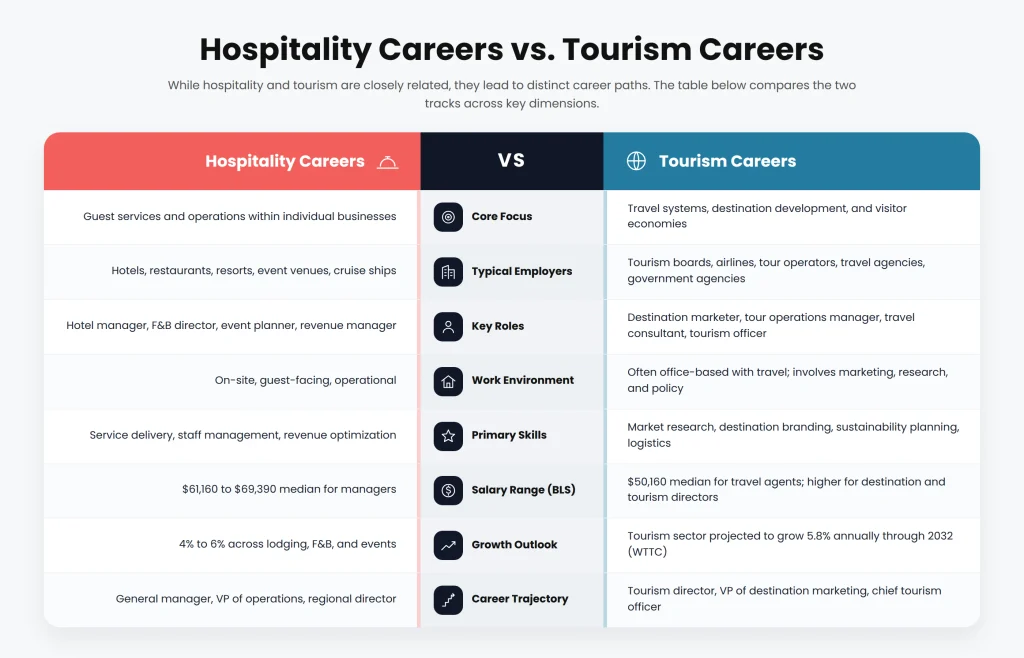
While hospitality and tourism are closely related, they lead to distinct career paths. The table below compares the two tracks across key dimensions.
| Dimension | Hospitality Careers | Tourism Careers |
|---|---|---|
| Core Focus | Guest services and operations within individual businesses | Travel systems, destination development, and visitor economies |
| Typical Employers | Hotels, restaurants, resorts, event venues, cruise ships | Tourism boards, airlines, tour operators, travel agencies, government agencies |
| Key Roles | Hotel manager, F&B director, event planner, revenue manager | Destination marketer, tour operations manager, travel consultant, tourism officer |
| Work Environment | On-site, guest-facing, operational | Often office-based with travel; involves marketing, research, and policy |
| Primary Skills | Service delivery, staff management, revenue optimization | Market research, destination branding, sustainability planning, logistics |
| Salary Range (BLS) | $61,160 to $69,390 median for managers | $50,160 median for travel agents; higher for destination and tourism directors |
| Growth Outlook | 4% to 6% across lodging, F&B, and events | Tourism sector projected to grow 5.8% annually through 2032 (WTTC) |
| Career Trajectory | General manager, VP of operations, regional director | Tourism director, VP of destination marketing, chief tourism officer |
Many professionals build careers that cross both tracks. A hotel manager may move into destination marketing, or a tourism planner may transition into resort management. A combined hospitality and tourism management degree provides the flexibility to pursue either direction.
Hotels and Lodging
The hotel industry is the most direct employer of hospitality management graduates. Roles span front office operations, housekeeping management, revenue management, sales, guest relations, and general management. Large hotel chains like Marriott, Hilton, and Hyatt run structured management training programs designed specifically for recent graduates.
The BLS reports that lodging managers earned a median annual wage of $69,250 as of May 2025, with approximately 54,800 jobs in the U.S. The field is projected to grow 4% from 2025 to 2035, with about 5,500 openings expected annually. Senior roles such as regional directors and vice presidents of operations command significantly higher compensation.
The global hotel pipeline remains strong. Industry data shows 8,011 hotel projects in development worldwide, with 2,771 properties scheduled to open in 2025, adding over 514,000 rooms. PwC projects U.S. hotel occupancy at 62.9% in 2025, with average daily rates rising 1.3% annually. This sustained investment signals continued demand for qualified hotel management professionals.
Students exploring this path can build their foundation through a Bachelor of Arts in Hospitality and Tourism Management, which covers hotel operations, revenue management, and guest services alongside broader business skills.
Food and Beverage
The food and beverage (F&B) industry employs more hospitality graduates than any other single sector. Roles include restaurant manager, food and beverage director, catering manager, banquet manager, bar manager, and executive chef positions that require operational management training rather than purely culinary skills.
The BLS reports a median annual wage of $69,390 for food service managers (May 2025), with 344,300 jobs in the U.S. and 6% projected growth from 2025 to 2035. Approximately 38,800 openings are expected annually, driven by both industry expansion and turnover in management positions.
The scale of this sector is significant. The global foodservice market was valued at approximately $3.49 trillion in 2024 and is projected to reach $6.35 trillion by 2032. Online food delivery alone is growing at 11.47% annually and is expected to reach $1.79 trillion by 2028. These trends create demand for managers who understand both traditional service operations and digital ordering platforms, delivery logistics, and technology integration.
Event Planning and Management
Event planning is one of the fastest-growing career paths for hospitality graduates. Professionals in this sector coordinate corporate conferences, trade shows, weddings, festivals, fundraising galas, and sporting events. The work involves venue selection, vendor management, budgeting, logistics, on-site coordination, and post-event analysis.
The BLS reports a median annual wage of $61,160 for meeting, convention, and event planners (May 2025), with 172,100 jobs in the U.S. Employment is projected to grow 6% from 2025 to 2035, with about 16,800 openings annually. Event management roles in luxury hospitality and corporate settings often pay a 15% to 20% premium over the industry median.
This field rewards the organizational, budgeting, and client management skills that hospitality programs develop. Students interested in combining event management with broader business strategy can also explore a Bachelor of Business Administration, which provides additional depth in finance, operations, and leadership.
Travel and Tourism
Travel and tourism encompasses airlines, cruise lines, tour operators, destination marketing organizations, travel agencies, and tourism boards. Roles include travel consultant, tour operations manager, destination marketing manager, visitor services coordinator, and tourism development officer.
The WTTC reported that international visitor spending reached $1.87 trillion in 2024 and is projected to hit $2.1 trillion in 2025. Business travel spending reached $1.48 trillion in 2024 and is expected to climb to $1.64 trillion in 2025. The cruise market alone is projected to reach $45 billion by 2030, growing at a 12.9% compound annual rate.
The BLS reports a median annual wage of $50,160 for travel agents (May 2025), with about 61,500 jobs and roughly 5,900 openings expected annually. However, salaries in tourism management and destination marketing roles are typically higher, particularly at national and regional tourism boards where strategic planning and policy development are central to the work.
Healthcare
Healthcare is one of the less obvious industries for hospitality graduates, but it is one of the fastest growing. Hospitals, senior living facilities, rehabilitation centers, and outpatient clinics increasingly hire professionals with hospitality training to manage patient experience, food services, facility operations, and guest relations.
The logic is straightforward: healthcare organizations compete on patient satisfaction scores, and the operational and service skills that hospitality programs teach are directly applicable. Patient experience coordinators, food service directors in healthcare settings, and facility managers all draw on hospitality management competencies.
The BLS projects healthcare and social assistance as the fastest-growing major employment sector from 2024 to 2034, adding approximately 1.98 million jobs. Hospitality graduates who combine their service management skills with healthcare-specific certifications can access a growing market with strong job security.
Sports, Entertainment, and Recreation
Stadiums, arenas, theme parks, casinos, concert venues, and recreational facilities all require hospitality-trained professionals. Roles include venue operations manager, guest experience director, VIP services coordinator, food and beverage manager for large-scale events, and entertainment district manager.
The global spa services market, another segment within this sector, was estimated at $96.51 billion in 2024 and is projected to grow at 7.5% annually through 2030. Wellness tourism and experiential entertainment are driving new roles that blend hospitality operations with health, fitness, and leisure programming.
Luxury tourism, expected to reach $1.2 trillion by 2026, also creates demand for professionals who can deliver premium guest experiences in resort, cruise, and entertainment settings.
Corporate Hospitality and Consulting
Large corporations hire hospitality graduates for roles in corporate event management, executive dining, client hospitality, and workplace experience management. Tech companies, financial institutions, and consulting firms maintain hospitality teams that manage on-site amenities, conference centers, and client-facing events.
Hospitality consulting is another growing segment. Firms specializing in hotel feasibility studies, restaurant concept development, and tourism planning hire graduates who combine industry knowledge with analytical and strategic skills. An MBA or a master’s in marketing can open doors to senior consulting and corporate strategy roles.
Real Estate and Property Management
Hospitality graduates are increasingly entering real estate and property management, particularly in the management of residential complexes, co-living spaces, and mixed-use developments that include retail, dining, and entertainment components. The overlap between hotel management and property management is significant: both require expertise in tenant or guest relations, facility maintenance, revenue optimization, and vendor coordination.
This is a natural extension for graduates who want to apply hospitality skills outside traditional hotel settings while remaining in an operations-focused career.
Skills That Transfer Across Industries
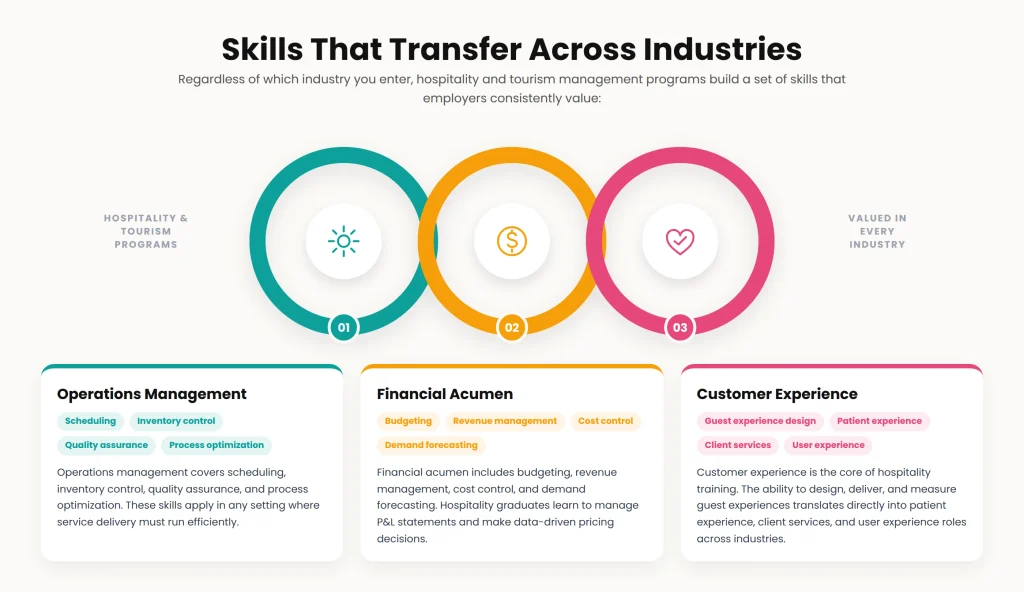
Regardless of which industry you enter, hospitality and tourism management programs build a set of skills that employers consistently value:
Operations Management
Operations management covers scheduling, inventory control, quality assurance, and process optimization. These skills apply in any setting where service delivery must run efficiently.
Financial Acumen
Financial acumen includes budgeting, revenue management, cost control, and demand forecasting. Hospitality graduates learn to manage P&L statements and make data-driven pricing decisions.
Customer Experience
Customer experience is the core of hospitality training. The ability to design, deliver, and measure guest experiences translates directly into patient experience, client services, and user experience roles across industries.
Leadership and Team Management
Leadership and team management are developed through practicum and internship components that most hospitality programs require. Managing diverse teams in fast-paced environments is a skill that hiring managers across sectors recognize.
Building these skills through a structured professional development plan and pursuing industry certifications in areas like food safety, event management, and revenue optimization strengthen your employability across all of these industries.
Start Your Career in Hospitality and Tourism
The hospitality and tourism sector supports over 371 million jobs globally and continues to grow faster than the broader economy. Whether you are drawn to managing a luxury hotel, planning large-scale events, shaping a country’s tourism strategy, or bringing hospitality expertise into healthcare or corporate settings, the right education builds the foundation.
Explore Charisma University’s Bachelor of Arts in Hospitality and Tourism Management to build the skills employers across industries are looking for. Apply today and start your path in one of the world’s most dynamic and transferable fields.
Frequently Asked Questions
What industries hire hospitality and tourism management graduates?
The most common industries include hotels and lodging, food and beverage, event planning, travel and tourism, healthcare, sports and entertainment, corporate hospitality, real estate, and consulting. The operational and service management skills that hospitality programs develop are valued across virtually every service-oriented sector.
What is the salary range for hospitality management careers?
According to the BLS (May 2025), lodging managers earn a median of $69,250, food service managers earn $69,390, and event planners earn $61,160. Senior and executive-level positions at hotel chains, resorts, and corporate hospitality companies offer substantially higher compensation.
Is hospitality management a good career?
Yes. The WTTC projects that travel and tourism will contribute $16.5 trillion to global GDP by 2035 and support over 460 million jobs. The sector is growing at 5.8% annually, more than double the 2.7% rate of the global economy, making it one of the strongest long-term career paths available.
Can hospitality graduates work in healthcare?
Yes. Hospitals, senior living facilities, and outpatient clinics increasingly hire hospitality-trained professionals for patient experience, food service management, facility operations, and guest relations roles. Healthcare is the fastest-growing major employment sector in the U.S.
What skills do hospitality graduates need?
Key skills include operations management, customer experience design, financial planning, leadership, team management, communication, and cultural awareness. Digital literacy, including familiarity with booking platforms, CRM systems, and data analytics, is increasingly important across all hospitality-related industries.
Do I need a master’s degree for hospitality management?
A bachelor’s degree is sufficient for most entry-level and mid-level positions. An MBA or a specialized master’s degree can accelerate your path to director and executive-level roles, particularly in hotel chains, corporate hospitality, consulting, and destination management organizations.