A school of business is a department within a university that’s entirely focused on teaching subjects related to business, management, and entrepreneurship. It prepares you to understand how businesses operate and what kind of skills you’ll be learning to make businesses successful.
According to several studies, there has been a 13% increase in graduate applications from business schools. More than 250,000 students have enrolled in business programs globally, and 70% of them are full-time students.
Additionally, BBA holders in 2026 make $83,000 to $89,560 annually with 3.1% increase in salaries.
Now, we’ll be walking through why students choose business school, the degrees that offer them, its core principles, admission requirements, and the career opportunities that you can avail after you graduate.
Why Students Choose Business Schools?
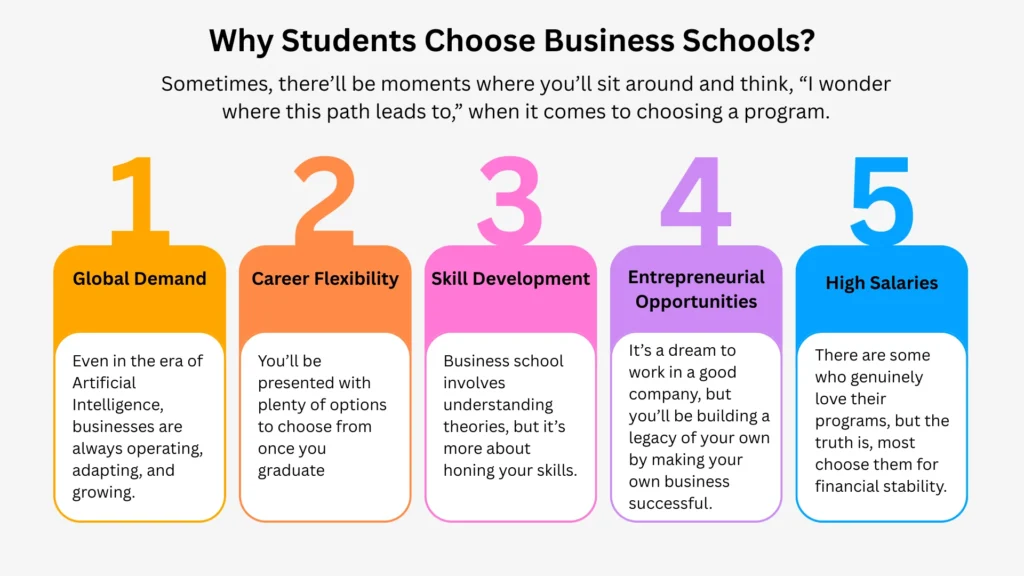
Sometimes, there’ll be moments where you’ll sit around and think, “I wonder where this path leads to,” when it comes to choosing a program. Choosing a business school usually begins with possibilities and the kind of future you plan on building for yourself.
Global Demand
Even in the era of Artificial Intelligence, businesses are always operating, adapting, and growing. From big shots to small startups, every business requires people who can manage teams and understand the market.
Career Flexibility
You’ll be presented with plenty of options to choose from once you graduate. There are plenty of business fields, such as marketing, finance, or management. You’ll basically be a jack of all trades who’s capable of excelling in any industry.
Skill Development
Business school involves understanding theories, but it’s more about honing your skills. You’ll be taught how to think critically, state your ideas clearly, and solve issues creatively. Over time, these skills will become essential as they’ll help you overcome challenges in your professional life.
Entrepreneurial Opportunities
It’s a dream to work in a good company, but you’ll be building a legacy of your own by making your own business successful. For this to happen, make sure you surround yourself with mentors and peers to find the support you need to shape your ideas into reality.
High Salaries
There are some who genuinely love their programs, but the truth is, most choose them for financial stability. Why wouldn’t they? Since most business careers have higher chances of earning more and other rewarding opportunities.
Historical Background Of Business Schools
There were several events that led to the emergence of business schools. Long before master’s and bachelor’s business programs existed, companies were desperately looking for those who understood management & finance. As time passed, these informal lessons transformed into an education system that brought forth the modern business school we know today.
Early Origins Of Business Education
We need to rewind to the 18th and early 19th centuries, where trade and commerce started to expand globally. Merchants needed skills like bookkeeping, accounting, and mathematics to manage their businesses effectively. To meet such requirements, schools began to teach these subjects and laid the foundation for modern business education.
Rise of Formal Business Schools
In the late 19th century, universities started to realise the importance of business in education as economies became more difficult to understand. This led to the creation of some of the first business schools that offered courses in finance and economics. Turning business into an academic discipline
Introduction of the MBA Degree
In the early 20th century, universities introduced the Master of Business Administration (MBA) to prepare professionals for leadership roles in growing companies. Unlike its bachelor’s counterpart, which focused on the technical aspects, MBA programs prioritised strategy and management leadership.
Global Expansion of Business Schools
By the mid-20th century, business education started gaining popularity beyond North America, Europe, Asia, and other parts of the world. Universities all over the world began making their own business schools and MBA programs to meet the growing demand for trained executives.
Modern Evolution of Business Education
Early business schools began as training programs, and now they emphasise innovation, entrepreneurship, and global business strategy. Many industries are getting shaped by technologies, and business schools are adapting accordingly, so you can move along with the rapidly developing world.
Core Programs & Key Principles of a Business School
Once you enter the world of business studies, you’ll notice that some are just beginning their journey, while others have already explored everything and now they wish to move on to leadership roles. That’s why business schools offer different types of degrees designed for different stages of a career.
| Programs | Level | What You’ll Learn |
| Bachelor of Business Administration (BBA) | Undergraduate | Basic knowledge about finances, economics, business and management |
| Master of Business Administration (MBA) | Post-Graduate | Advanced levels focusing on leadership and strategy |
| Executive MBA (EMBA) | Post-Graduate, but for well-established business students | Leadership development for those who are already excelling in their business career. |
| Master’s in Finance/Marketing/Accounting/Economics | Post-Graduate | To gain further expertise in a specific business field |
| PhD in Business Administration | Doctoral | Research and becoming an academic expert in the field of business |
Key Principles
Regardless of what program you’ve chosen, they all follow several core principles that are set by most business schools, and these principles influence how you think and learn. These principles cover everything from classroom discussions to real-world problem solving.
- General Management Foundation
Every big corporation started from nothing, at least those that weren’t born with a silver spoon. There’s a bigger structure that supports all the moving parts. This foundation will help you see how decisions in a particular area can affect the entire organisation.
- Builds an understanding of how different departments like accounting, finance and marketing operate together in a company.
- Introduces core subjects such as management principles, economics, and accounting basics.
- It’ll broaden your perspective so you can assess business decisions from different angles.
- Data-Driven Decision Making
Strategies in your business are guaranteed to be successful, as long as you have accurate information. Business schools prioritise analysing numbers and trends before making impactful decisions. All that matters is evidence-based thinking, there’s no room for guesswork.
- You’ll learn how to analyse data by using research, digital tools and software.
- The ability to spot patterns in financial performance and customer behaviour.
- Encourages strategic thinking through data insights.
- Practical Application
Gaining knowledge is one thing, but applying it in real situations is another. Business schools heavily emphasise actual learning experiences that are similar to the problems companies face every day.
- You’ll work on real-world case scenarios to assess the success and downfall of companies.
- Work on group projects, discuss possible solutions and execute the best option among them.
- Through practical experience, getting into an internship or entry-level job wouldn’t be a big deal.
- Leadership & Soft Skills
Even if you have all the soft and technical skills required to run a business, your empire will not last long if you’re the only one running it. Like it or not, you require a team. And to maintain this team, you need to have good communication and leadership skills.
- Enhance your communication skills through group discussions and presentations.
- Keep your team strong and hone their skills by giving them projects based on their capabilities.
- Build emotional intelligence, motivate your team and handle disputes.
- Ethics & Sustainability
Long-term impacts matter a lot in the business world, but so does its reputation and responsibility. That is why businesses stress ethical leadership and capability-based practices. You’ll learn how companies grow while maintaining their external and internal image.
- When handling a business, make sure to keep everything transparent.
- Examine the actual outcome between two unsatisfactory choices, the one that causes less impact on the company’s image.
- Use modern tools and AI to ease the burden on your employees.
Admission Requirements for Business Schools
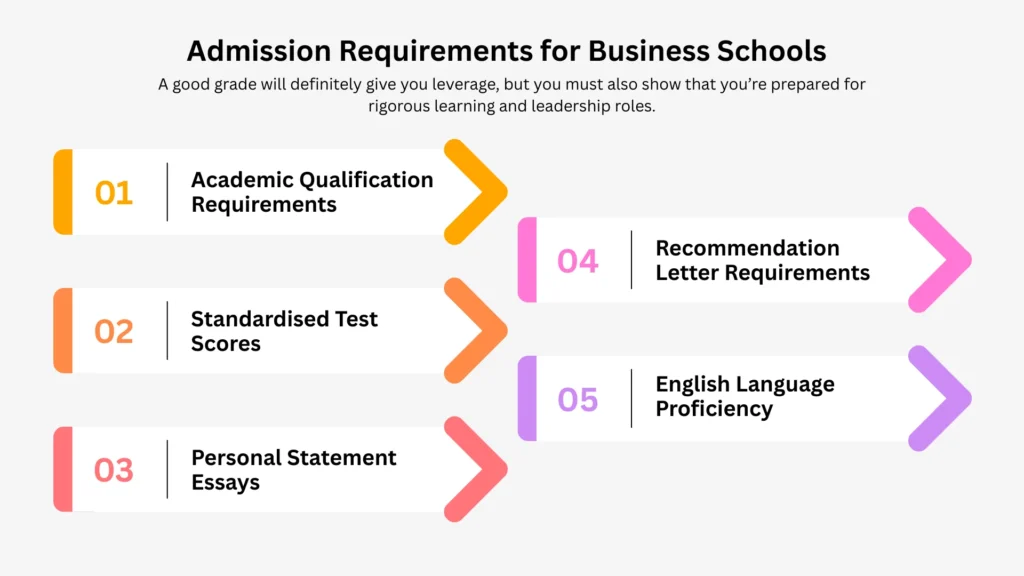
A good grade will definitely give you leverage, but you must also show that you’re prepared for rigorous learning and leadership roles. Admission processes depend on the institution, but there are certain requirements that can show you as a strong applicant.
Academic Qualification Requirements
The very first thing they’ll notice is your educational background. Undergraduate programs usually require a high school degree with impressive grades, especially in math or economics. For graduate programs, all that’s required is your bachelor’s degree and official transcripts.
Standardized Test Scores
Business schools are more focused on practicals, so they’ll request standardised test scores to measure your analytical and reasoning skills. The most common exams are the GMAT and GRE, as they evaluate your verbal, quantitative, and critical thinking abilities.
Personal Statement Essays
These essays will explain how determined you are to achieve your goals. You’ll mention reasons for choosing this program and how it can help you in the long run. This essay will help the admissions officer to understand you better.
Recommendation Letter Requirements
A recommendation letter will show the admission officers a good image of you. Such letters are usually written by professors or supervisors who can comment on skills and work ethics. These perspectives are valued because they show how you’ve performed in both academic & professional settings.
English Language Proficiency
If you live in a country where English isn’t your first language and want to enrol as an international student, you’ll have to present your English proficiency test. Such tests usually include TOEFL or IELTS, which determine how well you listen, read, write and speak English.
Career Opportunities
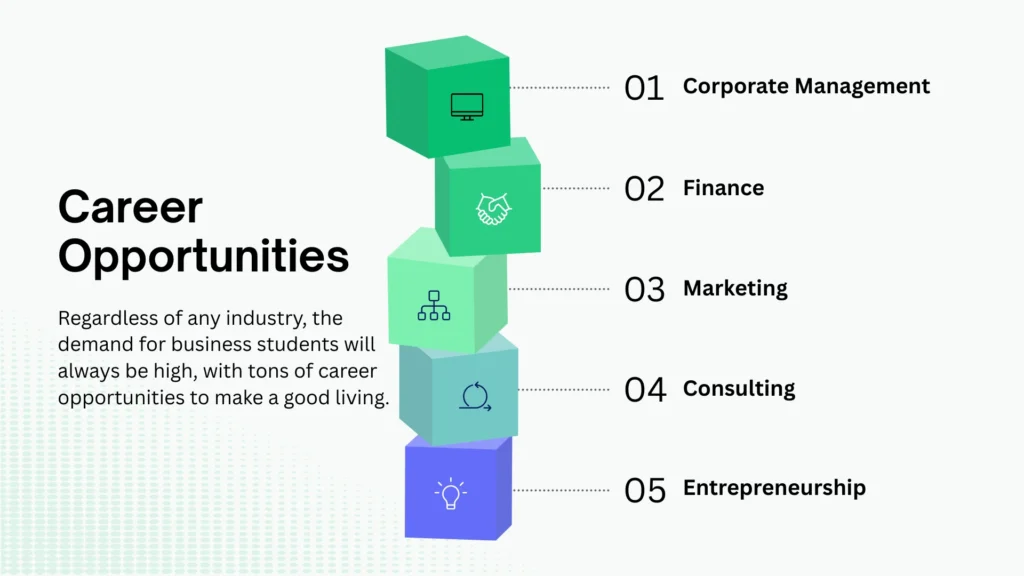
No matter how much technology we use or how much AI takes over. Regardless of any industry, the demand for business students will always be high, with tons of career opportunities to make a good living. You’ll either be working for someone else’s company or your own.
Corporate Management
In this field, you’ll be supervising teams and coordinating projects so that your company runs smoothly. You’ll also be responsible for setting goals and distributing resources, all for the benefit of the company you work for.
Finance
It is a very high-paying profession in the business field. As someone in finance, you’ll be surrounded by money where you’ll be managing money, evaluating investments, and making financial decisions that affect long-term growth.
Marketing
This opportunity is all about understanding the customer and promoting your product based on their preferences. If you’re someone who enjoys creativity while thinking about strategy, then you must pursue this one. You’ll conduct marketing research, design campaigns, and promote brand loyalty.
Consulting
It is a very active career choice where you’ll be helping companies solve problems and improve their performance. Consultants are typically hired by companies that need expert advice on strategy, operations, technology, or management challenges.
Entrepreneurship
Nothing feels better than having your own company and not working for someone else. Business schools will provide you with the tools required to transform your ideas into successful speculations. All you need is a team and the skills to make it happen.
FAQs
It can be very challenging as it involves analytical thinking and problem-solving scenarios. Although a lot genuinely enjoy such challenges.
Not a necessary requirement, you can apply if you have a different educational background.
To most people, it’s worth it. As it can lead to high-paying jobs and create a large, valuable network.
A business school is a place that teaches subjects solely based on business. On the other hand, a university is a place that consists of programs based on different disciplines.
Yes, a lot of business schools consist of internship programs where you can gain practical experience.