At its core, heroism is the choice to put someone else’s safety or well-being ahead of your own comfort. In simple terms, it is what happens when ordinary people decide that doing the right thing matters more than staying safe or silent.
We usually picture the obvious stuff first, where a soldier is protecting civilians or a stranger jumping into a river to save a child. And yes, that is heroism. But if we stop there, we miss a huge part of the story.
Researchers have spent years trying to understand why some people step up in critical moments while others hold back. Studies have found that individuals who have survived a personal disaster or trauma are three times more likely to act as heroes and volunteers.
To get a clear picture of this, we’ll explore the foundations of heroism, the psychology behind heroic behaviour, the essential traits of heroes, and the main types of heroism.
The Foundations of Heroism
We have to look at where the idea of “hero” came from before answering about “what heroism is”. Because humans didn’t just wake up one day and say, “Yep, that guy with a sword who’s moving like lightning is definitely a hero.” The idea of heroism has been shaped over thousands of years through myths & religion that each society chose to admire.
Greek Mythology
Greek mythology helped shape the earliest ideas of heroism through figures like Hercules, Achilles, and Odysseus. These heroes were admired for their strength, bravery, and ability to face impossible challenges.
Oral Traditions
Before written history, heroism was passed down through oral storytelling across cultures and communities. These stories preserved the values people admired most, such as courage, loyalty, and protection. Oral traditions helped define what it meant to be a hero long before books and films existed.
Religious Traditions
Religious traditions often connect heroism with moral courage, sacrifice, faith, and service to others. Across many beliefs, heroes are remembered for standing for truth and justice. This gave heroism a deeper spiritual and ethical meaning beyond physical bravery.
Evolutionary Mechanism
Some experts believe heroism may have developed as a survival advantage for human groups. People who protected others, faced danger, or acted selflessly helped communities survive and stay united. In that sense, heroism may be partly rooted in human cooperation and social survival.
Cultural Ideas & Moral Choices
Different cultures define heroism differently, depending on what they value most. Some admire warriors, while others honour protectors. At its heart, heroism often begins with a moral choice to do what is right, even when it is difficult.
Psychology Behind Heroic Behavior
So why do some people step up in difficult moments while others freeze, avoid, or walk away? That’s because heroism might look spontaneous from the outside, but underneath it, there’s usually a mix of emotion and values. Let’s break down the psychology behind that.
Empathy
Many heroic actions begin with empathy, which is the ability to feel someone else’s pain genuinely. When people emotionally connect with another person’s suffering, they’re more likely to step in instead of looking away. It’s often the spark behind selfless action.
Strong Moral Values
Some people act heroically because they have a strong inner sense of right and wrong. Even when doing the right thing is risky or unpopular, their values push them to act. That moral backbone often separates action from silence.
Ability To Manage Fear
Heroes are not fearless, they’re just normal humans who don’t let fear control them. They may panic internally, but they can still think clearly enough to act when it matters. That ability to function under pressure is a big part of heroic behaviour.
Risk taker
Heroic people are often more willing to take meaningful risks for others. That doesn’t mean they’re reckless, it means they can accept danger when something important is at stake. They choose action even when the outcome isn’t guaranteed.
Sociocentricity
Sociocentric is when people naturally think beyond themselves and care deeply about the community. Because they feel connected to others, they’re more likely to help or step up in difficult moments. Their mindset is often rooted in shared responsibility.
The 8 Essential Qualities of a Hero
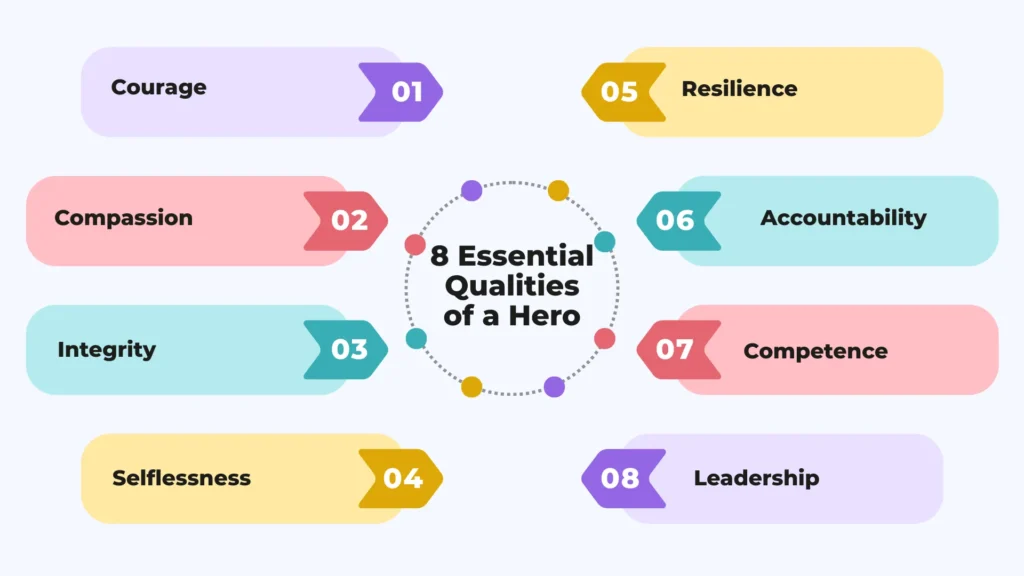
Not everyone who does one dramatic thing is automatically heroic in the deeper sense. A true hero isn’t just someone who gets noticed, it’s someone whose actions reflect a set of qualities we instinctively recognize as meaningful and worth remembering. This doesn’t mean heroes have to be perfect. But there are certain traits that show up constantly when we talk about real heroism.
Courage
It is usually the first thing people think of when they think about the hero. Most heroic moments begin when a person is faced with fear or danger. Even so, he still chooses to move forward anyway. True courage is all about doing what is right, or meaningful, even when fear is very much present.
Example
- A firefighter enters a burning building to rescue people trapped inside, knowing the danger to their own life is very real.
- A student speaks up against bullying in front of classmates, even though they know they may be targeted next.
- A whistleblower exposes corruption in a powerful organisation despite the risk of losing their job and safety.
Compassion
Compassion is what gives heroism its heart. Without it, bravery can feel cold or self-centred. A compassionate hero acts because they truly care about someone else’s pain or fear. This kind of quality doesn’t always make headlines, but changes someone’s world in a very real way.
Example
A nurse staying after her shift to sit beside a frightened patient who has no family around. It may seem like a small act, but in a moment of fear and loneliness, that kind of kindness can feel life-changing.
Integrity
Who are you when nobody’s watching? That question gets right to the heart of integrity because it means doing the right thing even when there’s no reward or applause. A person with integrity doesn’t just “look good” in public. Their values stay with them even when the truth becomes inconvenient.
Example
- Ensuring that a lost wallet is returned to its rightful owner with every cent and all personal items completely intact.
- Choosing to maintain absolute honesty even in difficult situations where a lie might seem like the easier way to avoid consequences.
- Taking full responsibility for one’s errors rather than shifting the fault onto others to protect one’s own reputation.
Selflessness
A lot of heroic moments begin the second someone stops making it all about themselves. Selflessness means putting another person’s safety or well-being ahead of your own comfort. Some of the most heroic people are quietly sacrificing things every single day without ever calling attention to it.
Example
A single parent works day and night without any rest just to make sure their children are fed and cared for. That kind of everyday sacrifice is a very real form of heroism.
Resilience
What happens after the hard moment matters just as much as what happens during it. Resilience is the ability to keep going after setbacks, pain, and loss. It’s what helps heroes stay standing when life keeps trying to knock them flat.
Example
- Having endured the unthinkable, they are now assembling the fragments of their broken world into a new, resilient foundation for the future.
- They step back into the line of fire despite the heavy burden of the trauma, driven by a profound commitment to save lives once more.
- Through a relentless cycle of setbacks, they remain an unwavering pillar of strength, who are dedicated to serving their people against all odds.
Accountability
Accountability is what keeps heroism grounded. It means owning your choices, admitting mistakes, and understanding that doing the right thing also includes taking responsibility when things go wrong. That’s important because someone can’t truly be heroic if they only want credit and never responsibility.
Example
A team captain admits his poor decision cost the group an important opportunity, then steps up to fix the damage instead of making excuses.
Competence
A good heart matters, but in a crisis, knowing what to do matters too. Competence is the ability to respond effectively when the pressure is on. It’s what turns good intentions into meaningful action. This is why so many real-world heroes are admired not just for their bravery, but for their calm judgment when things get serious.
Example
- A dedicated paramedic works with urgent precision, performing life-saving CPR on a patient at the chaotic scene of an accident.
- A composed pilot maintains focus under immense pressure to execute a flawless emergency landing and ensure the safety of everyone on board.
- A courageous firefighter moves calmly through the haze while guiding trapped individuals toward safety out of a heavily smoke-filled building.
Leadership
Sometimes all it takes is one person stepping forward for everyone else to stop standing still. Leadership is a heroic quality because it inspires movement and courage in other people. A hero often becomes a leader simply by being the first one willing to act.
Example
An activist speaking out against injustice in a fearful environment can give an entire community the confidence to speak up too. One brave voice often becomes the beginning of many.
Main Types Of Heroism
Heroism comes in many different forms. Different situations call for different kinds of courage, and some of the most meaningful heroic acts are the ones that barely look “heroic” at first glance. Let’s talk about the main types.
Physical Heroism
This is the kind of heroism that grabs your attention instantly. Physical heroism happens when someone risks their safety to protect others. It often shows up in emergencies where quick action can mean the difference between life and death.
Moral Heroism
Not all heroes run into fire, some stand firm in the truth. Moral heroism is about doing what is right even when it brings pressure or criticism. It takes real courage to speak up when silence feels safer.
Social Heroism
Changing the world often starts with one brave person refusing to stay quiet. Social heroism is about challenging injustice, unfair systems, and harmful social norms. These heroes fight for people and a better future for everyone.
Intellectual Heroism
Sometimes the bravest thing a person can do is think differently. Intellectual heroism means questioning false ideas and defending truth. It takes courage to challenge what everyone else blindly accepts.
Quiet Heroism
Some of the greatest heroes will never make the news. Quiet heroism lives in everyday acts of sacrifice, patience, and strength. It is often unseen, but it holds all the families and communities together.
Heroism In Literature
Literature has always been obsessed with heroes for good reasons. Stories are one of the main ways humans figure out who we are, what we value, and what kind of courage we admire. And over time, literature has given us many different versions of the hero, not just the sword-swinging warrior type.
Classical Hero
Think larger than life for a second. The classical hero is usually brave and chosen for something great, but they almost always carry a flaw that makes their journey more human and memorable.
Everyman Hero
What if the hero is just an ordinary person? The everyman hero shows that you do not need powers, status, or destiny to be heroic, just the courage to rise when life puts you in a difficult moment.
Reluctant Hero
Not every hero runs toward responsibility. The reluctant hero often avoids the spotlight at first and doubts themselves, or wants no part in the chaos. However, they will end up doing what is right when it matters most.
Tragic Hero
This is when heroism takes a painful turn. The tragic hero has strength, depth, and greatness in them. But one flaw, one bad decision, or one inner weakness slowly leads them toward downfall.
Anti Hero
Now this is where we get to see a rather unique side to heroism. The anti-hero is flawed, morally messy, and far from ideal, but somehow still manages to do something meaningful or unexpectedly heroic.
Heroism in Popular Culture
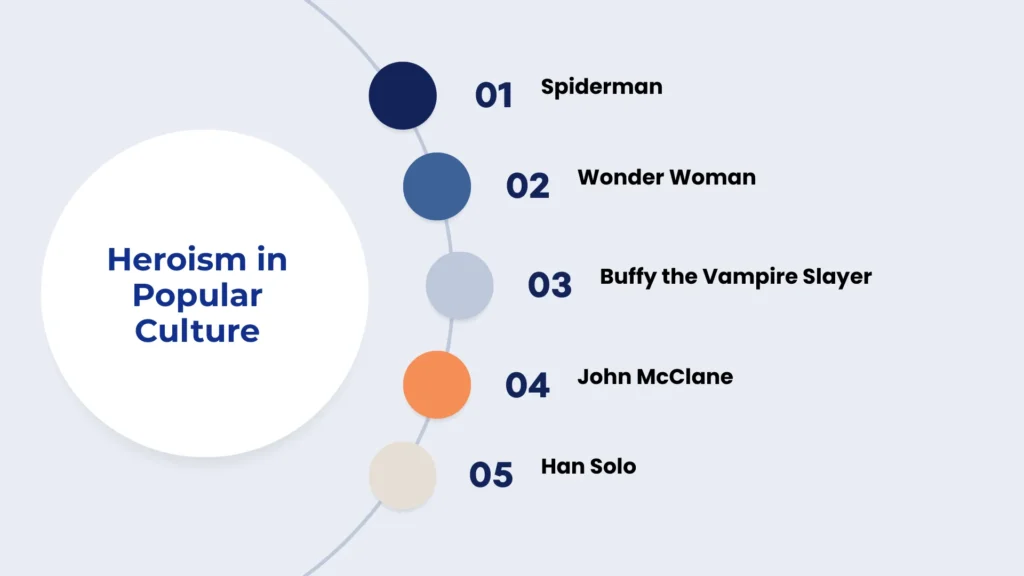
Pop culture has done a lot to shape how we imagine heroism. Sometimes for better, sometimes for “why is this billionaire solving emotional trauma by punching people?” Still, fictional heroes matter because they reflect what each generation values and admires.
Spiderman
What makes Spider-Man so relatable? He is not just saving the city, he is juggling school, money, heartbreak, and responsibility all at once. His heroism comes from choosing to do the right thing even when life keeps hitting him from every angle.
Wonder Woman
Here is what makes Wonder Woman unforgettable. She is powerful, graceful, and deeply driven by justice and compassion. Her heroism is not just in how she fights, but in what she fights for.
Buffy the Vampire Slayer
One of the most underrated heroes of our time. Buffy carries the weight of protecting everyone while trying to survive her own emotional battles. That quiet strength is exactly what makes her such a powerful hero.
John McClane
Not every hero looks polished and put together. John McClane feels real because he is tired, bruised, frustrated and still refuses to back down. His heroism comes from pure grit when everything goes wrong.
Han Solo
At first glance, Han Solo does not exactly scream “hero.” But underneath the sarcasm and selfish charm is someone who learns to care and fight for others. That growth is what makes his heroism so memorable.
Heroism Across Cultures & Religions
One of the coolest things about heroism is that every culture has its own version of it. The details like name, symbols and moral lessons may vary, but the core idea remains strangely universal. Let’s look at a few iconic examples.
Hercules from Greek Mythology
Picture raw strength tested by impossible trials. Hercules represents the classic Greek ideal of heroism through courage, endurance, and struggle. His story is not just about power, but also about redemption and proving worth through suffering.
Hanuman from Hinduism
Now here’s a hero powered by devotion as much as strength. Hanuman is admired for his humility and unwavering service to righteousness. He proves that true heroism is not just about being powerful, but about using that power with purpose.
St. Anthony from Egypt in Christianity
Not every hero wins by fighting on a battlefield. St. Anthony represents spiritual heroism through discipline and resistance to temptation. His life in the desert became a symbol of faith and moral endurance. He reminds us that some of the hardest battles are the ones fought within.
Hussain Ibn Ali from Islam
Some heroes become immortal through the stand they refuse to abandon. Husayn Ibn Ali is remembered for choosing truth and justice in the face of oppression. His sacrifice at Karbala made him a lasting symbol of moral courage and unwavering principle. His legacy shows that heroism often means standing firm even when the cost is everything.
Manabozho from Native America
Sometimes the greatest heroes are also teachers and guides.Manabozho appears in Native storytelling as a cultural figure connected to wisdom and learning. Rather than conquering through force, he often shapes understanding through lessons and spiritual meaning.
The Dark-Side & Misuse Of Heroism
Now for the uncomfortable but necessary part. Heroism is powerful and because of this, it can also be romanticised, or misused. Sometimes people hide behind the language of heroism to make harmful behavior look noble. And if we don’t talk about that, we end up with a very shallow understanding of what real heroism actually is. So yes, let’s ruin the mood productively.
Abdication of leadership responsibilities
Heroism gets glorified because leaders failed to do their job in the first place. When broken systems leave ordinary people to carry impossible burdens, society often praises their sacrifice instead of fixing the root problem. That can make heroic individuals look admirable while quietly excusing institutional neglect.
Coercion
What if it’s not really heroism if someone never had a real choice? In many cases, people are pressured by culture, family, religion, or public expectation to suffer silently or sacrifice themselves in ways that are labeled as noble. But when duty is forced and freedom is removed, the line between courage and manipulation gets blurry fast.
Meddling
Not every rescue is as heroic as it looks from the outside. Sometimes people step into situations believing they are helping, when in reality they are centering themselves in someone else’s struggle. This kind of “savior” behavior can do more harm than good, especially when listening would have been more useful than action.
Narcissistic Motivations
When the real goal is attention or public admiration, the action may still appear noble while being driven by ego underneath. That doesn’t mean every visible good deed is fake, but it does mean motives matter more than people like to admit. Heroism loses its depth when service becomes performance.
Masking Systemic Failures
Society often celebrates heroes instead of questioning why they had to suffer in the first place. We love stories about people overcoming impossible odds, but we rarely ask why those odds existed at all. Sometimes the “hero” narrative distracts from unfair systems, that should have been addressed much earlier.
FAQs
Not always, but sacrifice is often a part of heroic behavior. A person may give up comfort, safety, time, or personal benefit to help others.
Most heroes are made through values, experiences, and choices rather than birth. Heroism often appears when ordinary people respond bravely to extraordinary situations.
A hero usually represents moral goodness and courage, while an anti-hero may lack traditional heroic qualities. Anti-heroes can still do good, but often in flawed or unconventional ways.
Yes, children can show heroism through bravery, honesty, kindness, and protecting others. Even small courageous actions can reflect heroic character.
Yes, heroism remains highly relevant in today’s world through activism, caregiving, crisis response, and moral leadership. Modern heroism often appears in everyday social and personal struggles.