To put it simply, diversity in the workplace means creating teams that include different identities, viewpoints, and lived experiences so businesses can think more effectively, solve problems faster, and build a more inclusive culture. It’s all about making sure that everyone has a fair chance to contribute and grow.
A couple of studies have stated that the most diverse companies for ethnic diversity are 39% more likely to outperform financially. In contrast, those with strong gender diversity are more likely to deliver above-average profitability, according to recent McKinsey findings.
Diverse teams have also been linked to stronger innovation, better decision-making, and improved employee performance across industries.
To understand this concept further, we’ll be going through the importance of diversity, its major types and characteristics, and the practical strategies that can improve in workplaces.
Importance of Diversity in the Workplace
Diversity in the workplace influences far more than just who gets hired. When different perspectives come together, teams often become more creative and capable of solving real problems. That’s exactly why diversity has become such an important part of modern workplace success.
Stronger Innovation
Innovation gets stronger when teams include people who think differently and bring fresh perspectives to the table. Instead of repeating the same ideas, diverse employees often challenge assumptions and spark more creative solutions.
Better Decision-Making
Better decisions happen when teams include people with different viewpoints. Diversity helps reduce groupthink by bringing more balanced opinions and uncovering blind spots others may miss. As a result, businesses often make smarter and more thoughtful decisions.
Higher Employee Engagement
Employees feel more engaged when they are respected and valued for who they are. Diversity helps create a sense of belonging where people feel comfortable contributing their ideas, which leads to higher overall job satisfaction.
Improved Team Performance
Diverse teams often perform better because they bring a wider mix of strengths, ideas, and working styles. This helps teams solve problems more effectively and adapt more easily to challenges.
Greater Business Growth
Diversity helps businesses understand wider audiences, attract stronger talent, and adapt to changing markets. This often leads to stronger customer connections and long-term growth.
Types of Diversity in the Workplace
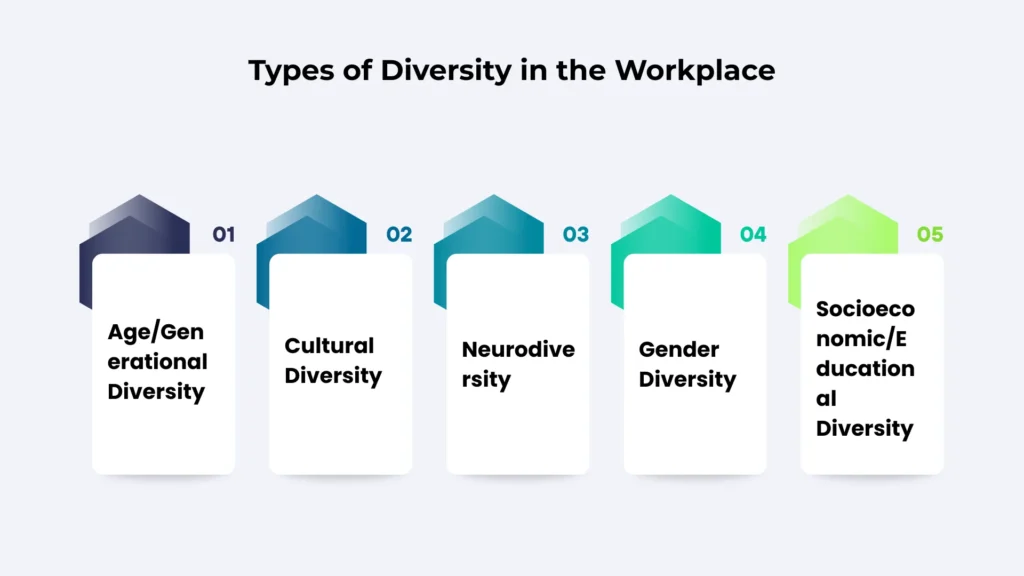
When people hear about diversity, they often think of just one or two things. But in reality, workplace diversity is much bigger than that. It shows up in the way people think, communicate, work, and experience the world around them.
Age/Generational Diversity
A workplace often includes people from different age groups and generations, each bringing their own work mindset and experience. Some may bring fresh trends and tech confidence, while others offer maturity and industry wisdom. When those strengths come together, teams become more balanced and capable.
Cultural Diversity
Cultural diversity means having employees from different backgrounds. It helps teams think beyond one narrow point of view and creates space for broader understanding. When respected properly, it makes the workplace more creative and globally aware.
Neurodiversity
Neurodiversity recognises that people process and learn in different ways, and that those differences can be powerful. Employees with ADHD, autism, dyslexia, and other cognitive differences often bring originality and unique problem-solving strengths. The goal is to create a workplace where different minds can succeed without having to mask who they are.
Gender Diversity
It means creating a workplace where people of all genders have fair access to opportunities. It’s not only about representation but also about making sure no one is limited by stereotypes or bias.
Socioeconomic/Educational Diversity
Not everyone enters the workforce with the same resources, education path, or professional network. Some people come from traditional academic routes, while others build their careers through experience, self-learning, or resilience. That kind of diversity brings grounded thinking, adaptability, and a real-world perspective into the workplace.
The Core Characteristics of Diversity in the Workplace
You can usually tell when workplace diversity is real and when it is just branding. It shows up in who gets hired, promoted, and who actually feels comfortable being there. These characteristics make that difference easier to spot.
Broad Workforce Representation
A diverse workplace should reflect a wide mix of people across the business, not just in a few entry-level roles. You should be able to see representation in different departments, job levels, and leadership positions.
Example
- A company hires employees from multiple age groups instead of focusing only on early-career candidates.
- Leadership includes both men and women rather than being dominated by one gender.
- Teams include individuals from different cultural, ethnic, and educational backgrounds.
Visible & Invisible Differences
Some forms of diversity are obvious the moment you meet someone. Others are not visible at all and may never be openly discussed. A truly diverse workplace understands that both matter and should be respected equally.
Example
A team may include someone with a visible physical disability and another employee managing ADHD or anxiety privately, yet both contribute equally to the workplace.
Diverse Backgrounds
People do not arrive at work with the same starting point. They come with different family situations, education levels, and career journeys. Those differences affect how they think, solve problems, and relate to others.
Example
One employee may have graduated from a top university with formal training, while another may have built their career through freelancing and online learning platforms. A third may be the first person in their family to enter a professional corporate environment.
Varied Perspectives
A workplace gains real value from diversity when different viewpoints are actually part of the conversation. People with different experiences often notice different risks, opportunities, and solutions. That range of thinking helps teams avoid tunnel vision.
Examples:
- One employee suggests improving customer experience, while another highlights accessibility gaps in the same process.
- A younger team member proposes a digital-first solution while a senior employee points out long-term operational risks.
- A multicultural team approaches a marketing campaign differently based on regional audience insights.
Equal Access to Opportunities
Diversity means very little if opportunities are not shared fairly. Employees should have equal access to learning, promotions, and leadership pathways. If growth only happens for a familiar few, then the workplace is not as fair as it looks.
Example
A company may hire diverse employees, but if promotions and leadership roles consistently go to the same group, then equal access is not truly being practised.
Inclusive Participation at Work
Being in the room is one thing, but being heard, included, and taken seriously is something else entirely. Inclusive participation means employees are able to contribute meaningfully instead of being quietly sidelined.
Examples
- A manager actively invites quieter employees to share their ideas during meetings, so their perspectives are not overlooked.
- Remote team members are included equally in important discussions instead of being unintentionally left out of key decisions.
- Junior employees are encouraged to contribute their thoughts rather than being ignored due to their lack of experience.
Respect for Individual Differences
Not everyone communicates, works, or sees the world the same way. A respectful workplace understands that these differences are normal and valuable rather than something that needs to be corrected. Instead of forcing everyone into one narrow idea of what a “good employee” should look or sound like, it creates space for people to contribute in ways that feel natural for them.
Examples
- One employee prefers clear written instructions, while another performs better with verbal collaboration.
- A company respects religious practices by allowing flexibility for important observances.
- Team members are not judged negatively for having different communication or work styles.
Belonging within Workplace Culture
This is the emotional side of diversity and one of the most important. Belonging means people feel accepted and safe enough to be themselves without constantly trying to “fit in” by hiding parts of who they are.
Example
A new employee feels comfortable sharing their ideas and identity without pressure to change their personality to match the rest of the team.
Practical Strategies to Improve Diversity in the Workplace
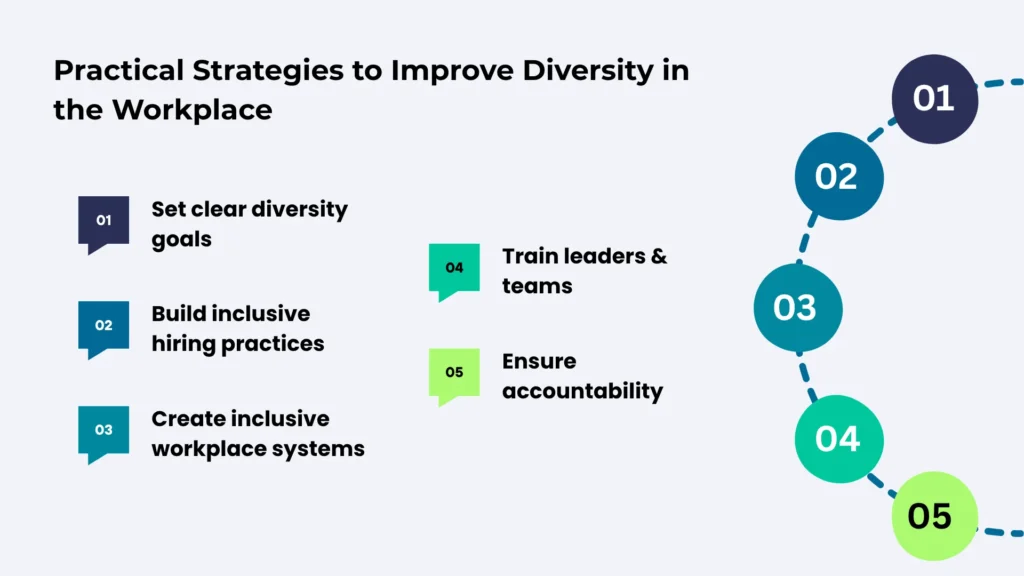
Diversity doesn’t improve because a company says the right things on LinkedIn. It improves when everyday decisions start changing behind the scenes. And usually, the biggest shifts come from a few smart moves done consistently.
Set clear diversity goals
If diversity stays vague, it usually gets ignored. Clear goals give teams something real to work toward. Once there’s direction, progress becomes easier to measure and harder to avoid.
Build inclusive hiring practices
Great teams start with thoughtful hiring. Inclusive hiring helps companies reach a wider talent pool and discover skilled people with fresh perspectives. It creates stronger teams right from the very beginning.
Create inclusive workplace systems
A welcoming workplace is built into the little things people experience every day. From feedback to growth opportunities, every system should feel fair and supportive. When the workplace is designed with inclusion in mind, people feel more comfortable showing up as themselves.
Train leaders & teams
Strong teams grow with the right guidance and support. Training helps people communicate better and understand each other more deeply. It builds awareness, strengthens collaboration, and creates a more inclusive work environment over time.
Ensure accountability
Real change becomes stronger when people stay committed to it over time. Accountability helps keep diversity and inclusion part of everyday workplace decisions. It encourages consistency and helps companies create progress that actually lasts.
Diversity in Remote and Hybrid Workplaces
Work doesn’t happen in one room anymore. Some people are fully remote, while some split time between home and office, and some are constantly moving between both worlds. That sounds flexible on paper, but it can quietly create new gaps. That’s exactly why diversity in remote and hybrid workplaces needs a more intentional approach.
Avoid Proximity Bias
Here’s something most teams miss, visibility often turns into opportunity. Employees who are seen more tend to be trusted more and remembered more. Not because they perform better, but because they are physically present.
Virtual Meeting Etiquette
In a diverse workplace, virtual meetings should make space for different voices and communication styles. Not everyone speaks up in the same way or at the same pace. Clear meeting etiquette helps each employee feel included and respected. That way, diverse perspectives are more likely to be heard and valued.
Intentional Connection
A meaningful connection helps employees feel included and valued. It creates space for people from different backgrounds to build trust and understanding. Simple moments of connection can strengthen team culture in powerful ways.
Inclusive Leadership Training
Leaders play a key role in creating an inclusive environment. Training helps them understand different perspectives and support all team members fairly. It builds awareness around communication and team dynamics. This leads to stronger collaboration and a more inclusive workplace culture.
Mentorship Programs
Mentorship helps employees feel supported and encouraged to grow. It creates opportunities for people from different backgrounds to learn and connect. Strong mentorship can build confidence, inclusion, and career development.
Real Life Examples of Diversity in Workplaces
Plenty of companies talk about diversity. Far fewer actually build it into how people are hired every day. That’s why real-world examples matter. They show what workplace diversity looks like when it moves beyond slogans and starts shaping culture. Below are a few well-known companies that have made diversity a visible part of how they operate.
Accenture
It has built a workplace that brings together people from different cultures, age groups, educational backgrounds, and professional experiences. The company is also known for supporting gender inclusion, accessibility, and equal opportunities across teams.
Microsoft
It is widely recognised for creating a workplace that values people from different backgrounds and ways of thinking. It supports diversity through inclusive hiring and opportunities for employees across varied experiences. The company is also known for embracing neurodiversity and building spaces where different strengths can thrive.
Salesforce
Salesforce fosters a diverse workplace by embedding equality as a core value that aims to build a team that reflects global society. It actively supports inclusion through 13 employee-led Equality Groups, covering diverse backgrounds, abilities, and communities.
Johnson & Johnson
It is recognised for creating a workplace that brings together people from many backgrounds and professional experiences. Johnson & Johnson supports diversity through inclusive hiring, leadership development, and equal growth opportunities.
PepsiCo
What makes PepsiCo stand out is how naturally diversity shows up across its workplace by bringing together people from different backgrounds and life experiences. The company actively promotes gender equality, striving to build diverse teams and inclusive environments, particularly through initiatives supporting women in leadership and agriculture.
Benefits & Limitations of Diversity in Workplaces
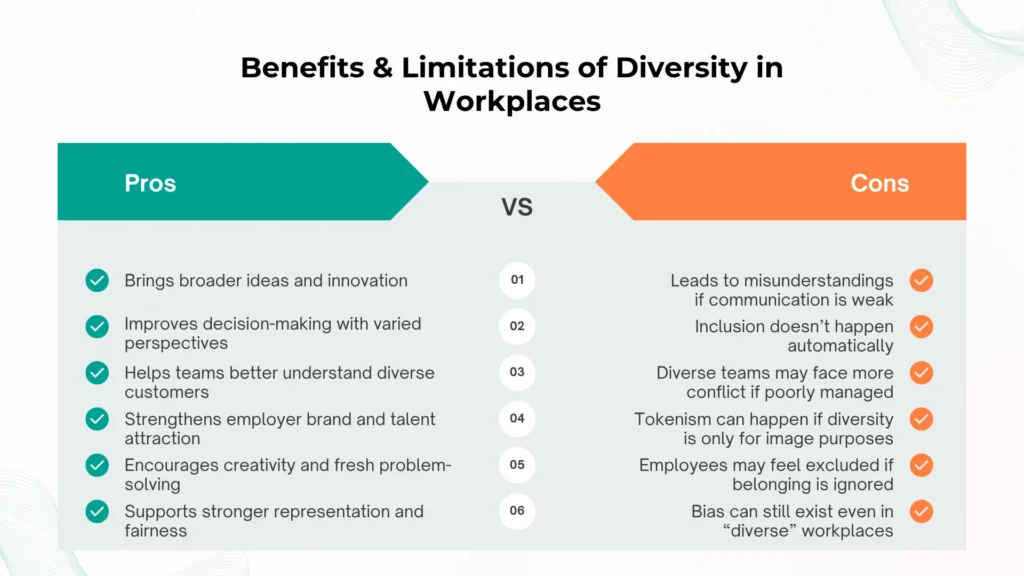
Diversity can transform a workplace in powerful ways, but it doesn’t work like magic. It definitely creates opportunity, but that doesn’t guarantee success. If any of the core characteristics are missing, then diversity can become surface-level instead of meaningful. So instead of pretending it’s all upside down with zero challenges, let’s be honest and look at both sides.
| Pros | Cons |
| Brings broader ideas and innovation | Leads to misunderstandings if communication is weak |
| Improves decision-making with varied perspectives | Inclusion doesn’t happen automatically |
| Helps teams better understand diverse customers | Diverse teams may face more conflict if poorly managed |
| Strengthens employer brand and talent attraction | Tokenism can happen if diversity is only for image purposes |
| Encourages creativity and fresh problem-solving | Employees may feel excluded if belonging is ignored |
| Supports stronger representation and fairness | Bias can still exist even in “diverse” workplaces |
| Improves employee engagement and retention | Change may be resisted by leadership or teams |
| Builds more adaptable, resilient teams | Progress can be slow without accountability |
| Helps businesses compete in broader markets | Poorly designed DEI efforts can feel performative |
| Creates opportunities for richer collaboration | Diversity without equity can create frustration |
FAQs
Diversity is about who is present in the workplace. Inclusion is about how those people are treated and whether they feel valued, heard, and able to participate fully.
Yes, and this happens often. A company can hire people from different backgrounds, but still have a culture where some employees feel ignored, undervalued, or excluded.
Diversity alone does not remove bias, but it can help challenge assumptions and expose people to different perspectives.
Some diversity efforts fail because companies focus on appearances instead of real structural change. Without leadership commitment, accountability, and inclusive systems, diversity efforts often remain surface-level.
Equality means giving everyone the same thing, while equity means giving people what they actually need to succeed fairly. In the workplace, equity helps address real differences in access, support, and opportunity.