At its core, transformational leadership is a style in which leaders inspire people to grow, innovate, and exceed expectations. Instead of just managing tasks, it focuses on vision, trust, and purpose.
Right now, only about 21–23% of employees globally are engaged at work, which shows a massive gap in motivation and leadership. Companies are losing billions in productivity due to disengagement. This is exactly where transformational leadership starts making a real difference.
On the bright side, studies also show that companies using transformational leadership can see up to 37% higher employee engagement and significantly better performance. It also improves job satisfaction, boosts innovation, and strengthens long-term commitment among employees.
We’ll be going through the importance of managing change and building trust, and the key components that define great leaders. We’ll also cover its benefits, real-world examples, industry applications, and what the future holds for transformational leadership.
Foundations of Transformational Leadership
Great leaders are not just born out of authority, they are shaped by ideas that change how we see leadership itself. Behind every inspiring leader, there is a story of how leadership evolved. To truly understand transformational leadership, you need to look at where it all began.
Emergence in Leadership Theory
Transformational leadership emerged when traditional theories failed to explain why some leaders inspire deep loyalty and change. Researchers began focusing on influence, motivation, and vision rather than control. Marking the beginning of leadership as a human-centered process.
Influence of Behavioral Theories
Behavioral theories emphasized what leaders do rather than who they are by nature. They showed that leadership is built through actions like communication, motivation, and empathy. This laid the foundation for leadership styles that focus on people and relationships.
Work of James MacGregor Burns
James MacGregor Burns introduced transformational leadership as a concept where leaders and followers grow together. He focused on values, purpose, and moral development rather than authority. His work redefined leadership as a shared journey instead of a one-sided role.
Expansion by Bernard M. Bass
Bernard M. Bass expanded the theory by explaining how transformational leadership works in real situations. He identified clear components and connected them to performance and motivation. His work made the concept practical and measurable for organisations.
Shift from Transactional Models
Leadership moved away from reward and punishment-based systems toward inspiration and purpose-driven approaches. Instead of focusing only on tasks, leaders began focusing on people and long-term growth, which made leadership more meaningful in modern organisations.
Importance of Transformational Leadership
Have you ever worked under someone who made you feel genuinely excited to show up, not just obligated to complete tasks? That kind of energy does not come from rules or rewards, it comes from real inspiration. This is exactly why transformational leadership matters so much in today’s fast-changing world.
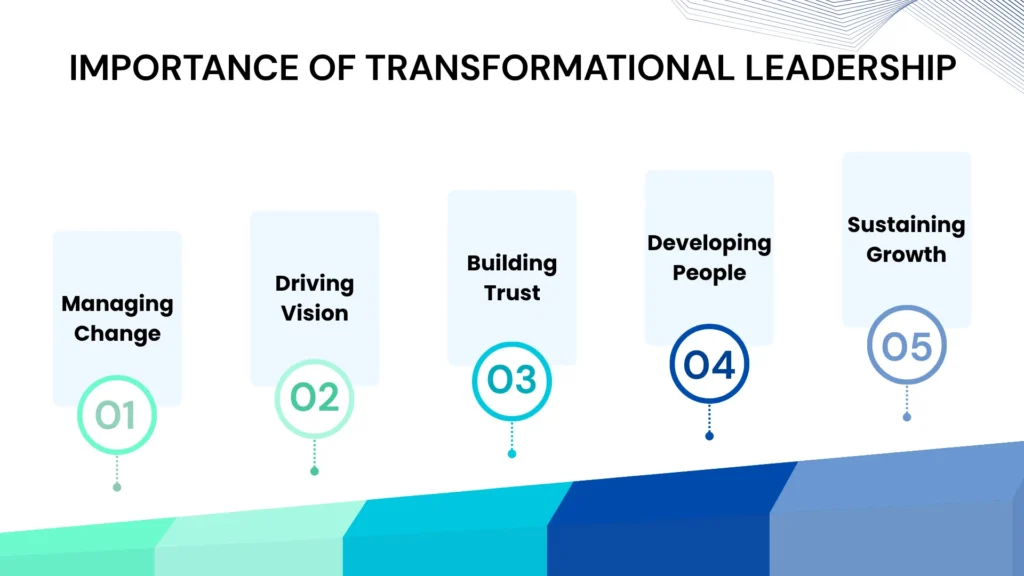
Managing Change
Transformational leaders make change easier by helping people clearly understand the bigger picture. They reduce fear through trust, transparency, and consistent communication. Instead of resistance, they turn uncertainty into acceptance and even excitement.
Driving Vision
They give people a strong sense of direction and purpose that goes beyond daily tasks. Teams do not just follow instructions, they truly believe in the goal they are working toward. This shared vision keeps everyone focused, aligned, and motivated.
Building Trust
Trust is built through consistency, honesty, and authenticity in every action. Transformational leaders lead by example and stay committed to their values. Creating deeper relationships, stronger loyalty, and a more supportive work environment.
Developing People
They focus on long-term growth instead of just short-term results. Employees are mentored, guided, and encouraged to improve their skills. Over time, this builds confidence, independence, and stronger overall performance.
Sustaining Growth
They do not chase quick wins, they focus on long-term success and stability. By encouraging learning and adaptability, they help teams evolve with changing demands. This ensures continuous progress and lasting growth for the organisation.
Understanding Transformational Leadership
Think about a moment when someone truly believed in you before you even believed in yourself. That quiet push, that confidence, that sense of being seen, it stays with you longer than any instruction ever could. That is the kind of influence transformational leadership is built on, and there is a deeper structure behind it.
The Four Components of Transformational Leadership
| Component | What it means | Real-World Impact |
| Idealised influence | Leaders act as strong role models and earn deep trust and respect | People trust them and naturally follow their lead |
| Inspirational Motivation | Leaders share a clear and exciting vision that motivates others | Teams feel inspired and stay focused on shared goals |
| Intellectual Simulation | Leaders encourage new ideas and different ways of thinking | Teams become more creative and confident in solving problems |
| Individualised Consideration | Leaders pay attention to each person’s growth and needs | Individuals feel valued and perform at their best |
Key Characteristics of Transformational Leaders
What makes someone the kind of leader people genuinely want to follow, not because they have to, but because they believe in them? Of course, skills or experience matter, but it is something deeper that shapes how they think, act, and connect with others. Let’s take a closer look at the traits that quietly turn ordinary leaders into truly transformational ones.
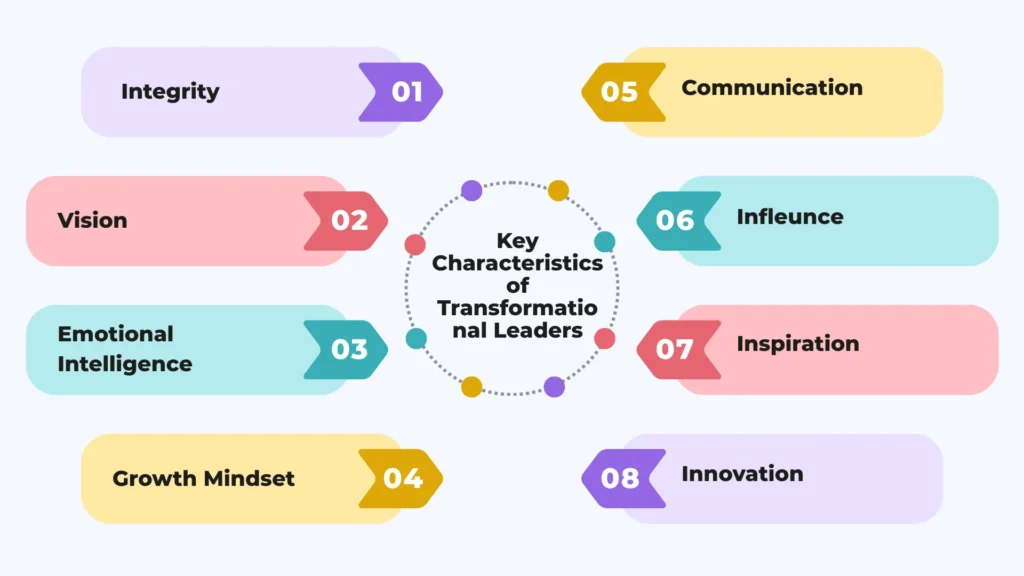
- Integrity
You can feel it instantly when a leader is genuine because their actions match their words and nothing feels forced or fake. Integrity builds a quiet kind of confidence where people trust not just what is said but what is done. It creates a foundation where teams feel safe, respected, and willing to give their best without hesitation.
- Honesty in action builds trust when a leader openly admits mistakes and takes responsibility.
- Consistency in behavior strengthens credibility when decisions align with values every time.
- Ethical decision-making inspires loyalty when leaders choose what is right over what is easy.
- Vision
Some leaders focus on today, but transformational leaders make you see what tomorrow could look like, and suddenly you want to be part of it. A strong vision pulls people forward and gives meaning to everyday work. It turns ordinary efforts into something that feels purposeful and exciting.
- Clear direction helps teams understand exactly where they are heading and why it matters.
- Future thinking allows leaders to spot opportunities before others even notice them.
- Shared purpose connects individuals to a bigger goal that feels meaningful and motivating
- Emotional Intelligence
Great leaders understand people, and that changes everything. Emotional intelligence helps them read the room, respond with empathy, and build strong human connections. It creates an environment where people feel heard, valued, and motivated to contribute.
- Empathy in leadership allows leaders to truly understand what their team members are experiencing.
- Self-awareness helps leaders manage their emotions and stay calm under pressure.
- Relationship building strengthens teamwork by creating trust and open communication.
- Growth Mindset
Transformational leaders never see limits, they see possibilities, and that mindset spreads to everyone around them. They believe that skills can be developed and that challenges are opportunities to grow. This attitude encourages teams to take risks, learn, and keep improving.
- Continuous learning pushes individuals to keep developing new skills and knowledge.
- Resilience through challenges helps teams bounce back stronger after a setback.
- Encouraging experimentation creates a safe space where trying new ideas is welcomed.
- Communication
You know a great leader by how they make you feel when they speak, because their words do more than inform, they inspire. Communication in transformational leadership is clear, engaging, and emotionally powerful. It connects people to ideas in a way that sticks with them.
- Clarity in messaging ensures everyone understands goals without confusion
- Active listening makes team members feel valued and respected during conversations
- Storytelling ability turns ideas into memorable messages that inspire action
- Influence
True influence is not about authority, it is about the ability to move people through trust and inspiration. Transformational leaders do not force anything, they create belief. People follow them because they want to, not because they have to.
- Leading by example inspires others to adopt the same behaviors and standards.
- Building credibility makes people trust decisions and direction without resistance
- Positive persuasion encourages action without pressure or control.
- Inspiration
Some leaders assign tasks, but transformational leaders light a fire within people that makes them want to achieve more. Inspiration creates energy, passion, and commitment. It turns ordinary teams into driven and enthusiastic groups.
- Creating excitement motivates teams to approach work with energy and passion
- Encouraging belief helps individuals see their own potential and capabilities.
- Recognizing efforts boosts morale by appreciating contributions and achievements.
- Innovation
Innovation begins where comfort ends, and transformational leaders are not afraid to step into the unknown. They encourage new ideas and challenge the status quo. This creates an environment where creativity thrives, and progress becomes natural.
- Encouraging new ideas allows team members to think freely and share creative solutions.
- Challenging norms pushes organizations to improve beyond traditional methods.
- Supporting experimentation helps teams learn through action and discovery.
Benefits of Transformational Leadership
There is a certain kind of workplace you can feel the moment you walk in. People are engaged, conversations have purpose, and the vibe does not feel artificial. That atmosphere is the direct result of leadership that knows how to inspire and elevate others.
Increased Employee Motivation
People stop working just to get through the day and start showing up with genuine energy.
It’s simply because they’re valued and connected to something bigger than their daily tasks or routine responsibilities. That internal drive pushes them to go beyond expectations without needing constant pressure.
Improved Organizational Performance
When everyone is aligned and believes in the same vision, progress starts to feel smooth and natural. Teams collaborate better, and unnecessary friction begins to disappear. The organization grows not just in results, but in stability and long-term success.
Enhanced Creativity
People no longer hold back their ideas because they feel safe to speak up and be heard. Different perspectives are welcomed, which leads to fresh solutions and smarter ways of thinking. Creativity becomes part of everyday conversations instead of something saved for special moments.
Stronger Workplace Culture
There is a shift from just working together to actually supporting and trusting one another.
People communicate openly, build stronger relationships, and feel a real sense of belonging.
The workplace becomes a space where positivity, respect, and teamwork naturally thrive.
Development of Future Leaders
Individuals are encouraged to step up, take responsibility, and grow beyond their current roles. They gain confidence through guidance, learning, and real opportunities to lead and make decisions. Over time, companies build a pipeline of capable leaders who are ready for bigger challenges.
Transformational Leadership in Different Industries
Walk into two different workplaces, and you can feel the contrast instantly. One feels mechanical and routine, while the other feels driven by purpose and energy. That shift is the result of leadership that inspires people across every industry.
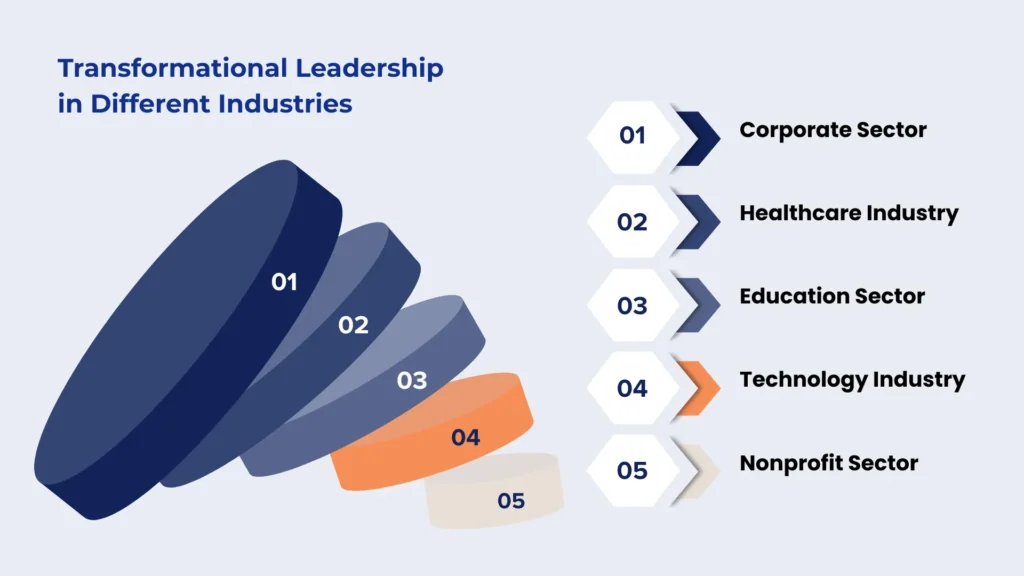
Corporate Sector
In the corporate world, transformational leaders push teams beyond routine targets by connecting daily work to a bigger purpose. They create environments where employees feel driven to innovate and contribute ideas that move the company forward.
Healthcare Industry
Within healthcare settings, transformational leadership encourages professionals to look beyond routine treatment and focus on meaningful patient impact. It strengthens collaboration, builds trust among teams, and motivates staff to improve care standards while adapting to constant changes in medical practices and technologies.
Education Sector
In education, transformational leaders motivate both teachers and students to think differently and aim higher. They foster curiosity and creativity, turning learning into an engaging and meaningful experience.
Technology Industry
Transformational leaders drive constant innovation by encouraging bold thinking and experimentation. Creating an environment where teams feel safe to test ideas, learn from mistakes, and develop solutions that keep organizations competitive in rapidly evolving digital landscapes.
Nonprofit Sector
In nonprofit organizations, transformational leadership plays a key role in connecting individuals to a deeper mission. It inspires teams and volunteers to remain committed, fosters a sense of purpose, and drives consistent efforts toward creating long-term social impact and meaningful community change.
Real-World Examples of Transformational Leadership
Most leaders don’t leave a mark, but some leave a legacy that people feel for generations. They do not just guide teams, they ignite belief and shift entire mindsets. These are the leaders who turned vision into something people could truly believe in.
Steve Jobs
Steve Jobs transformed Apple by combining creativity with bold vision, pushing teams to build products people did not even know they needed. His leadership inspired innovation, challenged limits, and created a culture where excellence and design thinking became the standard.
Elon Musk
He leads with ambitious goals that often seem impossible, motivating teams to innovate in electric vehicles and space travel. His ability to inspire belief in futuristic ideas pushes people to work beyond expectations and redefine what technology can achieve.
Oprah Winfrey
Oprah Winfrey built a media empire by connecting deeply with people and sharing meaningful stories that inspired growth and self-belief. Her leadership empowered audiences and teams alike, creating a culture of empathy, authenticity, and personal transformation.
Nelson Mandela
He led South Africa through a period of deep division by promoting unity, forgiveness, and equality. His leadership inspired millions to rise above conflict, showing how vision and resilience can transform not only a nation but the spirit of its people.
Satya Nadella
Satya Nadella reshaped Microsoft by focusing on empathy, collaboration, and a growth mindset. He encouraged innovation while changing the company culture, helping employees embrace learning and adaptability, which led to renewed success and a stronger global presence.
Difference between Transformational & Transactional Leadership
The way leadership feels can completely shape how people show up to work each day. One approach sparks purpose and energy, while the other keeps everything structured and predictable. Both exist side by side, but they create very different experiences for those being led.
| Transformational Leadership | Transactional Leadership |
| Focuses on vision and long-term growth | Focuses on tasks and short-term goals |
| Inspires through purpose and meaning | Motivates through rewards and penalties |
| Encourages creativity and innovation | Follows structure and established processes |
| Builds strong emotional connections | Maintains formal and authority-based relationships |
| Develops people into future leaders | Focuses on performance and efficiency |
| Adapts easily to change | Prefers stability and control |
Both leadership styles have their place depending on the situation and goals involved. While one focuses on inspiration and growth, the other ensures structure and consistency. Knowing when to apply each approach is what truly defines an effective leader.
Advantages & Disadvantages of Transformational Leadership
A leader can ignite sparks of energy and belief across a team, completely transforming how people perform. Yet beneath that inspiring surface lies a deeper reality where remarkable strengths exist alongside notable challenges that influence long-term effectiveness.
| Advantages | Disadvantages |
| High employee motivation | Can overlook details |
| Encourages innovation | Requires strong leadership skills |
| Builds a strong workplace culture | Not suitable for highly rigid environments |
| Develops future leaders | Risk of employee burnout |
| Improves overall performance | Can depend heavily on the leader’s personality |
Understanding both the strengths and limitations of helps you create a balanced perspective. While it offers powerful benefits, recognising its challenges allows leaders and organisations to apply it thoughtfully and adapt it to different situations effectively.
Future of Transformational Leadership
The future of leadership is not waiting quietly in the distance. It is already unfolding around us, reshaping how people connect, work, and grow. Transformational leadership will define who adapts with confidence and who struggles to keep up in this fast-moving world.
Digital Transformation
Transformational leaders must guide teams through constant technological change while keeping people aligned with purpose. They focus on clarity, adaptability, and continuous learning so employees feel confident using new tools instead of being overwhelmed by rapid digital shifts.
Remote Leadership
Leading from a distance requires stronger communication and deeper trust. Transformational leaders create connection through empathy, regular interaction, and clear expectations so teams remain engaged, motivated, and productive even when physical presence is no longer possible.
AI Adoption
Artificial intelligence is changing how decisions are made, but leaders must balance technology with human insight. Transformational leaders encourage ethical use of AI while ensuring creativity, emotional intelligence, and critical thinking remain central to decision-making.
Talent Development
Future success depends on how well leaders develop people, not just results. Transformational leaders invest in continuous learning, mentorship, and skill building so individuals grow confidently and are prepared to handle evolving challenges and opportunities.
Cultural Change
Organisations are becoming more diverse and dynamic, which requires leaders to build inclusive environments. Transformational leaders promote openness, respect, and shared values so teams feel valued and motivated to contribute their best work consistently.
FAQs
Transformational leadership stands out because it focuses on inspiring and developing people, rather than controlling them.
Transformational leadership works very effectively in small businesses by strengthening relationships, encouraging innovation, and aligning teams with a shared vision, which helps accelerate growth.
They often face challenges such as managing high expectations, maintaining consistency, avoiding burnout, and balancing visionary thinking with practical execution in demanding environments.
Managers can start by developing a clear vision, communicating effectively, building trust, and encouraging creativity while consistently leading by example in their daily actions.
They handle conflict by encouraging open communication, understanding different perspectives, and finding solutions that strengthen relationships while maintaining team harmony and trust.