In a nutshell, Justice and fairness are the qualities that every balanced and stable society needs, ensuring that its people are treated with equality and accountability in both personal and public life. Together, they guide how decisions are made, how rights are protected, and how responsibilities are shared.
When justice and fairness are prioritised, you won’t ever have to worry about being treated badly. Unfortunately, the world lacks such qualities, and we need them now more than ever.
About 1.5 billion peopleare unable to obtain justice for civil & criminal problems. 253 million people live in extreme conditions of injustice, including slavery, and states that are unable to provide justice lose 0.5% to 3% of their GDP.
To further understand these qualities, we will explore their foundation, importance, key principles, their major differences, and the barriers that prevent them from taking place.
The Core Foundations of Justice & Fairness
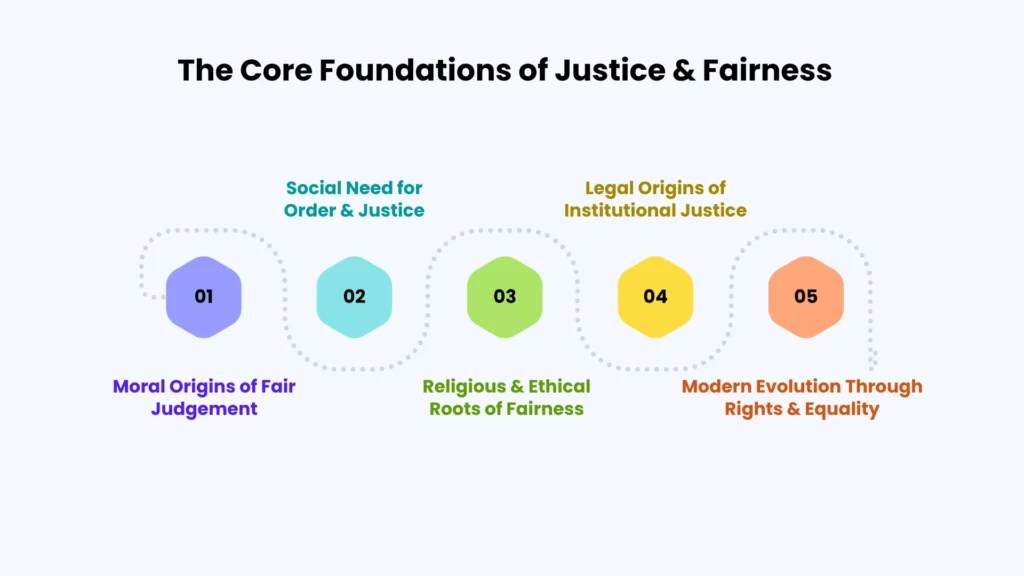
Justice and fairness were shaped slowly through human experience, moral thinking, shared values, and the need to live together without chaos. If we want to understand why these ideas still matter so much today, we first need to look at the foundations on which they were built.
Moral Origins of Fair Judgement
The earliest foundation of justice came from the human conscience. Even before laws existed, people could sense when something felt unfair or morally wrong. That natural reaction became the starting point of fair judgment and moral responsibility.
Social Need for Order & Justice
As societies grew, fairness became necessary for survival and stability. People needed rules and protection so conflict could be controlled and communities could function peacefully. Justice helped create order by giving people a system they could live under together.
Religious & Ethical Roots of Fairness
Religious teachings and ethical traditions gave fairness a deeper moral meaning. They taught that truth, honesty, accountability, and balance were essential in how people treated one another. This helped shape justice as a value connected to both conscience and duty.
Legal Origins of Institutional Justice
Over time, societies turned fairness into formal systems through laws and institutions. Courts, rules, and legal procedures were created to make justice more consistent and less dependent on personal power or opinion.
Modern Evolution Through Rights & Equality
In the modern world, justice expanded through the ideas of rights and equality. People began questioning whether systems were fair not only in theory but also in practice. This made justice more focused on dignity, access, and equal opportunity for all.
Understanding Justice & Fairness in Society
Justice and fairness are not just big ideas people debate in books or courtrooms. They quietly shape how people live, trust, connect, and survive every single day. You don’t really think about justice and fairness every day until you notice how much life changes when they are missing.
Social Purpose of Justice & Fairness
You cannot live in peace for long if you’re constantly ignored, mistreated, or pushed aside. Every society needs some kind of balance so people know they matter and that there are limits to what others can do to them. That is why justice creates a social environment where people feel protected and respected.
Role of Fairness in Human Relationships
Fairness helps relationships feel safe. It creates a sense that you and the other person matter. Your voice matters just as much as the other’s. That is why fairness is one of the most practical things needed to keep all of your relationships stable and healthy.
The Value of Fair Systems in Public Life
When you interact with public systems, you require fairness more than you need efficiency. Whether you’re dealing with a campus, workplace, a government office, or a legal institution. You’ll need to know whether you’ll be treated with dignity and not pushed around by personal bias.
Impact of Justice on Communities & Institutions
Justice shapes the emotional and social health of entire communities. When you feel that systems are fair, you’re more likely to trust one another and stay involved in the institutions around you.
Role of Justice in Building Social Trust
Trust does not appear out of nowhere. It grows when people repeatedly see that fairness is real and that justice is not just a slogan. Justice assures you that rules have meaning, violating them has consequences, and that no one should be above accountability.
Principles Of Justice & Fairness
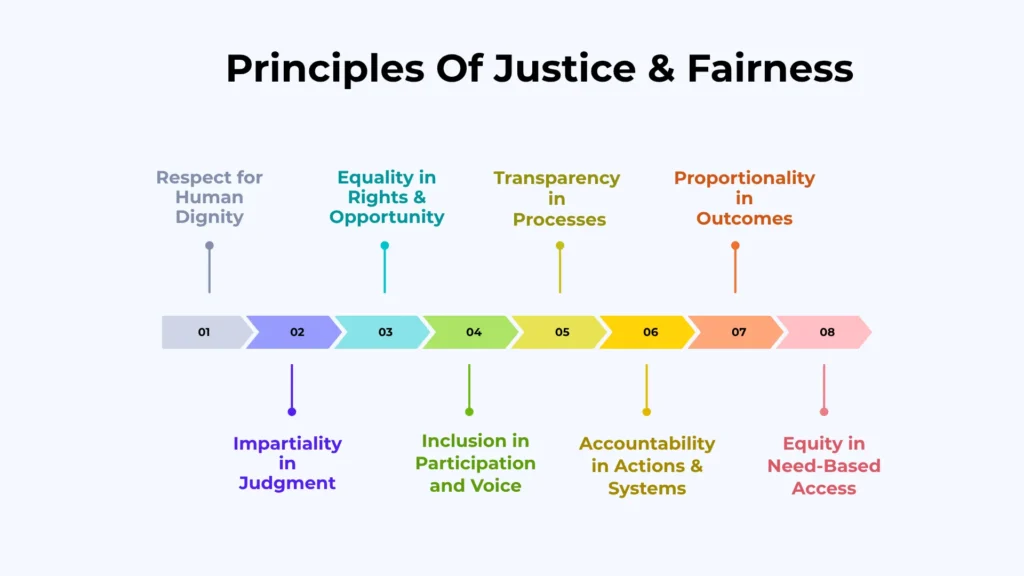
Some decisions instantly feel right while others leave a bad taste you cannot quite explain. That feeling usually comes down to a few core principles working quietly in the background. These principles matter because people notice very quickly when the response does not match the situation.
Respect for Human Dignity
Every person deserves to be treated like they matter, regardless of their status, wealth, or influence. Respect for human dignity means recognising that every individual has value and should not be humiliated or treated as less important.
Examples
- A parent disciplining their children privately without humiliating them in front of the family.
- A teacher correcting a troublemaking student instead of humiliating him in front of the whole class.
- A hospital treating all patients with equal care and attention, regardless of their financial background or social status.
Impartiality in Judgment
Most people want fairness until someone they care about is involved. That is where impartiality becomes difficult but necessary. It asks us to step away from bias and judge based on what is actually right. Impartiality means decisions should not be influenced by favoritism or personal feelings. It requires looking at facts and applying the same standards to everyone.
Example
As a father, you shouldn’t discipline your children based on how well they are academically. You must apply the rules to everyone regardless of how they excel in certain aspects.
Equality in Rights & Opportunity
Equality in justice means that everyone should have the same basic rights, protections, and chances to participate in society. No one should be blocked because of their background, identity, or social position.
Examples
- Both males and females should receive the same access to education and chances to grow without discrimination.
- Employees are being considered for promotions based on their performance instead of favoritism or personal connections.
- Citizens have equal legal protection and the same right to vote and participate in public decisions.
Equity in Need Based Access
Sometimes, treating everyone the same can still lead to unfair outcomes. That is where equity becomes important. It looks beyond equality and asks what people actually need to succeed fairly. It provides support based on your circumstances so that everyone has a real chance to reach similar outcomes.
Example
A student with learning difficulties receiving extra academic support helps them keep up fairly. Financial aid given to a low-income student makes education possible. Accessible spaces for people with disabilities ensure they are not excluded from basic participation.
Inclusion in Participation and Voice
Fairness is not just about decisions, it is also about who gets to be part of them. A system cannot be truly just if certain people are always left out of the conversation. Inclusion means giving people the opportunity to participate, express opinions, and be heard in matters that affect them.
Example
- Students share their opinions about school policies that affect their daily experience.
- Employees are included in discussions about workplace changes that impact their roles and responsibilities.
- Communities are being consulted before major decisions are made that affect their living conditions or resources.
Transparency in Processes
People are more likely to accept decisions when they understand how those decisions were made. What creates frustration is often not just the outcome, but the lack of clarity behind it. So rules and decisions should be clear and open enough for people to understand.
Examples
A company explaining how promotions are decided builds trust among employees. A manager giving clear reasons for a decision makes the process feel fair, even if the outcome is not ideal.
Accountability in Actions & Systems
Fairness loses its meaning if no one is responsible when something goes wrong. A system can look perfect on paper, but it holds no value without accountability. It means that those responsible must answer for their actions and face consequences when they misuse power.
Examples
- A public official held responsible for misuse of authority instead of being protected by their position.
- A company taking action against a senior employee for misconduct instead of ignoring it due to their rank.
- A school responding properly to repeated bullying complaints and ensuring the issue is addressed seriously.
Proportionality in Outcomes
Not every situation should be treated the same. Fairness requires balance in how responses are given. Too harsh or too lenient, both can create injustice. Proportionality assures that outcomes match the seriousness of the situation.
Examples
A first minor mistake being met with a warning instead of harsh punishment reflects balance. A serious act of fraud receiving strong consequences shows fairness in response.
Major Types Of Justice & Their Role in Society
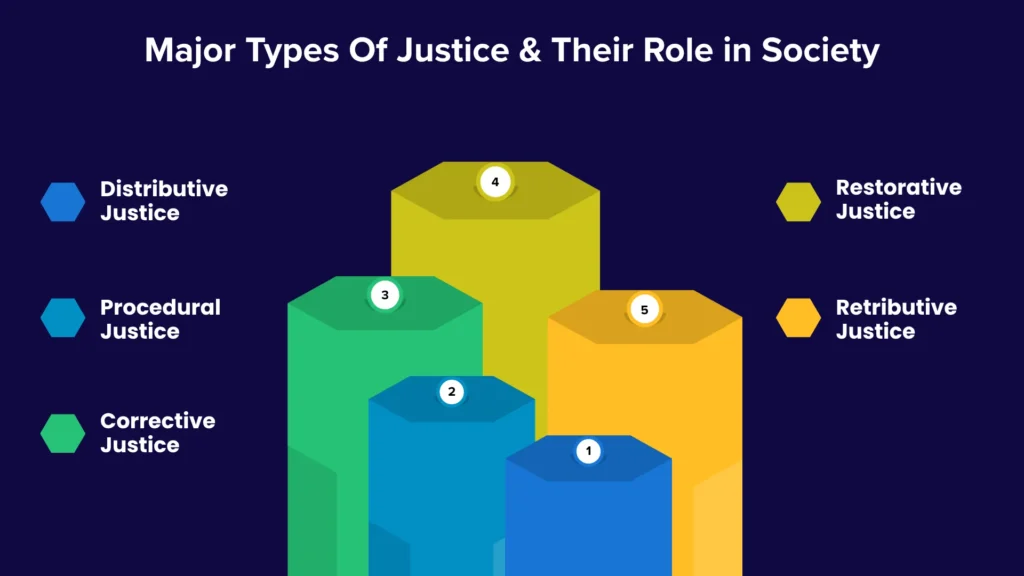
Justice actually works in different ways depending on the situation, the harm, and the kind of fairness people are trying to protect. It shows up in money, rules, relationships, consequences, and even in how society decides what is “fair enough” and what clearly is not.
Distributive Justice
Some unfairness shows up in who gets more and who keeps getting less. That is where distributive justice becomes important. Distributive justice focuses on how resources and benefits are shared across society. It asks whether people are getting a fair share or if the system keeps favoring certain groups over others.
Procedural Justice
Procedural justice is about fairness in the process. It focuses on whether rules are clear, whether people are heard, and whether decisions are made without bias. This matters because even a good outcome can feel unfair if the process was one-sided or dismissive.
Corrective Justice
Not every situation is about punishment. Sometimes problems can be fixed beforehand. Corrective justice focuses on repairing harm when one party has suffered loss due to another’s actions. Its goal is to restore balance by correcting what went wrong. People need to see that harm can be acknowledged and corrected practically.
Restorative Justice
Restorative justice focuses on healing relationships by addressing the harm, the people affected, and the responsibility of the person involved. It looks beyond consequences and asks what repair actually looks like.
Retributive Justice
There are times when harm needs a clear consequence, and that is where retributive justice becomes necessary. It is based on the idea that wrongdoing deserves a proportionate response. It focuses on holding people accountable by ensuring actions have consequences.
The Difference Between Justice and Fairness
At first glance, justice and fairness seem like twins, and people use them together all the time, almost like they’re interchangeable. However, they’re more like cousins that share the same blood, but they’re not entirely the same. One often lives in the structure; the other lives in the human experience.
| Basis Of Comparison | Justice | Fairness |
| Meaning | The principle of doing what is right according to law, ethics, and social order. | The quality of treating people in a balanced, unbiased, and reasonable way. |
| Core Focus | Rights, rules, accountability, and correcting wrongs. | Equal or appropriate treatment in specific situations |
| Nature | Structured and institutional. | Personal and situational |
| Where it Commonly Appears | Courts, laws, governance, and institutions | Classrooms, workplaces, families, and everyday decisions |
| Relationship with rules | Strongly tied to laws and established standards. | May follow rules, but often depends on human judgment. |
| Emotional Dimensional | Can feel objective or detached from personal feelings. | Often connected to how people emotionally experience treatment. |
| Examples of daily life | A court ensures both sides get a legal hearing before judgment. | A parent listens to both children before deciding who was wrong. |
Justice gives society a structure, while fairness gives that structure heart. You can have rules without humanity, and you can have good intentions without consistency, but neither one works well on its own. The healthiest societies are the ones where justice and fairness support each other instead of competing.
Barriers to Justice and Fairness in Modern Society
A society would be wonderful if qualities like justice and fairness were prioritised. However, the reality is that they are constantly being blocked or weakened by the system and certain individuals in power. Unfairness and injustice only survive when people stop calling them out.
Weak Institutions with Poor Accountability
A society cannot protect fairness if its institutions are weak and unreliable. Even the best laws lose meaning when the systems meant to apply them fail to do their job properly. Weak institutions often struggle to enforce rules equally, which creates frustration because people begin to feel that justice depends more on luck than on principle.
Corruption with Abuse of Power
Corruption is one of the fastest ways to damage justice because it allows power to override fairness. The moment decisions are influenced unfairly, trust in the system starts falling apart. This barrier appears when people in authority misuse their position for personal gain.
Bias Discrimination Exclusion
Not all injustice begins with broken laws. Sometimes it begins with how people are judged before the system even has a chance to act fairly. Bias and discrimination distort fairness by choosing who to take seriously. Exclusion then follows by pushing certain people away from opportunity and equal treatment.
Poverty with Unequal Opportunity
Poverty creates barriers long before opportunity even appears. It affects access to education, legal support, and healthcare, which people need to move forward in life. Justice becomes weaker when society ignores those who were born with nothing.
Normalisation of Unfair Treatment
One of the most dangerous barriers to justice is when unfairness starts feeling ordinary. Once people get used to it, they stop reacting to it with the seriousness it deserves. Normalisation happens when harmful behavior, unequal treatment, or abuse of power gets accepted as “just how things are.”
FAQs
They can be promoted through equal treatment, clear rules, accountability, and unbiased decisions. Education and strong laws also play a major role.
Injustice creates anger, mistrust, and social division, which can weaken communities and make people feel excluded or powerless.
That’s because unfair treatment creates feelings of disrespect and emotional pain, especially when they’re judged unfairly.
Justice is important in leadership because leaders must make ethical decisions in order to protect people’s rights and treat everyone with equal respect and accountability.
A fair legal system applies laws equally, allows fair trials, and ensures decisions are made through evidence and impartial judgment.