Qualitative and quantitative research methodologies provide different approaches for gathering and interpreting Information. Qualitative research is entirely focused on human behavior, and quantitative analysis strictly prioritises numbers.
Analysts predict the data analytics market will grow from $72.4 billions to $483.83 billions by 2033. This vast growth demonstrates how corporations priorities quantitative research data above all else.
At the same time, the qualitative research market isn’t far off, because companies also focus a lot more on customer experiences and behavioral analysis. Business Research Insights states that the qualitative research data could surpass $3 billion globally within the next decade.
To get a better idea of their differences, we’ll cover the importance of research methods, their core differences, and common mistakes you need to avoid before you begin your research.
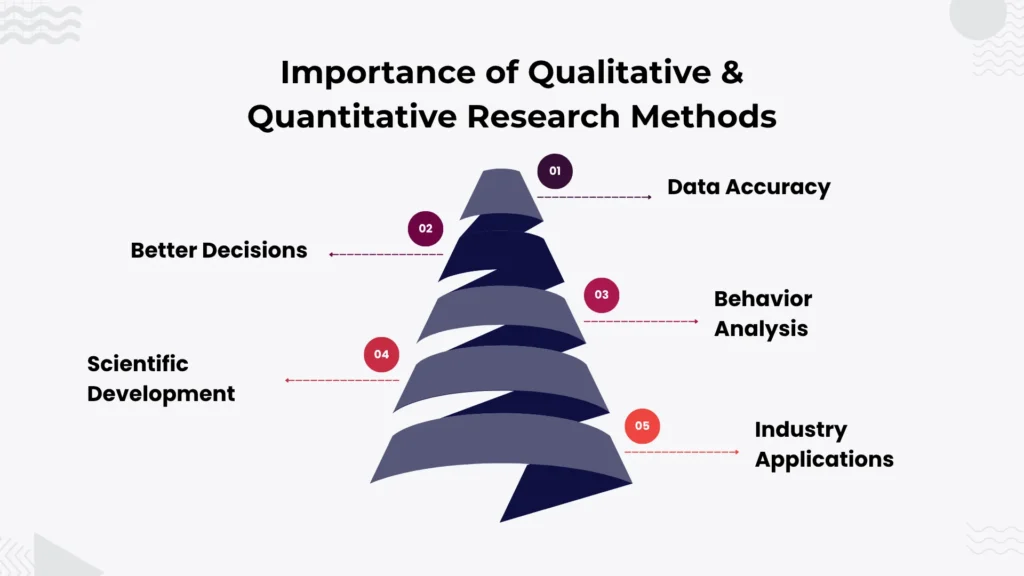
Importance of Qualitative & Quantitative Research Methods
It is a lot stressful to make a decision that can cause a corporation’s downfall. A misstep could be incredibly costly in terms of both money and time. That’s why research is so important. Well executed research techniques assist individuals in distinguishing facts from fantasies and feelings.
Data Accuracy
Research refines accuracy by replacing assumptions with concrete evidence. Quantitative methods capture precise data, while qualitative approaches reveal personal narratives. Utilising these approaches creates a complete factual record of patterns and human perspectives.
Better Decisions
It’s a lot simpler to make the right decision when research points in a clear direction. In businesses, schools, or any other industry, research gives them certainty about what will be effective before making significant investments in important strategies or future development.
Behavior Analysis
Human actions are often driven by certain factors that statistics alone can’t explain. Qualitative research explores those factors, whereas quantitative methods identify the trends that drive them. Combining both approaches yields profound insights into a person’s thoughts and broader social patterns.
Scientific Development
Evidence-based data and effective research methods are critical to all areas of scientific development. Quantitative research gives measurable data, whereas qualitative research explains personal experiences relating to health and psychology.
Industry Applications
If multiple industries need to dominate, then they require research. Marketing departments analyse customer preferences, and healthcare providers examine patient experiences. Good research methodologies enable organizations to enhance their services and create better products.
Sampling Techniques in Research Studies
The success of your research depends on how you plan on gathering information. If you choose a poor sampling method, it will ruin your results even if your research has been perfect from the get go. A clever sampling scheme lets you find rich insights backed by confidence and clarity.
Purposive Sampling
This is for when you require your participants to have particular knowledge based on your topic. It is most effective in qualitative research where detailed viewpoints are more important than a large number of opinions, and each participant provides useful insight towards the objective of your study.
Random Sampling
It gives each of your participants an equal chance of being selected. This method also reduces bias and increases fairness. If your research consists of a quantitative method, then this sampling technique aligns perfectly because of its high efficiency, as its results represent a large population.
Stratified Sampling
The population is divided into different groups in this sampling, in order to determine suitable participants for your research. This improves balance and ensures that important segments of the population, such as age, gender, or income ranges, are properly reflected in the outcomes of your study.
Convenience Sampling
In some cases, you’ll have the option to sample easily accessible groups due to time and cost savings. While convenience sampling offers quick data collection, it may not always generate highly accurate information about broader populations or more involved studies.
Snowball Sampling
Through snowball sampling, you can reach secluded communities and connect with isolated participants through those participants who are already a part of your research. Sensitive subjects demand such approaches because typical sampling strategies often fail.
Core Differences in Qualitative vs Quantitative Research
The incorrect research method can destroy all the value of information, even if you haven’t analysed it yet. It is your responsibility to differentiate between research that is meant to be emotionally interpreted and research that is meant to be factual.
| Aspects | Qualitative Research | Quantitative Research |
| Purpose | To understand meanings and experiences | To measure numbers and figures |
| Data Type | Verbal | Numerical |
| Sample Size | Small | Large |
| Data Collection | Interviews & Observations | Surverys & Experiments |
| Data Analysis | Themes & Interpretation | Statisitcs & Calculations |
| Result Accuracy | Subjective but detailed | Objective and precise |
| Common Sampling Techniques | Convenience, snowball, purposive sampling | Stratified, systematic, and random sampling |
- Research Purpose
Many researchers fail because they are chasing numbers instead of understanding emotional significance. Some focus intensely on their individual experience and lose sight of what can be measured. Knowing your research goal from the start helps you avoid confusing issues.
- Qualitative data involves an individual’s feelings, beliefs, motives and in-depth experience.
- Quantitative data involves an accurate numerical representation of trends, behaviours, and percentages.
- The wrong aims will inevitably lead to inconclusive findings and poor study results.
- Data Type
Research becomes frustrating when the collected information fails to answer important questions that you desperately seek. That is because you’re most likely unaware of how compatible a research method is with your topic. Recognising proper data types early can help you avoid confusion, wasted resources, and incomplete findings throughout projects.
- Qualitative data consist of opinions, conversations, observations, and narratives.
- Quantitative data consist of percentages, figures, rating scales, and statistics.
- By using correct data types, you can enhance the accuracy and quality of your research significantly.
- Sample Size
Researchers often panic when deciding participant numbers because study accuracy depends heavily upon sampling choices. Some projects succeed using tiny, focused groups while others require massive datasets. Understanding sample size differences prevents misleading conclusions and improves confidence in research findings tremendously.
- Qualitative studies tend to involve small groups of participants in order to deeply explore emotions.
- Quantitative studies require larger populations to support statistical reliability and broader research generalisation capabilities effectively.
- Choosing the correct sample sizes consistently improves credibility and meaningful interpretation throughout your research project.
- Data Collection
Many studies fail because researchers collect information using completely unsuitable methods from participants. Some situations require honest conversations, while others need carefully organized, structured measurements. Understanding collection differences helps researchers gather reliable insights without confusion or inaccurate responses during studies.
- Qualitative collection methods include interviews and open-ended conversational questioning techniques.
- Quantitative collection methods involve surveys, questionnaires, polls, and measurable statistical recording systems.
- Strong data collection methods improve research trustworthiness and participant response accuracy significantly throughout investigations.
- Data Analysis
Researchers frequently feel overwhelmed once massive amounts of collected information require proper interpretation. Some data demands emotional & social understanding, while other datasets require statistical calculations for clarity.
- Qualitative analysis identifies themes, emotional patterns, and behavioral insights from raw data.
- Quantitative methods apply statistics and correlations within datasets.
- Effective data improves decision-making accuracy significantly for researchers worldwide.
- Result Accuracy
Nothing is more disappointing for researchers than discovering unreliable conclusions after exhausting months of gathering information carefully. Accuracy depends heavily upon selecting appropriate research methods from the beginning. Understanding result accuracy helps you produce findings that support future decisions confidently.
- Qualitative accuracy delivers emotional depth but may involve subjective interpretation during findings evaluation processes.
- Quantitative accuracy produces objective measurements supporting consistent replication and stronger statistical reliability across studies globally.
- Better result accuracy significantly improves the practical usefulness of research findings for professionals.
- Real World Applications
Different industries rely heavily upon specific research approaches, depending entirely upon goals and required outcomes. Choosing suitable applications helps researchers produce valuable findings supporting accurate and meaningful decisions across industries.
- Qualitative applications dominate psychology, counseling, sociology, and education worldwide.
- Quantitative applications support medicine, engineering, economics, finance, and scientific and technological advancement projects extensively today.
- Selecting relevant applications ensures research findings remain practical, valuable, and professionally useful across industries.
Qualitative Data Analysis Techniques
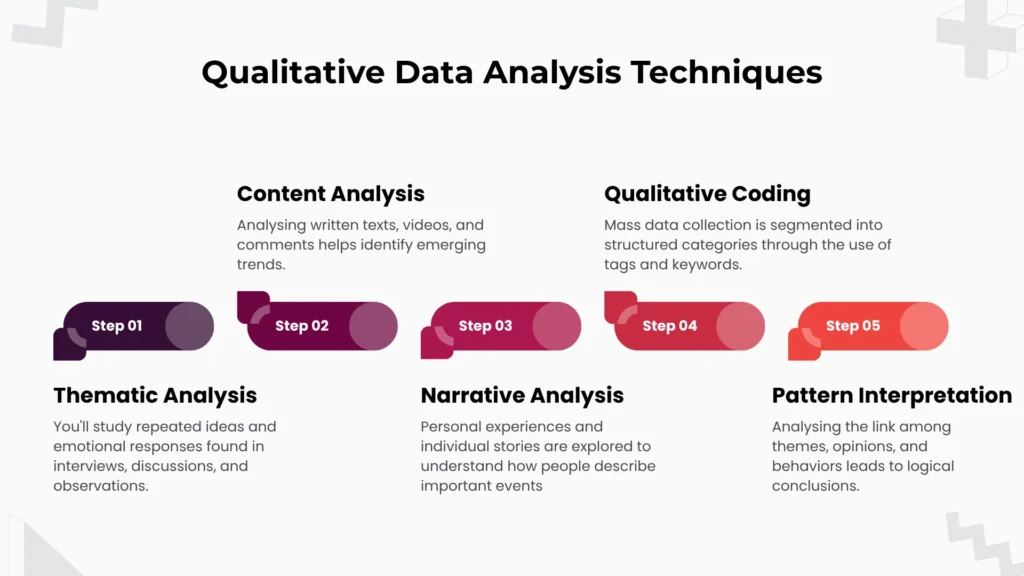
People often share far more than simple answers during research. Hidden emotions, personal struggles, and honest experiences can reveal powerful insights. Qualitative data analysis helps you unveil hidden meanings and transform scattered responses into a valuable understanding.
Thematic Analysis
You’ll study repeated ideas and emotional responses found in interviews, discussions, and observations. This approach helps you discover common themes that explain behaviors and experiences while making large amounts of descriptive information that’s easier to understand.
Content Analysis
Analysing written texts, videos, and comments helps identify emerging trends. This method clarifies public sentiment through detailed qualitative reviews. Examining these diverse data sources allows you to understand emotional reactions.
Narrative Analysis
Personal experiences and individual stories are explored to understand how people describe important events. You’ll focus on language, storytelling style, and emotional expression to find out deeper meanings connected to human behavior and lived experiences.
Qualitative Coding
Mass data collection is segmented into structured categories through the use of tags and keywords. It enables you to eliminate non-essential details from your key insights, enhancing clarity and making highly detailed qualitative information more effectively analysed.
Pattern Interpretation
Analysing the link among themes, opinions, and behaviors leads to logical conclusions. You’ll apply this method to clarify why specific actions persist across interviews, observations, and qualitative findings.
Quantitative Data Analysis Techniques
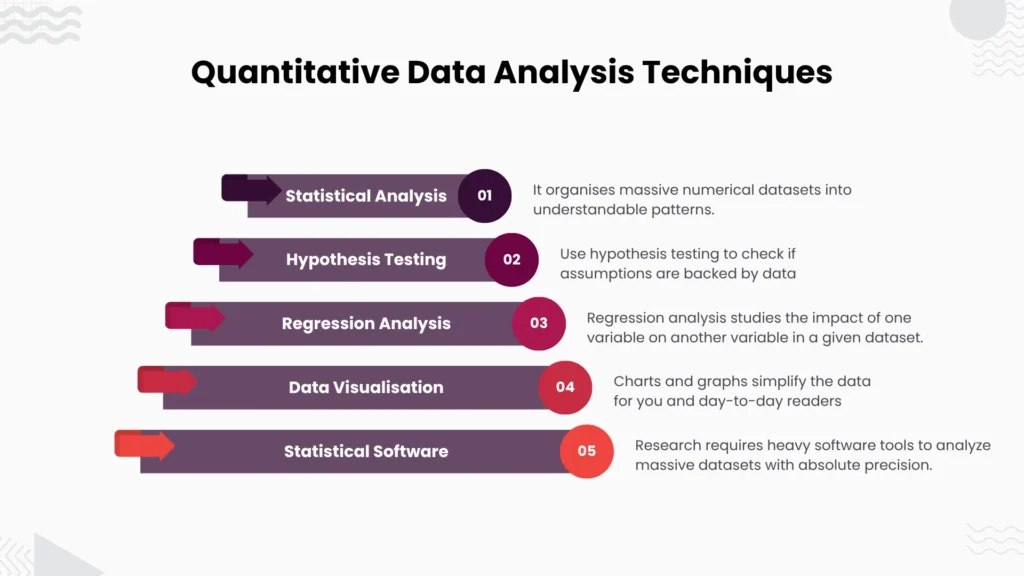
Numbers can sometimes seem hard to understand at first, but they also tell stories that you might never have discovered otherwise. This stage of research will assist you in converting figures into substantial information that allows you to make wiser choices in industries.
Statistical Analysis
It organizes massive numerical datasets into understandable patterns. You’ll compare results and identify trends to measure relationships between distinct variables with precision. Your conclusions will solely be based on evidence rather than assumptions.
Hypothesis Testing
Use hypothesis testing to check if assumptions are backed by data. Compare expected outcomes to actual results, and see if those findings actually prove those assumptions are factual instead of randomly guessing.
Regression Analysis
Regression analysis studies the impact of one variable on another variable in a given dataset. It is commonly used by businesses to forecast sales trends and by health scientists to investigate links between lifestyle behaviours and diseases.
Data Visualisation
Charts and graphs simplify the data for you and day-to-day readers. Visual displays are also more effective at quickly highlighting trends and comparisons, in order to help audiences pick up on key findings without having to wade through endless rows of spreadsheets or pages of reports.
Statistical Software
Research requires heavy software tools to analyze massive datasets with absolute precision. Programs like SPSS, R, and Python cut down manual research and boost overall efficiency. Scientists thrive when machines carry out the burden.
Types of Qualitative Research Methods
Human interaction reveals depth beyond mere statistics. Qualitative research methods effectively navigate personal narratives, allowing you to document unique life experiences. Numbers lack soul, but direct engagement remains the primary way for uncovering authentic findings.
Ethnography
You will observe a certain group of people’s day-to-day lives to learn about their customs and social interactions. You’ll be living among them and spending considerable time so you can genuinely study their behavior and how they survive as a community.
Phenomenology
Personal feelings and experiences are the main focus in this methodology. In detailed discussions and personal reflections, you will examine the way how certain people interpret their life experiences (like trauma, loss, or success).
Case Studies
A single person, situation, or organization is examined closely to gather detailed insights. This helps you understand complex issues while identifying patterns and lessons that broader studies may fail to uncover clearly.
Focus Groups
Smaller groups discuss particular topics while you observe their thoughts and responses. You will discover common experiences and narratives about the perception of the public that give valuable clues about attitudes and their decision-making process.
In-Depth Interviews
Open conversations allow participants to share thoughts freely without strict answer limitations. You’ll use this method to gather meaningful insights and discover perspectives that structured questionnaires often fail to capture properly.
Types of Quantitative Research Methods
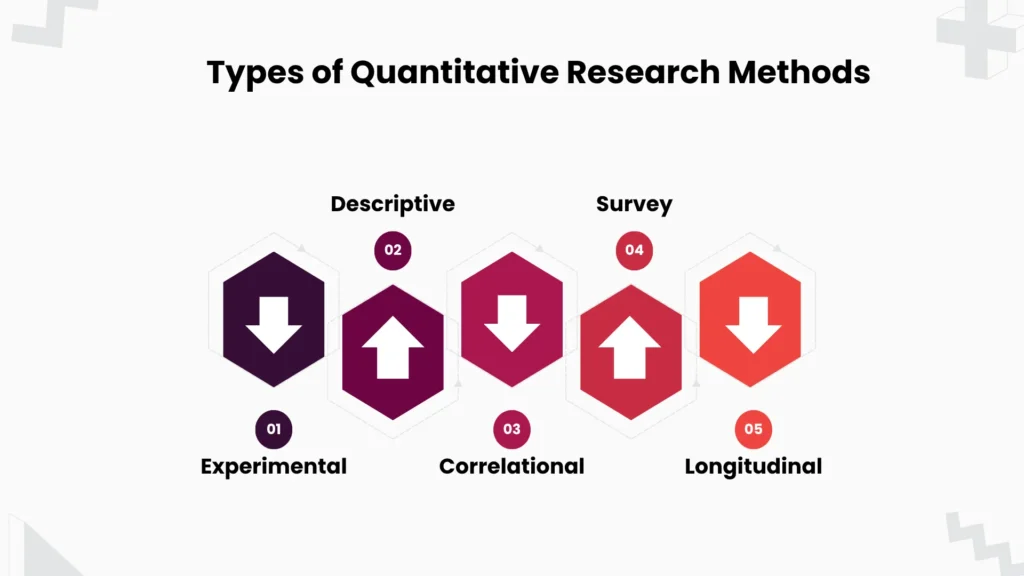
Pick your methods carefully before collecting data. Research gains clarity when you measure trends or study relationships using quantitative tools, while keeping results organised and reliable. Choosing the right method makes comparing large groups a lot easier.
Experimental
Adjusting one variable while monitoring surroundings lets you track cause and effect. Researchers rely on this method across science and healthcare industries to secure reliable results. Such findings can be used repeatedly under consistent testing conditions.
Descriptive
Analysing current habits, behaviors, and trends is based on gathering raw statistics and observations. You’ll use this method if you want to understand genuine life events without influencing the participants or changing environmental conditions.
Correlational
You’ll study connections between variables to spot long-term relationships. This approach is commonly used in industries like education, healthcare, and business because patterns are identified without forcing the participants to act in a certain way.
Survey
Gathering feedback through online surveys generates massive datasets quickly. Big industries love this method because comparing stats becomes simple, and processing their responses helps leaders pinpoint trends clearly. Additionally, it saves a lot of time during complex research projects.
Longitudinal
The same participants are observed across extended periods to study gradual changes and long-term developments. You’ll use this method when short studies cannot capture evolving behaviors, health conditions, or social patterns accurately over several years.
Advantages & Limitations for Qualitative Research Methods
Selecting qualitative research requires knowing where it truly shines. Every method carries inherent baggage alongside its unique strengths. Understanding where you might struggle can prevent wasted effort. If you need clear results, then pick the right method for your research.
| Advantages | Limitations |
| Provides emotional insights | Difficult to generalise findings |
| Explore personal experiences | Small samples reduce broad accuracies |
| Flexible Research Structure | Research bias may influence interpretation |
| Open and honest responses | Data collection takes time |
| Helps understand human behaviour clearly | Analysis can become complex |
| Useful for exploratory research | Results vary between researchers |
Qualitative studies provide insights that mere numbers simply miss. But you must also balance this with careful focus on potential bias, heavy time commitments, plus small sample sizes. Keep your research credible enough that it holds value.
Advantages & Limitations for Quantitative Research Methods
Numerical data can be empowering since they give a sense of certainty and clarity. However, behind every graph, percentage, and statistic, there are hidden challenges that you’ll definitely face in secret when you transform raw data.
| Advantages | Limitations |
| Produces reliable results | Overlooks emotions |
| Statistical analysis becomes easier | Feels restrictive in complex situations |
| Supports large sample sizes | Needs a strong mathematical understanding |
| Identifies trends and patterns | Human behaviour becomes oversimplified |
| Results are easy to replicate | Large studies can become expensive |
| Often viewed as objective | Unexpected responses may not fit structured formats |
Quantitative study is still the most reliable and practical method in studies for academicians and professionals, as it provides structured findings. Nevertheless, the best results are frequently obtained by those who strike a balance between the raw precision of numbers and deep human understanding.
Common Research Mistakes
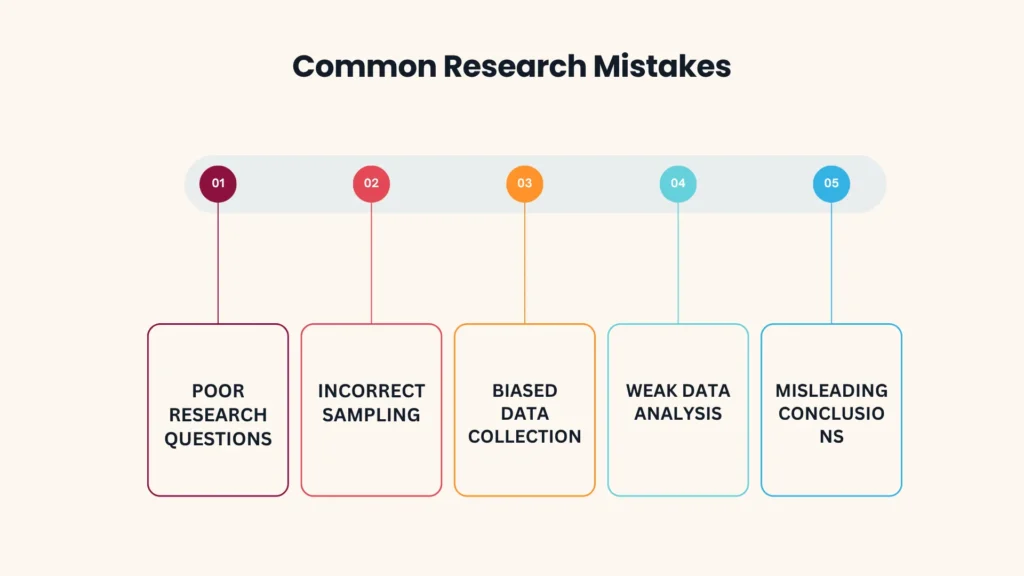
The accuracy and reliability of any good study can be undermined by innocent errors. You may have acquired a lot of data, and yet be frustrated that minor mistakes in collection and analysis are yielding you weak and misleading results.
Poor Research Questions
Researchers tend to make general or vague questions, which are confusing for the participants and can compromise the research altogether. Weak questions also tend not to target the research purpose, hence making the data gathered not viable for their objectives.
Incorrect Sampling
Researchers also tend to choose participants who do not represent the population of interest. This error results in biased outcomes and compromises reliability. Results fail to reflect broader behaviors or perspectives entirely and diminish the value of their findings.
Biased Data Collection
Some studies use leading questions or allow personal opinions to influence responses during interviews and surveys. Biased collection methods damage credibility because participants may provide answers shaped by pressure instead of honest opinions.
Weak Data Analysis
A common mistake happens when researchers misread patterns or ignore important details while reviewing data. Poor analysis creates inaccurate findings and can completely change the meaning of results, even when strong information was collected.
Misleading Conclusions
Certain researchers make exaggerated claims that the data cannot fully support. This mistake confuses readers and reduces trust because assumptions are presented as facts without enough evidence or a proper logical connection.
FAQs
Both are valuable because quantitative research measures trends while qualitative research explains customer motivations, preferences, and buying behavior.
Sampling techniques help them to save time, reduce costs, improve accuracy, and study populations without collecting data from everyone.
Only structured interviews with fixed numerical responses can be quantitative, though most interviews are commonly qualitative in nature.
Researcher bias occurs when personal beliefs, opinions, or expectations unintentionally influence data collection, interpretation, or study conclusions.
Primary research collects original data directly from participants, while secondary research analyses existing information from previous studies or sources.