To put it simply, sociological imagination is the ability to connect your personal experiences with the larger forces shaping society. It helps you understand how everyday choices and challenges are influenced by culture, history, and social structures.
Introduced in 1959 by C. Wright Mills, the concept has remained influential for more than six decades and continues to be widely taught and applied worldwide. It is often described as a quality of mind that helps people interpret complex social realities, especially in today’s fast changing and information rich world.
Rather than seeing problems within a society, sociological imagination connects them to broader patterns, making it highly relevant for analyzing modern social issues.
By exploring its foundations, importance, key components, everyday applications, and role in understanding major social issues, we’ll be going over how sociological imagination shapes the way we think about society and our place within it.
Foundations of Sociological Imagination
Life can feel strangely unfair at times, like you are being pushed by forces you cannot see or control. Such dissatisfaction is where sociological imagination begins, encouraging you to look beyond yourself and uncover the deeper forces shaping your reality.
Origin by C. Wright Mills
Introduced in 1959, this concept emerged from Mills’s concern that people felt trapped in personal struggles. He argued that individuals must connect their private lives with wider social realities to truly understand their circumstances and the world around them.
Historical Background
During the post war period, rapid industrial growth and social change created confusion for many individuals. Society was transforming quickly, yet people continued blaming themselves for struggles that were actually shaped by economic conditions and institutional shifts.
Concept Development
Mills built this idea to help people move beyond surface level thinking. Instead of viewing events as isolated, he encouraged analysing patterns and connections, allowing people to see how personal experiences are influenced by broader social systems.
Shift to Social Analysis
Traditional thinking focuses on individual responsibility, but sociological imagination redirects attention toward society. It encourages examining structures, institutions, and cultural expectations that shape behaviour.
Biography & History Link
Personal life stories cannot be separated from the time period in which they occur. Biography reflects a person’s experiences, while history represents larger social forces, and understanding their connection reveals how society influences opportunities, challenges, and life outcomes.
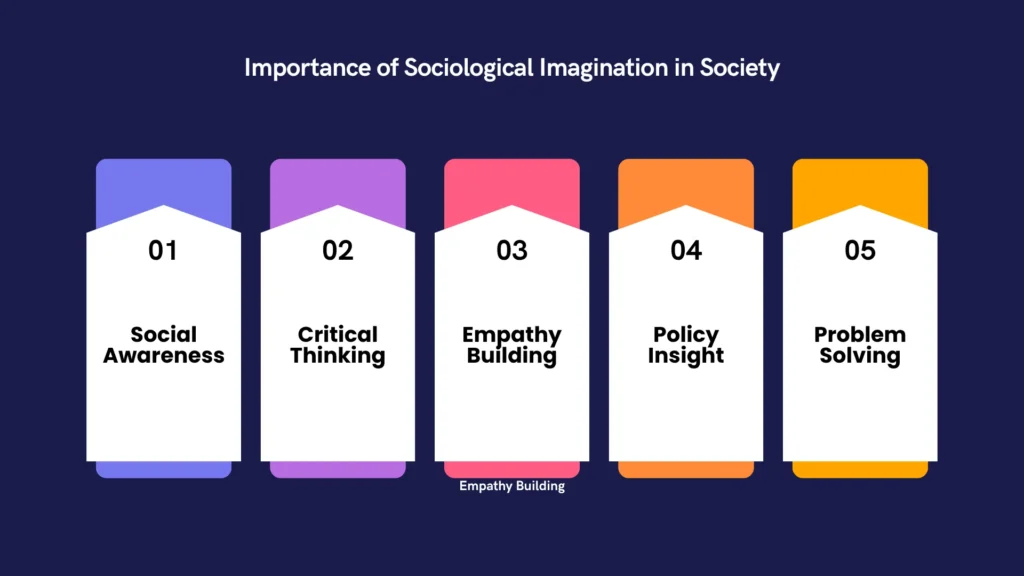
Importance of Sociological Imagination in Society
Why do people often feel stuck, confused, or even blamed for situations beyond their control? That frustration usually comes from missing the connection between personal experiences and the larger social forces that quietly shape everyday life.
Social Awareness
Understanding sociological imagination makes hidden patterns in society visible. It allows you to recognise inequality, privilege, and social structures that influence daily life, helping you move beyond assumptions and see how larger systems shape individual experiences.
Critical Thinking
Developing this perspective encourages deeper questioning of beliefs and norms. Instead of accepting information at face value, it’ll push you to analyse causes, examine evidence, and understand how social forces influence decisions.
Empathy Building
Seeing life through a broader social lens helps you understand struggles beyond your own experiences. It reduces judgment and increases compassion by showing how factors like class, culture, and opportunity shape the challenges others face.
Policy Insight
This approach helps reveal the root causes behind social issues, which is essential for creating effective policies. You can design solutions that address underlying problems instead of focusing only on surface-level symptoms.
Problem Solving
Looking at issues through a societal lens allows for more effective solutions. It shifts focus from blaming individuals to understanding systems, making it easier to identify long-term strategies that address the real causes of problems.
Breaking Down Sociological Imagination
It starts with a quiet question that you ask yourself, and it might feel almost uncomfortable, “Why does life unfold so differently for different people?” The answer is rarely simple. Beneath everyday choices lies a deeper structure that shapes outcomes in ways most people never stop to notice.
Key Components
Nothing feels more confusing than trying your best and still wondering why outcomes differ so much for people. That question opens a door to something deeper. Once you step through, you start noticing the core forces that quietly shape every life.
| Component | Role |
| Time Context | The historical period you live in shapes opportunities and limitations. |
| Social Structures | Institutions like family, education, government, and economy influence life |
| Economic Systems | How wealth, jobs, and resources are created, distributed, and controlled |
| Cultural Norms | Shared beliefs, values, and behaviours guiding everyday actions |
| Biography | Your personal experiences shaped by all the forces above |
Personal Troubles
It feels personal when life goes wrong. You blame yourself, your choices, and your effort. But what if that heavy feeling is not entirely yours to carry? What if your struggles are quietly shared by thousands experiencing the same unseen pressure?
- Losing a job often reflects a wider economic slowdown rather than just personal failure.
- Struggles in relationships can come from cultural expectations shaping roles and emotional behaviour.
- Ongoing financial stress may result from rising living costs, affecting entire communities.
Public Issues
Some problems feel distant until you realise they are quietly shaping your daily life. These are not just headlines or statistics. They are powerful forces influencing millions of people at once, including you, whether you notice them or not.
- High unemployment reflects broader economic instability, impacting large groups beyond an individual.
- Rising prices increase the cost of living, making basic needs harder for many households.
- Unequal education systems show clear social inequality, limiting opportunities across regions.
Social Norms
You rarely notice them, yet they guide almost everything you do. From how you speak to what you believe is acceptable. These unwritten rules quietly shape your identity, often without you realising you are following them every single day.
- Expectations around careers are influenced by gender roles shaped by society.
- Choices in clothing and style often follow social trends to gain acceptance.
- Everyday actions in public follow behaviour standards to avoid judgment.
Institutional Impact
There is a hidden system working behind your daily life. You do not see it directly, yet it shapes your opportunities, your limits, and even your mindset. These powerful institutions influence your path long before you make your own choices.
- Access to knowledge depends on how education systems are structured and funded.
- Stability and opportunities are shaped by changing government policies over time.
- Opinions and beliefs are influenced through constant exposure to media platforms.
Power Dynamics
At some point, it starts to feel like certain doors open easily for some people while others stay shut no matter the effort. That feeling reflects how power quietly operates in society, shaping outcomes behind the scenes.
- Decisions that shape daily life are often made by political leaders, influencing laws and policies.
- Employment opportunities and wages are heavily affected by powerful corporate structures controlling markets.
- Access to resources and influence is often held by groups with strong social and economic power.
Structural Inequality
It can feel unfair when effort does not always lead to success. However, this disappointment has deeper roots. Inequality is often built into systems, making it easier for some and harder for others before they even begin their journey.
- Access to opportunities differs because of deep rooted class divisions shaping education and financial stability.
- Career progression and income gaps persist due to ongoing gender based barriers in many industries.
- Unequal treatment and limited access still occur because of systemic racial inequalities within institutions.
Life Chances
Have you ever looked at someone’s life and thought they just got lucky, while others keep struggling no matter how hard they try? That difference is shaped by invisible starting points that quietly decide how far someone can actually go.
- Early advantages or limitations often come from family background, influencing opportunities.
- The range of careers available is strongly linked to access to education and the quality of learning.
- Many doors open or stay closed depending on connections within social networks and influential circles.
Social Change
The world around you is never still. It keeps shifting, evolving, and transforming in ways you might not notice immediately. These changes reshape how people live, think, and interact, often creating new opportunities and new challenges at the same time.
- Everyday interactions have transformed as digital technology continues to reshape communication and daily routines.
- What people value and accept changes over time through evolving cultural beliefs and shared ideas.
- Opportunities and job security shift constantly due to changing economic conditions affecting entire populations.
Role of Sociological Imagination in Understanding Social Issues
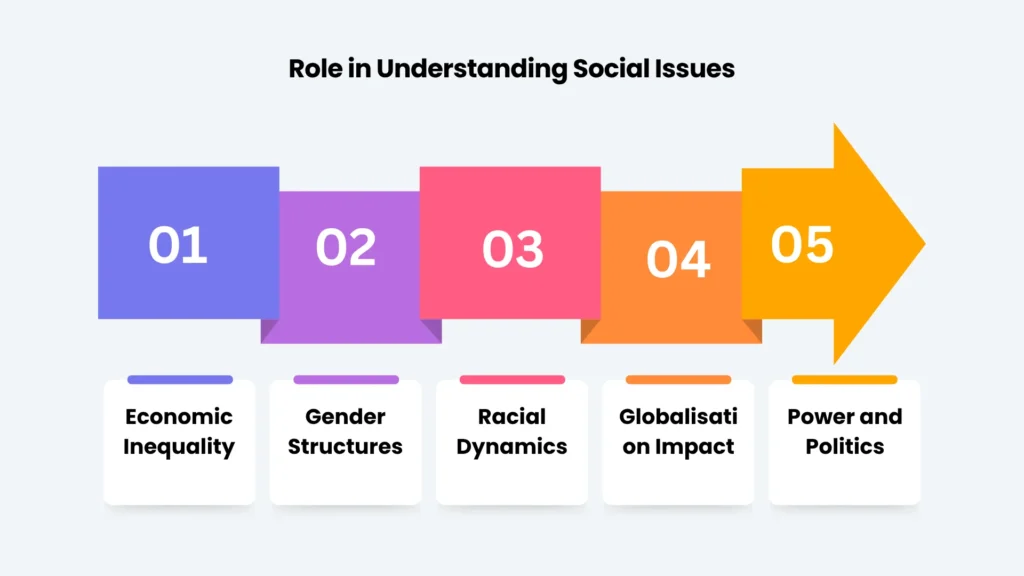
Sociological imagination helps connect personal experiences with larger social patterns, making it easier to understand why issues like inequality, discrimination, and power imbalances exist and persist across different groups within society.
Economic Inequality
Economic gaps rarely come down to effort alone. Wealth distribution, access to education, and job opportunities shape outcomes long before you make your choice, revealing how systems can advantage some groups while quietly limiting the progress of others.
Gender Structures
Gender expectations influence roles, behaviours, and opportunities in everyday life. From career paths to social expectations, these structures shape how people are perceived and treated, often reinforcing patterns that persist across generations without being immediately visible.
Racial Dynamics
Racial experiences are shaped by historical systems and present-day institutions. Opportunities, treatment, and outcomes often reflect deeper structural patterns that show how inequality is maintained through social arrangements rather than only your actions or beliefs.
Globalisation Impact
Global connections influence local lives in ways you may or may not notice. Job markets shift, cultures blend, and economic pressures travel across borders, shaping challenges that you face within your own communities.
Power and Politics
Decisions made by those in authority affect everyday realities for millions. Laws, policies, and leadership choices shape access to resources and opportunities, highlighting how power structures influence life outcomes far beyond personal control.
Sociological Imagination vs Common Sense Thinking
You trust your instincts, right? Most of us do. But sometimes what feels obvious is just a small piece of a much larger story, and that hidden gap between instinct and reality is exactly where this comparison starts to get noticeable.
| Aspect | Sociological Imagination | Common Sense Thinking |
| Perspective | Broad societal view | Limited personal view |
| Approach | Analytical and evidence-based | Based on beliefs and assumptions |
| Problem Understanding | Looks at the root causes | Focuses on surface-level explanations |
| Bias | Aims to reduce bias through analysis | Often influenced by personal bias |
| Depth | Encourages deeper understanding | Stays at a basic level |
Understanding this difference allows you to move beyond quick assumptions and see patterns that shape everyday experiences. It offers a more balanced way to interpret situations, helping you respond thoughtfully rather than relying only on instinct or familiar beliefs.
Real Life Applications of Sociological Imagination
A graduate struggles to find work, a student falls behind despite trying hard, a family remains stuck in poverty, and rising crime worries communities. These situations look personal, yet each reflects deeper social patterns shaping everyday realities.
Job Loss
Losing a job during a recession is not just personal failure. Economic decline, company layoffs, and reduced hiring affect many workers at once, showing how larger financial conditions shape individual employment outcomes.
Unequal School Resources
Students in rural schools often face limited resources compared to those in urban areas. Differences in funding, facilities, and teacher access create unequal outcomes, proving education success is influenced by systemic conditions, not just effort.
Living Below the Poverty Line
Many families remain in poverty due to limited job access and rising living costs. Structural barriers reduce opportunities, making it difficult to improve financial conditions despite effort and motivation.
Limited Healthcare Access
People in low income areas often face poor healthcare access and fewer facilities. Living conditions and income levels affect health outcomes, showing that well-being is shaped by social and economic environments.
Youth Crime
Young people in high-risk neighbourhoods face higher exposure to crime and fewer opportunities. Social environment and lack of support systems increase involvement, linking crime to broader societal conditions rather than personal choice alone.
Advantages & Disadvantages of Sociological Imagination
Seeing the world through a wider lens can feel empowering, but it also comes with trade-offs. What sharpens your understanding of society can just as easily complicate simple situations, making you question more while trying to balance clarity with confusion in everyday thinking.
| Advantages | Disadvantages |
| Improves critical thinking | Can be complex to understand |
| Builds empathy | May over complicate simple issues |
| Helps identify root causes | Not always easy to apply practically |
| Encourages social awareness | Requires effort and awareness |
| Useful for policy making | Can challenge deeply held beliefs |
Sociological imagination offers both strengths and limitations depending on how it is used. It can deepen understanding and awareness, yet also introduce complexity into simple matters. Its effectiveness ultimately depends on maintaining a balance between insight, practicality, and thoughtful application in real life.
FAQs
It helps students develop critical thinking, analyze social issues, and understand how society influences their opportunities, education, and life outcomes.
Indeed, it promotes understanding of social influences behind behavior, helping reduce stereotypes and encouraging empathy toward diverse groups.
It explains how cultural norms and values shape individual behavior, influencing perceptions, decisions, and interactions within society.
It absolutely is, it helps analyze how social media, technology, and global connectivity influence behaviors, trends, and individual perceptions in modern society.
It connects mental health struggles to social pressures, environment, and systemic factors instead of viewing them purely as personal problems.