First and foremost, Ethics is the set of moral principles that helps you to decide what is right or wrong in your actions. It serves as your personal handbook, telling you how to treat others and make decisions in daily life. Whether you’re being truthful or choosing to be fair over selfish, ethics shape the kind of person you’ll become.
Its importance is applied in every aspect of life. In corporate settings, the Ethisphere Institute study stated that companies that were more recognised for their ethical behaviour have managed to outperform the market by 10.5%.
Whether you realise it or not, it quietly guides your actions and influences how you treat others. From small choices like returning extra change to big ones like standing up for what’s right, ethics is always at work behind the scenes.
To truly understand how it fits together, we’ll be walking through the origins of ethics, its importance, breakdown of its types & principles and the consequences of unethical behaviours.
The Foundation Of Ethics
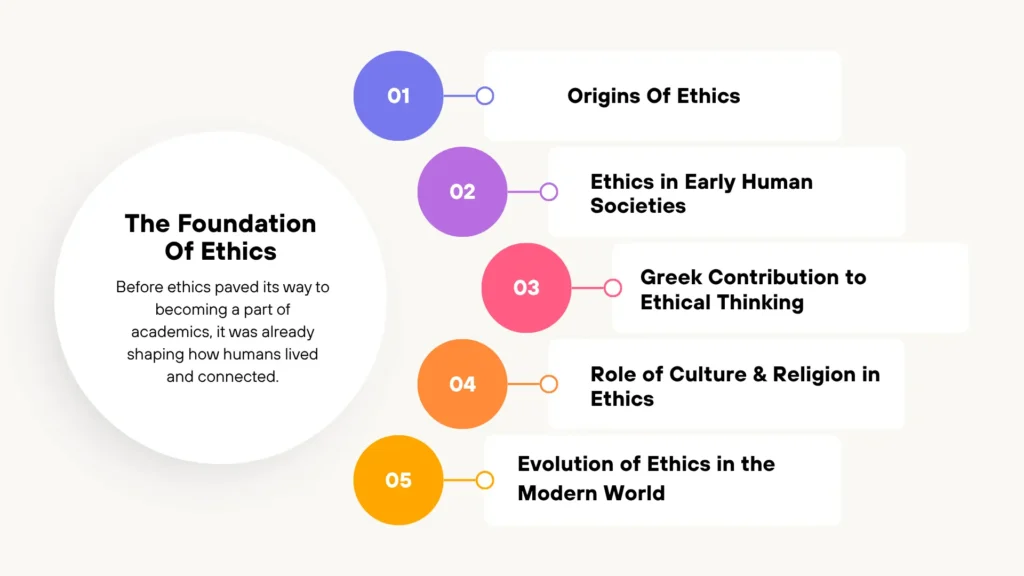
Before ethics paved its way to becoming a part of academics, it was already shaping how humans lived and connected. It sits beneath our choices, our values, and even the rules we rarely stop to question. To get a clear picture, you need to rewind all the way to the past.
Origins Of Ethics
It began during the earliest stages of human civilisation, when survival depended on cooperation rather than individual success. People quickly realised that if everyone lied, cheated, or harmed one another, communities would fall apart. So humans began to develop basic moral expectations like honesty and loyalty, even before formal systems existed.
Ethics in Early Human Societies
Ethics was something that humans practised naturally as part of group survival. Tribes and communities relied on shared values such as helping one another, respecting elders, protecting children, and dividing resources fairly to avoid conflict.
Greek Contribution to Ethical Thinking
They were among the first to turn ethics into a serious subject of thought rather than just social behaviour. Philosophers like Socrates, Plato, and Aristotle asked deeper questions about virtue, justice, happiness, and what it truly means to live a “good” life.
Role of Culture & Religion in Ethics
Culture and religion have played a massive role in shaping ethical beliefs across different societies and generations. Religious teachings often introduced ideas like honesty, forgiveness, and justice, while culture influenced what behaviours were considered respectful, acceptable, or morally wrong.
Evolution of Ethics in the Modern World
Ethics in the modern world has grown far beyond personal behaviour, and now it shapes how entire industries and societies function. Today, they influence everything from business practices and healthcare decisions to artificial intelligence and online behaviour.
Why Ethics Is Important in Everyday Life
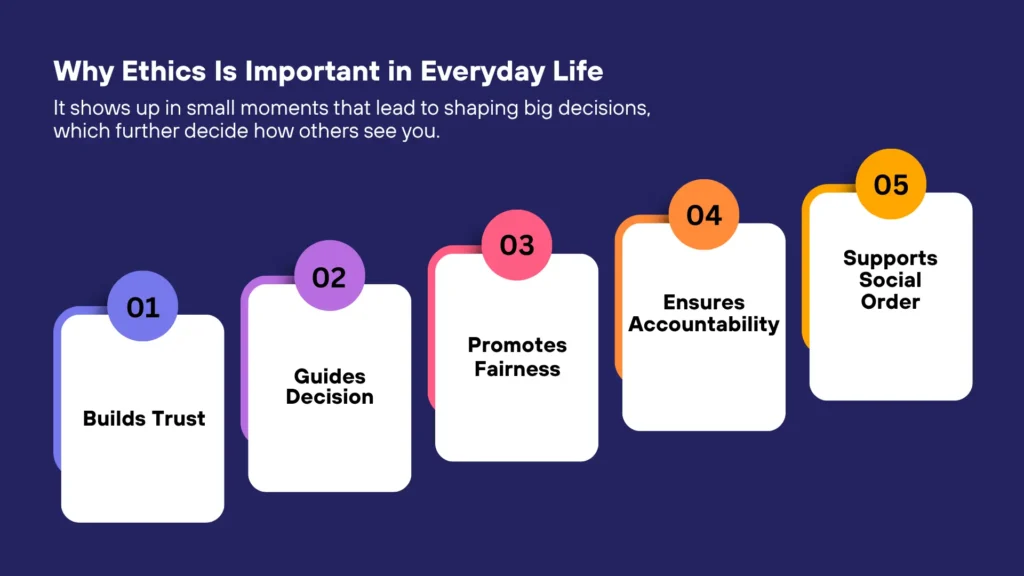
Ever notice how some people just feel easier to trust and work with? Such a speculation is based on ethics. It shows up in small moments that lead to shaping big decisions, which further decide how others see you. Let’s break down how it actually plays out in real life.
Builds Trust
Trust isn’t something that people take out of their pockets and hand it to you, it’s built through consistent ethical behaviour. When you’re honest and reliable, people naturally feel comfortable depending on you. Over time, this trust becomes the foundation of strong relationships in both your personal and professional lives.
Guides Decision
At every moment, you make certain choices. Some can be simple, while some can be complicated and require more time to consider. Ethics acts like a mental guide that helps you think and choose what aligns with your values.
Promotes Fairness
Ethics encourages you to treat people equally without any sort of favouritism. It pushes you to consider the perspectives of others before you act. This sense of fairness helps create balance and reduces conflict in everyday interactions.
Ensures Accountability
Being ethical means that you must take responsibility for what you do, regardless of the outcome, without playing the blame game. Own up to your actions and learn from them so you can rise stronger and better.
Supports Social Order
Society functions smoothly when people follow shared ethical standards. From respecting rules to valuing the rights of other folks, to keep things from falling into chaos. It creates a sense of order where people can coexist peacefully and cooperatively.
Types & Core Principles Of Ethics
Ethics may seem like one big idea, but once you start looking closer, it opens up into different paths, each with its own way of understanding right and wrong. Before getting into the principles, we’ll be going through its main types.
Types Of Ethics
Ethics isn’t built like a sphere, it’s built like a particular shape where each angle views right & wrong from a different angle. Some focus on what you must do, while others explore what you believe and practice. Once you see these types laid out, ethics starts making a whole lot more sense.
| Types | Explaination |
| Normative Ethics | Focuses on what people should do and what actions are morally right or wrong. It helps create standards for ethical behaviour. |
| Descriptive Ethics | Looks at how people actually behave and what moral beliefs they follow in real life, without judging whether those beliefs are right or wrong. |
| Meta Ethics | Goes deeper into the meaning of ethics itself by asking questions like what “good,” “bad,” “right,” and “wrong” really mean. |
| Applied Ethics | Takes ethical theories and applies them to real-world issues like healthcare, business, law, environment, and technology. |
Principles
Ethics may sound like a big idea, but at its heart, it often comes down to a few timeless qualities people recognise almost instantly. These are the traits that quietly shape trust and respect as you move through everyday life. Such principles naturally appear in the choices you make every day.
- Honesty
It’s usually the smallest moments that reveal honesty, not the big speeches. The truth has a way of testing you when it’s inconvenient, not when it’s easy. And more often than not, people remember honesty long after the moment has passed. So you better:
- Be truthful, even if the odds are against you and your kin.
- Avoid lying or exaggerating facts that can mislead people without directly sounding false.
- Always remain genuine in your words and actions, instead of pretending to be something you’re not.
- Integrity
There’s a difference between knowing what’s right and actually doing it, especially when no one is watching. Integrity lives in that gap between intention and action. It’s what turns values into something real, not just something you talk about.
Integrity shows up when you stay consistent with your values, whether in public or private. It means refusing shortcuts that compromise your principles and choosing character over convenience, even when doing the right thing comes with a personal cost.
- Respect
Respect often shows up in the way you handle differences in opinions, backgrounds, or beliefs. It’s not about always agreeing, but about how you treat people when they don’t share the same set of ethics as you. The smallest gestures of respect can leave the biggest impressions.
- Listening to others with patience and attention, even when their opinions differ completely from your own.
- Recognising that everyone deserves dignity, regardless of their status and background.
- Choosing your words and actions carefully so that disagreement never turns into disrespect.
- Fairness
Life isn’t always equal, but fairness is about making sure your actions don’t make it worse. It requires you to step back from personal bias and always look at the bigger picture. In many ways, fairness is what keeps ethics from becoming self-centred.
Fairness means making decisions without favouritism and giving everyone an equal chance to be heard or considered, alongside judging situations based on facts rather than personal feelings.
- Responsibility
There’s always a moment where you either own what happened or start giving excuses. Responsibility is one of the clearest signs of maturity because it reveals whether you can handle the weight of your own actions without constantly shifting blame onto others.
- You’ll accept the consequences of your actions instead of pretending they don’t exist.
- When you make mistakes, responsibility shows up as accountability.
- Additionally, you’ll keep your commitments and become someone others can genuinely rely on.
- Empathy
Some people are quick to judge because they only see situations through their own lens. Empathy changes that. It gives you the ability to slow down, imagine what someone else might be carrying, and respond with greater awareness rather than just react.
Empathy is the ability to understand and care about another person’s feelings, struggles, or point of view. It helps you make choices that are not only logically right but also emotionally considerate.
- Loyalty
Sounds noble, doesn’t it? It is, but it also gets complicated the moment emotions and relationships collide. The real test is what loyalty looks like when doing the right thing becomes uncomfortable. That’s where this principle becomes more than just blindly standing by someone.
- Healthy loyalty means standing by others in difficult times without abandoning your own moral judgment.
- It includes being committed and emotionally present for people or responsibilities that matter.
- Loyalty is also knowing when support is honourable and when silence becomes harmful.
Major Ethical Theories & Approaches
Behind every moral decision, there’s usually a deeper way of thinking driving it. Some approaches ask whether an action follows a duty, others care about the results, and some focus on the values a person lives by. These theories help explain why people can face the same situation and still believe completely different choices are right.
Virtue Ethics
This one is all about character over checklists. Instead of obsessing over one isolated decision, it asks a bigger question like “What kind of person are you becoming through your choices?” It’s less about following a strict moral script and more about building traits.
Deontological Ethics
This approach states that some actions are considered right or wrong, no matter what outcome they produce. That means things like lying & manipulating people unfairly are wrong, even if they seem helpful in the moment. It’s a stricter approach, but one that gives ethics clear boundaries.
Consequentialism
Consequentialism judges morality by looking at what happens in the end. It asks whether a decision leads to more harm or more good. It’s realistic and often used in serious decision-making, especially when choices affect many people.
Utilitarianism
This approach is built around the idea of creating the greatest good for the greatest number. It tries to measure which choice benefits the most people overall, even if the situation is messy. That makes it useful in big social decisions, but it also raises uncomfortable questions when the majority benefits at the expense of a smaller group.
Moral Absolutism
It’s basically the idea that certain moral rules should stay fixed and not change depending on convenience. Lying, stealing, or hurting innocent people are seen as wrong, even if someone thinks they have a good reason.
Ethical Dilemmas In Complex Situations
Some choices in life don’t come with a clear right answer, just difficult trade-offs that test your values. This is where ethics becomes personal and often uncomfortable. In these situations, judgment matters more than easy rules because every option may come with a cost.
Clash between right & wrong choices
Some ethical dilemmas seem simple until the “right” choice starts carrying personal consequences. You may know what should be done, but that doesn’t make it easy to do. This is where ethics becomes difficult, because doing the right thing can still come with loss and discomfort.
Hard decisions in serious scenarios
Serious situations can force you to make decisions quickly and emotionally under pressure. In these moments, you have to make very responsible choices, even if they sound heavy. Whether in healthcare or emergencies, these situations test judgment more than certainty.
Clash of Personal Beliefs & Professional Duties
Sometimes what you personally believe and what your role requires are not the same thing. That creates an ethical conflict where values and responsibilities can pull in completely different directions. This kind of dilemma is common in professions where duty must come before personal comfort.
Prioritizing Law over What Feels Right
This is a challenging situation where everything legal doesn’t automatically make it ethical, and not everything ethical is always supported by law. This creates a moral tension where you may have to choose between obeying the rules and following your conscience.
Resolving situations with the best judgment
Some ethical dilemmas do not have a perfect solution, only a more thoughtful one. In such cases, the goal is to make the most responsible decision by weighing values, consequences, and fairness carefully. Best judgment matters because ethics often requires wisdom, not just rules.
Ethical Decision Making in Real-Life Situations
Most ethical decisions show up in ordinary moments that don’t feel “big” at first. One small choice, and suddenly you’re shaping your character without even realising it. The real question isn’t if you’ll face these moments, it’s whether you’ll recognise them in time.
Identifying Ethical Situations
An ethical situation exists when your decision affects others in terms of honesty or harm. Lying to avoid trouble, taking credit for someone else’s work, or remaining silent about wrongdoing are all part of the ethical situations.
Recognizing Right & Wrong actions
The right action is fair and does not intentionally harm others for personal benefit. A wrong action usually involves exploiting, manipulating, or doing something you know you’d hide if others found out. A simple way to judge it is if the action feels wrong when done to you.
Consider the consequences of decisions.
Before making a decision, think about who will be affected and how. A choice that benefits you might harm someone or create long-term problems. Ethical decisions require looking beyond short-term gain and considering the overall impact.
Manage Conflicts
When two values clash, break the situation down instead of guessing. Identify the exact conflict (e.g., honesty vs loyalty), list who will be affected, and compare the outcomes of each option. After careful consideration, choose the option that causes the least harm.
Ethics in daily choices
Ethics shows up in ordinary moments in how you speak to people, handle money, or behave when no one is paying attention. Things like respecting boundaries, avoiding gossip, and owning up to your mistakes are all part of ethical living. These habits may seem small, but actions always speak louder than words.
Ethics In Different Disciplines
Beyond books and day-to-day life, it paves it way into those places where you probably didn’t see it coming. From hospitals and courtrooms to offices and technology, it shows up in different ways depending on the field. And that’s where things start to matter on a much higher level.
Philosophy
In philosophy, ethics is about thinking deeply about what is right and what is wrong. It helps people ask questions like, “Is this a good choice?” or “Should I do this?” This is the place where people try to understand how to be a good person.
Corporate Environment
In the corporate world, ethics shape how business is done behind the scenes. It includes fair treatment of employees, honest communication with customers, and avoiding practices like fraud or exploitation. Trust and reputation are what guarantee them long-term success.
Medicine & Healthcare
Healthcare is one of the most sensitive spaces where ethics becomes impossible to ignore. Here, decisions often involve human dignity and care at the most vulnerable moments of life. Ethics helps make sure treatment stays human, not just clinical.
Law & Governance
They deal with authority and public responsibility, which means ethics naturally play a major role here. It helps question whether power is being used fairly, whether justice is truly being served, and whether decisions made for society are actually right.
Technology
Ethics is about using things like computers, AI, and social media in a safe way. Where people’s private information is safe, and cyberbullying is prevented. Since technology can reach so many people quickly, making the right choices here is very important.
Cost Of Unethical Behavior
At first, unethical choices can look harmless, which often leads to them getting ignored. Sometimes they may even seem fun and justifiable in the moment, but the real damage rarely shows up instantly. It gradually builds up in ways you don’t see coming until the cost becomes too big to ignore.
Loss of trust
Trust is the very first thing that is destroyed. Once you lie, manipulate or cheat, people will start questioning your words and intentions. The worst part is, trust takes time to rebuild, if it comes back at all.
Damage to reputation
It takes years (or lifetimes) to build a reputation, only to see it crumbling down because of one moment. One unethical action can completely change how people see you or your company. Even after the issue passes, it takes years for the damage to be undone.
Legal & Financial Consequences
It doesn’t just stop at having your morals hurt, they create serious legal and financial problems as well. Fines, lawsuits, penalties, job loss, and business decline are all common outcomes when unethical decisions cross professional or legal boundaries.
Harm to Relationships
Unethical behaviour often leaves emotional damage behind, especially in close relationships. Lies, betrayal, dishonesty, and disrespect can make people feel unsafe or undervalued around you. Even if the relationship survives, it rarely feels the same afterward.
Long term social & personal impact
When unethical behaviour becomes normalised, its impact grows beyond one single moment. It can slowly shape your character by weakening your values and creating harmful patterns in families, workplaces, and society.
FAQs
Morals are your own set of personal beliefs about right or wrong, while ethics are broader rules that are shared by a system or society.
It’s something that goes against moral principles such as honesty, fairness, and respect. Common examples include lying, cheating, stealing, manipulation, and corruption.
Ethics in the workplace means behaving professionally and respectfully while carrying out job responsibilities. It helps create trust, teamwork, and a healthy work environment.
They are closely connected because ethical choices shape the kind of person someone becomes over time. Good character is built through consistent moral behavior and responsible actions.
Yes, they change over time as cultures evolve and new challenges emerge. However, some core principles like honesty, fairness, and respect often remain timeless.