A bachelor’s in marketing opens doors across industries. But the field is evolving fast. The global digital marketing market reached $456.7 billion in 2025 and is projected to hit $1.2 trillion by 2034, growing at a 10.99% compound annual rate (IMARC Group). That pace of change means the skills you graduate with today may not be enough for the roles you want in five years.
Graduate education closes that gap. According to the NACE Winter 2026 Salary Survey, marketing master’s graduates from the Class of 2026 earned a projected average starting salary of $88,125, compared to $66,994 for bachelor’s graduates. That is a 31.5% salary premium for one additional degree. For MBA graduates in business administration, the premium climbed to 43.1%, with projected starting salaries of $98,514.
Whether you want to specialize in digital strategy, move into data analytics, pivot to management, or build expertise in a complementary field, the right graduate program accelerates both your earning potential and your career trajectory. This guide covers the most valuable paths you can pursue after completing your Bachelor of Arts in Marketing.
Master of Arts or Master of Science in Marketing
A graduate degree in marketing is the most direct path to advanced roles in the field. Master’s programs in marketing go deeper into consumer behavior, marketing analytics, brand strategy, digital marketing, and research methodology than undergraduate programs can. They prepare graduates for senior positions such as marketing director, VP of marketing, and chief marketing officer (CMO).
The BLS reports that marketing managers earned a median annual wage of $166,790 as of May 2025, with 421,600 jobs in the U.S. and 7% projected growth from 2025 to 2035. While a bachelor’s degree is the minimum for most marketing management roles, the BLS notes that some employers prefer candidates with a master’s degree, particularly for senior and strategic positions.
NACE data reinforces this. The projected starting salary for marketing master’s graduates ($88,125) represents a 15.8% increase over the prior year’s projection, one of the strongest year-over-year gains across all business disciplines.
Charisma University’s Master of Arts in Marketing provides advanced training in digital strategy, consumer insights, and brand management for graduates looking to move into leadership roles.
Master of Business Administration (MBA)
An MBA is the most popular graduate degree for marketing professionals who want to move beyond functional marketing roles into general management, executive leadership, or entrepreneurship. MBA programs cover finance, operations, strategy, organizational behavior, and leadership alongside marketing electives.
The salary premium is significant. NACE projects an average starting salary of $98,514 for MBA graduates from the Class of 2026, compared to $68,831 for bachelor’s graduates in business administration. GMAC research shows that 85% of MBA graduates who held entry-level positions before business school advanced to higher roles after completing the degree. Graduates of top-ranked programs reported average salary increases of 119% within three years, according to Financial Times data.
An MBA is particularly valuable for marketing professionals targeting roles such as brand director, VP of marketing, general manager, or C-suite positions. Students can explore Charisma University’s MBA program or the Executive MBA designed for working professionals with management experience.
MBA vs. Master’s in Marketing
These two graduate paths serve different career goals. The table below compares them across key dimensions.
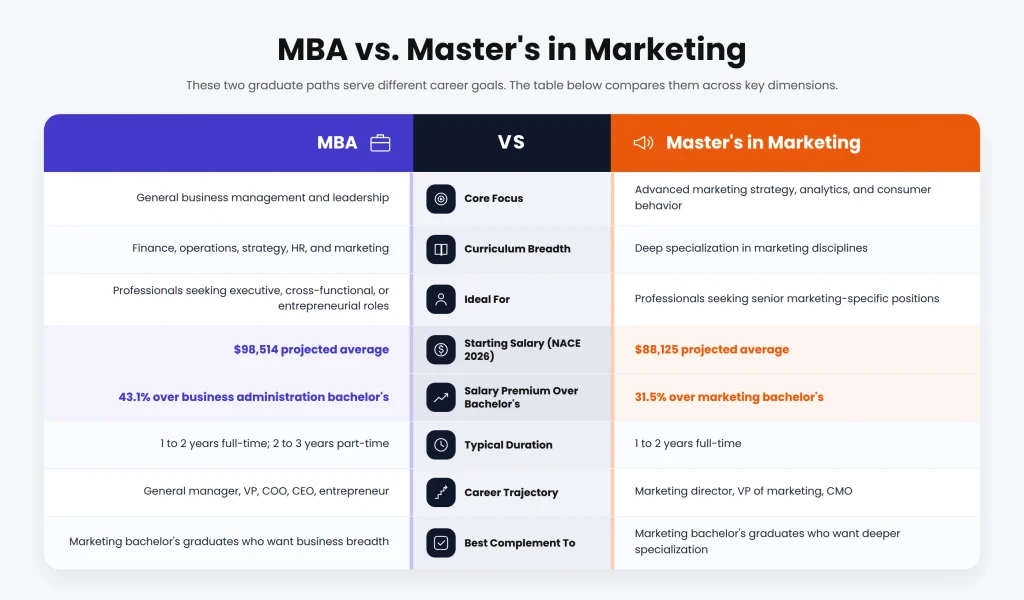
| Dimension | MBA | Master’s in Marketing |
|---|---|---|
| Core Focus | General business management and leadership | Advanced marketing strategy, analytics, and consumer behavior |
| Curriculum Breadth | Finance, operations, strategy, HR, and marketing | Deep specialization in marketing disciplines |
| Ideal For | Professionals seeking executive, cross-functional, or entrepreneurial roles | Professionals seeking senior marketing-specific positions |
| Starting Salary (NACE 2026) | $98,514 projected average | $88,125 projected average |
| Salary Premium Over Bachelor’s | 43.1% over business administration bachelor’s | 31.5% over marketing bachelor’s |
| Typical Duration | 1 to 2 years full-time; 2 to 3 years part-time | 1 to 2 years full-time |
| Career Trajectory | General manager, VP, COO, CEO, entrepreneur | Marketing director, VP of marketing, CMO |
| Best Complement To | Marketing bachelor’s graduates who want business breadth | Marketing bachelor’s graduates who want deeper specialization |
Many professionals pursue one and then the other at different career stages. A master’s in marketing early in your career builds functional depth, while an MBA later positions you for cross-functional leadership.
Data Analytics and Marketing Analytics
Data analytics is one of the fastest-growing areas of graduate study for marketing professionals. As companies invest more in digital channels, the demand for marketers who can interpret data, build attribution models, and optimize campaigns using quantitative methods has surged.
The BLS reports that market research analysts, many of whom hold analytics-focused graduate degrees, earned a median annual wage of $78,760 (May 2025), with 952,700 jobs in the U.S. and 7% projected growth from 2025 to 2035. Roughly 82,000 openings are expected annually.
Graduate certificates and master’s programs in data analytics, marketing analytics, or business analytics teach skills in statistical modeling, machine learning, data visualization, SQL, Python, and tools like Google Analytics and Tableau. These credentials are increasingly valued by employers who need marketing professionals capable of translating data into strategy.
Marketing graduates with analytics training are well positioned for roles such as marketing analyst, consumer insights manager, CRM strategist, and data-driven product marketer.
Digital Marketing Certifications
Not every post-bachelor’s path requires a full graduate degree. Industry certifications in digital marketing offer a faster, more affordable way to build specialized skills that employers recognize. Common certifications include:
Google Analytics Certification validates proficiency in web analytics, audience measurement, and conversion tracking. Google Ads Certification covers search, display, video, and shopping campaign management. HubSpot Content Marketing Certification teaches inbound marketing, content strategy, and lead generation. Meta Blueprint Certification focuses on advertising across Facebook and Instagram platforms.
These certifications typically take weeks to months to complete and are often free or low-cost. They complement a marketing degree by adding verifiable, platform-specific skills that hiring managers look for in job candidates. The American Marketing Association (AMA) and the Chartered Institute of Marketing (CIM) also offer professional certifications that demonstrate broader marketing competency.
Communications and Public Relations
A graduate degree in communications or public relations is a natural extension for marketing graduates interested in brand reputation, media relations, crisis communications, and corporate messaging. These programs develop advanced skills in strategic communication, media planning, storytelling, and stakeholder engagement.
The BLS reports that public relations specialists earned a median annual wage of $74,750 (May 2025), with 314,500 jobs in the U.S. PR managers and directors earn significantly more, with senior roles at major corporations and agencies commanding six-figure salaries.
This path suits marketing graduates who are drawn to the qualitative, narrative side of the profession rather than the quantitative, analytics-driven side.
Finance and Economics
Marketing professionals who want to move into pricing strategy, revenue management, financial planning, or consulting often benefit from graduate study in finance or economics. These disciplines sharpen skills in financial modeling, valuation, forecasting, and economic analysis that complement marketing expertise.
Understanding financial performance is increasingly important for senior marketing roles. CMOs are expected to justify marketing spend with revenue attribution and ROI analysis. A graduate degree or coursework in finance or economics provides the quantitative foundation for those conversations.
Charisma University also offers an MS in Finance for professionals who want to build financial expertise alongside their marketing background.
Human Resource Management
Marketing and human resources share common ground in employer branding, internal communications, talent marketing, and organizational culture. Marketing graduates who pursue HR management develop skills in recruitment strategy, employee engagement, labor relations, and workforce planning.
The BLS reports that human resources managers earned a median annual wage of $149,280 (May 2025), with 224,900 jobs in the U.S. and 6% projected growth from 2025 to 2035. A master’s degree in human resource management or an MBA with an HR concentration can open doors to this well-compensated field.
Entrepreneurship and Business Development
Marketing graduates with entrepreneurial ambitions often pursue graduate programs that focus on venture creation, business strategy, innovation management, and growth marketing. An MBA with an entrepreneurship focus or a specialized master’s in innovation provides the business planning, fundraising, and operations knowledge needed to launch and scale a business.
The combination of marketing skills and entrepreneurial training is powerful. Marketing graduates understand customer acquisition, brand positioning, and market research. Graduate study adds financial planning, operations management, and strategic leadership. Students interested in this path can explore the entrepreneurial skills needed to build a successful venture.
How to Choose the Right Graduate Program
Selecting a graduate program depends on where you want your career to go.
If you want to lead marketing teams and shape brand strategy at a senior level, a Master’s in Marketing provides the deepest specialization. If you want to move into general management, consulting, or executive leadership, an MBA delivers the broadest preparation. If you are drawn to the technical side of marketing, a program in data analytics or marketing analytics builds the quantitative skills that are in highest demand. If you want to add credentials without committing to a full degree, digital marketing certifications offer a fast, targeted path.
Consider the salary data as part of your decision. The 31.5% premium for a marketing master’s and the 43.1% premium for an MBA are substantial returns on the investment of time and tuition. GMAC research shows that 68% of MBA and business master’s graduates say their degree supported their financial goals.
A strong professional development plan helps you map out which credentials, certifications, and graduate programs align with your timeline and career objectives.
Start Your Graduate Journey
The marketing landscape rewards professionals who keep building their skills. With digital ad spending growing at nearly 11% annually and employers placing increasing value on advanced degrees and certifications, the right graduate program can transform your career trajectory.
Explore Charisma University’s Master of Arts in Marketing or MBA to take the next step after your marketing degree. Apply today and invest in the skills that set you apart.
Frequently Asked Questions
The most common paths include a Master’s in Marketing, an MBA, data analytics or marketing analytics, digital marketing certifications, communications, finance, human resource management, and entrepreneurship. The right choice depends on whether you want deeper marketing specialization, broader business leadership skills, or technical expertise.
Yes. NACE data shows that marketing master’s graduates earn a projected average starting salary of $88,125, a 31.5% premium over the $66,994 average for bachelor’s graduates. Advanced degrees also open doors to senior roles such as marketing director and CMO.
An MBA is best for professionals seeking general management, executive, or entrepreneurial roles. A master’s in marketing is ideal for those who want to specialize in marketing strategy, analytics, or brand management. Both offer strong salary premiums over a bachelor’s degree.
A bachelor’s degree is sufficient for most entry-level and mid-level marketing positions. However, the BLS notes that some employers prefer a master’s degree for senior roles, and NACE data shows a clear salary advantage for master’s holders.
Google Analytics, Google Ads, HubSpot Content Marketing, and Meta Blueprint are among the most recognized certifications. The AMA and CIM also offer professional credentials that demonstrate marketing competency to employers.
Most full-time marketing master’s programs take 1 to 2 years to complete. Part-time and online options may take 2 to 3 years, allowing students to continue working while earning their degree.