Hospitality and tourism are two of the fastest-growing sectors in the global economy. According to the World Travel and Tourism Council (WTTC), travel and tourism contributed approximately $11.1 trillion to global GDP in 2024, accounting for roughly 10% of the world’s total economic output. The sector supported nearly 330 million jobs worldwide, with the WTTC projecting that number to reach 449 million by 2034, representing 12.2% of the global workforce.
Given this scale, it is no surprise that students and professionals often ask whether hospitality management and tourism management are the same thing. While the two fields are closely related and frequently taught together, they focus on different aspects of the travel and service industry. Understanding these differences is essential for choosing the right academic path, targeting the right career, and building skills that match your professional goals.
Hospitality management is the study and practice of running businesses that provide direct services to guests and customers. These businesses include hotels, resorts, restaurants, bars, catering companies, cruise lines, casinos, and event venues.
What Is Hospitality Management?
The core focus of hospitality management is the guest experience. Professionals in this field handle day-to-day operations such as front desk management, food and beverage service, housekeeping, revenue management, staff training, health and safety compliance, and customer satisfaction. The goal is to create a seamless, high-quality experience that keeps guests coming back.
For example, a hotel general manager oversees everything from room pricing and occupancy rates to staff scheduling, maintenance, and guest complaint resolution. A restaurant manager handles menu planning, food safety compliance, vendor relationships, and service quality. These roles require a combination of operational expertise and strong interpersonal skills.
The hospitality industry is massive in its own right. The global hospitality market reached approximately $4.9 trillion in 2024, and U.S. hotel room demand is projected to grow by 2.0% year over year through 2025, according to STR and Tourism Economics. PwC projects U.S. hotel occupancy at 62.9% in 2025, with average daily rates rising 1.3% annually.
What Is Tourism Management?
Tourism management focuses on the broader ecosystem of travel, including the planning, development, marketing, and management of destinations and travel experiences. While hospitality operates within individual businesses, tourism operates at the level of entire destinations, regions, and travel systems.
Tourism management professionals work on attracting visitors to specific locations, developing travel packages, managing cultural and heritage sites, promoting sustainable tourism practices, and analyzing visitor behavior and travel trends. Their work often involves coordination with government agencies, tourism boards, local communities, and international organizations.
For example, a destination marketing manager for a coastal city might develop campaigns to attract off-season visitors, partner with local hotels and restaurants for bundled packages, and track visitor spending patterns to measure economic impact. A tour operations manager designs and coordinates travel itineraries, handles logistics across multiple providers, and ensures that each leg of a trip runs smoothly.
Tourism is a global force. The WTTC reported that international tourism spending totaled $1.9 trillion in 2024. From January to September 2024, global travelers reached 1.1 billion, an 11% increase year over year. The luxury tourism segment alone is expected to reach $1.2 trillion by 2026, and adventure tourism spending is projected to grow 7.3% annually through 2030.
Key Differences Between Hospitality Management and Tourism Management
The table below compares the two fields across the most important dimensions.
| Dimension | Hospitality Management | Tourism Management |
|---|---|---|
| Core Focus | Guest services and customer experience within individual businesses | Travel planning, destination development, and visitor economy at a regional or national level |
| Scope | Operates within hotels, restaurants, resorts, event venues, and similar service businesses | Operates across destinations, travel systems, tourism boards, and policy organizations |
| Primary Skills | Operations management, service quality, revenue management, food safety, staff leadership | Destination marketing, travel logistics, sustainability planning, market research, cultural awareness |
| Typical Employers | Hotels, resorts, restaurants, catering firms, cruise lines, casinos, event centers | Tourism boards, travel agencies, tour operators, government agencies, visitor attractions, airlines |
| Treatment of Guests | Focuses on service delivery during the guest’s stay or visit | Focuses on attracting visitors to a destination and shaping their overall travel experience |
| Academic Subjects | Hotel operations, food and beverage management, hospitality accounting, service quality, housekeeping | Tourism geography, destination management, sustainable tourism, tourism policy, visitor behavior |
| Revenue Model | Room rates, food sales, event bookings, amenity fees | Package pricing, destination fees, attraction tickets, travel commissions |
| Career Orientation | Operational leadership and direct guest interaction | Strategic planning, marketing, and destination-level coordination |
The simplest way to understand the distinction: hospitality is about what happens when the guest arrives, while tourism is about why and how the guest decided to travel in the first place.
How the Two Fields Overlap
Despite their differences, hospitality and tourism are deeply interconnected. Tourists rely on hospitality businesses for accommodation, dining, and entertainment. Hospitality businesses, in turn, depend on tourist demand to fill rooms and tables.
Consider a traveler visiting a historic European city. Tourism management is responsible for the destination marketing that brought them there, the heritage site management that preserves the attractions, and the visitor infrastructure that makes the trip possible. Hospitality management is responsible for the hotel where they sleep, the restaurant where they eat, and the quality of service they receive throughout their stay.
This overlap is why many universities offer combined programs that cover both disciplines. Students in a Bachelor of Arts in Hospitality and Tourism Management program study both the operational side of guest services and the strategic side of destination development, giving them a broader foundation for careers in either field.
Both fields also share a common set of transferable skills: customer service, leadership, communication, financial management, problem-solving, cultural awareness, and adaptability. These skills are valuable across the wider business administration landscape and translate well into roles in event management, retail, marketing, and general management.
Career Paths and Salary Data
Hospitality Management Careers
Common roles in hospitality management include hotel general manager, front office manager, food and beverage director, catering manager, revenue manager, resort manager, guest relations manager, and events coordinator.
The Bureau of Labor Statistics (BLS) reports that lodging managers in the United States earned a median annual wage of $69,250 as of May 2025. The BLS projects 4% employment growth for lodging managers from 2025 to 2035, with approximately 5,500 job openings expected annually. Meeting, convention, and event planners, another key hospitality role, earned a median annual wage of $61,160, with 6% projected growth and about 16,800 openings per year over the same period.
Senior-level roles such as regional hotel directors, vice presidents of operations, and food and beverage executives at major hospitality chains command significantly higher compensation, particularly for professionals with graduate-level education and extensive operational experience.
Tourism Management Careers
Common roles in tourism management include destination marketing manager, tourism officer, travel consultant, tour operations manager, visitor attraction manager, sustainable tourism coordinator, heritage tourism manager, and travel product manager.
Tourism careers span the private and public sectors. Private-sector employers include travel agencies, tour operators, airlines, cruise lines, and travel technology companies. Public-sector employers include national and regional tourism boards, government cultural agencies, and international organizations.
Salary ranges in tourism management vary widely depending on the role, location, and employer. Destination marketing managers and tourism directors at national or state tourism boards often earn competitive salaries, particularly in regions where tourism is a major economic driver. The travel and tourism sector is projected to grow at 5.8% annually through 2032, nearly double the 2.7% growth rate of the global economy, which signals strong long-term demand for qualified professionals.
Students exploring career options should also consider how these paths connect with broader professional development strategies, since both fields reward continuous learning and industry-specific certifications.
Education Requirements
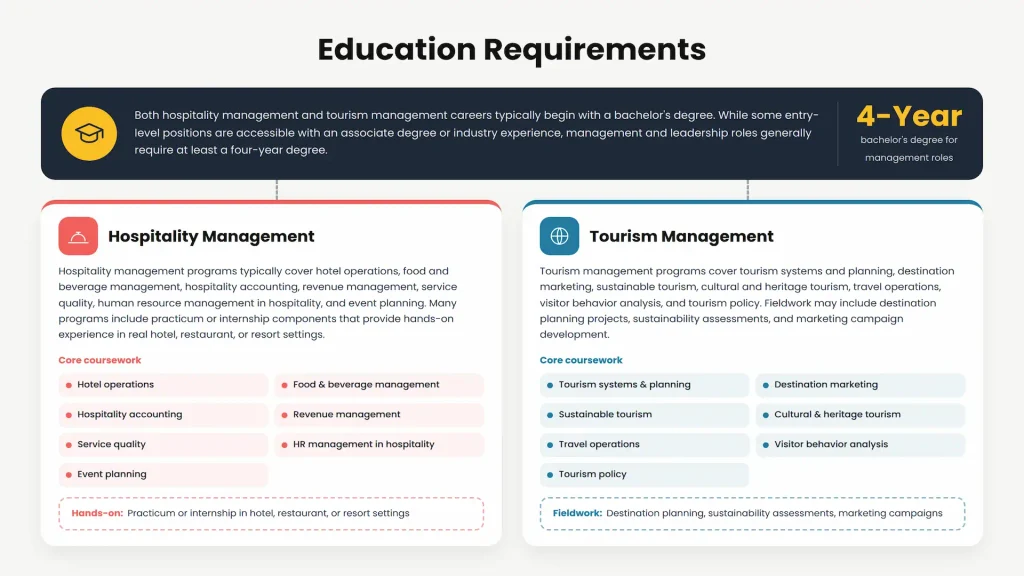
Both hospitality management and tourism management careers typically begin with a bachelor’s degree. While some entry-level positions are accessible with an associate degree or industry experience, management and leadership roles generally require at least a four-year degree.
Hospitality management programs typically cover hotel operations, food and beverage management, hospitality accounting, revenue management, service quality, human resource management in hospitality, and event planning. Many programs include practicum or internship components that provide hands-on experience in real hotel, restaurant, or resort settings.
Tourism management programs cover tourism systems and planning, destination marketing, sustainable tourism, cultural and heritage tourism, travel operations, visitor behavior analysis, and tourism policy. Fieldwork may include destination planning projects, sustainability assessments, and marketing campaign development.
Combined programs, such as Charisma University’s hospitality and tourism management degree, prepare students for careers in either field by covering both operational management and strategic tourism planning within a single curriculum.
For students considering graduate study, an MBA or a specialized master’s program can open doors to executive-level positions in hotel chains, destination management organizations, and international hospitality companies.
Industry Trends Shaping Both Fields
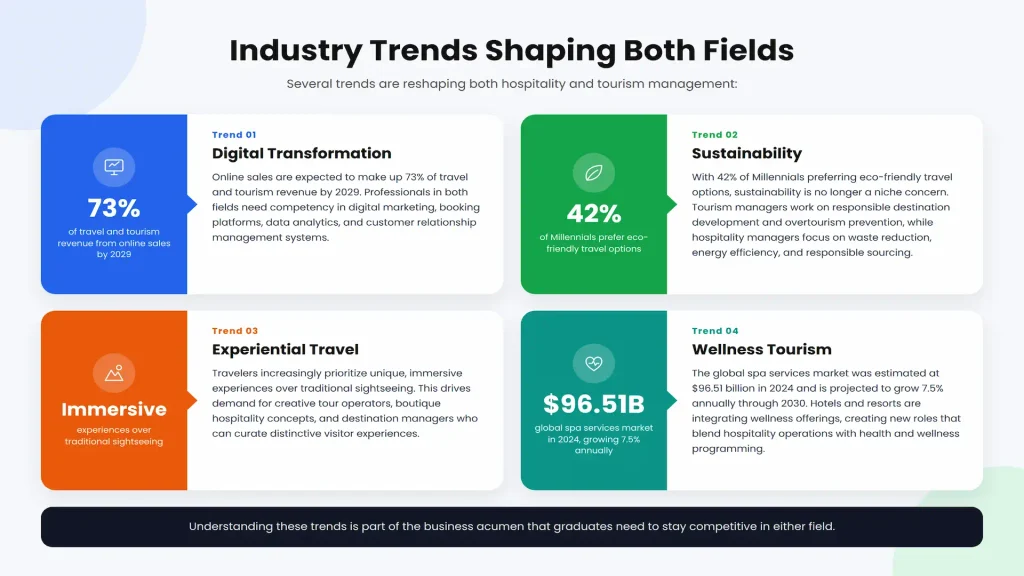
Several trends are reshaping both hospitality and tourism management:
Digital transformation.
Online sales are expected to make up 73% of travel and tourism revenue by 2029. Professionals in both fields need competency in digital marketing, booking platforms, data analytics, and customer relationship management systems.
Sustainability.
With 42% of Millennials preferring eco-friendly travel options, sustainability is no longer a niche concern. Tourism managers work on responsible destination development and overtourism prevention, while hospitality managers focus on waste reduction, energy efficiency, and responsible sourcing.
Experiential travel.
Travelers increasingly prioritize unique, immersive experiences over traditional sightseeing. This drives demand for creative tour operators, boutique hospitality concepts, and destination managers who can curate distinctive visitor experiences.
Wellness tourism.
The global spa services market was estimated at $96.51 billion in 2024 and is projected to grow 7.5% annually through 2030. Hotels and resorts are integrating wellness offerings, creating new roles that blend hospitality operations with health and wellness programming.
Understanding these trends is part of the business acumen that graduates need to stay competitive in either field.
Which Field Is Right for You?
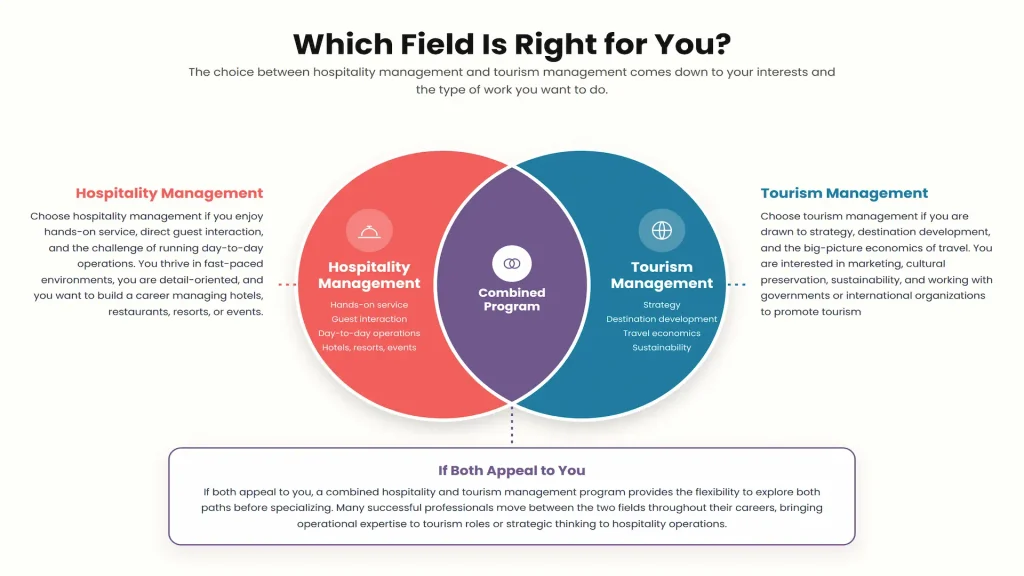
The choice between hospitality management and tourism management comes down to your interests and the type of work you want to do.
Choose hospitality management if you enjoy hands-on service, direct guest interaction, and the challenge of running day-to-day operations. You thrive in fast-paced environments, you are detail-oriented, and you want to build a career managing hotels, restaurants, resorts, or events.
Choose tourism management if you are drawn to strategy, destination development, and the big-picture economics of travel. You are interested in marketing, cultural preservation, sustainability, and working with governments or international organizations to promote tourism
If both appeal to you, a combined hospitality and tourism management program provides the flexibility to explore both paths before specializing. Many successful professionals move between the two fields throughout their careers, bringing operational expertise to tourism roles or strategic thinking to hospitality operations.
Start Your Career in Hospitality and Tourism
The hospitality and tourism industry offers diverse career paths with strong growth potential in a sector that contributes trillions of dollars to the global economy. Whether you are drawn to managing a luxury resort or shaping a country’s tourism strategy, the right education builds the foundation.
Explore Charisma University’s Bachelor of Arts in Hospitality and Tourism Management to build the skills employers in both fields are looking for. Apply today and start your path in one of the world’s most dynamic industries.
Frequently Asked Questions
Hospitality management focuses on running businesses that serve guests directly, such as hotels, restaurants, and event venues. Tourism management focuses on the broader travel ecosystem, including destination marketing, travel planning, and visitor economy development.
Yes. The two fields overlap significantly, and many employers value the operational and customer service skills that hospitality programs teach. A combined program covering both disciplines gives you the broadest range of career options.
According to the BLS, lodging managers in the U.S. earned a median annual wage of $69,250 as of May 2025. Meeting, convention, and event planners earned a median of $61,160. Senior-level positions at major hotel chains and hospitality companies offer substantially higher compensation.
Tourism is one of the world’s largest economic sectors, contributing $11.1 trillion to global GDP in 2024 and supporting nearly 330 million jobs. The WTTC projects the sector will grow at 5.8% annually through 2032, nearly double the global economic growth rate, making it a strong long-term career choice.
Both fields require customer service, leadership, communication, financial management, problem-solving, and cultural awareness. Hospitality roles emphasize operations and service delivery, while tourism roles emphasize marketing, research, and strategic planning. Digital literacy is increasingly important across both fields.
A bachelor’s degree is sufficient for most entry-level and mid-level positions. However, an MBA or a specialized master’s degree can accelerate your path to executive and director-level roles, particularly at large hotel chains, international tourism organizations, or destination management companies.