Mental health care in the United States has become a growing priority. According to the National Alliance on Mental Illness (NAMI), 23.4% of U.S. adults experienced mental illness in 2024, affecting roughly 61.5 million people. Yet only 52.1% of those individuals received treatment, and the average delay between symptom onset and first treatment is 11 years.
When people do seek help, two of the most common professionals they encounter are psychologists and psychiatrists. While both work in mental health, they differ significantly in their education, training, treatment methods, and scope of practice. Understanding these differences helps you choose the right provider for your needs and pursue the right academic path if you are considering a career in mental health.
What Is a Psychologist?
A psychologist is a mental health professional who studies human behavior, cognitive processes, and emotional functioning. Psychologists hold doctoral degrees, either a Ph.D. (Doctor of Philosophy in Psychology) or a Psy.D. (Doctor of Psychology), and specialize in diagnosing mental health conditions through psychological assessment and therapy.
Psychologists use talk therapy as their primary treatment tool. Common therapeutic approaches include cognitive behavioral therapy (CBT), dialectical behavior therapy (DBT), psychodynamic therapy, and humanistic therapy. They work with individuals, couples, families, and groups to address conditions such as anxiety, depression, PTSD, phobias, and obsessive-compulsive disorder.
In most U.S. states, psychologists cannot prescribe medication. However, a small number of states including Idaho, Iowa, Illinois, Louisiana, and New Mexico have granted prescriptive authority to psychologists with additional pharmacological training. Even in these states, psychologists must complete specialized coursework in psychopharmacology and pass additional examinations before they are eligible to prescribe.
Education Path for Psychologists
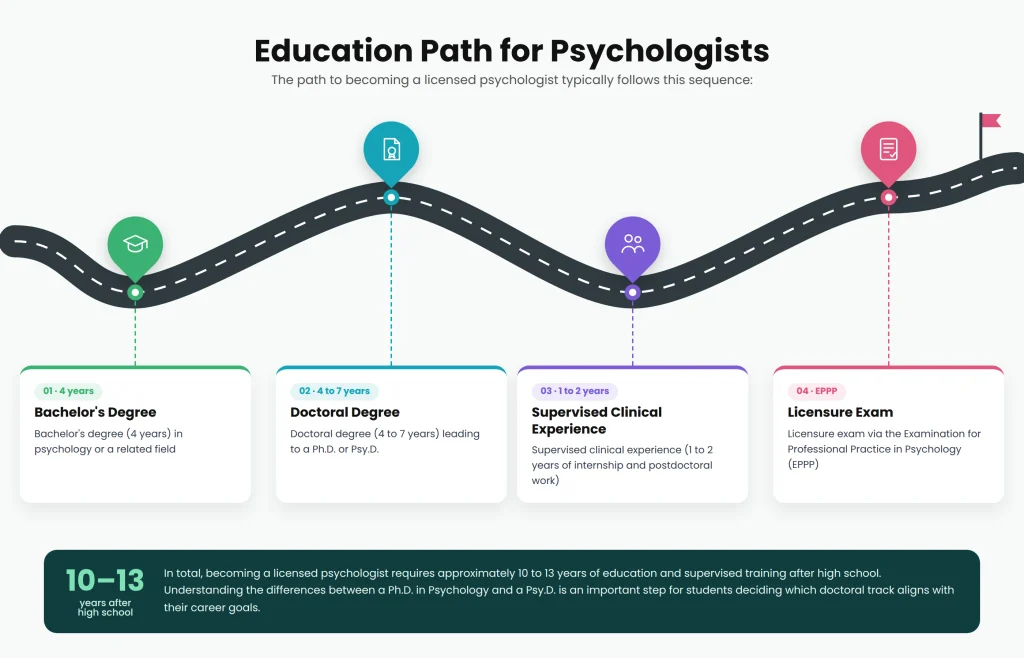
The path to becoming a licensed psychologist typically follows this sequence:
- Bachelor’s degree (4 years) in psychology or a related field
- Doctoral degree (4 to 7 years) leading to a Ph.D. or Psy.D.
- Supervised clinical experience (1 to 2 years of internship and postdoctoral work)
- Licensure exam via the Examination for Professional Practice in Psychology (EPPP)
In total, becoming a licensed psychologist requires approximately 10 to 13 years of education and supervised training after high school. Understanding the differences between a Ph.D. in Psychology and a Psy.D. is an important step for students deciding which doctoral track aligns with their career goals.
What Is a Psychiatrist?
A psychiatrist is a medical doctor who specializes in the diagnosis, treatment, and prevention of mental health disorders. Psychiatrists hold either an M.D. (Doctor of Medicine) or a D.O. (Doctor of Osteopathic Medicine) and completed a four-year residency in psychiatry after medical school.
Because they are licensed physicians, psychiatrists can prescribe medication, order and interpret lab tests, conduct physical examinations, and evaluate the interaction between mental health conditions and physical health. Their treatment focus often centers on the biological and neurological factors underlying mental illness, including brain chemistry and neurotransmitter function.
Psychiatrists frequently treat more severe or complex conditions such as schizophrenia, bipolar disorder, major depressive disorder, and treatment-resistant cases where medication management is essential. Many also offer psychotherapy alongside pharmacological treatment, though their sessions tend to be shorter (often 15 to 30 minutes for medication management) compared to the 45 to 60 minute sessions typical of psychologists.
Education Path for Psychiatrists
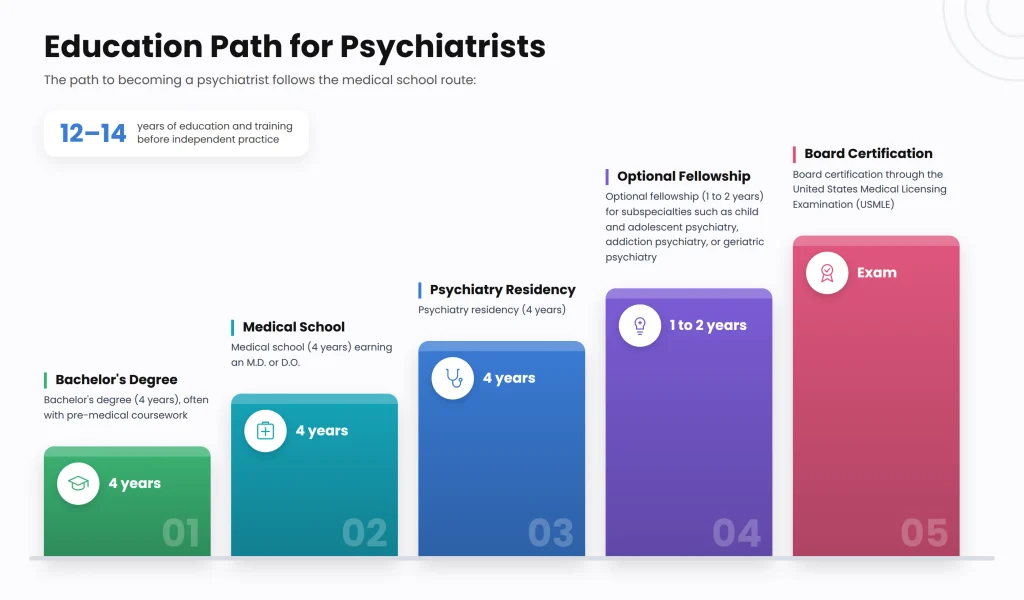
The path to becoming a psychiatrist follows the medical school route:
- Bachelor’s degree (4 years), often with pre-medical coursework
- Medical school (4 years) earning an M.D. or D.O.
- Psychiatry residency (4 years)
- Optional fellowship (1 to 2 years) for subspecialties such as child and adolescent psychiatry, addiction psychiatry, or geriatric psychiatry
- Board certification through the United States Medical Licensing Examination (USMLE)
Total training time ranges from 12 to 14 years after high school. This medical foundation equips psychiatrists to work at the intersection of physical and mental health, which is particularly valuable for patients whose mental health symptoms have biological or medical causes.
Psychologist vs Psychiatrist: Key Differences
The table below compares psychologists and psychiatrists across the most important dimensions.
| Dimension | Psychologist | Psychiatrist |
|---|---|---|
| Degree | Ph.D. or Psy.D. in Psychology | M.D. or D.O. in Medicine |
| Training Duration | 10 to 13 years total | 12 to 14 years total |
| Prescribing Authority | No (with limited exceptions in a few states) | Yes, full prescribing authority |
| Primary Treatment Method | Talk therapy (CBT, DBT, psychodynamic, humanistic) | Medication management, pharmacotherapy |
| Session Length | Typically 45 to 60 minutes | Often 15 to 30 minutes for medication visits |
| Conditions Commonly Treated | Anxiety, depression, phobias, PTSD, behavioral issues | Schizophrenia, bipolar disorder, severe depression, treatment-resistant cases |
| Diagnostic Tools | Psychological testing, behavioral assessments, interviews | Medical exams, lab work, imaging, plus psychological evaluation |
| Median Annual Wage (BLS) | $99,110 (May 2025) | $269,120 (May 2024) |
Both professionals use the Diagnostic and Statistical Manual of Mental Disorders (DSM-5) as the standard reference for diagnosing mental health conditions.
Salary and Job Outlook
Career prospects are strong for both psychologists and psychiatrists, driven by growing demand for mental health services across the country.
Psychologists: The Bureau of Labor Statistics (BLS) reports a median annual wage of $99,110 as of May 2025. Clinical and counseling psychologists earn approximately $100,580 on average, while industrial-organizational psychologists earn significantly more at $193,950. The BLS projects 6% employment growth for psychologists from 2025 to 2035, faster than the average for all occupations, with roughly 11,300 openings expected annually.
Psychiatrists: The BLS reports an average annual wage of $269,120 as of May 2024 for psychiatrists. Employment is projected to grow by 6% from 2024 to 2034, generating an estimated 1,700 new positions. This growth rate is double the overall physician growth rate of 3%. Psychiatry also reports one of the highest job satisfaction rates among medical specialties at 83%.
Students exploring high-paying career paths will find that both psychology and psychiatry offer strong earning potential, particularly at the doctoral level.
The Mental Health Workforce Shortage
Understanding the difference between psychologists and psychiatrists also matters in the context of a significant national workforce shortage. According to HRSA data, over 137 million Americans live in designated Mental Health Professional Shortage Areas, with 4,212 of those designations in rural communities. The current national ratio stands at approximately one psychiatrist per 5,058 residents.
NAMI reports that 120 million people live in areas where mental health professionals are in short supply. This shortage means that in many regions, patients face wait times of three months or longer to see a psychiatrist. It also drives the growing adoption of telehealth services and integrated care models where psychologists and psychiatrists collaborate as part of a treatment team.
For students interested in addressing this gap, pursuing a Doctor of Psychology (Psy.D.) or a Master of Science in Psychology provides a direct path into a field with high demand and meaningful impact.
When to See a Psychologist
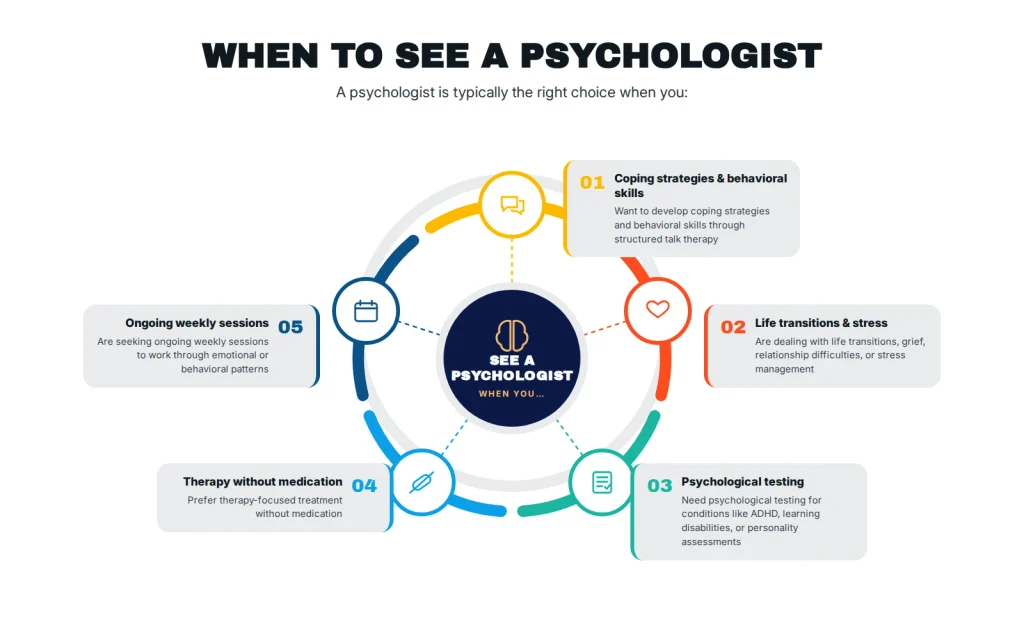
A psychologist is typically the right choice when you:
- Want to develop coping strategies and behavioral skills through structured talk therapy
- Are dealing with life transitions, grief, relationship difficulties, or stress management
- Need psychological testing for conditions like ADHD, learning disabilities, or personality assessments
- Prefer therapy-focused treatment without medication
- Are seeking ongoing weekly sessions to work through emotional or behavioral patterns
Psychologists often meet with clients on a weekly basis, and sessions typically last 45 to 60 minutes. This format is well-suited for building long-term therapeutic skills and addressing the root causes of emotional distress.
When to See a Psychiatrist
A psychiatrist is typically the right choice when you:
- Believe medication may be necessary to manage your symptoms
- Have been diagnosed with a complex or severe mental health condition such as bipolar disorder or schizophrenia
- Experience mental health symptoms that may have a biological or medical component
- Have not responded to therapy alone and need a combined treatment approach
- Need a provider who can coordinate mental health care with other medical treatments
Many patients benefit from seeing both a psychologist and a psychiatrist, especially for conditions like major depression or severe anxiety. In this collaborative model, the psychiatrist manages medication while the psychologist provides ongoing therapy.
How Psychologists and Psychiatrists Work Together
In modern mental health care, the most effective treatment often involves collaboration between psychologists and psychiatrists. A psychiatrist may handle the initial diagnostic evaluation and prescribe medication, while a psychologist provides weekly therapy sessions to address behavioral and emotional patterns.
This integrated approach is particularly effective for conditions where both biological factors and learned behaviors play a role. For example, a patient with severe depression might take an antidepressant prescribed by a psychiatrist while also working with a psychologist on cognitive behavioral strategies to challenge negative thought patterns. Research consistently shows that the combination of medication and psychotherapy produces better outcomes than either treatment alone for conditions like major depression, bipolar disorder, and severe anxiety disorders.
In practice, the psychiatrist and psychologist communicate regularly about the patient’s progress. The psychologist may report that a patient’s therapy sessions reveal persistent sleep disruption or increased irritability, prompting the psychiatrist to adjust medication dosages. This feedback loop creates a more responsive treatment plan than either provider could offer independently.
The growing emphasis on collaborative care reflects broader trends in health sciences education, where interdisciplinary teamwork is a core competency across all clinical programs.
Choosing the Right Career Path
If you are considering a career in mental health, your choice between psychology and psychiatry depends on several factors:
Choose psychology if you are drawn to research, behavioral analysis, and therapeutic techniques. You want to work directly with clients through talk therapy and psychological assessment without the medical school pathway. A psychology career also offers more flexibility in work settings, including private practice, schools, government agencies, and research institutions. Psychologists who pursue a Ph.D. can also build careers in academic research, contributing to the scientific understanding of cognition, behavior, and mental health treatment effectiveness.
Choose psychiatry if you are interested in the medical side of mental health, including brain chemistry, pharmacology, and the intersection of physical and mental health. You are prepared for the medical school and residency pathway and want the ability to prescribe medication as part of treatment. Psychiatry also allows you to subspecialize in areas like forensic psychiatry, consultation-liaison psychiatry, or neuropsychiatry, each of which opens distinct career opportunities within hospitals and specialized clinics.
Both paths require significant academic commitment, and both lead to careers with strong demand and the opportunity to make a real difference. Exploring what a bachelor’s degree involves is a practical first step for students in either direction.
Start Your Journey in Psychology
Whether you are interested in becoming a psychologist, a psychiatrist, or another mental health professional, the foundation begins with the right education. Charisma University’s School of Psychology and Behavioral Science offers programs designed to prepare you for advanced study and clinical practice.
Apply today and take the first step toward a career in mental health care.
Frequently Asked Questions
Can a psychologist prescribe medication?
In most U.S. states, psychologists cannot prescribe medication. A small number of states, including Idaho, Iowa, Illinois, Louisiana, and New Mexico, allow psychologists with additional pharmacological training to prescribe. Psychiatrists, as medical doctors, have full prescribing authority in all states.
Is a psychiatrist a medical doctor?
Yes. Psychiatrists hold an M.D. (Doctor of Medicine) or D.O. (Doctor of Osteopathic Medicine) and completed four years of medical school followed by a four-year psychiatry residency. This medical training allows them to prescribe medication, order lab tests, and conduct physical examinations.
How long does it take to become a psychologist vs a psychiatrist?
Becoming a licensed psychologist typically takes 10 to 13 years after high school, including a doctoral degree and supervised clinical experience. Becoming a psychiatrist takes 12 to 14 years, including medical school, a four-year residency, and an optional fellowship for subspecialties.
Can I see both a psychologist and a psychiatrist?
Yes, and many patients do. A common collaborative model involves a psychiatrist managing medication while a psychologist provides ongoing talk therapy. This integrated approach is especially effective for severe depression, bipolar disorder, and treatment-resistant anxiety.
What is the salary difference between a psychologist and a psychiatrist?
According to the BLS, psychologists earn a median annual wage of $99,110 (May 2025), while psychiatrists earn an average of $269,120 (May 2024). The difference reflects the additional medical training psychiatrists complete and their ability to prescribe medication.
Which professional should I see for anxiety or depression?
For mild to moderate anxiety or depression, a psychologist offering talk therapy such as CBT is often an effective first step. For severe symptoms, symptoms that do not respond to therapy alone, or cases where medication may help, a psychiatrist is the appropriate choice. Many patients benefit from seeing both.