The difference between a PhD in Psychology and a PsyD comes down to their focus. A PhD is built for those who are interested in research. Whereas a PsyD is all bout the practical. Both degrees can lead to becoming a licensed psychologist, but they differ in training style and career direction.
PhD programs are highly competitive, often accepting fewer than 10% of applicants and offering full funding. PsyD programs generally have higher acceptance rates but are usually self-funded and more expensive.
Program length also varies slightly, these differences affect not only your education experience but also your financial investment and long-term career flexibility.
To help you decide, we’ll be breaking down everything you need to know. From academic requirements and key differences to skills, career paths, and common misconceptions. By the end, you’ll have a clear understanding of which degree aligns best with your ambitions.
Understanding Doctoral Degrees in Psychology
Before you choose between a PhD or PsyD, you need to understand what these degrees really mean. Most people jump straight to comparisons without knowing the foundation. Let’s break it down in a simple way so everything else starts to make sense.
Definition of Doctoral Psychology Degrees
A PhD and a PsyD are both doctoral-level degrees in psychology. This means they represent the highest level of academic training in the field. Both paths can lead you to become a licensed psychologist and work with patients or in professional settings. The real difference lies in their focus.
Historical Development of Psychology Doctorates
The PhD was the original path in psychology, and it was built on scientific research. Early psychologists were focused on studying behaviour through experiments and data. Over time, there was a growing need for professionals who could work directly with patients. This led to the creation of the PsyD in the 1970s.
Purpose of Advanced Psychology Education
It prepares you for roles that go far beyond basic understanding. It gives you the skills needed to assess and treat mental health conditions. It also allows you to conduct research or teach at a higher level.
Role of Accreditation in Psychology Education
Accreditation plays a key role in the value of your degree. It ensures that your program meets accepted standards of quality and training. Without proper accreditation, your degree may not be recognised by employers or licensing boards, which can limit your career options.
Importance of Licensure in Professional Practice
Licensure is what allows you to legally practice as a psychologist. It shows that you have completed the required education and training. Most regions require supervised clinical experience along with passing a licensing exam. Without a license, you cannot work independently as a psychologist.
Academic Requirements
This is the part most people underestimate when they start dreaming about a PhD or PsyD, because getting in is not just about wanting it, but proving you are ready for it. Once you see what schools actually expect, you will understand why many applicants never make it through.
GPA
PhD programs usually look for a higher GPA, often around 3.5 or above, because they want candidates who can handle heavy research work and theory. PsyD programs are a bit more flexible, but that does not mean low standards. They still expect consistent performance and a solid understanding of psychology fundamentals.
Research Experience Expectations
This is where the gap becomes very clear. PhD programs almost demand research experience because their entire structure revolves around producing new knowledge. PsyD programs, on the other hand, care more about your interest in working with people. Research experience is helpful but not always required.
Tests & Application Materials
You will need transcripts, letters of recommendation, and a personal statement that clearly explains your goals. Some universities still require GRE scores, but many are moving away from it. What really stands out is how well you present your story.
Acceptance Rates
PhD programs are known for being extremely selective. In many cases, acceptance rates are in single digits, which means only a small number of applicants make it through. PsyD programs are more accessible, but that does not mean it is easy.
Ideal Candidate Profiles
A strong PhD candidate is someone who is comfortable spending long hours on research and motivated by discovery. A strong PsyD candidate is someone who is drawn to helping people directly. They are empathetic patients and interested in real-world impact through therapy and clinical work.
Key Differences Between a PhD in Psychology and a PsyD
If you’ve made it this far, you’re probably thinking, “Okay, but what really separates these two?” This is the part where everything becomes clear as day, and the confusion finally goes away. Let’s break it down side-by-side so you can instantly see which path fits you better.
| Aspects | PhD in Psychology | PsyD |
| Primary Focus | Research + Academia | Clinical Practice |
| Curriculum Approach | Theory & Research Heavy | Practical & Therapy Focused |
| Dissertation Requirements | Extensive Original Research | Applied or shorter clinical project |
| Admission Standards | Highly Competitive | More Flexible |
| Program Length | 5 to 7 years | 4 to 6 years |
| Cost & Funding | Often Funded with a stipend | Usually Self-Funded |
| Global Recognition | Widely recognised | Varies Recognition |
Primary Focus
This is the core difference that shapes everything else in your journey. It determines what you’ll spend most of your time doing every single day. Think of it as choosing between being a scientist and a practitioner.
- A PhD focuses on generating new knowledge through research and academic work.
- PsyD, on the other hand, focuses on applying psychological knowledge in real clinical settings.
- Your daily work, responsibilities, and overall career direction will differ significantly based on this core focus choice.
Curriculum Approach
Your classroom experience will feel completely different depending on the path you choose. One leans heavily into theory and data, while the other emphasises real-world interaction. This directly affects how you learn and what skills you build.
- The PhD curriculum includes advanced courses like statistics, research design, and theoretical frameworks.
- PsyD curriculum prioritises therapy techniques, case studies, and clinical training.
- Learning style in a PhD is analytical, while PsyD is more hands-on and practical.
Dissertation Requirements
This is often the biggest academic hurdle and also the biggest differentiator. It’s where PhD students spend years, while PsyD students take a more applied route. Your relationship with research will be tested here.
- A PhD requires a lengthy and rigorous original research dissertation that contributes new knowledge.
- PsyD typically requires a shorter, practice-oriented clinical project that focuses on applying psychological knowledge to real-world patient care.
- Time, depth, and complexity of research commitment are significantly higher in PhD programs compared to PsyD programs.
Admission Standards
Getting into these programs is a completely different experience. One feels like applying to an elite research club, the other is more accessible. But both still expect strong commitment and clarity of purpose.
- PhD programs require a high GPA, a strong research background, and a clearly defined research interest.
- PsyD programs are more flexible in GPA and research, but still require relevant experience.
- Competition levels are significantly higher for PhD admissions due to limited seats and available funding opportunities.
Program Length
Time is a huge factor when planning your future, and these paths differ slightly. While both are long-term commitments, one tends to stretch further. Your patience and long-term goals all play an important role here.
- PhD programs usually take 5–7 years due to intensive research and dissertation work.
- PsyD programs typically take 4–6 years with a more structured, practice-focused timeline and fewer research demands.
- The additional time in a PhD is mainly due to conducting original research, publishing work, and completing a detailed dissertation.
Cost & Funding Availability
This is where you get a reality check, because your financial situation can strongly influence which path you choose. Understanding how tuition, stipends, and debt work here can save you from major long-term financial stress.
- PhD programs are often fully funded, meaning tuition is covered, and you may also receive a monthly stipend for living expenses.
- PsyD programs usually require paying full tuition out of pocket, making them significantly more expensive over time.
- Student debt is much more common among PsyD graduates due to limited funding opportunities and higher overall program costs.
Global Recognition
If you’re planning to work internationally, this is something you absolutely cannot overlook.
Different countries have different rules, and not all psychology degrees are treated the same.
Choosing the right one now can save you from major limitations later in your career.
- PhD degrees are widely recognised and accepted across most countries, universities, and research institutions worldwide.
- PsyD recognition varies depending on country, licensing requirements, and whether the degree aligns with local regulatory standards.
- International career flexibility, academic mobility, and global job opportunities are generally stronger with a PhD degree.
Skills Developed in Each Degree Path
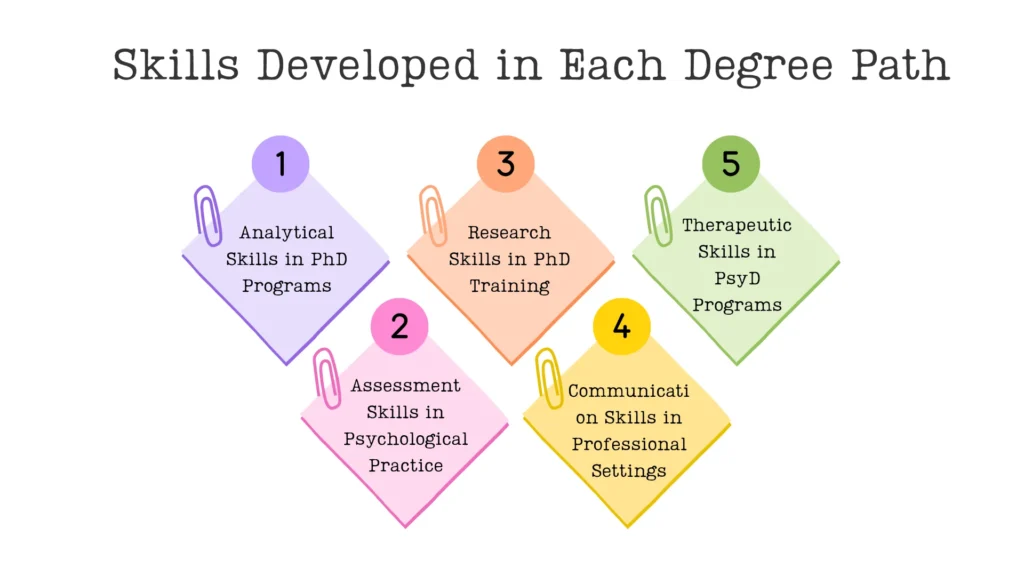
Let’s shift from theory to what you actually gain. This is the part most people overlook when choosing a degree. Because the skills you build will shape how you think, work, and interact every single day.
Analytical Skills in PhD Programs
PhD training deeply sharpens your thinking. You learn how to question everything instead of accepting surface answers. Over time, you become someone who can break down complex problems with clarity and confidence.
Research Skills in PhD Training
Research becomes second nature in a PhD. You learn how to design studies and collect data with purpose. You also learn how to turn raw information into meaningful insights that others can trust.
Therapeutic Skills in PsyD Programs
PsyD programs focus on real human interaction. You learn how to listen with intent and respond with care. Over time, you build the ability to guide people through difficult emotional experiences.
Assessment Skills in Psychological Practice
Both paths teach you how to understand people on a deeper level. You learn how to evaluate behaviour and identify patterns that are not obvious at first glance. This skill becomes essential for accurate diagnosis and treatment planning.
Communication Skills in Professional Settings
Strong communication is at the core of psychology. You learn how to explain complex ideas in simple ways that others can understand. You also develop the ability to connect with people in a way that builds trust and clarity.
Decision Framework for Choosing the Right Degree
Choosing between a PhD and a PsyD can feel confusing at first, especially with so much mixed advice online. This is usually the moment where students either gain clarity about their future or stay stuck in overthinking. Let’s simplify everything so you can make a confident decision without second-guessing yourself later.
Career Goals Alignment
Start by thinking about the kind of professional life you actually want to build for yourself. If you see yourself teaching, publishing research, or working in universities, then a PhD is the better fit. If you want to work closely with clients and focus on therapy sessions, then PsyD aligns much better.
Research/Practice Preference
This decision becomes easier when you understand what type of work you naturally enjoy doing.
If analysing data and exploring theories excites you, then a PhD will suit you more. If you prefer helping people through therapy, then PsyD is the clearer choice.
Time Commitment
You need to be realistic about how many years you are willing to invest in your education.
A PhD often takes longer because of research work, and a PsyD is slightly shorter in most cases but still demands full-time effort and long-term commitment.
Financial Considerations
Finances are a major factor, so it is important to think this through carefully before deciding.
PhD programs are often funded, which means lower tuition costs, and PsyD programs can be expensive, so you should plan your finances and potential debt firsthand.
Long Term Flexibility
Your degree should support your future goals instead of limiting your career options later. A PhD offers more flexibility since it opens doors to research or theory based roles. A PsyD is more specialised, which works best if you are certain about a clinical practice career.
Career Opportunities and Professional Outcomes
At some point, the big question hits where you ask yourself, “What can I actually do with this degree?” The answer is not just one job but a range of paths, depending on your direction. Here is how both degrees translate into real careers you can build
Professors & Academic Researchers
This path is ideal if you enjoy teaching and exploring complex ideas deeply. Most roles require a PhD along with strong research and publication experience. You will teach students to conduct studies and contribute new knowledge to psychology.
Clinical Psychologists
Both PhD and PsyD graduates can work directly with patients in clinical settings. You will assess, diagnose and treat a wide range of mental health conditions. These roles are commonly found in hospitals, clinics and mental health centres.
Private Practice Psychologists
This path offers independence and full control over your professional life. You can build your own clinic and develop long-term relationships with clients. Your income and growth depend on your reputation, experience and client base.
Healthcare & Organizational Psychologists
You can work in medical settings or within companies and large organisations. Healthcare roles focus on treatment and improving patient well-being. Organisational roles focus on productivity, leadership and employee satisfaction.
Specialized Roles in Psychology Fields
You can choose a niche area based on your interests and career goals. Options include forensic psychology, neuropsychology and child psychology fields. Specialising helps you stand out and often leads to better career opportunities.
Common Misconceptions About PhD & PsyD
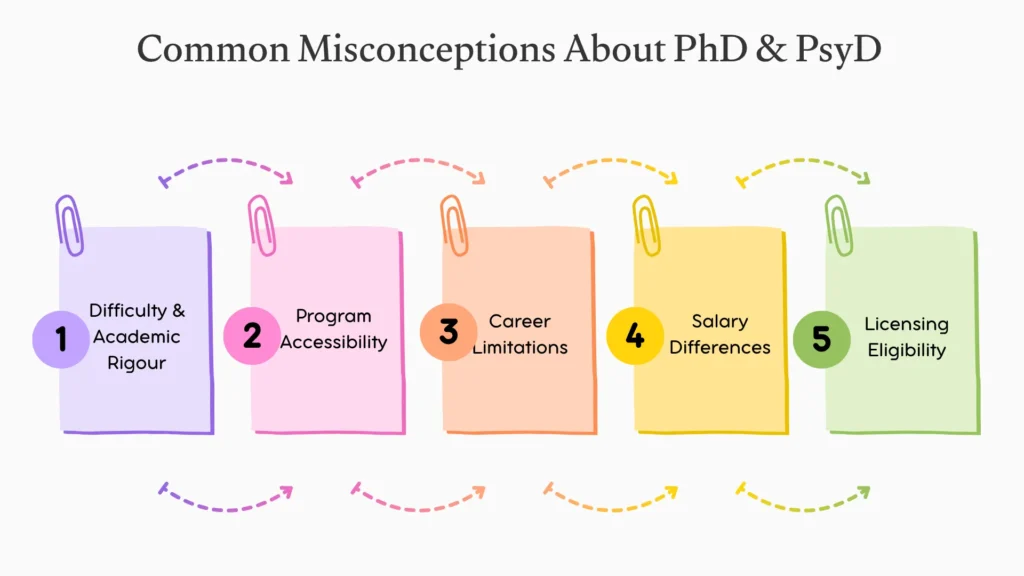
If you’ve spent even 10 minutes researching this topic, you’ve probably run into conflicting opinions. Some people make it sound like one degree is clearly better, while the other is a backup option. In reality, most of these claims are oversimplified or just plain wrong.
Difficulty & Academic Rigor
People often assume a PhD is harder and a PsyD is easier. That comparison does not really hold up. A PhD demands deep research and long-term academic focus. A PsyD requires constant clinical work and emotional resilience. Both programs are intense in different ways.
Program Accessibility
PsyD programs indeed accept more students than PhD programs. That does not mean they are easy to enter. You still need solid grades and a strong application. Staying in the program is where the real challenge begins.
Career Limitations
A common belief is that PsyD only leads to therapy jobs. That is not accurate. PsyD graduates work in hospitals, clinics, and leadership roles. PhD graduates are not limited to research, either and can work in clinical settings as well.
Salary Differences
Many assume PhD holders always earn more money. That depends on the career path you choose. Private practice can be very profitable for PsyD graduates. Academic roles may offer stability, but not always provide high income at the start.
Licensing Eligibility
Some think only PhD graduates can become licensed psychologists. That is incorrect. Both PhD and PsyD graduates can get licensed. The key requirement is graduating from an accredited program and completing supervised experience.
FAQs
Yes, PsyD graduates can conduct research, but it’s not their primary training focus. PhD graduates are generally more skilled and involved in advanced research work.
Both degrees allow you to open a private practice after licensure. A PsyD is often preferred due to its strong focus on clinical skills and therapy.
Yes, but opportunities are more limited compared to PhD holders. Most universities prefer PhD graduates for full-time academic roles.
Switching is possible but uncommon and often requires starting over. Programs have different structures, so credits may not transfer easily.
Yes, clinical PhD graduates are fully trained to provide therapy after licensure. They combine research knowledge with clinical practice skills.