Marketing is one of the most versatile fields in business. It touches every industry, from healthcare and technology to finance, entertainment, and nonprofit organizations. Professionals with marketing degrees plan campaigns, analyze consumer behavior, build brands, manage digital platforms, and drive revenue growth for organizations of all sizes.
The career potential is strong. The Bureau of Labor Statistics (BLS) reports that marketing managers earned a median annual wage of $166,790 as of May 2025, with 7% projected employment growth from 2025 to 2035. Market research analysts, another core marketing role, earned a median of $78,760 with the same 7% growth rate and roughly 82,000 job openings expected annually. These numbers reflect a field that offers both high earning potential and consistent demand.
The global digital advertising market reinforces that outlook. Digital ad spending reached approximately $730 billion in 2025 and is projected to surpass $800 billion in 2026, according to industry data. As businesses allocate larger portions of their budgets to digital channels, the demand for skilled marketing professionals continues to rise.
Top Careers You Can Pursue With a Marketing Degree
A marketing degree prepares you for a wide range of roles. The specific path you choose depends on whether you are drawn to strategy, creativity, data analysis, or client-facing work.
Marketing Manager
Marketing managers plan and execute campaigns, set pricing strategies, identify target audiences, and oversee the work of marketing teams. They coordinate across departments and track campaign performance to ensure that marketing efforts align with business objectives.
The BLS reports a median annual wage of $166,790 for marketing managers (May 2025), with approximately 421,600 jobs in the U.S. The field is projected to grow 7% from 2025 to 2035, with about 36,300 annual openings across advertising, promotions, and marketing management roles combined.
Market Research Analyst
Market research analysts study market conditions, consumer preferences, and competitive landscapes to help organizations make informed business decisions. They design surveys, analyze data, interpret trends, and present findings to stakeholders.
This is one of the fastest-growing marketing careers. The BLS reports a median annual wage of $78,760, with 952,700 jobs in 2025 and 7% projected growth through 2035. Roughly 82,000 openings are expected annually, driven by the increasing importance of data in business strategy.
Brand Manager
Brand managers oversee the positioning, messaging, and perception of a product or company in the marketplace. They develop brand strategies, manage product launches, coordinate with creative teams, and monitor brand performance metrics.
Brand management roles are common in consumer goods, technology, and retail industries. Indeed reports an average salary of approximately $91,553 per year for brand managers, with senior brand managers earning around $132,756. Strong brand managers combine creative instinct with analytical rigor, making this a good fit for marketing graduates who want to shape how consumers perceive products and companies. Understanding the 4 Ps of marketing is foundational to success in this role.
Digital Marketing Manager
Digital marketing managers develop and execute strategies across online channels including search engines, social media, email, content marketing, and paid advertising. They manage budgets, track key performance indicators (KPIs), and optimize campaigns based on real-time data.
With digital channels now accounting for roughly 65% of total global ad spending, digital marketing expertise is in high demand. Indeed reports an average salary of approximately $83,597 per year for digital marketing managers, though compensation varies significantly by company size, industry, and location.
Public Relations Specialist
Public relations specialists manage an organization’s public image by writing press releases, coordinating media outreach, handling crisis communications, and building relationships with journalists and influencers. They help shape the narrative around a brand, product, or executive.
The BLS reports a median annual wage of $74,750 for PR specialists (May 2025), with 314,500 jobs in the U.S. Projected growth is 2% from 2025 to 2035, with about 23,000 openings expected annually. PR roles are available in agencies, corporate communications departments, government, healthcare, and nonprofit organizations.
Content Strategist
Content strategists plan, create, and manage content across websites, blogs, social media, email campaigns, and other digital channels. They align content with business goals, conduct keyword research, develop editorial calendars, and measure content performance through analytics.
This role has grown rapidly as content marketing has become a central pillar of digital strategy. Content strategists often work closely with SEO specialists, designers, and product teams, making it a natural fit for marketing graduates who enjoy both writing and data analysis.
Sales Manager
While sales and marketing are distinct functions, they share a common foundation. Sales managers lead teams that sell products and services, set sales targets, develop training programs, and analyze sales data to refine strategies.
Marketing graduates who move into sales management bring valuable skills in consumer behavior, competitive analysis, and persuasion. The BLS reports a median annual wage of $141,870 for sales managers (May 2025), making it one of the highest-paying paths accessible with a marketing background.
Marketing Manager vs. Market Research Analyst
These two roles represent different sides of marketing. The table below compares them across the most important dimensions.
| Dimension | Marketing Manager | Market Research Analyst |
|---|---|---|
| Primary Focus | Planning and executing marketing campaigns | Studying consumer behavior and market conditions |
| Key Responsibilities | Campaign strategy, team management, budget allocation, brand positioning | Survey design, data collection, trend analysis, competitive research |
| Core Skills | Leadership, creativity, strategic thinking, cross-functional coordination | Data analysis, statistical software, critical thinking, research methodology |
| Median Annual Wage (BLS, May 2025) | $166,790 | $78,760 |
| Number of U.S. Jobs (2025) | 421,600 | 952,700 |
| Projected Growth (2025-2035) | 7% | 7% |
| Education | Bachelor’s degree required; MBA preferred for senior roles | Bachelor’s degree required; master’s degree beneficial for advanced positions |
| Career Trajectory | Marketing Director, VP of Marketing, Chief Marketing Officer | Senior Analyst, Research Director, VP of Consumer Insights |
Both roles offer strong growth and compensation, but they require different temperaments. Marketing managers thrive in fast-paced, creative environments where they lead teams and make strategic decisions. Market research analysts excel in data-driven settings where they uncover insights that inform those decisions.
Skills Employers Look For
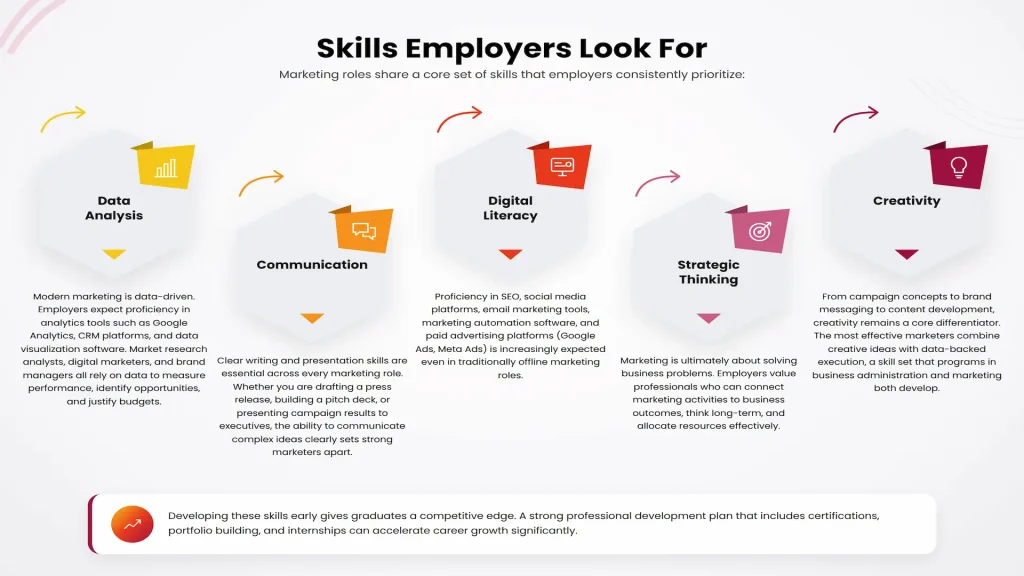
Marketing roles share a core set of skills that employers consistently prioritize:
Data analysis.
Modern marketing is data-driven. Employers expect proficiency in analytics tools such as Google Analytics, CRM platforms, and data visualization software. Market research analysts, digital marketers, and brand managers all rely on data to measure performance, identify opportunities, and justify budgets.
Communication.
Clear writing and presentation skills are essential across every marketing role. Whether you are drafting a press release, building a pitch deck, or presenting campaign results to executives, the ability to communicate complex ideas clearly sets strong marketers apart.
Digital literacy.
Proficiency in SEO, social media platforms, email marketing tools, marketing automation software, and paid advertising platforms (Google Ads, Meta Ads) is increasingly expected even in traditionally offline marketing roles.
Strategic thinking.
Marketing is ultimately about solving business problems. Employers value professionals who can connect marketing activities to business outcomes, think long-term, and allocate resources effectively.
Creativity.
From campaign concepts to brand messaging to content development, creativity remains a core differentiator. The most effective marketers combine creative ideas with data-backed execution, a skill set that programs in business administration and marketing both develop.
Developing these skills early gives graduates a competitive edge. A strong professional development plan that includes certifications, portfolio building, and internships can accelerate career growth significantly.
Industries That Hire Marketing Graduates
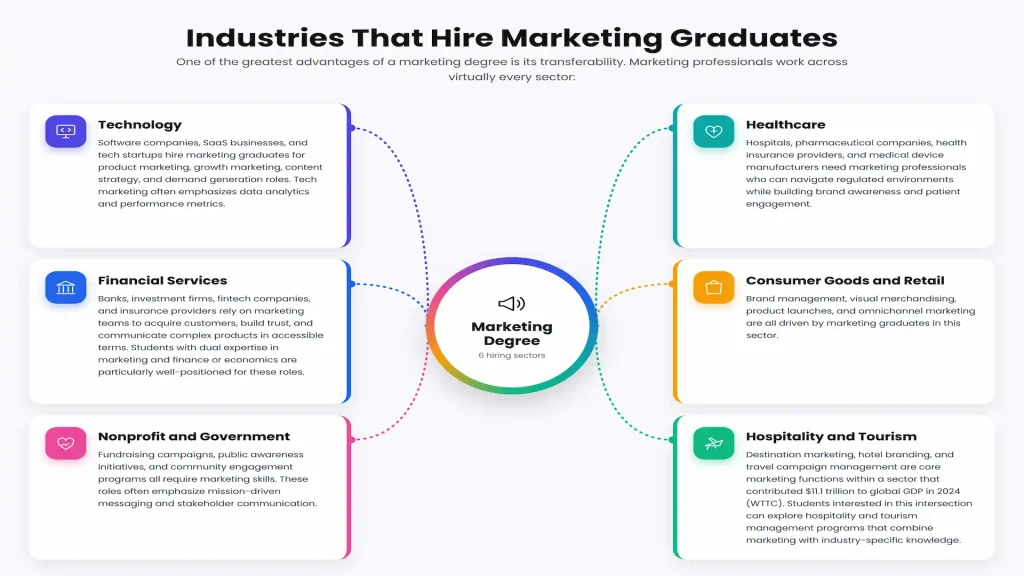
One of the greatest advantages of a marketing degree is its transferability. Marketing professionals work across virtually every sector:
Technology
Software companies, SaaS businesses, and tech startups hire marketing graduates for product marketing, growth marketing, content strategy, and demand generation roles. Tech marketing often emphasizes data analytics and performance metrics.
Healthcare
Hospitals, pharmaceutical companies, health insurance providers, and medical device manufacturers need marketing professionals who can navigate regulated environments while building brand awareness and patient engagement.
Financial services
Banks, investment firms, fintech companies, and insurance providers rely on marketing teams to acquire customers, build trust, and communicate complex products in accessible terms. Students with dual expertise in marketing and finance or economics are particularly well-positioned for these roles.
Consumer goods and retail
Brand management, visual merchandising, product launches, and omnichannel marketing are all driven by marketing graduates in this sector.
Nonprofit and government
Fundraising campaigns, public awareness initiatives, and community engagement programs all require marketing skills. These roles often emphasize mission-driven messaging and stakeholder communication.
Hospitality and tourism
Destination marketing, hotel branding, and travel campaign management are core marketing functions within a sector that contributed $11.1 trillion to global GDP in 2024 (WTTC). Students interested in this intersection can explore hospitality and tourism management programs that combine marketing with industry-specific knowledge.
Education Paths: Bachelor’s vs. Master’s in Marketing
A bachelor’s degree in marketing is the standard entry point for most marketing careers. It covers core subjects including consumer behavior, market research, advertising principles, digital marketing, brand management, and marketing strategy.
A master’s degree, such as a Master of Arts in Marketing or an MBA, is typically pursued by professionals seeking leadership positions. According to the NACE Winter 2026 Salary Survey, marketing bachelor’s graduates from the Class of 2026 earned an average starting salary of $66,994, while master’s graduates across business disciplines averaged $86,563. That salary premium reflects the strategic and analytical depth that graduate programs provide.
For students early in their academic journey, a Bachelor of Arts in Marketing builds the foundational skills employers expect, while keeping graduate study as an option for career advancement later.
How to Choose the Right Marketing Career
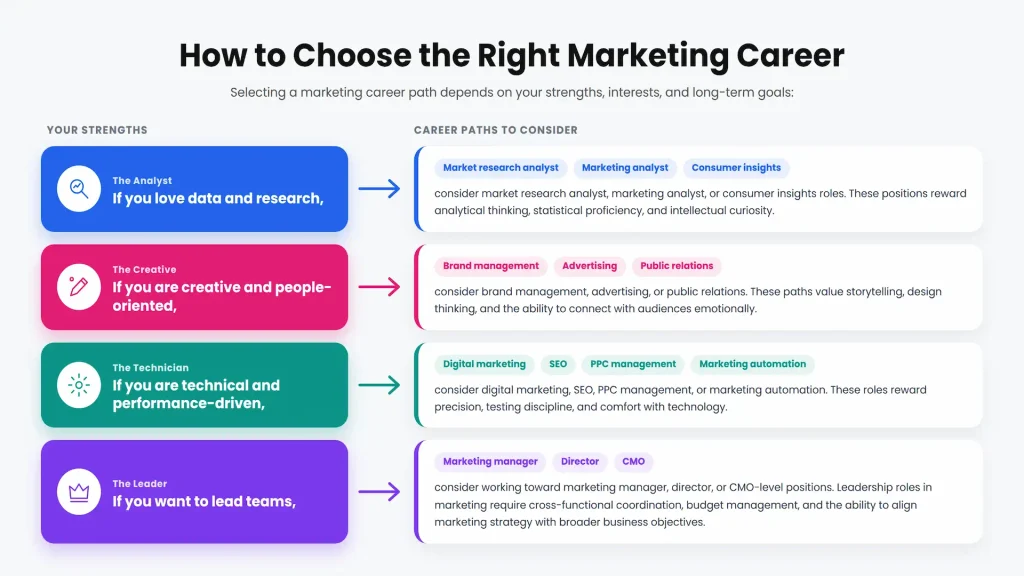
Selecting a marketing career path depends on your strengths, interests, and long-term goals:
If you love data and research, consider market research analyst, marketing analyst, or consumer insights roles. These positions reward analytical thinking, statistical proficiency, and intellectual curiosity.
If you are creative and people-oriented, consider brand management, advertising, or public relations. These paths value storytelling, design thinking, and the ability to connect with audiences emotionally.
If you are technical and performance-driven, consider digital marketing, SEO, PPC management, or marketing automation. These roles reward precision, testing discipline, and comfort with technology.
If you want to lead teams, consider working toward marketing manager, director, or CMO-level positions. Leadership roles in marketing require cross-functional coordination, budget management, and the ability to align marketing strategy with broader business objectives.
Many marketing professionals move between specializations throughout their careers. A digital marketer may transition into brand management. A market research analyst may move into product marketing. The analytical, creative, and strategic skills that a marketing degree provides are transferable across all of these paths.
Start Your Marketing Career
Marketing offers a combination of creative, analytical, and strategic work that few other fields can match. With strong salary data, consistent job growth, and demand across every industry, a marketing degree is one of the most practical investments you can make in your professional future.
Explore Charisma University’s Bachelor of Arts in Marketing to build the skills that employers are looking for. Apply today and take the first step toward a career in one of the most dynamic fields in business.
Frequently Asked Questions
Common careers include marketing manager, market research analyst, brand manager, digital marketing manager, public relations specialist, content strategist, and sales manager. Marketing degrees also prepare you for roles in advertising, SEO, social media management, and media planning.
Salaries vary widely by role and experience. According to the BLS (May 2025), marketing managers earn a median of $166,790, market research analysts earn $78,760, and public relations specialists earn $74,750. Senior and executive-level positions offer substantially higher compensation.
Yes. Marketing careers offer strong salaries, consistent demand, and opportunities across virtually every industry. The BLS projects 7% growth for both marketing managers and market research analysts through 2035, and digital ad spending continues to grow year over year, increasing demand for skilled marketing professionals.
A bachelor’s degree is sufficient for most entry-level and mid-level marketing positions. A master’s degree or MBA can accelerate your path to senior and executive roles and typically comes with a salary premium. NACE data shows that master’s graduates in business average $86,563 in starting salary compared to $66,994 for bachelor’s graduates.
Key skills include data analysis, written and verbal communication, digital literacy (SEO, social media, analytics tools), strategic thinking, creativity, and project management. Employers increasingly value proficiency with marketing technology platforms and data-driven decision-making.
Marketing professionals work in technology, healthcare, financial services, consumer goods, retail, hospitality, entertainment, nonprofit, government, and education. Nearly every industry relies on marketing to attract customers, build brand awareness, and drive revenue growth.