The 4 Ps are part of a strategic business framework called the marketing mix. These 4 Ps stand for product, price, place, and promotion. They create a practical roadmap for turning a business idea into something customers actually notice, trust, and buy.
Imagine you’re opening a pizza restaurant. You’ve got the dough, the sauce, cheese, and probably the best aesthetics to keep the vibe going. But then you ask yourself this “How much will it cost? When will people buy it? How are people going to know that my pizza restaurant exists?” This is where the 4 Ps enter.
For decades, businesses across many industries have used the 4 Ps to influence buying decisions and strengthen competitive positioning in crowded markets.
To make sure you stand out in the competition, we’ll be covering the importance of the 4 Ps, how you can utilize them, and common mistakes you need to avoid when using them.
Understanding The Foundation Of Marketing Mix
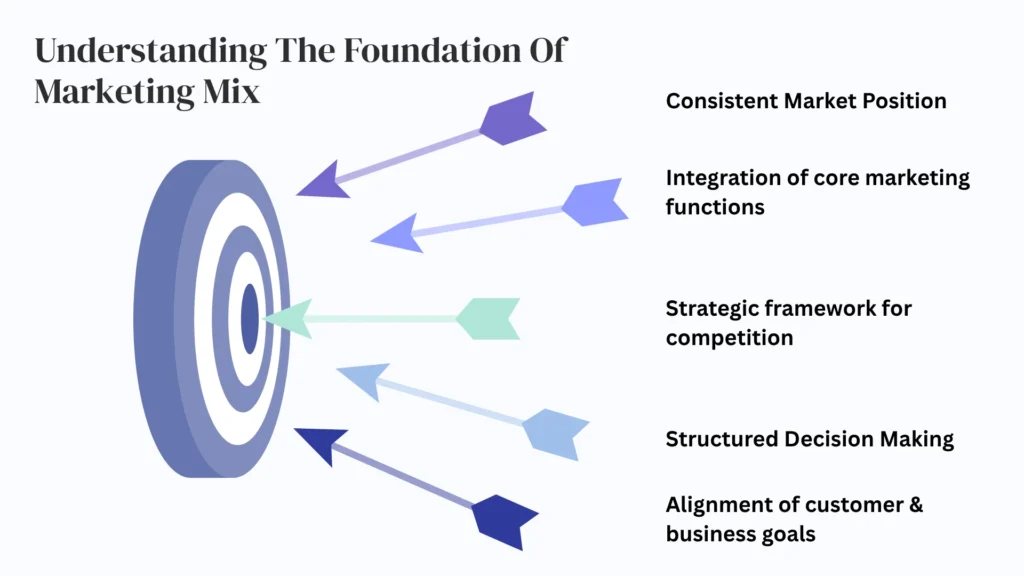
The marketing mix gives businesses a clear structure for how to grow a product or service effectively. Instead of making random marketing decisions, it helps brands align what they offer with what customers actually want. That’s why the 4 Ps of marketing remain one of the strongest foundations in business strategy.
The Early Evolution of the Marketing Mix
Long before the 4 Ps became standard, marketers needed a way to organise the many decisions involved in selling a product. The marketing mix emerged as a broad concept that grouped key business activities into manageable categories. This early thinking laid the groundwork for a more structured approach to marketing strategy.
Neil Borden’s Contribution to Marketing Theory
Neil Borden described marketing as a blend of controllable elements that businesses could adjust to influence demand. His work gave marketers a clearer way to think about strategy, planning, and customer reach.
E. Jerome McCarthy’s Development of the 4 Ps
The turning point came when E. Jerome McCarthy simplified the marketing mix into the product, price, place, and promotion. This model made marketing easier to understand and apply across industries. It quickly became one of the most recognized frameworks in modern business education.
The Shift from Broad Theory to a Practical Framework
Companies could now apply the 4 Ps directly when launching products, setting prices, choosing channels, and planning promotions. That practical value helped turn the marketing mix into a core strategic tool.
The Enduring Relevance of the Marketing Mix Model
Even in a digital-first world, the marketing mix remains a foundation of effective strategy. Businesses still rely on its principles to create value, position, and connect with customers. Its lasting relevance comes from how simply it explains the essentials of marketing success.
Why the 4 Ps of marketing matter in business growth
A lot of businesses think growth comes from doing more ads and offers, but that’s rarely the actual issue. It happens when the product, price, place, and promotion all work together in a way that makes sense to customers and supports long-term goals.
Impact on Brand Consistency
The 4 Ps help your business stay consistent in how it looks, feels, and delivers value. When all four are aligned, the brand becomes trustworthy and is easily chosen by the masses.
Influence on Customer Buying Behavior
Customer decisions are shaped by more than just interest because people also think about value and trust before buying. The 4 Ps influence that process by making the offer fairly priced and worth paying attention to.
Role in Shaping Marketing Position
The 4 Ps determine how your business is seen in the market and what kind of place it holds in the customer’s mind. They shape whether a brand feels premium, affordable, or somewhere in between. Strong positioning matters because customers are more likely to choose brands they can understand quickly.
Value in Competitive Differentiation
In competitive markets, businesses need more than just a decent product because being “good enough” rarely stands out anymore. The 4 Ps create room for differentiation through smarter pricing or easier access. That difference helps customers see why one brand deserves attention over another.
Contribution to Long Term Business Planning
The 4 Ps of marketing are useful for more than short-term campaigns because they also support smarter long-term business decisions. They help shape product development, pricing strategy, market expansion, and future positioning in a structured way.
How the 4 Ps of Marketing Work and Their Real-World Uses
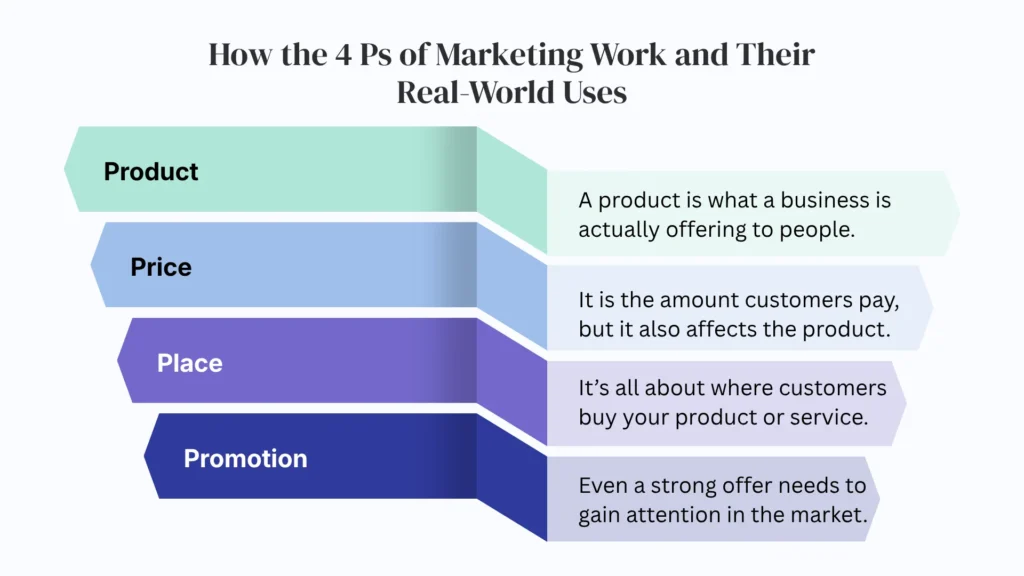
The 4 Ps work best when they are used together, not separately. A business needs the right product, the right price, the right place, and the right promotion for things to actually work. When all four are aligned, marketing becomes much more effective and easier to manage.
Product
A product is what a business is actually offering to people. It can be a physical item, a service, a digital tool, or even an experience. This part focuses on making sure your offer is useful, appealing, and worth choosing over all the other options in the market.
Uses:
- As a business owner, you need to use this part to decide exactly what you want to sell and how it meets the demands of the customers.
- Product planning helps improve quality, design, features, packaging, and the overall experience attached to the offer.
- Different versions of the same product can be created to match different customer preferences, budgets, or expectations.
Price
It is the amount customers pay, but it also affects how they see your product. A low price can make something feel affordable, while a high price can make it feel more premium. You can use pricing to attract the right people and stay profitable at the same time.
Uses:
- Helps your business decide how much customers should pay based on value, competition, and business goals.
- You can create discounts and subscriptions to make the offer more appealing.
- Customer perception shifts depending on whether the price feels too cheap, fairly priced, or more premium than competitors.
Place
It’s all about where customers can buy your product or service. This could be your physical shop, a website, an app, or even social media. You can use this part to make buying easy and convenient for the customer.
Uses:
- You need to choose selling channels based on where customers are most likely to discover and buy the offer.
- Online stores, physical shops, delivery apps, and third-party platforms are all part of the marketing.
- A smoother buying process often comes from making the product easy to access, order, and receive without hassle.
Promotion
Even a strong offer needs visibility to gain attention in the market. That’s where communication and brand visibility begin to play a role. This part covers how businesses bring their offer in front of the right audience.
Uses:
- Create marketing campaigns to spread awareness and bring more attention to the product or service.
- Social media, paid ads, SEO, email marketing, and content creation are all common ways businesses promote themselves.
- Clear messaging makes it easier for customers to understand what the business offers and why it is worth noticing.
Industry-Wise Relevance of the 4 Ps of Marketing
The best thing about the 4 Ps of marketing is that they don’t belong to one type of business only. Doesn’t matter whether you’re selling products or software, the same framework still applies. It just looks a little different depending on the industry. The difference is simply in how each industry applies Product, Price, Place, and Promotion to match customer expectations.
Retail and e-commerce
One click can make or break a sale in retail and e-commerce. Success here depends on offering products that people actually want, pricing them in a way that feels fair, and promoting them with enough appeal to drive action.
Technology and software
Great software rarely sells itself just because it has powerful features. What really matters is how clearly the solution is packaged, how easily users can access or try it, and how effectively the brand communicates its usefulness. That’s why successful tech companies focus just as much on user adoption and positioning as they do on building the tool itself.
Healthcare and wellness
When people invest in their health, trust becomes part of the buying decision. Businesses in this space offer something credible and genuinely useful, price it in a way that reflects both value and reassurance.
Education and training
People don’t sign up for a course or program just to collect information, they do it because they want a result. That means education brands need to package their learning experience in a way that feels practical and set their pricing that matches the transformation being promised, and market it in a way that builds trust and motivation.
Hospitality and real estate
Few industries rely more heavily on perception than hospitality and real estate. Whether it’s a hotel stay or a property listing, success depends on how desirable the offer feels, whether the pricing matches the experience or location, how visible it is to the right audience, and how effectively it’s presented through visuals and messaging.
4Ps of marketing vs 7Ps of marketing
The 4 Ps focus on the core elements needed to sell a product. As businesses evolved (especially service-based ones), marketers realized that customer experience plays a bigger role than just the product itself. That’s where the 7 Ps come in, adding three more elements that focus on how the service is delivered and experienced.
| Basis Of Comparison | 4 Ps of marketing | 7 Ps of marketing |
| Full form | Product, price, place, promotion | Product, price, place, promotion, people, process, physical evidence |
| Core focus | Product & Sales strategy | Product + service experience strategy |
| Business Type | Best for the product-based businesses | Best for service-based businesses |
| Customer Interaction | Limited | Strongly focused |
| Product Element | Physical or digital | Product + service delivery quality |
| Price Element | Pricing strategy | Pricing + perceived service value |
| Place Element | Distribution Channels | Distribution + Service accessibility |
| Promotion Element | Communication & Advertising | Communication + Customer engagement |
| People | Not included | Employees, customer support, service staff |
| Process | Not included | Systems, workflows, service delivery methods |
| Physical Evidence | Not included | Tangible proof like environment, branding, and reviews |
| Modern Relevance | Widely used | More relevant for experience-driven markets |
The 4 Ps still work perfectly for many businesses. However, the 7 Ps expand that foundation by focusing more on customer interaction and service quality. In today’s experience-driven market, businesses often combine both models to create strategies that are not just effective but also memorable.
4 Ps of Marketing vs 4 Cs of Marketing
The 4 Ps focus on how a business builds and delivers its offer, while the 4 Cs of marketing change the perspective and focus on how the customer experiences that offer. In simple terms, the 4 Ps ask, “What are we selling?” and the 4 Cs ask, “Why would the customer care?”
| Basis Of Comparison | 4 Ps of Marketing | 4 Cs of marketing |
| Full form | Product, price, place, promotion | Customer Solution, Customer Cost, Convenience, Communication |
| Core focus | Business and product strategy | Customer needs and buying experience |
| Main Perspective | Seller’s point of view | Buyer’s point of view |
| Business Goal | Sell and position the offer | Solve customer problems effectively |
| Customer Relevance | Indirectly customer-focused | Directly customer-focused |
| Best Use | Planning the marketing mix | Understanding customer expectations |
| Strategy Style | Traditional marketing structure | Modern customer-centric approach |
| Product Element | Physical or digital | Customer Solution |
| Price Element | Pricing strategy | Customer Cost |
| Place Element | Distribution Channels | Convenience |
| Promotion Element | Communication & Advertising | Communication |
| Modern Relevance | Still widely used | Highly relevant in customer-driven markets |
The 4 Ps provide a solid structure for building a business strategy, while the 4 Cs make that strategy more customer-friendly and relevant. Rather than replacing one another, both models work best when used together. Businesses that balance internal planning with customer expectations usually create stronger marketing strategies and better long-term results.
Common Mistakes Businesses Make with the 4 Ps
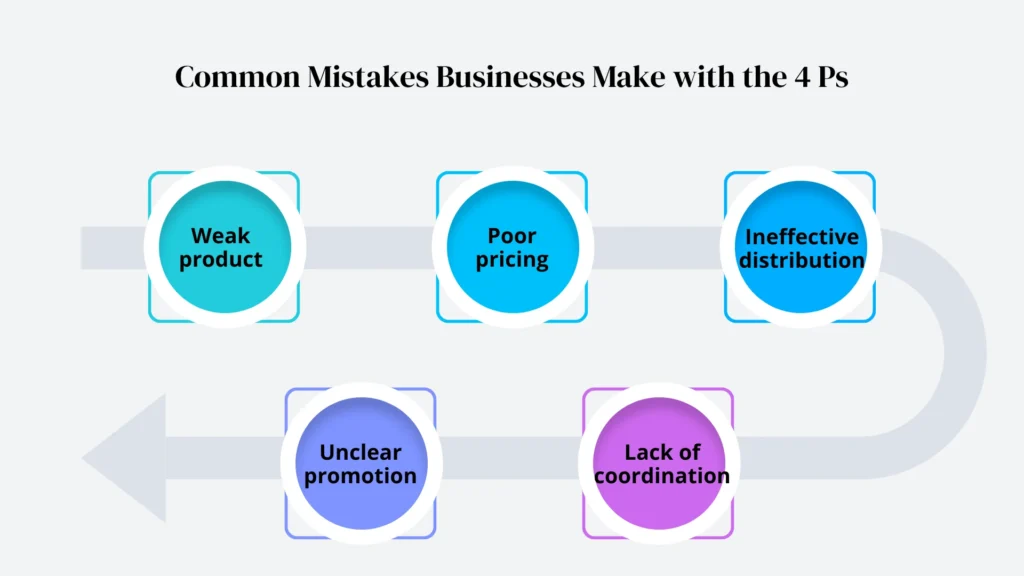
Even though the 4 Ps sound simple, your business might start slipping without you realising it. One wrong move in the marketing mix can quietly weaken sales, confuse customers, and make growth feel way harder than it should. So, before you make full use of the 4 Ps, it’s better to understand how they often end up working against one another.
Weak product-market alignment
You may have a well-made product, but if it doesn’t match what customers actually need or want, it will struggle to gain traction. This happens when you focus too much on what you want to sell instead of what the market is actively looking for.
Poor pricing decisions & value mismatch
Pricing mistakes happen when you either undervalue your offer or price it beyond what customers believe it’s worth. In both cases, the issue is not just the number, it’s the gap between price and perceived value.
Ineffective distribution planning
Even a strong product can underperform if customers find it difficult to access or purchase. Poor distribution planning often creates friction by placing the product in the wrong channels or making the buying process unnecessarily inconvenient.
Unclear promotion
Many businesses promote regularly but still fail to communicate clearly what they actually offer. When your messaging is vague, inconsistent, or too focused on style over substance, customers notice the brand but don’t fully understand its value, and that makes promotion far less effective than it should be.
Lack of coordination across the full marketing mix
One of the biggest mistakes is treating Product, Price, Place, and Promotion as separate decisions instead of one connected strategy. When these four elements don’t align, your brand starts to feel confusing, inconsistent, or unconvincing to customers. A strong marketing mix works best when all four Ps support the same message and positioning.
FAQs
Yes, the 4 Ps are still widely used in modern marketing. They apply to both traditional and digital strategies. Many businesses combine them with newer models for better results.
It refers to the set of tools a business uses to market a product or service. It mainly includes Product, Price, Place, and Promotion. These elements help shape an effective marketing strategy.
The 4 Ps of marketing were popularized by E. Jerome McCarthy in 1960. He introduced them as a simple framework for marketing planning. It later became a core concept in business and marketing education.
There is no single most important P because all four work together. However, many marketers consider “Product” the foundation. Without a strong product, the other elements become less effective.
Marketing mix refers to the tactical tools like Product, Price, Place, and Promotion. Marketing strategy is the broader plan used to reach business goals. The marketing mix is part of that overall strategy.