Every fiscal year, businesses face the same critical question: do the financial statements reflect what actually happened, or just what was paid? Year-end accruals bridge that gap. They are the adjusting entries that ensure expenses incurred and revenues earned within a fiscal year are recorded in that year, regardless of when cash changes hands. Without them, financial statements misrepresent performance, misinform stakeholders, and create compliance risk.
This guide explains what year-end accruals are, why they are required, how to record them, and the most common mistakes that lead to material misstatements during the close process.
What Are Year-End Accruals?
A year-end accrual is an adjusting journal entry that records an expense incurred or revenue earned during the current fiscal year when the corresponding cash transaction has not yet occurred. The entry ensures the transaction is recognized in the accounting period when the economic activity took place, not when payment is made or received.
Under Generally Accepted Accounting Principles (GAAP), financial statements must follow the matching principle, which requires that expenses be recorded in the same period as the revenues they help generate. Year-end accruals are how organizations satisfy this requirement at the close of a fiscal year.
For example, if a company receives legal services in December but does not receive the invoice until January, the expense still belongs in December. A year-end accrual records that obligation so the financial statements accurately reflect the company’s position as of December 31.
The IRS reinforces this through Section 448 of the Internal Revenue Code. C corporations, partnerships with C corporation partners, and tax shelters are generally required to use the accrual method of accounting. Small businesses can use the cash method if their average annual gross receipts fall below the inflation-adjusted threshold, which was $29 million for tax year 2023 and is adjusted upward annually. As of 2025, the threshold stands at approximately $30 million. Businesses that exceed this threshold must switch to accrual-basis accounting and, consequently, must record year-end accruals.
Why Year-End Accruals Matter
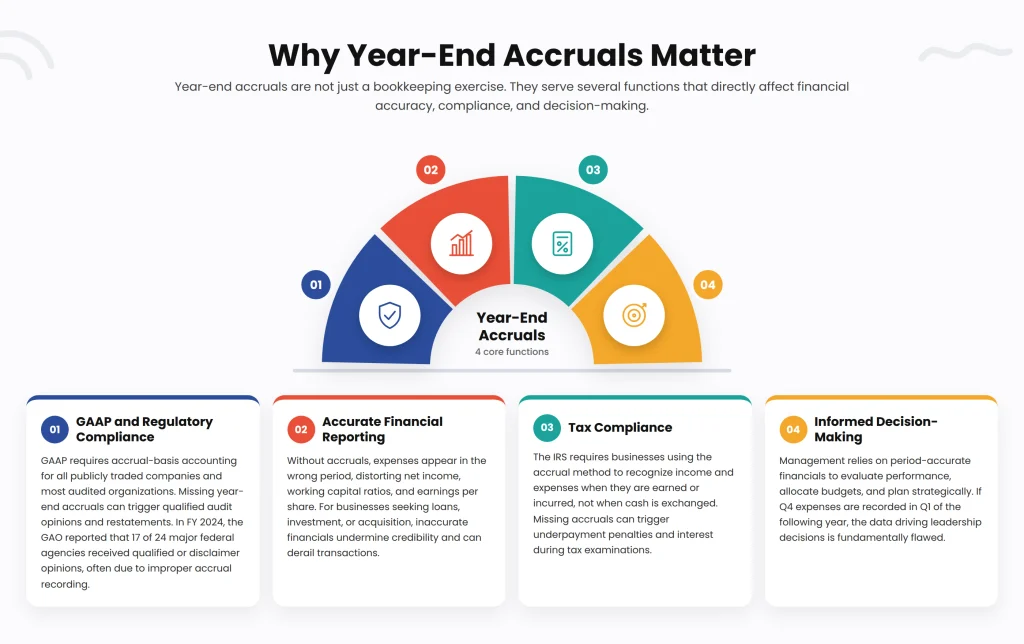
Year-end accruals are not just a bookkeeping exercise. They serve several functions that directly affect financial accuracy, compliance, and decision-making.
GAAP and regulatory compliance.
GAAP requires accrual-basis accounting for all publicly traded companies and most audited organizations. Missing year-end accruals can trigger qualified audit opinions and restatements. In FY 2024, the GAO reported that 17 of 24 major federal agencies received qualified or disclaimer opinions, often due to improper accrual recording.
Accurate financial reporting.
Without accruals, expenses appear in the wrong period, distorting net income, working capital ratios, and earnings per share. For businesses seeking loans, investment, or acquisition, inaccurate financials undermine credibility and can derail transactions.
Tax compliance.
The IRS requires businesses using the accrual method to recognize income and expenses when they are earned or incurred, not when cash is exchanged. Missing accruals can trigger underpayment penalties and interest during tax examinations.
Informed decision-making.
Management relies on period-accurate financials to evaluate performance, allocate budgets, and plan strategically. If Q4 expenses are recorded in Q1 of the following year, the data driving leadership decisions is fundamentally flawed.
The Four Types of Year-End Accruals
Year-end accruals fall into four primary categories, each addressing a different timing mismatch between economic activity and cash flow.
1. Accrued Expenses
An accrued expense records a cost that has been incurred but not yet paid or invoiced. This is the most common type of year-end accrual.
Example: A company’s employees work the last week of December, but payroll is not processed until January 5. The wages earned in December must be accrued as of December 31.
Journal entry:
- Debit: Wages Expense
- Credit: Accrued Wages Payable (liability)
2. Accrued Revenue
Accrued revenue records income that has been earned through the delivery of goods or services but has not yet been invoiced or collected.
Example: A consulting firm completes 40 hours of work for a client in December but does not send the invoice until January 10. The revenue earned in December must be accrued.
Journal entry:
- Debit: Accounts Receivable
- Credit: Service Revenue
3. Prepaid Expenses (Deferrals)
A prepaid expense occurs when a company pays for a service or product in advance. At year-end, only the portion consumed during the current period should appear as an expense; the unused portion remains as an asset.
Example: A business pays $12,000 for a 12-month insurance policy on July 1. By December 31, six months ($6,000) had been used. The remaining $6,000 is a prepaid asset carried into the next year.
Journal entry (adjusting):
- Debit: Insurance Expense ($6,000)
- Credit: Prepaid Insurance ($6,000)
4. Deferred Revenue (Unearned Revenue)
Deferred revenue is the opposite of accrued revenue. It occurs when a company receives payment before delivering the goods or services. At year-end, only the portion of the obligation fulfilled during the current period is recognized as revenue.
Example: A software company collects $24,000 for a 12-month subscription on October 1. By December 31, three months ($6,000) of service had been delivered. The remaining $18,000 remains as a liability.
Journal entry (adjusting):
- Debit: Deferred Revenue ($6,000)
- Credit: Subscription Revenue ($6,000)
Accrual Basis vs. Cash Basis Accounting
Understanding the difference between these two methods is essential for grasping why year-end accruals exist. The following table compares them across key dimensions.
| Dimension | Accrual Basis | Cash Basis |
|---|---|---|
| Revenue Recognition | Recorded when earned, regardless of when payment is received | Recorded only when cash is received |
| Expense Recognition | Recorded when incurred, regardless of when payment is made | Recorded only when cash is paid |
| GAAP Compliance | Required under GAAP for publicly traded companies and most audited entities | Not GAAP compliant; acceptable for small businesses under the IRS gross receipts threshold |
| Financial Accuracy | Provides a more accurate picture of financial performance within each period | Can distort period performance by shifting income and expenses across periods |
| Complexity | More complex; requires adjusting entries, accruals, and deferrals | Simpler to maintain; tracks only cash inflows and outflows |
| IRS Requirement | Required for C corporations, partnerships with C corporation partners, and businesses exceeding the gross receipts threshold (approximately $30 million as of 2025) | Permitted for sole proprietors, small partnerships, and S corporations meeting the gross receipts test |
| Best Suited For | Mid-to-large businesses, publicly traded companies, and organizations seeking external financing or audit compliance | Small businesses, freelancers, and sole proprietors with straightforward transactions |
Key takeaway: Cash basis accounting tells you how much money moved. Accrual basis accounting tells you how much value was created and consumed. Year-end accruals exist because GAAP and the IRS require the latter for most businesses of significant size.
Common Year-End Accruals in Practice
While every business has unique transactions, the following accruals appear consistently across industries during the year-end close.
Payroll accruals.
Wages, salaries, bonuses, commissions, and employer payroll taxes earned by employees before year-end but paid afterward. For most companies, payroll is the single largest accrued expense at year-end.
Utility accruals.
Electricity, gas, water, internet, and telecommunications charges for service consumed before year-end. Utility billing cycles rarely align with fiscal years, so a proportional accrual is typically necessary. If a billing period covers December 15 through January 14, approximately half the charge belongs in the current fiscal year.
Interest accruals.
Interest on loans, lines of credit, and bonds that has accumulated through the last day of the fiscal year but is not due until a future payment date. Under ASC 835 (Interest), interest expense must be recognized as it accrues over time, not when it is paid.
Tax accruals.
Income taxes, property taxes, and other tax liabilities that relate to the current fiscal year but are payable after year-end. Companies must estimate their current-year tax liability and record it as an accrual.
Professional services accruals.
Legal, audit, consulting, and advisory fees for work performed before year-end when the invoice has not yet been received. This is common with external auditors, whose engagement spans the year-end close itself.
Leave and benefits accruals.
Earned but unused vacation time, sick leave, and other compensated absences. Under ASC 710 (Compensation), employers must accrue a liability for compensated absences that employees have earned and are likely to use or be paid for.
The Year-End Accrual Process: Step by Step
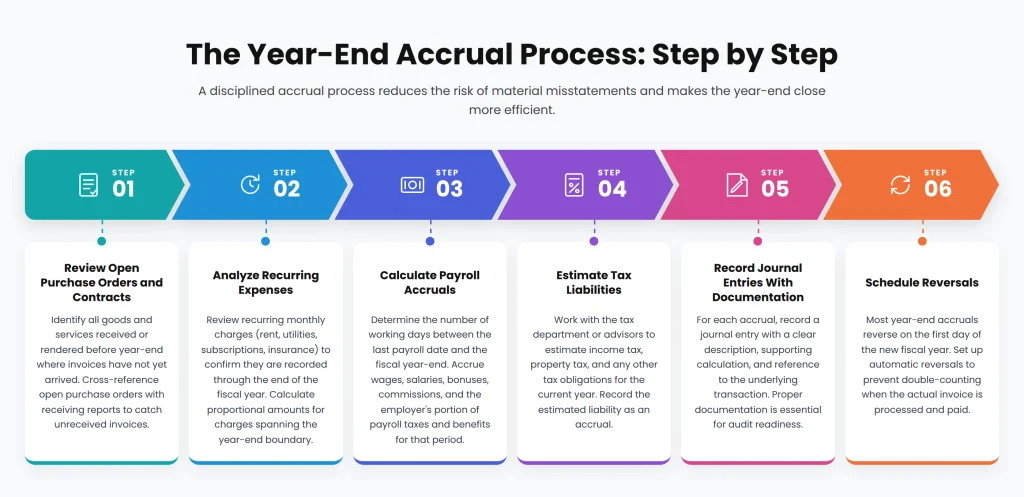
A disciplined accrual process reduces the risk of material misstatements and makes the year-end close more efficient.
Step 1: Review open purchase orders and contracts.
Identify all goods and services received or rendered before year-end where invoices have not yet arrived. Cross-reference open purchase orders with receiving reports to catch unreceived invoices.
Step 2: Analyze recurring expenses.
Review recurring monthly charges (rent, utilities, subscriptions, insurance) to confirm they are recorded through the end of the fiscal year. Calculate proportional amounts for charges spanning the year-end boundary.
Step 3: Calculate payroll accruals.
Determine the number of working days between the last payroll date and the fiscal year-end. Accrue wages, salaries, bonuses, commissions, and the employer’s portion of payroll taxes and benefits for that period.
Step 4: Estimate tax liabilities.
Work with the tax department or advisors to estimate income tax, property tax, and any other tax obligations for the current year. Record the estimated liability as an accrual.
Step 5: Record journal entries with documentation.
For each accrual, record a journal entry with a clear description, supporting calculation, and reference to the underlying transaction. Proper documentation is essential for audit readiness.
Step 6: Schedule reversals.
Most year-end accruals reverse on the first day of the new fiscal year. Set up automatic reversals to prevent double-counting when the actual invoice is processed and paid.
Common Mistakes in Year-End Accruals
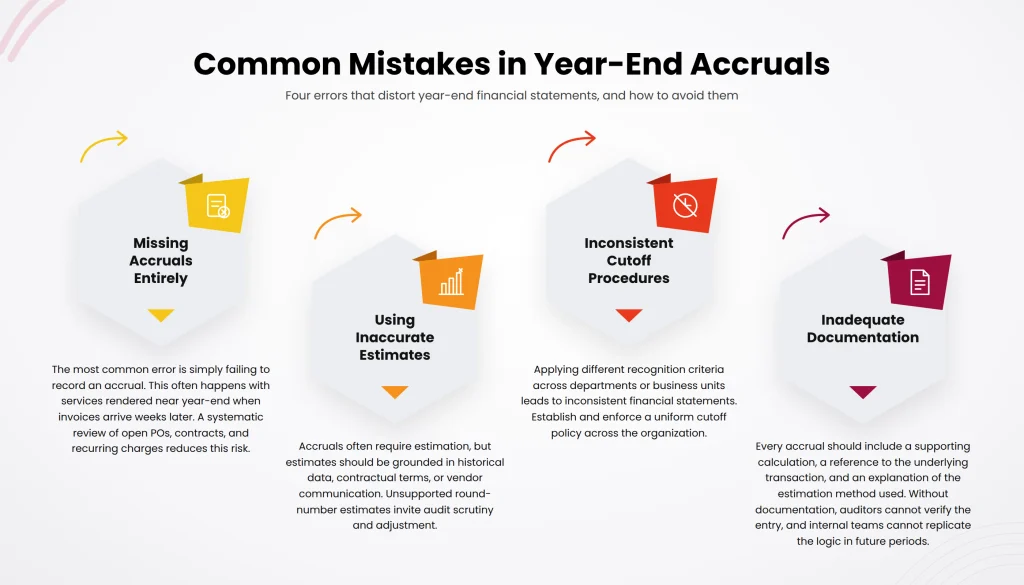
Even experienced accounting professionals encounter recurring issues during the accrual process. The following mistakes are among the most frequent and consequential.
Missing accruals entirely.
The most common error is simply failing to record an accrual. This often happens with services rendered near year-end when invoices arrive weeks later. A systematic review of open POs, contracts, and recurring charges reduces this risk.
Using inaccurate estimates.
Accruals often require estimation, but estimates should be grounded in historical data, contractual terms, or vendor communication. Unsupported round-number estimates invite audit scrutiny and adjustment.
Inconsistent cutoff procedures.
Applying different recognition criteria across departments or business units leads to inconsistent financial statements. Establish and enforce a uniform cutoff policy across the organization.
Inadequate documentation.
Every accrual should include a supporting calculation, a reference to the underlying transaction, and an explanation of the estimation method used. Without documentation, auditors cannot verify the entry, and internal teams cannot replicate the logic in future periods.
Best Practices for Accurate Year-End Accruals
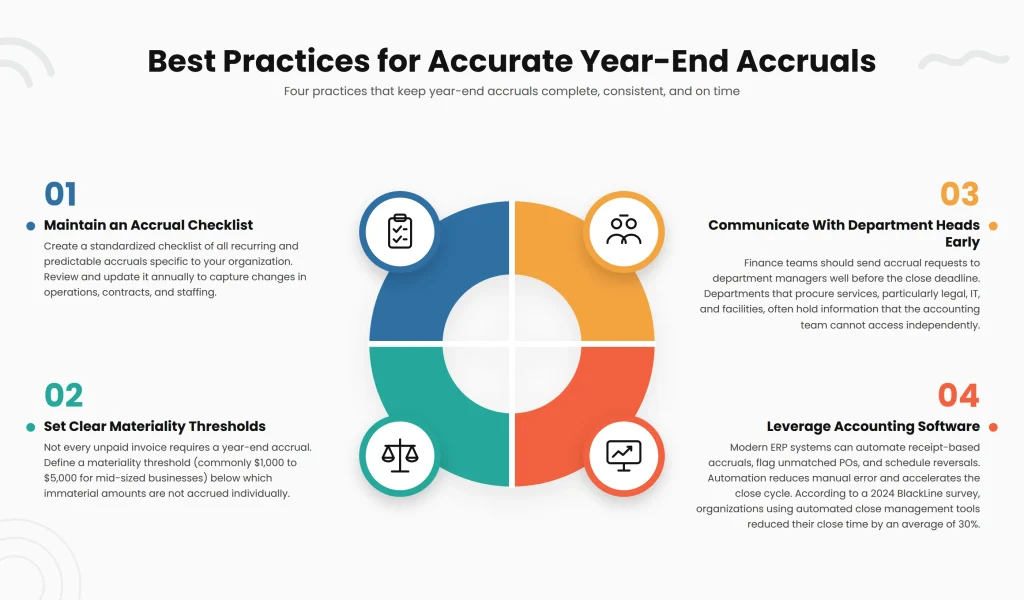
Maintain an accrual checklist.
Create a standardized checklist of all recurring and predictable accruals specific to your organization. Review and update it annually to capture changes in operations, contracts, and staffing.
Set clear materiality thresholds.
Not every unpaid invoice requires a year-end accrual. Define a materiality threshold (commonly $1,000 to $5,000 for mid-sized businesses) below which immaterial amounts are not accrued individually.
Communicate with department heads early.
Finance teams should send accrual requests to department managers well before the close deadline. Departments that procure services, particularly legal, IT, and facilities, often hold information that the accounting team cannot access independently.
Leverage accounting software.
Modern ERP systems can automate receipt-based accruals, flag unmatched POs, and schedule reversals. Automation reduces manual error and accelerates the close cycle. According to a 2024 BlackLine survey, organizations using automated close management tools reduced their close time by an average of 30%.
Build Your Expertise in Accounting and Finance
Year-end accruals sit at the intersection of financial reporting, tax compliance, and strategic decision-making. Mastering them requires a solid foundation in accounting principles, attention to detail, and the ability to exercise professional judgment. Charisma University’s School of Business offers programs designed to build these competencies, from the Bachelor of Science in Accounting and Bachelor of Science in Finance to the MBA and Ph.D. in Forensic Accounting and Audit. Whether you are beginning your career or advancing through graduate study, building expertise in financial close processes is essential preparation for any accounting or finance role.
Frequently Asked Questions
A year-end accrual is an adjusting journal entry that records an expense incurred or revenue earned during the current fiscal year when the corresponding payment has not yet occurred. It ensures financial statements reflect economic activity in the correct period.
GAAP requires businesses to follow the matching principle, which means expenses must be recorded in the same period as the revenues they support. The IRS also requires accrual-method taxpayers to recognize income and expenses when earned or incurred, not when cash changes hands.
The most common types include payroll accruals (wages earned but not yet paid), utility accruals (services consumed but not yet billed), interest accruals (interest accumulated but not yet due), tax accruals (estimated tax liabilities), and professional services accruals (work performed but not yet invoiced).
Missing an accrual understates expenses and overstates net income for the current period, which can lead to inaccurate financial statements, qualified audit opinions, tax discrepancies, and misinformed business decisions.
Most year-end accruals are reversed on the first day of the new fiscal year through an automatic reversing entry. When the actual invoice is later received and paid, it is recorded normally, and the reversal prevents double-counting.
An accounts payable entry is recorded when an invoice has been received and entered into the system. An accrual is recorded when the expense has been incurred but the invoice has not yet been received. Both represent obligations, but accruals are based on estimates or known amounts without formal invoicing.