Artificial intelligence is no longer a future concept in the legal profession. It is an active, measurable force reshaping how lawyers research, draft, review, and deliver legal services. From contract analysis tools that flag risk in seconds to research platforms that summarize case law across jurisdictions, AI in law has moved from experimental pilots to everyday infrastructure.
The shift is happening fast. According to the Thomson Reuters 2026 AI in Professional Services Report, 41% of law firms and 47% of corporate legal departments now use generative AI, up from 28% and 23% respectively in 2025. The global legaltech AI market reached $3.7 billion in 2026 and is projected to grow to $11.06 billion by 2030 at a 31.5% compound annual growth rate.
For legal professionals and students entering the field, understanding how AI is transforming the practice of law is no longer optional. It is a core competency.
How AI Is Being Used in Legal Practice
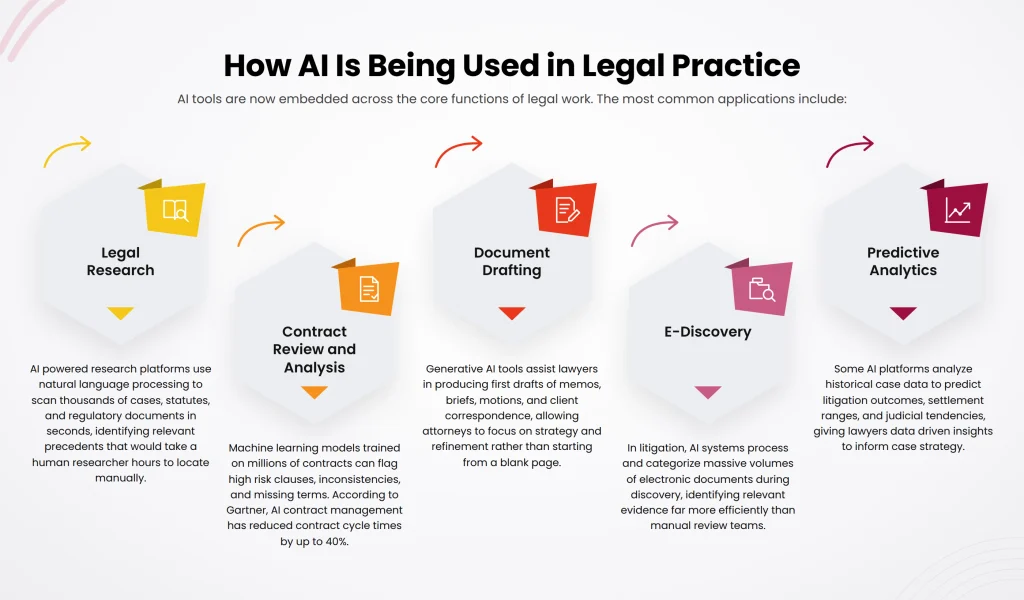
AI tools are now embedded across the core functions of legal work. The most common applications include:
Legal research
AI powered research platforms use natural language processing to scan thousands of cases, statutes, and regulatory documents in seconds, identifying relevant precedents that would take a human researcher hours to locate manually.
Contract review and analysis
Machine learning models trained on millions of contracts can flag high risk clauses, inconsistencies, and missing terms. According to Gartner, AI contract management has reduced contract cycle times by up to 40%.
Document drafting
Generative AI tools assist lawyers in producing first drafts of memos, briefs, motions, and client correspondence, allowing attorneys to focus on strategy and refinement rather than starting from a blank page.
E-discovery
In litigation, AI systems process and categorize massive volumes of electronic documents during discovery, identifying relevant evidence far more efficiently than manual review teams.
Predictive analytics
Some AI platforms analyze historical case data to predict litigation outcomes, settlement ranges, and judicial tendencies, giving lawyers data driven insights to inform case strategy.
AI in Law: Adoption by the Numbers
The pace of AI adoption across the legal industry has accelerated sharply since 2023. Here is where things stand in 2026 based on verified industry data:
- The American Bar Association reports that 30% of lawyers now use AI based tools, nearly triple the 11% figure from 2023.
- Large firms with 500 or more attorneys lead adoption at 47.8%, while solo practitioners trail at 17.7% (ABA Technology Survey 2024).
- Corporate legal departments are outpacing law firms: in house AI adoption more than doubled from 23% to 52% in a single year (ACC and Everlaw).
- 78% of law firm respondents expect AI to become central to their workflow within five years (Thomson Reuters 2025).
- Thomson Reuters estimates AI could free up approximately 240 hours per lawyer per year, roughly $19,000 worth of billable time.
- 66% of lawyers report that AI frees them to focus on strategic, high value work (Thomson Reuters Future of Professionals Report 2025).
Despite rapid adoption, a governance gap persists. According to the ABA’s Task Force on Law and Artificial Intelligence, AI is “rapidly becoming core infrastructure for law practice, courts, legal education, and access to justice efforts,” yet many firms still lack formal AI use policies.
AI-Assisted Legal Work vs. Traditional Legal Work
The following table compares how key legal tasks are performed with and without AI tools:
| Legal Task | Traditional Approach | AI-Assisted Approach |
|---|---|---|
| Legal Research | Manual review of case databases, statutes, and secondary sources; hours to days per issue | NLP powered platforms scan thousands of sources in seconds; results summarized with citations |
| Contract Review | Line by line manual reading; one contract can take 1 to 2 hours | Machine learning flags high risk clauses, missing terms, and deviations in minutes |
| Document Drafting | Attorney writes from scratch or adapts prior templates | Generative AI produces first drafts; attorney reviews, refines, and applies judgment |
| E-Discovery | Teams of reviewers manually sort thousands of documents | AI classifies, prioritizes, and tags relevant documents automatically |
| Case Outcome Prediction | Based on attorney experience and intuition | Predictive models analyze historical data for probability ranges and settlement benchmarks |
| Billing and Time Tracking | Manual time entry; prone to human error and underbilling | AI captures and categorizes time automatically, reducing revenue leakage |
Key takeaway: AI does not eliminate the need for legal expertise. It shifts where that expertise is applied, moving lawyers from repetitive execution toward analysis, judgment, and client strategy.
Benefits of AI in the Legal Profession
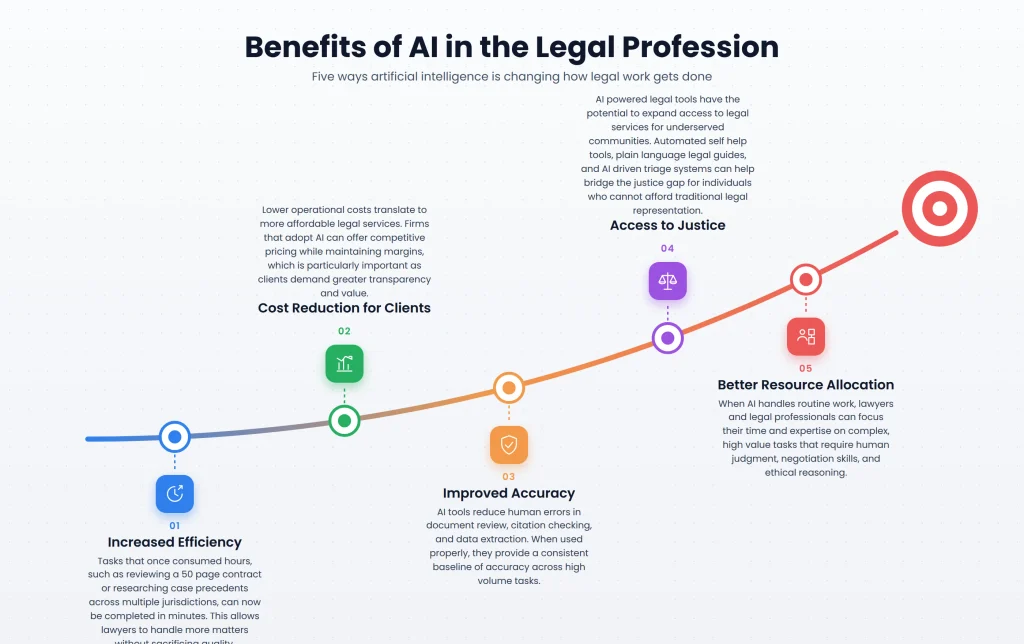
Increased efficiency
Tasks that once consumed hours, such as reviewing a 50 page contract or researching case precedents across multiple jurisdictions, can now be completed in minutes. This allows lawyers to handle more matters without sacrificing quality.
Cost reduction for clients
Lower operational costs translate to more affordable legal services. Firms that adopt AI can offer competitive pricing while maintaining margins, which is particularly important as clients demand greater transparency and value.
Improved accuracy
AI tools reduce human errors in document review, citation checking, and data extraction. When used properly, they provide a consistent baseline of accuracy across high volume tasks.
Access to justice
AI powered legal tools have the potential to expand access to legal services for underserved communities. Automated self help tools, plain language legal guides, and AI driven triage systems can help bridge the justice gap for individuals who cannot afford traditional legal representation.
Better resource allocation
When AI handles routine work, lawyers and legal professionals can focus their time and expertise on complex, high value tasks that require human judgment, negotiation skills, and ethical reasoning.
Challenges and Ethical Concerns of AI in Law
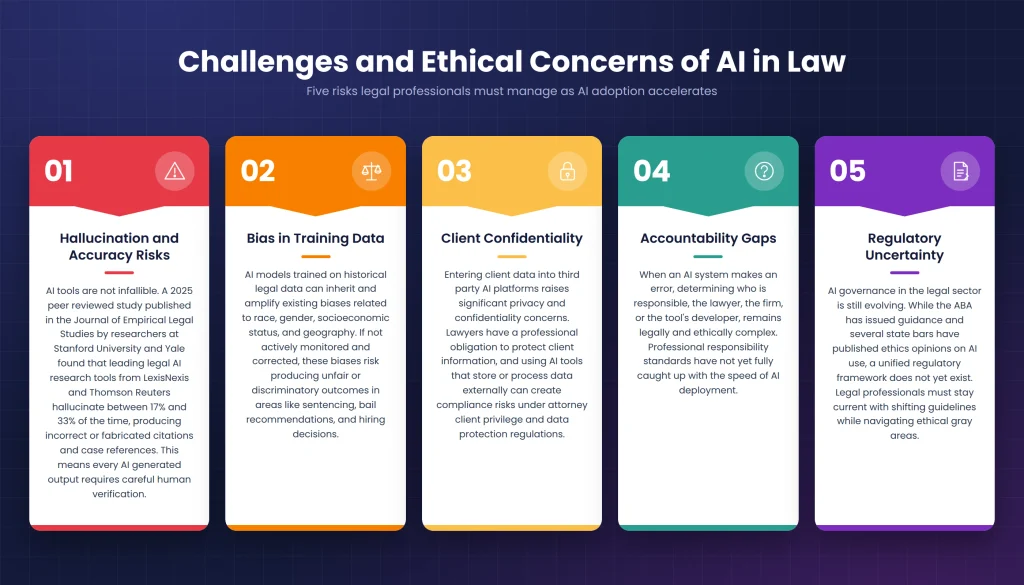
Hallucination and accuracy risks
AI tools are not infallible. A 2025 peer reviewed study published in the Journal of Empirical Legal Studies by researchers at Stanford University and Yale found that leading legal AI research tools from LexisNexis and Thomson Reuters hallucinate between 17% and 33% of the time, producing incorrect or fabricated citations and case references. This means every AI generated output requires careful human verification.
Bias in training data
AI models trained on historical legal data can inherit and amplify existing biases related to race, gender, socioeconomic status, and geography. If not actively monitored and corrected, these biases risk producing unfair or discriminatory outcomes in areas like sentencing, bail recommendations, and hiring decisions.
Client confidentiality
Entering client data into third party AI platforms raises significant privacy and confidentiality concerns. Lawyers have a professional obligation to protect client information, and using AI tools that store or process data externally can create compliance risks under attorney client privilege and data protection regulations.
Accountability gaps
When an AI system makes an error, determining who is responsible, the lawyer, the firm, or the tool’s developer, remains legally and ethically complex. Professional responsibility standards have not yet fully caught up with the speed of AI deployment.
Regulatory uncertainty
AI governance in the legal sector is still evolving. While the ABA has issued guidance and several state bars have published ethics opinions on AI use, a unified regulatory framework does not yet exist. Legal professionals must stay current with shifting guidelines while navigating ethical gray areas.
Will AI Replace Lawyers?
The short answer is no. The data does not support the replacement narrative, but it does support a significant restructuring of legal work.
Goldman Sachs estimated in 2023 that 44% of legal tasks could be automated by generative AI, the second highest exposure of any profession after clerical work. However, by 2025, Goldman Sachs revised the actual job loss exposure down to approximately 17% of legal employment, about 228,000 of the roughly 1.32 million lawyers in the United States.
More importantly, the U.S. Bureau of Labor Statistics reported that legal employment reached a record 1,208,100 jobs in December 2025, and the BLS projects 4% employment growth for lawyers through 2034. Am Law 100 firms posted record gross revenues of $158.3 billion in fiscal 2024, up 13.3% year over year. None of the AmLaw 100 firms currently anticipate reducing attorney headcount because of AI.
The roles most directly affected are support positions. McKinsey estimates that approximately 69% of paralegal tasks could be automated with current technology. The World Economic Forum’s 2025 Future of Jobs Report lists legal secretaries among the fastest declining occupations globally. For lawyers, AI is changing what they do, not whether they are needed.
How Legal Professionals Can Prepare for AI
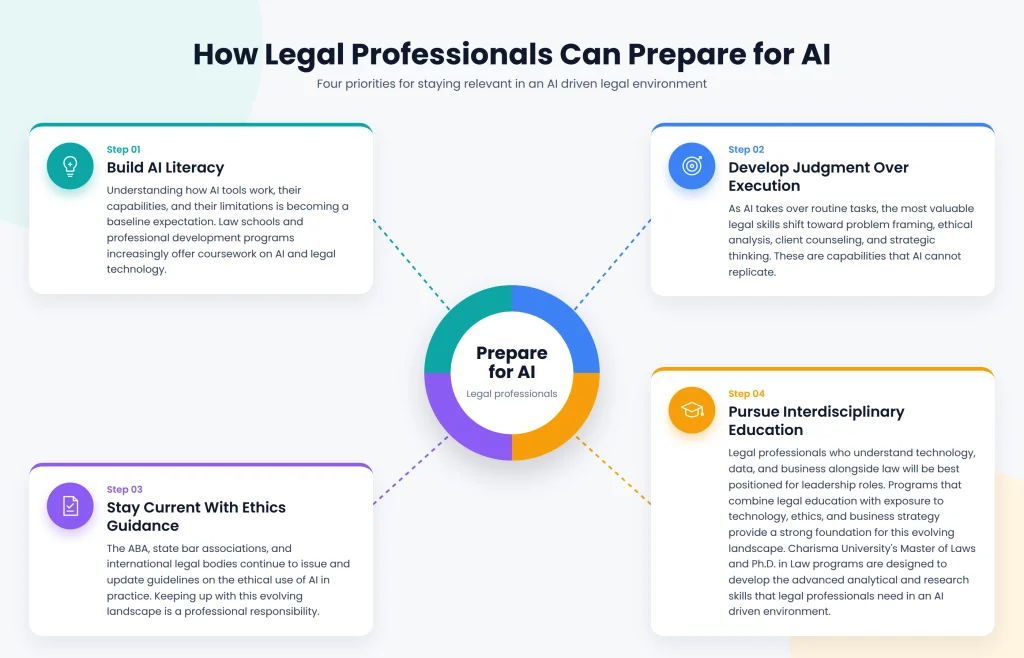
Build AI literacy
Understanding how AI tools work, their capabilities, and their limitations is becoming a baseline expectation. Law schools and professional development programs increasingly offer coursework on AI and legal technology.
Develop judgment over execution
As AI takes over routine tasks, the most valuable legal skills shift toward problem framing, ethical analysis, client counseling, and strategic thinking. These are capabilities that AI cannot replicate.
Stay current with ethics guidance
The ABA, state bar associations, and international legal bodies continue to issue and update guidelines on the ethical use of AI in practice. Keeping up with this evolving landscape is a professional responsibility.
Pursue interdisciplinary education
Legal professionals who understand technology, data, and business alongside law will be best positioned for leadership roles. Programs that combine legal education with exposure to technology, ethics, and business strategy provide a strong foundation for this evolving landscape. Charisma University’s Master of Laws and Ph.D. in Law programs are designed to develop the advanced analytical and research skills that legal professionals need in an AI driven environment.
How Charisma University Prepares Future Legal Professionals
The intersection of AI and law requires graduates who can think critically, reason ethically, and adapt to technological change. Charisma University’s School of Law programs build exactly these competencies, combining rigorous legal education with the analytical and research skills that the modern legal profession demands.
Whether you are beginning your legal education or advancing your career through graduate study, understanding the role of AI in law is essential preparation for the challenges and opportunities ahead.
Frequently Asked Questions
How is AI used in law?
AI is used for legal research, contract review, document drafting, e-discovery, predictive analytics, and automated compliance monitoring. These tools help lawyers work faster and more accurately on high volume, repetitive tasks.
Will AI replace lawyers?
No. AI is restructuring legal work by automating routine tasks, but it is not replacing the need for human judgment, ethical reasoning, and client relationships. U.S. legal employment reached a record high in 2025, and the BLS projects continued growth through 2034.
How accurate is legal AI?
Legal AI tools have improved significantly but are not error free. A 2025 Stanford study found that leading legal research tools hallucinate between 17% and 33% of the time. Every AI output should be reviewed and verified by a qualified legal professional.
What percentage of law firms use AI?
As of 2026, 41% of law firms use generative AI according to Thomson Reuters. The ABA reports that 30% of individual lawyers use AI based tools, with adoption rates highest at large firms (47.8%) and lowest among solo practitioners (17.7%).
What legal jobs are most at risk from AI?
Support roles face the most direct impact. McKinsey estimates 69% of paralegal tasks could be automated, and the WEF lists legal secretaries among the fastest declining occupations. Lawyers themselves face task restructuring rather than replacement.
Is AI in law regulated?
AI governance in the legal sector is still developing. The ABA has issued guidance, and several state bars have published ethics opinions on AI use. A comprehensive regulatory framework does not yet exist, and legal professionals are expected to exercise judgment and maintain human oversight.