Explicit instruction is one of the most extensively researched teaching approaches in education. As Torgesen (2004) described it, explicit instruction is “instruction that does not leave anything to chance and does not make assumptions about skills and knowledge that children will acquire on their own.” This guide covers what explicit instruction involves, the research behind it, its core elements, and how educators can apply it effectively across subjects and grade levels.
Defining Explicit Instruction
Explicit instruction is a purposeful way of overtly teaching students using clear, direct explanations combined with modeling, guided practice, and independent practice. The term “explicit” means that the teaching is clear cut and intentional. Nothing is implied or left for students to figure out without support.
Archer and Hughes (2011), in their foundational text “Explicit Instruction: Effective and Efficient Teaching,” define it as a structured, systematic approach to teaching that includes both instructional design principles and delivery techniques. Instruction is explicit when teachers tell students directly what they need to do, demonstrate new skills through modeling, and provide multiple opportunities for practice with corrective feedback.
The Research Behind Explicit Instruction
What the Data Shows
John Hattie’s “Visible Learning,” a synthesis of over 800 meta-analyses involving more than 80 million students, found that explicit teaching produces an effect size of 0.57, well above the 0.40 threshold for meaningful learning gains. Teacher clarity, a closely related factor, scored even higher at 0.75. In mathematics, the Australian Education Research Organisation (AERO) found effect sizes ranging from 0.55 to 1.22 across five meta-analyses, confirming strong impact regardless of year level.
Consistency Across Subjects, Ages, and Learner Profiles
Stockard et al. (2018) analyzed 328 Direct Instruction studies and found no other curricular program produced such consistently strong effects across ability levels, ages, and content areas, with an average effect size of 0.69 in the Adams and Engelmann meta-analysis. A separate review of 108 studies with 580 comparisons confirmed that explicit instruction significantly outperformed unassisted discovery learning (d = 0.38). These findings apply equally in special education: half of the AERO meta-analyses focused on students with additional learning needs, and results showed explicit instruction benefits these learners as much as, and often more than, their peers.
The 16 Core Elements of Explicit Instruction
Archer and Hughes identified 16 elements of effective explicit instruction, organized across instructional design and delivery. These elements work together as a system rather than as isolated techniques.
Instructional Design Elements
Focus on critical content
Prioritize the most important concepts and skills students need to master. Time spent on nonessential content reduces the time available for foundational knowledge.
Sequence skills logically
Teach prerequisite skills before more complex ones. Instruction should move from simple to complex, with each new skill building on what students already know.
Begin with a review of prior knowledge
Connecting new material to what students already know strengthens retention and provides a foundation for new learning.
Break complex skills into smaller steps
Large tasks become manageable when divided into components. Students master each component before combining them into the full skill.
Design organized and focused lessons
Every lesson should have a clear objective, a logical structure, and a defined outcome. Students should know what they are learning and why.
Provide clear and concise language
Use direct, unambiguous explanations. Avoid unnecessary complexity in instructions or descriptions. The clearer the language, the less cognitive load on the learner.
Delivery Elements
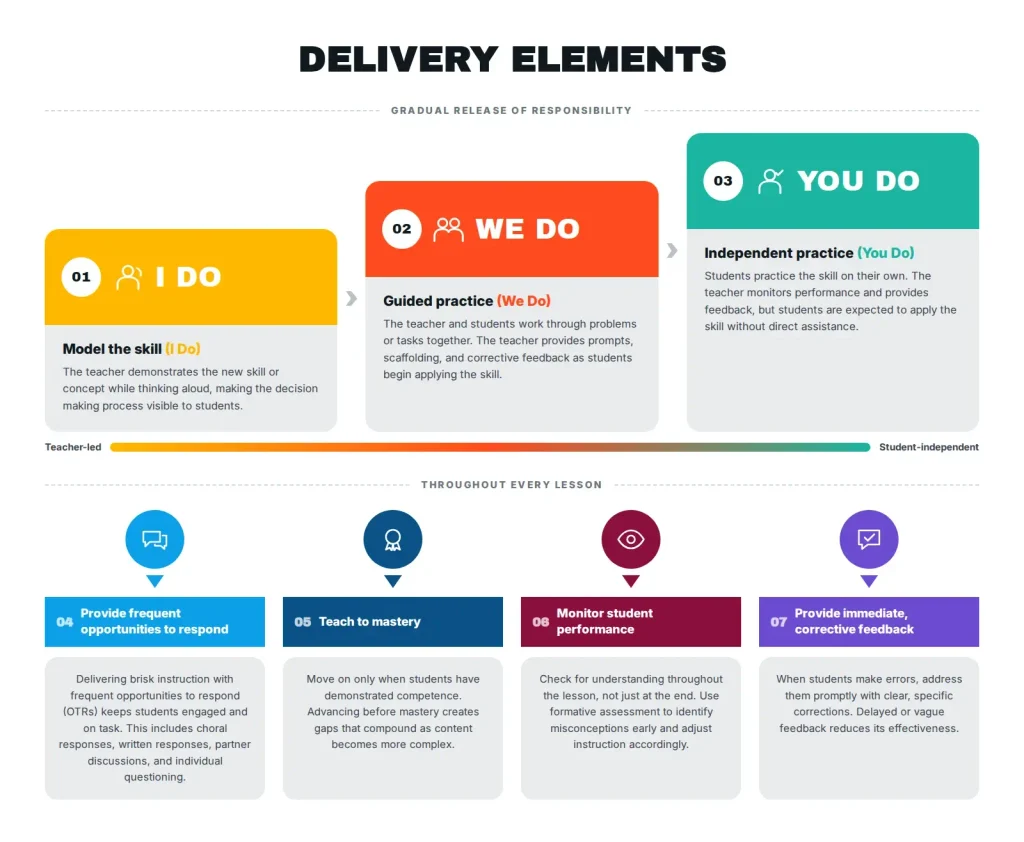
Model the skill (I Do)
The teacher demonstrates the new skill or concept while thinking aloud, making the decision making process visible to students.
Guided practice (We Do)
The teacher and students work through problems or tasks together. The teacher provides prompts, scaffolding, and corrective feedback as students begin applying the skill.
Independent practice (You Do)
Students practice the skill on their own. The teacher monitors performance and provides feedback, but students are expected to apply the skill without direct assistance.
Provide frequent opportunities to respond
Delivering brisk instruction with frequent opportunities to respond (OTRs) keeps students engaged and on task. This includes choral responses, written responses, partner discussions, and individual questioning.
Teach to mastery
Move on only when students have demonstrated competence. Advancing before mastery creates gaps that compound as content becomes more complex.
Monitor student performance
Check for understanding throughout the lesson, not just at the end. Use formative assessment to identify misconceptions early and adjust instruction accordingly.
Provide immediate, corrective feedback
When students make errors, address them promptly with clear, specific corrections. Delayed or vague feedback reduces its effectiveness.
The I Do, We Do, You Do Model
The gradual release of the responsibility framework, commonly known as I Do, We Do, You Do, is the instructional backbone of explicit instruction.
I Do (Modeling)
The teacher demonstrates the skill while explaining each step aloud. Students observe and listen. The purpose is to show exactly what the expected performance looks like.
We Do (Guided Practice)
The teacher and students work through the skill together. The teacher gradually reduces support as students demonstrate increasing competence. This phase is where most corrective feedback occurs.
You Do (Independent Practice)
Students apply the skill independently while the teacher monitors, assesses, and provides feedback. This stage confirms whether students have internalized the skill.
This structure ensures that students are never asked to perform a skill they have not first seen modeled and practiced with support. It systematically builds confidence and competence before releasing full responsibility to the learner.
Explicit Instruction vs. Inquiry Based Learning
One of the most debated topics in education is whether explicit instruction or inquiry based learning produces better outcomes. The following table compares the two approaches:
| Dimension | Explicit Instruction | Inquiry Based Learning |
|---|---|---|
| Teacher Role | Teacher led; models, explains, and guides | Facilitator; sets up problems, guides exploration |
| Student Role | Active responder; practices with feedback | Active explorer; investigates and constructs understanding |
| Structure | Highly structured, sequenced, and scaffolded | More open ended; students direct parts of the learning |
| Best For | Novice learners, foundational skills, new content | Learners with prior knowledge, application and transfer |
| Cognitive Load | Manages cognitive load by breaking content into steps | Can overload working memory if students lack prerequisite knowledge |
| Feedback | Immediate, corrective, teacher directed | Delayed; often peer or self directed |
| Risk | Can become overly rigid if used exclusively | Can lead to misconceptions if students lack sufficient background knowledge |
The research consensus, supported by scholars including Kirschner, Sweller, and Clark (2006) and reaffirmed in a 2023 exchange in the Educational Research Review, is that explicit instruction is essential for novice learners, while inquiry based approaches become more effective as students develop foundational knowledge and expertise. The most effective educators use both strategically, matching the approach to the learner’s readiness and the complexity of the content.
Where Explicit Instruction Is Most Effective
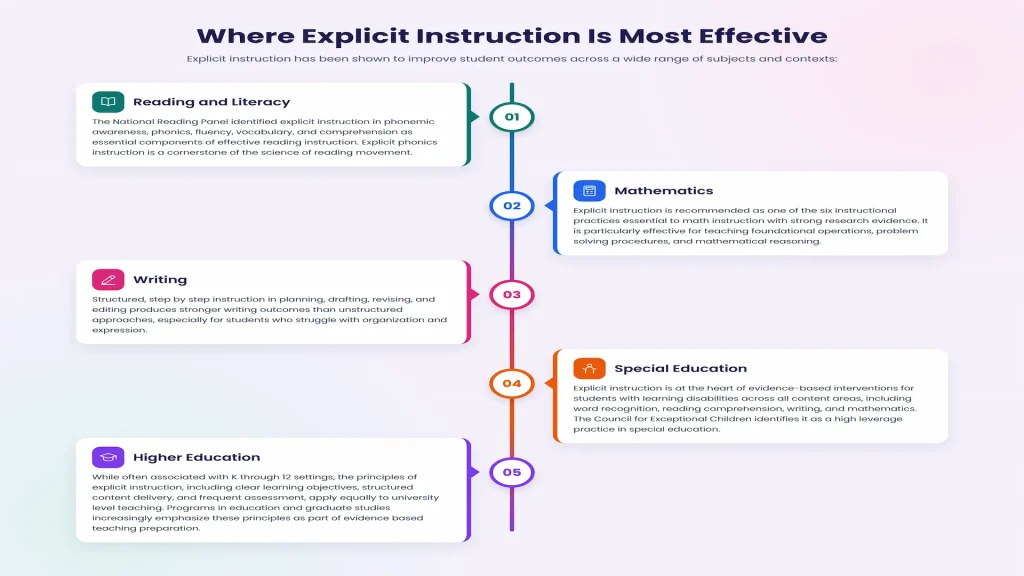
Explicit instruction has been shown to improve student outcomes across a wide range of subjects and contexts:
Reading and literacy
The National Reading Panel identified explicit instruction in phonemic awareness, phonics, fluency, vocabulary, and comprehension as essential components of effective reading instruction. Explicit phonics instruction is a cornerstone of the science of reading movement.
Mathematics
Explicit instruction is recommended as one of the six instructional practices essential to math instruction with strong research evidence. It is particularly effective for teaching foundational operations, problem solving procedures, and mathematical reasoning.
Writing
Structured, step by step instruction in planning, drafting, revising, and editing produces stronger writing outcomes than unstructured approaches, especially for students who struggle with organization and expression.
Special education
Explicit instruction is at the heart of evidence-based interventions for students with learning disabilities across all content areas, including word recognition, reading comprehension, writing, and mathematics. The Council for Exceptional Children identifies it as a high leverage practice in special education.
Higher education.
While often associated with K through 12 settings, the principles of explicit instruction, including clear learning objectives, structured content delivery, and frequent assessment, apply equally to university level teaching. Programs in education and graduate studies increasingly emphasize these principles as part of evidence based teaching preparation.
Common Misconceptions About Explicit Instruction
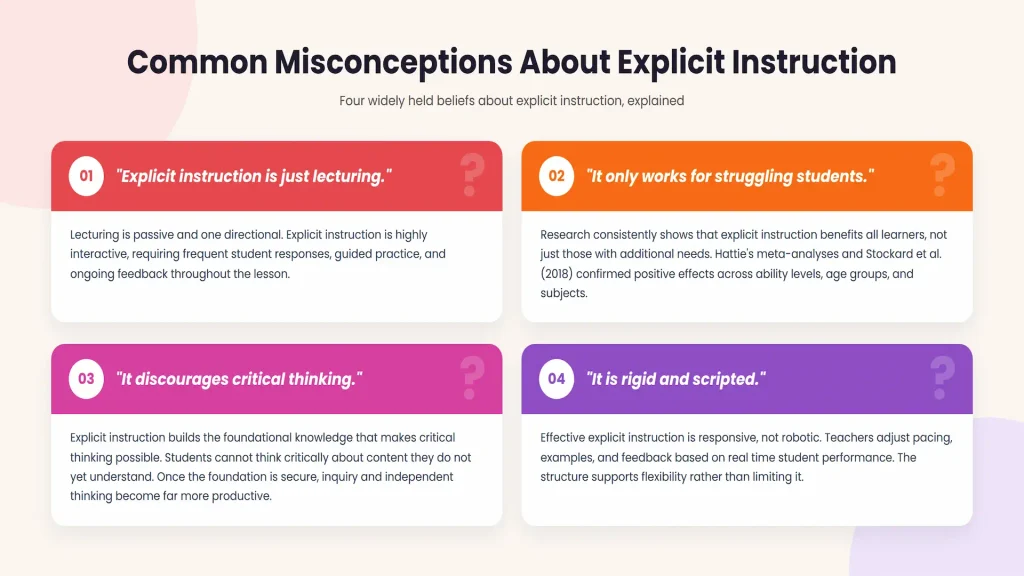
“Explicit instruction is just lecturing.”
Lecturing is passive and one directional. Explicit instruction is highly interactive, requiring frequent student responses, guided practice, and ongoing feedback throughout the lesson.
“It only works for struggling students.”
Research consistently shows that explicit instruction benefits all learners, not just those with additional needs. Hattie’s meta-analyses and Stockard et al. (2018) confirmed positive effects across ability levels, age groups, and subjects.
“It discourages critical thinking.”
Explicit instruction builds the foundational knowledge that makes critical thinking possible. Students cannot think critically about content they do not yet understand. Once the foundation is secure, inquiry and independent thinking become far more productive.
“It is rigid and scripted.”
Effective explicit instruction is responsive, not robotic. Teachers adjust pacing, examples, and feedback based on real time student performance. The structure supports flexibility rather than limiting it.
How Charisma University Prepares Effective Educators
Developing the ability to deliver clear, structured, evidence based instruction is a core competency for any educator. Charisma University’s School of Education programs, from the Bachelor of Education through the Doctor of Education, equip students with both theoretical understanding and practical skills to implement research backed teaching strategies in real classrooms. Whether you are entering the profession or advancing your expertise through graduate study, understanding explicit instruction is essential to becoming an effective, evidence informed educator.
Frequently Asked Questions
What is explicit instruction in simple terms?
Explicit instruction is a teaching method where the teacher directly explains, models, and guides students through new skills step by step before asking them to practice independently. It is designed to be clear, structured, and intentional.
What is the I Do, We Do, You Do model?
It is the gradual release of the responsibility framework used in explicit instruction. The teacher first demonstrates the skill (I Do), then practices it together with students (We Do), and finally has students practice independently (You Do).
Does explicit instruction work for all students?
Yes. Research shows that explicit instruction benefits learners across all ability levels, age groups, and subjects. It is especially effective for novice learners and students with additional learning needs, but it produces positive outcomes for all students.
Is explicit instruction the same as direct instruction?
They are closely related but not identical. Direct Instruction (capitalized) refers to a specific, scripted curriculum developed by Siegfried Engelmann. Explicit instruction (lowercase) is a broader set of instructional principles that include clear modeling, guided practice, and corrective feedback, applicable across any curriculum.
How is explicit instruction different from inquiry based learning?
Explicit instruction is teacher led and highly structured, with the teacher modeling skills before students practice. Inquiry based learning is more student directed, with learners exploring and constructing understanding through investigation. Research supports using explicit instruction first for novices, then incorporating inquiry as students build knowledge.
What subjects benefit from explicit instruction?
Explicit instruction has been shown to be effective in reading, mathematics, writing, science, and special education. Its principles apply to virtually any subject where students need to acquire new knowledge or skills.