You walk into a networking event, and someone asks, “So, what do you do?” Your mind goes blank. You stumble through a scattered explanation, and by the time you find your words, the moment has passed.
The solution is an elevator pitch, a prepared, practiced introduction that communicates who you are, what you offer, and why it matters, all within 30 to 60 seconds. This guide breaks down exactly how to build one, deliver it with confidence, and adapt it for any professional scenario.
What Is an Elevator Pitch?
An elevator pitch is a brief, persuasive introduction that summarizes who you are, what you do, and the value you bring, delivered in roughly the time it takes to ride an elevator, which is typically 30 to 60 seconds or about 75 to 150 words.
The term originated in the business world, where the idea was simple: if you stepped into an elevator with a senior executive, you had the length of that ride to pitch your idea before the doors opened and the opportunity walked away.
Today, elevator pitches extend far beyond corporate lobbies. Students use them at career fairs, job seekers deliver them in interviews, entrepreneurs pitch to investors, and professionals use them at conferences, on LinkedIn, and in everyday conversations that lead to unexpected opportunities.
Why Do You Need an Elevator Pitch?
According to the U.S. Bureau of Labor Statistics, approximately 70% of all jobs are found through networking. Research from Princeton University psychologists Janine Willis and Alexander Todorov found that people form judgments about traits like trustworthiness, competence, and likability in as little as one-tenth of a second. Those snap judgments, once formed, are remarkably resistant to change, a phenomenon psychologists call the primacy effect.
With those realities in mind, here is why a prepared elevator pitch matters:
Make a strong first impression:
An elevator pitch helps you introduce yourself clearly and confidently when meeting someone for the first time. Since initial judgments are formed almost instantly, a well-prepared opening sets a positive tone from the start.
Be prepared for networking opportunities:
Research shows that 85% of all positions are filled through personal connections, and up to 70% of job openings are never publicly advertised. A pitch ensures you are ready whenever an unexpected opportunity presents itself.
Communicate your value quickly:
A well-prepared pitch allows you to highlight your skills, experience, interests, and career goals without giving your entire résumé. Research by Dr. Gloria Mark at the University of California, Irvine, shows that average attention spans on screens have dropped from 2.5 minutes in 2004 to roughly 47 seconds today, making concise communication more important than ever.
Build professional connections:
According to a 2025 Wave Connect report, 80% of professionals consider networking essential for career growth, and 70% were hired at a company where they already had a connection. A clear pitch makes it easier for others to remember you and offer relevant opportunities.
Speak with greater confidence:
Practicing your pitch beforehand means you are less likely to struggle for words when an unexpected networking or career opportunity comes your way.
The Importance of Having an Elevator Pitch Ready
An elevator pitch does more than introduce you. It serves several practical functions that compound over time:
Build your personal brand
Every time you describe yourself to someone new, you are shaping how they perceive you. A well-crafted pitch ensures that perception is consistent, intentional, and aligned with your professional goals.
Forces clarity
Writing a 60-second introduction requires you to strip away the unnecessary and focus on what truly defines your professional value. That process alone sharpens your self-awareness and career direction.
Demonstrates preparedness
Showing up with a polished pitch signals professionalism. It tells recruiters, clients, and collaborators that you take your career seriously and have done the work to articulate your strengths.
Opens doors you cannot plan for
Opportunities do not always arrive in scheduled interviews or formal meetings. They happen at conferences, in coffee shops, at social gatherings, and yes, in actual elevators. A prepared pitch means you are ready whenever these moments arise.
Key Elements of an Effective Elevator Pitch
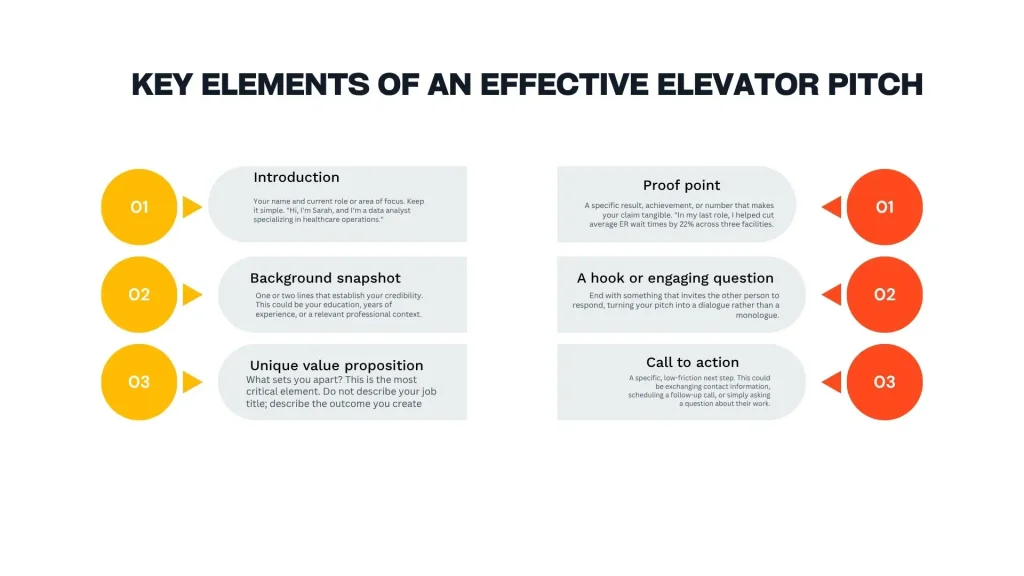
Every strong elevator pitch contains the same core building blocks, regardless of industry or experience level:
Introduction
Your name and current role or area of focus. Keep it simple. “Hi, I’m Sarah, and I’m a data analyst specializing in healthcare operations.”
Background snapshot
One or two lines that establish your credibility. This could be your education, years of experience, or a relevant professional context.
Unique value proposition
What sets you apart? This is the most critical element. Do not describe your job title; describe the outcome you create. “I help hospitals reduce patient wait times by identifying bottlenecks in their scheduling systems” is far stronger than “I work with data.”
Proof point
A specific result, achievement, or number that makes your claim tangible. “In my last role, I helped cut average ER wait times by 22% across three facilities.”
A hook or engaging question
End with something that invites the other person to respond, turning your pitch into a dialogue rather than a monologue.
Call to action
A specific, low-friction next step. This could be exchanging contact information, scheduling a follow-up call, or simply asking a question about their work.
How to Craft Your Elevator Pitch: A Step-by-Step Process
Step 1: Define your goal and audience
Before writing a single word, ask yourself who will hear this pitch and what you want them to do after hearing it. A pitch for a hiring manager is fundamentally different from one aimed at a potential client or investor.
Step 2: Describe what you do in terms of outcomes
Replace job-title language with impact language. Instead of “I’m a marketing manager,” try “I help B2B companies generate qualified leads through content strategies that consistently outperform paid advertising.”
Step 3: Identify what makes you different
Think about your specific combination of skills, experiences, and perspectives. What can you offer that someone else in your field cannot? This does not need to be revolutionary; even a unique approach or niche expertise counts.
Step 4: Add a concrete proof point
Numbers speak louder than adjectives. A single statistic, result, or achievement does more to establish credibility than any amount of self-description.
Step 5: Close with a call to action or question
Do not let the conversation die after your pitch. Ask something relevant: “What has been your team’s biggest hurdle this quarter?”
Step 6: Edit ruthlessly
Read it aloud and time it. If it exceeds 60 seconds, cut. Every sentence must earn its place.
Elevator Pitch Template
Use this fill-in framework as a starting point, then refine it until it sounds natural:
“Hi, I’m [Name]. I [what you do / your role] helps [target audience] achieve [specific outcome] by [your method or approach]. Recently, I [one proof point — achievement, result, or milestone]. I’d love to learn more about [something relevant to the listener] — [engaging question or CTA].”
Example: “Hi, I’m James. I’m a supply chain consultant who helps mid-sized manufacturers reduce production delays by streamlining their vendor management processes. Last year, I helped a client cut their lead times by 35% while reducing procurement costs. I’d love to hear how your team handles vendor coordination; is that something you’re looking to improve?”
The 3 C’s of a Great Elevator Pitch
A useful framework for evaluating your pitch is the 3 C’s:
Clear:
Use plain, straightforward language. If your pitch requires industry jargon to make sense, rewrite it. A strong pitch should be understood by someone with no background in your field.
Concise:
Respect the time constraint. Thirty to sixty seconds is the target. Going longer signals that you cannot prioritize your own message, which is not the impression you want to leave.
Compelling:
Your pitch should create curiosity. The goal is not to tell your entire story; it is to say just enough that the listener wants to hear more.
Elevator Pitch Examples for Different Scenarios
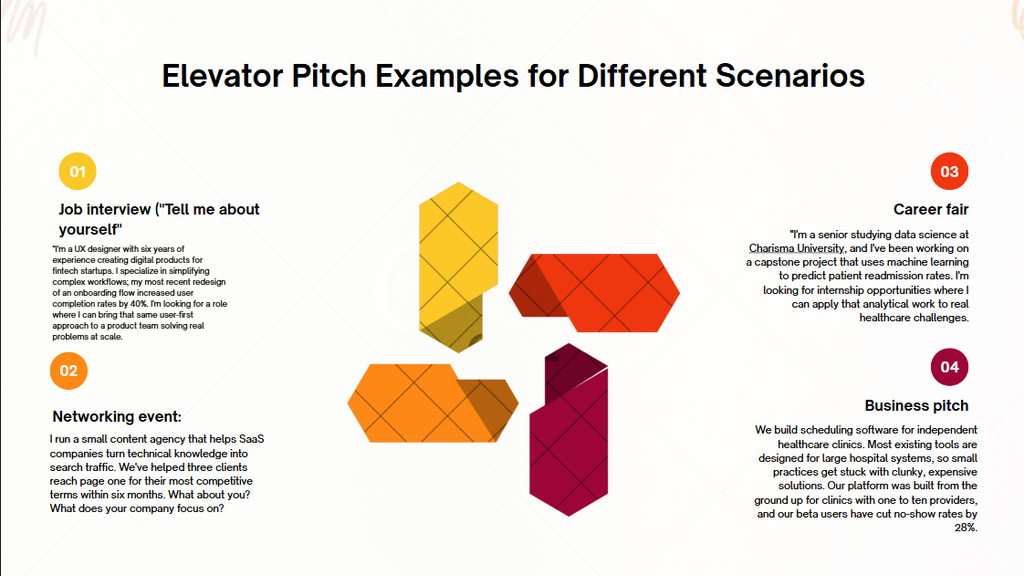
Job interview (“Tell me about yourself”): “I’m a UX designer with six years of experience creating digital products for fintech startups. I specialize in simplifying complex workflows; my most recent redesign of an onboarding flow increased user completion rates by 40%. I’m looking for a role where I can bring that same user-first approach to a product team solving real problems at scale.”
Networking event: “I run a small content agency that helps SaaS companies turn technical knowledge into search traffic. We’ve helped three clients reach page one for their most competitive terms within six months. What about you? What does your company focus on?”
Career fair (student): “I’m a senior studying data science at Charisma University, and I’ve been working on a capstone project that uses machine learning to predict patient readmission rates. I’m looking for internship opportunities where I can apply that analytical work to real healthcare challenges.”
Business pitch: “We build scheduling software for independent healthcare clinics. Most existing tools are designed for large hospital systems, so small practices get stuck with clunky, expensive solutions. Our platform was built from the ground up for clinics with one to ten providers, and our beta users have cut no-show rates by 28%.”
Body Language and Delivery Tips
A strong elevator pitch is not just about the words you use. Your body language, tone, and delivery also influence how confidently and naturally your message comes across. Research shows that candidates have just 7 seconds to make a first impression, and 33% of recruiters know within the first 90 seconds whether they will hire someone. The well-known 55% body language, 38% tone, and 7% words figures associated with Albert Mehrabian apply to specific situations involving feelings and attitudes, rather than communication in general. The broader takeaway is still useful: how you deliver your pitch matters.
Maintain Natural Eye Contact
Aim for comfortable, natural eye contact while speaking, roughly 60 to 80% of the time. Avoid constantly looking away, but also avoid staring intensely. Balanced eye contact helps you appear engaged and confident.
Use an Open Posture
Keep your arms relaxed and uncrossed. Face the person you are speaking to and keep your shoulders relaxed. This open posture communicates interest and approachability, a nonverbal cue psychologists call fronting.
Use Gestures Purposefully
Hand gestures can help emphasize important points, but keep them natural and controlled. Too much movement distracts your listener from what you are saying.
Control Your Speaking Pace
Avoid rushing through your pitch, especially when you feel nervous. Speak clearly and pause briefly between important points. A steady pace makes your message easier to understand and gives your key ideas time to register.
Smile Naturally
A natural smile makes you appear more approachable and enthusiastic. Recruitment research shows that 40% of hiring managers cite a candidate’s voice quality and lack of smile as reasons for rejection. Let your expression match the tone of your conversation rather than forcing a smile throughout your pitch.
Sound Conversational, Not Memorized
Practice your pitch enough to remember the key points, but avoid sounding like you are reciting a script. Your goal is to have a natural conversation, not deliver a speech.
Adapting Your Pitch for Different Audiences
A one-size-fits-all elevator pitch rarely works. Prepare variations for different contexts:
- When speaking to recruiters or hiring managers, lead with your impact and career narrative. Focus on results that align with the role you are pursuing.
- When addressing potential clients, emphasize the specific value you deliver and the problems you solve. Frame your pitch around their pain points, not your credentials.
- When pitching to investors, open with traction, revenue, users, growth rate, or market size. Investors want to see evidence, not enthusiasm alone. Developing strong entrepreneurial skills can help you articulate this kind of value clearly.
- When meeting peers or industry professionals, speak to your perspective and what drives your work. The goal here is connection and mutual learning, not a transaction.
- It also helps to prepare three versions: a 15-second version for brief introductions, a 30-second version for standard networking, and a 60-second version for interviews or more formal settings.
Common Elevator Pitch Mistakes to Avoid
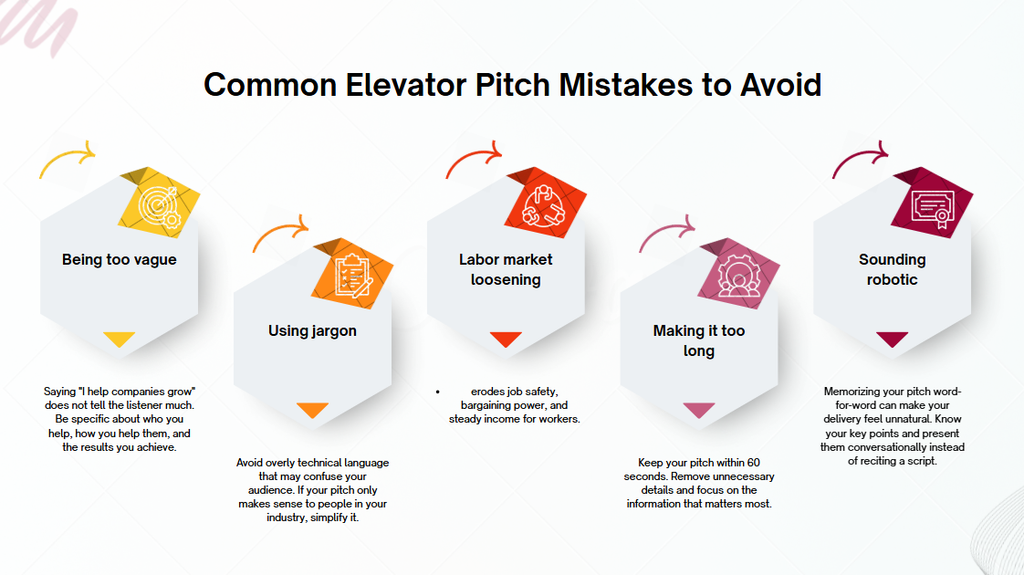
Being too vague:
Saying “I help companies grow” does not tell the listener much. Be specific about who you help, how you help them, and the results you achieve.
Using jargon:
Avoid overly technical language that may confuse your audience. If your pitch only makes sense to people in your industry, simplify it.
Making it too long:
Keep your pitch within 60 seconds. Remove unnecessary details and focus on the information that matters most.
Sounding robotic:
Memorizing your pitch word-for-word can make your delivery feel unnatural. Know your key points and present them conversationally instead of reciting a script.
Forgetting the call to action:
Give the listener a clear next step. End with a relevant question, invitation, or way to continue the conversation.
Focusing on yourself instead of the listener:
Connect your skills and experience to the listener’s needs. Focus on how you can provide value rather than simply describing yourself.
How to Practice and Refine Your Elevator Pitch
- Write your pitch down and keep it concise, making sure every sentence adds value.
- Read your pitch aloud and time yourself to ensure it fits within a natural 30–60 second conversation.
- Record yourself on your phone and listen for filler words, awkward phrasing, unclear points, or speaking too quickly.
- Practice with a friend, colleague, teacher, or mentor and ask whether your message was clear and what they remembered most.
- Use the STAR method (Situation, Task, Action, Result) when sharing an achievement or experience to keep your example focused and meaningful.
- If you are a student, campus resources like the Writing Center can help you structure and polish your pitch before heading into real-world conversations.
- Refine your pitch regularly as your skills, experience, and career goals develop.
Elevator Pitch vs. Personal Brand Statement
These two tools serve related but distinct purposes. Understanding the difference helps you use each one effectively:
| Aspect | Personal Brand Statement | Elevator Pitch |
| Purpose | Describes your professional identity | Introduces you and what you do |
| Main Question | “Who are you professionally?” | “What do you do, and why should I care?” |
| Format | Usually a short, single statement | Usually a 30–60 second spoken introduction |
| Context | General and relatively consistent | Adapted to the audience and situation |
| Where Used | LinkedIn, resume, portfolio, or email signature | Networking events, career fairs, interviews, and conferences |
| Main Goal | Establishes your professional identity and value | Starts a conversation and encourages further interaction |
Think of your personal brand statement as the foundation, and your elevator pitch as the structure you build on top of it, adjusted each time for the audience and occasion.
Elevator Pitch Self-Assessment Checklist
Before you deliver your pitch in a live setting, run it through these questions:
- Is it under 60 seconds when spoken at a natural pace?
- Does it clearly state what you do and for whom?
- Does it include at least one specific proof point or result?
- Is it free of jargon and technical language?
- Does it end with a call to action or an engaging question?
- Would someone outside your industry understand it?
- Does it sound conversational rather than scripted?
- Have you tailored it for your specific audience?
If you can answer yes to all eight, your pitch is ready.
Develop Your Professional Edge at Charisma University
A strong elevator pitch is one piece of a larger professional toolkit that includes communication, leadership, critical thinking, and the confidence to present yourself in any setting. Charisma University’s degree programs are designed to build exactly these competencies, equipping students and working professionals with practical, career-ready skills that drive professional growth. Whether you are exploring undergraduate studies or pursuing an advanced degree through Graduate School, developing your ability to communicate your value clearly is one of the most impactful investments you can make.
Frequently Asked Questions
The ideal length is 30 to 60 seconds, or approximately 75 to 150 words. Shorter risks leaving out key information; longer risks losing the listener.
Start with your name and a clear statement of what you do. Avoid opening with your life story. A direct, confident introduction sets the right tone.
Have a core pitch that captures your essential value, but adapt it to each audience. A pitch for a recruiter should emphasize different strengths than one aimed at a potential client.
Know your key points by heart, but avoid memorizing word-for-word. Deliver the ideas conversationally. The more you practice in real conversations, the more natural it will feel.
Review it every few months or whenever your role, goals, or target audience changes significantly. An outdated pitch undermines your credibility.