The term “liberal arts” gets used constantly in higher education, yet most people cannot clearly define it. Some confuse it with a political stance. Others dismiss it as an impractical degree. Both miss the point entirely. This guide explains what liberal arts actually means, where it comes from, what it covers, and why it remains one of the most relevant educational models in the modern world.
What Does Liberal Arts Mean?
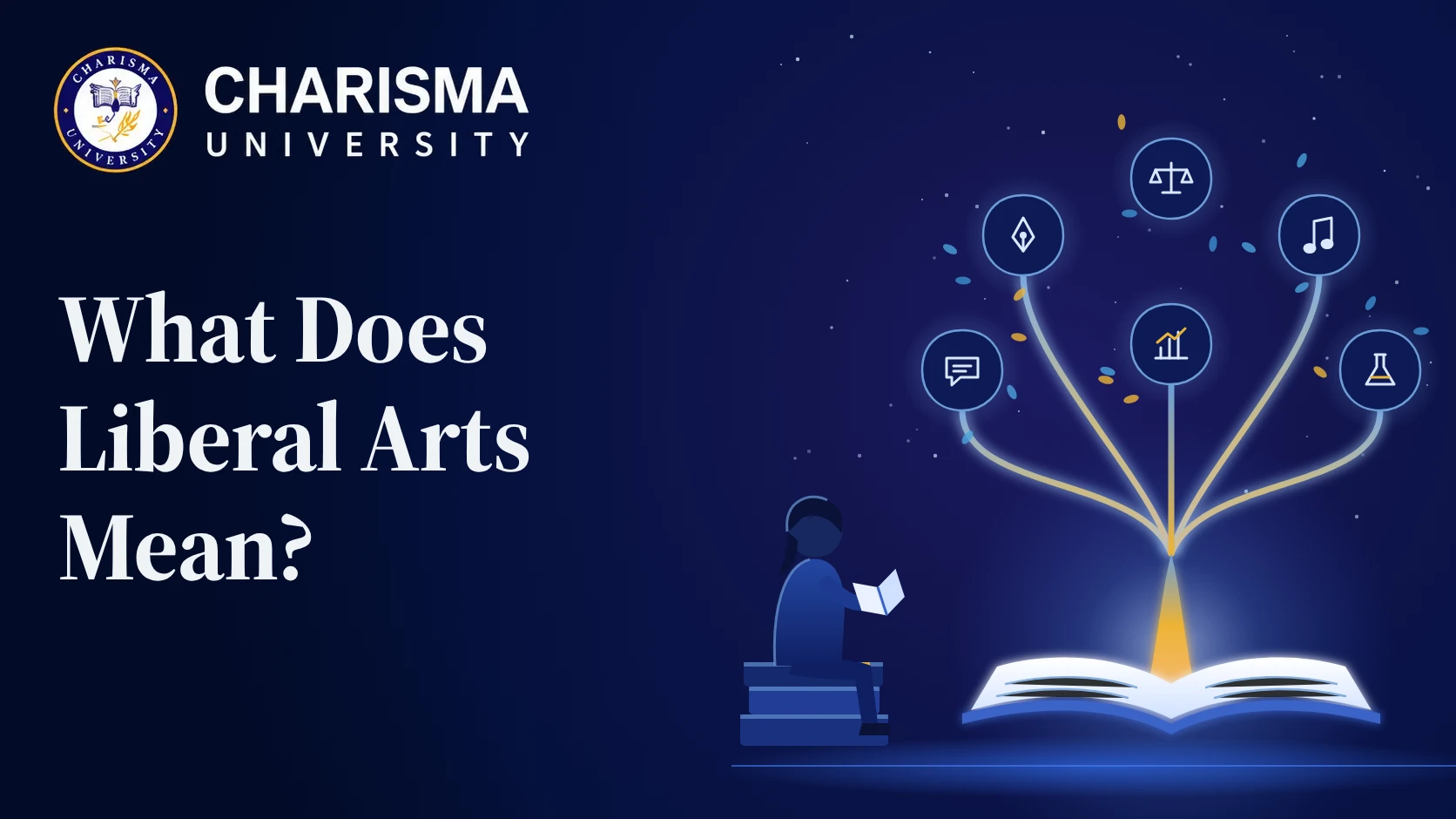
Liberal arts is a broad-based educational approach that builds knowledge and skills across the humanities, social sciences, natural sciences, and creative arts. Rather than training students for one specific profession, it develops the ability to think critically, communicate clearly, reason logically, and analyze complex problems from multiple perspectives.
What makes it distinctive is the cross-disciplinary structure. A student studying computer science also takes courses in history and philosophy. A business student explores psychology and ethics. A pre-law student studies economics and literature. The result is graduates who connect ideas across fields and bring both depth and adaptability to whatever career they pursue. At its core, a liberal arts education teaches students not only how to solve problems but which problems to solve and why, preparing them for leadership and meaningful contribution beyond a single job title.
Where Does the Term “Liberal Arts” Come From?
The term originates from the Latin “artes liberales,” meaning the arts befitting a free person. In ancient Greece and Rome, these were the subjects considered essential for any free citizen to participate fully in civic life, debating in public forums, making informed decisions, and contributing to governance. They were distinguished from “artes serviles” (servile arts), which referred to manual trades and vocational skills.
The word “liberal” here has nothing to do with political ideology. It derives from the Latin “liber,” meaning free. A liberal arts education was, at its origin, an education designed for freedom, intellectual freedom, civic freedom, and the freedom that comes from understanding the world broadly rather than narrowly.
The Seven Original Liberal Arts: Trivium and Quadrivium
The roots of liberal arts education stretch back more than 2,500 years. Ancient Greek philosophers, particularly Plato, outlined a curriculum of seven essential subjects divided into two groups.
The Trivium comprised the three language-based arts: Grammar (the mechanics of language), Logic or Dialectic (the principles of reasoning and argument), and Rhetoric (the art of persuasive communication). These formed the foundation, the tools for thinking and expressing ideas clearly.
The Quadrivium comprised the four number-based arts: Arithmetic (number in the abstract), Geometry (number in space), Music (number in time and harmony), and Astronomy (number in space and time). These disciplines focused on understanding the patterns and structure of the natural world.
During the medieval period, students studied the trivium first as preparatory work, then advanced to the quadrivium. Together, these seven arts formed the basis of Western education from ancient Athens through the European Renaissance. The modern liberal arts curriculum evolved from this framework, expanding to encompass the full range of disciplines we recognize today, from philosophy and literature to biology and political science.
What Disciplines Does Liberal Arts Cover?
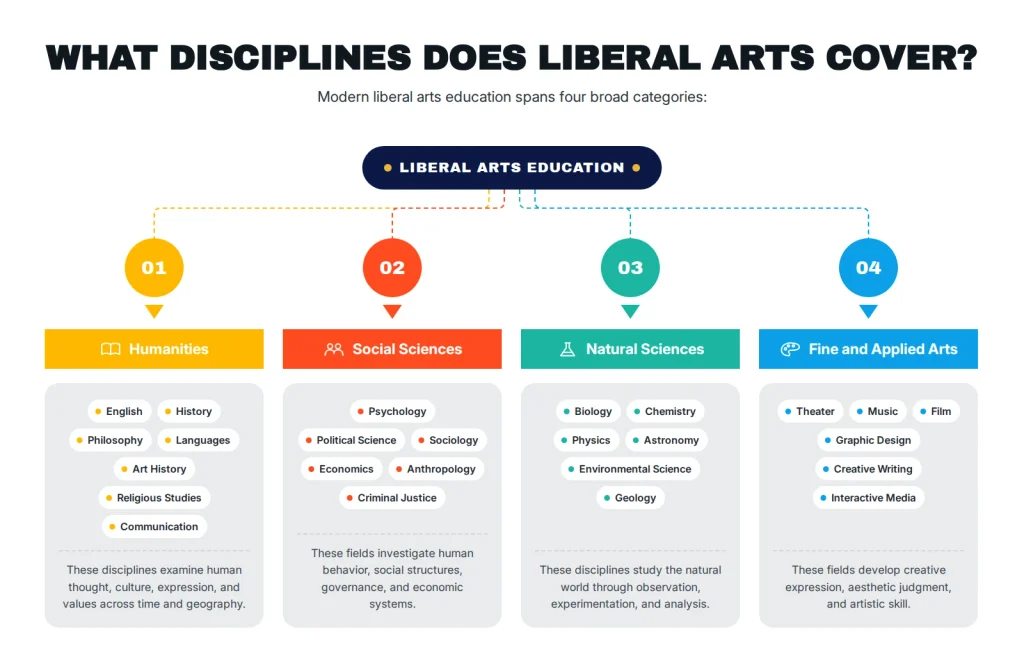
Modern liberal arts education spans four broad categories:
- Humanities
English, history, philosophy, languages, art history, religious studies, and communication. These disciplines examine human thought, culture, expression, and values across time and geography.
- Social Sciences
Psychology, political science, sociology, economics, anthropology, and criminal justice. These fields investigate human behavior, social structures, governance, and economic systems.
- Natural Sciences
Biology, chemistry, physics, astronomy, environmental science, and geology. These disciplines study the natural world through observation, experimentation, and analysis.
- Fine and Applied Arts
Theater, music, film, graphic design, creative writing, and interactive media. These fields develop creative expression, aesthetic judgment, and artistic skill.
The defining characteristic across all these categories is the emphasis on intellectual inquiry, analytical reasoning, and understanding, not narrow vocational training for a single occupation.
What Is a Liberal Arts Degree?
A liberal arts degree is a bachelor’s degree, typically a Bachelor of Arts (BA), Bachelor of Science (BS), or Bachelor of Fine Arts (BFA), earned through a program that requires broad coursework across multiple disciplines alongside a chosen major.
Most programs take four years and require approximately 120 credits to complete. Students typically spend their first two years completing core liberal arts requirements across different fields, building a broad intellectual foundation. During the final two years, they specialize in their chosen major.
It is worth noting what does not fall under liberal arts. Programs like engineering, nursing, accounting, and dentistry are generally classified as professional degrees because they train students for specific occupations from the outset. However, many universities, including those with strong professional programs, require even these students to complete liberal arts coursework in subjects like writing, ethics, and social science, recognizing the value of a well-rounded education.
Why Does a Liberal Arts Education Matter?
Develops Skills Employers Value
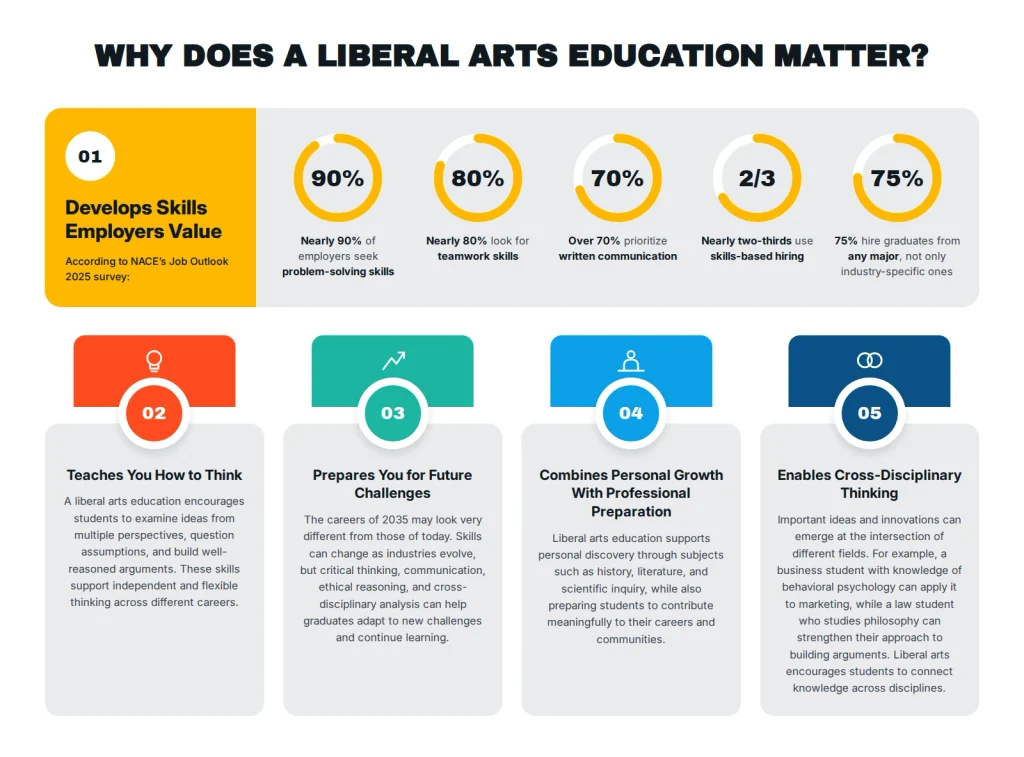
According to NACE’s Job Outlook 2025 survey, nearly 90% of employers seek problem-solving skills, nearly 80% look for teamwork skills, and over 70% prioritize written communication. Nearly two-thirds use skills-based hiring, while 75% hire graduates from any major, not only industry-specific ones.
Teaches You How to Think
A liberal arts education encourages students to examine ideas from multiple perspectives, question assumptions, and build well-reasoned arguments. These skills support independent and flexible thinking across different careers.
Prepares You for Future Challenges
The careers of 2035 may look very different from those of today. Skills can change as industries evolve, but critical thinking, communication, ethical reasoning, and cross-disciplinary analysis can help graduates adapt to new challenges and continue learning.
Combines Personal Growth With Professional Preparation
Liberal arts education supports personal discovery through subjects such as history, literature, and scientific inquiry, while also preparing students to contribute meaningfully to their careers and communities.
Enables Cross-Disciplinary Thinking
Important ideas and innovations can emerge at the intersection of different fields. For example, a business student with knowledge of behavioral psychology can apply it to marketing, while a law student who studies philosophy can strengthen their approach to building arguments. Liberal arts encourages students to connect knowledge across disciplines.
Common Misconceptions About Liberal Arts
Liberal Arts Graduates Can Find Career Opportunities
Research from the Association of American Colleges and Universities (AAC&U) shows that liberal arts majors can close the earnings gap with professional and pre-professional degree holders over time, particularly by mid-career. Bureau of Labor Statistics data reports a median annual salary of approximately $60,000 for liberal arts degree holders, with top-employed fields including education (19%), management (16%), and business operations (10%).
Liberal Arts Covers More Than English and Philosophy
Liberal arts encompasses much more than the humanities. It includes fields such as biology, chemistry, physics, economics, political science, psychology, and many other disciplines.
Liberal Arts Education Is Academically Rigorous
Liberal arts programs require proficiency across multiple fields, demanding intellectual flexibility and discipline. Many of the world’s most selective and highly ranked universities are built on a liberal arts foundation.
“Liberal” Does Not Mean Politically Liberal
In this context, the term “liberal” comes from the Latin liber, meaning “free.” It refers to intellectual freedom and broad education rather than a political ideology.
Liberal Arts vs. Professional Degrees
Understanding the distinction between liberal arts and professional degrees helps clarify what each is designed to do:
| Aspect | Liberal Arts Degree | Professional Degree |
|---|---|---|
| Focus | Broad intellectual development across disciplines | Training for a specific career or profession |
| Approach | Wide and adaptable | Narrow and deep |
| Core Skills | Critical thinking, communication, analysis, reasoning | Technical competency, applied skills |
| Examples | Psychology, history, economics, philosophy, biology | Nursing, engineering, accounting, dentistry |
| Career Path | Broader entry points; specialization through experience or graduate study | Direct entry into a specific profession |
The distinction is not either/or. Many strong universities integrate both models, requiring professional-track students to complete liberal arts coursework and offering liberal arts students opportunities to develop practical, career-relevant skills.
Liberal Arts in the Age of AI
According to the World Economic Forum’s Future of Jobs Report 2025, 86% of employers expect AI to transform their business by 2030, with 170 million new jobs created and 92 million displaced globally. The report found that 39% of workers’ existing skill sets will be transformed or outdated within five years, and 40% of employers plan to reduce roles where AI can automate tasks, meaning positions built on routine technical execution are the most vulnerable.
This shift directly favors the competencies a liberal arts education builds. The WEF’s 2023 report found that seven out of ten fastest-growing skills from 2023 to 2027 were soft skills, analytical thinking, creative thinking, resilience, flexibility, curiosity, and lifelong learning.
As AI handles routine work, the skills that remain distinctly human, critical thinking, ethical reasoning, communication, and the ability to navigate ambiguity , are rising in demand. New hybrid roles like AI ethics advisors, digital content strategists, and human-AI interaction designers require exactly this combination of technical literacy and humanistic judgment.
What Careers Can You Pursue with a Liberal Arts Background?
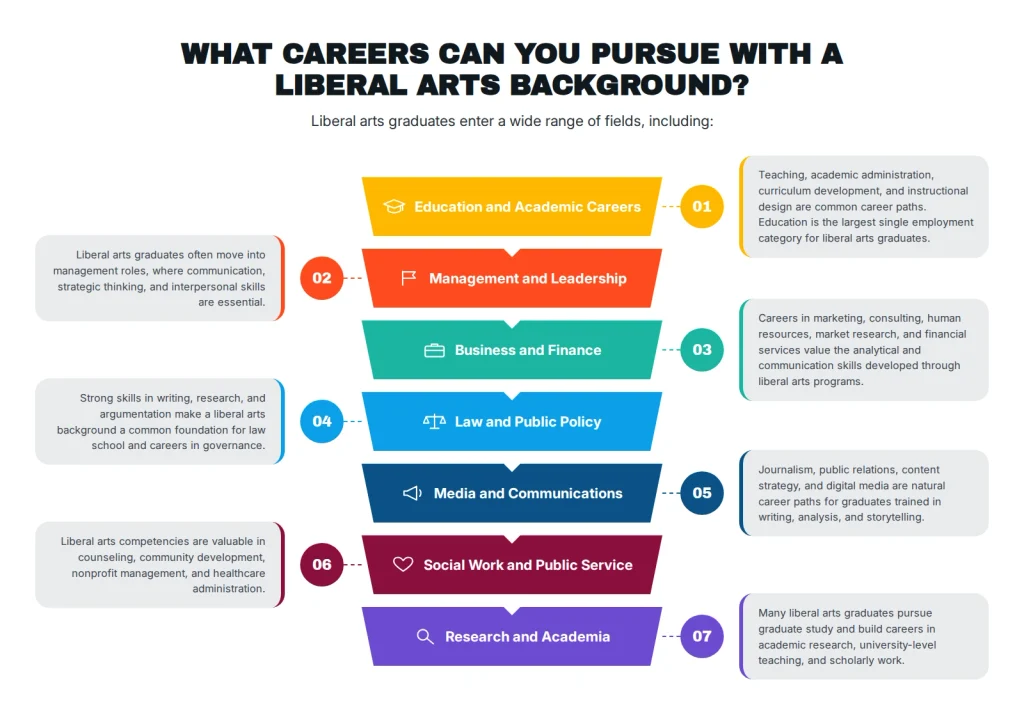
Liberal arts graduates enter a wide range of fields, including:
- Education and Academic Careers
Teaching, academic administration, curriculum development, and instructional design are common career paths. Education is the largest single employment category for liberal arts graduates.
- Management and Leadership
Liberal arts graduates often move into management roles, where communication, strategic thinking, and interpersonal skills are essential.
- Business and Finance
Careers in marketing, consulting, human resources, market research, and financial services value the analytical and communication skills developed through liberal arts programs.
- Law and Public Policy
Strong skills in writing, research, and argumentation make a liberal arts background a common foundation for law school and careers in governance.
- Media and Communications
Journalism, public relations, content strategy, and digital media are natural career paths for graduates trained in writing, analysis, and storytelling.
- Social Work and Public Service
Liberal arts competencies are valuable in counseling, community development, nonprofit management, and healthcare administration.
- Research and Academia
Many liberal arts graduates pursue graduate study and build careers in academic research, university-level teaching, and scholarly work.
One notable pattern: 70% of liberal arts graduates change career fields between their first and second jobs, a significantly higher rate than IT majors (53%) or allied health majors (54%). This reflects the versatility of the degree rather than a weakness; liberal arts graduates are uniquely positioned to transition into high-skill roles in marketing, management, human resources, and public relations as their careers develop.
Skills You Develop Through a Liberal Arts Education
A liberal arts education builds a toolkit of transferable skills that apply across industries and career stages. These include critical thinking and analytical reasoning, clear written and oral communication, research and information evaluation, complex problem-solving, cross-cultural understanding, collaboration and teamwork, ethical reasoning and sound judgment, and adaptability, the capacity to learn continuously and apply knowledge to new contexts.
These are not soft skills in the sense of being secondary. They are the foundational capabilities that determine how effectively someone can lead, communicate, analyze, and adapt, regardless of their specific job title.
How Charisma University Delivers a Liberal Arts Foundation
Charisma University’s degree programs are designed to provide students with the broad intellectual grounding and practical skills that define a strong liberal arts education. Across its schools, including the School of Business, the School of Education, the School of Health Sciences, and the School of Law, the university combines disciplinary depth with the critical thinking, communication, and analytical skills that prepare graduates for careers and challenges across every field.
Whether you are beginning your undergraduate journey or advancing through a graduate program, Charisma University equips you with the well-rounded education that employers, graduate programs, and the modern economy demand.
Frequently Asked Questions
Liberal arts is a type of education that covers a broad range of subjects, including humanities, sciences, social sciences, and the arts, instead of focusing on one specific career. The goal is to develop well-rounded thinkers with strong communication, analytical, and problem-solving skills.
Yes. Liberal arts graduates develop highly transferable skills that employers consistently rank among the most important: communication, critical thinking, teamwork, and problem-solving. Research shows that liberal arts majors close earnings gaps with professional degree holders by mid-career.
Common examples include English, history, philosophy, psychology, political science, sociology, economics, biology, chemistry, physics, art history, music, theater, and communication studies.
A liberal arts degree emphasizes broad intellectual development across multiple disciplines, while a professional degree (such as nursing, engineering, or accounting) trains you for a specific career. Many universities combine elements of both.
Early-career earnings for liberal arts graduates tend to be lower than STEM graduates, but the gap narrows significantly by mid-career. Liberal arts graduates also have higher rates of career flexibility and adaptability, which contributes to long-term earning potential.
Liberal arts graduates work in education, management, business, law, media, public policy, social services, research, and many other fields. The degree provides a versatile foundation rather than a single career track.