Neoliberalism is a set of ideas that promotes free market competition, the sale of public services to private firms, fewer rules on business, and a smaller role for the state in markets. It took shape in the 1930s as a school of thought and gained power in the late 1970s under Margaret Thatcher and Ronald Reagan. It reshaped trade, finance, and social policy in more than 100 countries.
The term has a tangled past. It was first coined to describe a moderate, rule-based update to laissez-faire thinking. Over time, it became a label that critics use for aggressive free-market policy. Few of its own builders ever embraced it. That gap between the original idea and its real-world use is key to the whole story.
Where the Term Comes From
German thinker Alexander Rüstow coined the word “neoliberalism” in August 1938 at the Colloque Walter Lippmann in Paris. French thinker Louis Rougier ran this meeting of 26 liberal scholars. Those present included Friedrich von Hayek, Ludwig von Mises, Raymond Aron, Wilhelm Röpke, Jacques Rueff, and Michael Polanyi. Rüstow used it for a reformed, socially aware form of liberalism. It embraced state rules, welfare, and public schooling alongside open markets. It was never meant to describe rigid free-market dogma.
The group was split from day one. Mises and Rueff advocated strict laissez-faire. Rüstow, Röpke, Hayek, and Lippmann favored a middle path. That rift never healed. The German ordoliberals who held to Rüstow’s vision built West Germany’s Soziale Marktwirtschaft (social market economy). This model paired free enterprise with strong worker protections and social insurance. By the 1950s, most ordoliberals had broken from the Anglo-American version of the creed that now bears the same name.
The Intellectual Roots: Hayek, Friedman, and Buchanan
While Rüstow coined the word, the modern form of the creed came from three thinkers whose reach went far beyond the classroom.
Friedrich von Hayek
Hayek (1899–1992) built the core case. His 1944 book The Road to Serfdom argued that central planning, even with good aims, puts too much power in too few hands. This erodes personal freedom. The framing was blunt: choose state control or choose liberty.
His second big role was building networks. In 1947, he set up the Mont Pelerin Society. It funded think tanks like the Cato Institute, the Heritage Foundation, and London’s Institute of Economic Affairs. These groups spent decades crafting policy tools and sharpening their message. They waited for a crisis that would open the door to power.
Milton Friedman
Friedman (1912–2006) built the policy toolkit. He argued that managing the money supply, not state spending, was the best way to steady markets. He recast the Great Depression as a central bank mistake, not a market failure. In a 1951 essay titled Neo-Liberalism and its Prospects, he backed school vouchers and a negative income tax. He also pushed to end job licensing rules and remove price controls.
He also voiced the movement’s key insight: only a crisis (real or perceived) produces real change. The role of thinkers, he wrote, was to build options and keep them ready until the moment arrives. That logic proved right when the 1970s stagflation hit.
James Buchanan and Public Choice Theory
Buchanan (1919–2013) added a theory of state failure. His public choice model argued that politicians and officials act in self-interest, chasing reelection, bigger budgets, and job security. They behave much like business owners chasing profit. This psychology-rooted view eroded trust in the state and built the case for handing public services to private firms.
Gary Becker and Human Capital
Becker (1930–2014) stretched market logic into schooling, health, and skills. His human capital theory reframed these as self-funded bets made for future returns. This shifted the duty of job readiness from the state and employers to each person. It reshaped how societies think about career growth. It also changed who gets blamed when people fall behind.
How It Took Power: From Theory to Governance
The 1970s brought the crisis that free-market thinkers had prepared for. Western nations stalled under stagflation: flat growth, rising job losses, and stubborn inflation that standard tools could not fix. Oil shocks in 1973 and 1979 hammered output. Public debt rose. By the late 1970s, four decades of groundwork was ready for real-world use.
Thatcher’s Britain
Margaret Thatcher won power in 1979. Her team sold off state firms in steel, coal, gas, water, telecoms, and power. They curbed union power and opened up finance through the 1986 “Big Bang” reforms. They also moved the tax burden from income to spending. Her claim that “there is no alternative” defined the era.
The shift ran deep. In 1995, the Labour Party under Tony Blair dropped its pledge to “common ownership of the means of production.” The opposition had given up the terms of the debate.
Reagan’s America
Ronald Reagan (1981–1989) ran the American parallel. His team cut the top income tax rate from 70% to 28% and eased rules across airlines, banking, and savings and loans. Supply-side thinking became the default creed.
The reach across party lines showed under Bill Clinton. His New Democrats backed welfare reform, signed NAFTA, and repealed the Glass-Steagall Act in 1999. This tore down the Depression-era wall between retail and Wall Street banking.
The Washington Consensus and Reform Programs
In 1989, the term “Washington Consensus” was coined by John Williamson. It named 10 policy rules the IMF, World Bank, and U.S. Treasury imposed as terms for aid: budget control, tax reform, trade opening, sell-offs, fewer rules, and backing for property rights.
Through the 1980s and 1990s, reform programs in Latin America, Africa, and Southeast Asia demanded fast subsidy cuts and open borders to foreign goods. They also forced the sale of state assets. The results were often harsh: food and fuel price jumps, mass layoffs, and crumbling healthcare and school systems.
Chile Under Pinochet: The Laboratory
After the 1973 coup that toppled Chile’s elected socialist state, General Pinochet brought in University of Chicago-trained economists (the “Chicago Boys”) to rebuild markets. They privatized pensions, healthcare, and schooling, removed trade barriers, and crushed labor unions. Friedman called it a “miracle of growth” in 1982. GDP grew, but income gaps sharpened, poverty spiked, and every reform phase ran under armed force.
Naomi Klein’s 2007 book The Shock Doctrine traced this pattern across several nations. She argued that free-market overhauls are often forced through during crises (coups, disasters, crashes). People are too shaken to push back. Gabriel Boric’s election as Chile’s president in 2021, on a vow to tear down Pinochet-era structures, marked a direct answer to that legacy.
What Neoliberal Governance Looks Like in Practice
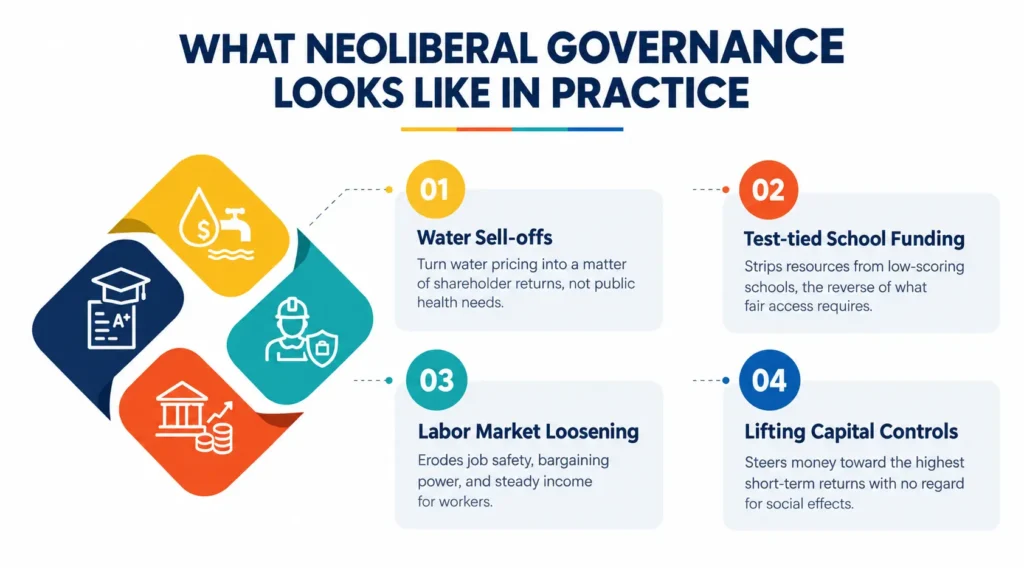
The ideas sound abstract until you see how they reshape daily life:
- Water sell-offs turn water pricing into a matter of shareholder returns, not public health needs.
- Test-tied school funding strips resources from low-scoring schools, the reverse of what fair access requires.
- Labor market loosening erodes job safety, bargaining power, and steady income for workers.
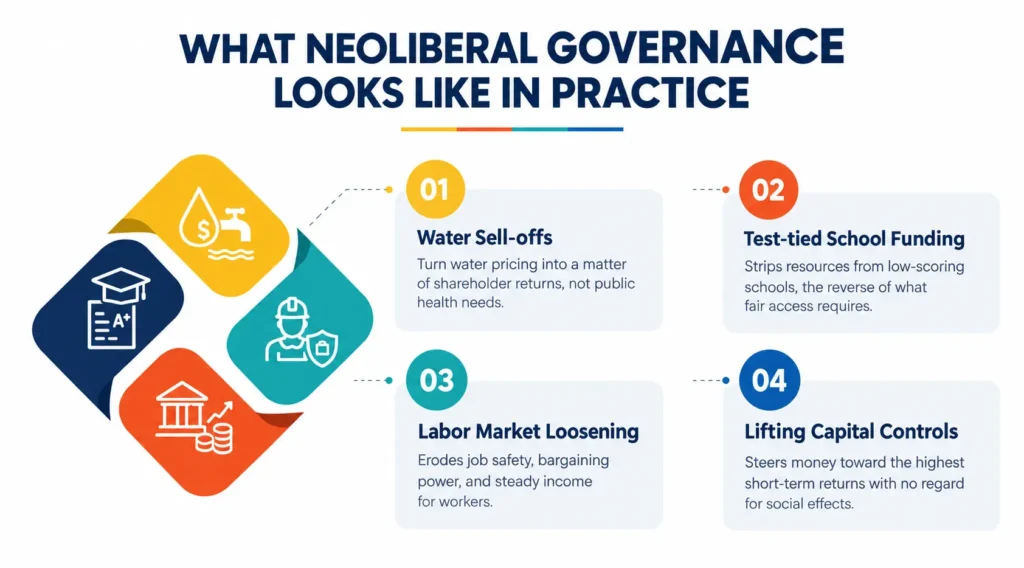
- Lifting capital controls steers money toward the highest short-term returns with no regard for social effects.
Impact on Education
School vouchers, charter school growth, test-based teacher reviews, and tuition fees at public colleges have reshaped access in at least 30 countries since the 1980s. Budgets for public colleges have dropped in real terms across most OECD nations. Tuition has climbed. PISA data from 2006 to 2015 show falling average scores that tracked rising gaps tied to household income. Programs in education now study how these market forces shape learning outcomes and access.
The NGO Gap
As states cut social spending, NGOs and non-profits fill the void. Many are funded by the same bodies that gain from the policies creating the gap. By 2020, roughly 10 million NGOs worked worldwide, running healthcare, schooling, and local services that shrinking state bodies once handled.
The Case For: What Defenders Argue

It would be dishonest to show only the critique. The era of market opening lines up with some of the most striking gains in human welfare on record.
Global Poverty Reduction
The World Bank says that between 1990 and 2015, more than 1 billion people rose above the extreme poverty line of $1.90 per day. That is the fastest drop in absolute poverty ever recorded. Global trade as a share of GDP rose from about 39% in 1990 to over 60% by 2008. This linked once-closed nations to global capital.
China and India as Case Studies
China’s post-1978 reforms blended state control with private firms and open trade. The result was average GDP growth of roughly 10% per year for three decades. India’s 1991 shift, which ended the “License Raj” of controls on industry, likewise sped up growth and broadened the middle class. Neither adopted a pure free-market model. Both kept large state roles but drew heavily on trade openness, fewer rules, and sell-offs.
The Counter-Argument on Alternatives
Backers argue that the stagnant, state-led models that came before had clearly failed to deliver growth or opportunity. Even the IMF’s own critical 2016 paper noted there is “much to cheer.” Free trade “has rescued millions from abject poverty.” Sell-offs “in many instances led to more efficient running of services.”
The Case Against: Where It Breaks Down
The sharpest critique comes not from outside critics but from within the bodies that pushed the agenda. In June 2016, three IMF scholars (Jonathan Ostry, Prakash Loungani, and Davide Furceri) published Neoliberalism: Oversold? in the Fund’s Finance & Development journal. Their finding: key policies (mainly free capital flows and spending cuts) had widened income gaps instead of spurring growth. This in turn held back lasting gains.
Capital Flows and Austerity: The IMF’s Own Evidence
Lifting capital controls opened poorer nations to hot money that fueled bubbles, then triggered sharp flight. The 1997-1998 Asian crisis showed this clearly. Foreign cash rushed in during boom years, then fled at the first sign of trouble. Currencies crashed across Thailand, Indonesia, South Korea, and Malaysia.
Cutting state spending during downturns made recessions worse, not better. Austerity in Greece, Spain, and Portugal after the 2008 bank bailouts deepened the slump and pushed Greek joblessness past 25%.
Rising Economic Inequality
In the United States, the top 1% took 27% of total income growth between 1980 and 2019. The bottom 50% took just 12%. Oxfam’s 2023 report found that the richest 1% gained nearly twice as much new wealth as the rest of the world combined. The World Inequality Database shows the top 1%’s global income share rose from roughly 16% in 1980 to over 22% by 2020.
Financial Instability
Loose rules spawned a chain of crises: the U.S. savings and loan crash (1986-1995), the dot-com bust (2000-2001), and the 2007-2008 global meltdown. The 2008 crash started in poorly watched U.S. mortgage markets, wiped out roughly $2 trillion in global output, and set off the worst recession since the 1930s. States that had long preached small government then spent trillions of public money to rescue private banks: $700 billion through TARP in the U.S. alone, £37 billion pumped into British banks.
Public Erosion
Wendy Brown and David Harvey argue that casting policy as market need rather than a public choice strips citizens of real say over how they are governed. Loan terms imposed on nations by global lenders (forcing austerity and sell-offs with no public vote) stand as the clearest example. This tension drives protest movements worldwide.
Environmental Cost
Nobel laureate Joseph Stiglitz has said that market logic, used with no limits, speeds up climate harm. A growth-first outlook treats nature as raw material rather than a shared resource that needs care.
Social Dislocation
Fast market overhauls have caused proven harm across regions: mass job losses after sell-offs, household debt surging as safety nets shrank, and the fraying of community ties. David Harvey calls the result “buildup by dispossession.” Public wealth shifts into private hands through steps that look like reform but work as extraction.
Neoliberalism vs Classical Liberalism vs Modern Liberalism
These three schools share Enlightenment roots but assign very different roles to markets, the state, and the individual. The table below sums up the main splits, from founding thinkers to their stance on ethics, justice, and the state’s role. Academic programs in philosophy and religion explore these frameworks in depth.
| Feature | Classical Liberalism | Modern Liberalism | Neoliberalism |
| Era of origin | 18th–19th century | Late 19th–mid 20th century | 1930s theory, 1980s policy |
| Key thinkers | Adam Smith, John Locke, John Stuart Mill | John Maynard Keynes, John Rawls, T.H. Green | Hayek, Friedman, Buchanan, Becker |
| Core belief | Personal liberty and laissez-faire yield the best results | State action removes barriers to genuine freedom | Market competition delivers welfare better than state programs |
| Role of the state | Minimal: enforce contracts, guard property, keep order | Active: fund schooling, healthcare, welfare, and public works | Limited: secure markets, guard property rights, then step back |
| View on inequality | A natural outcome of free exchange | A barrier to freedom that the state must fix | Best cut through growth and competition, not transfers |
| Economic model | Free trade, light rules, gold standard | Demand management, higher-bracket tax, public spending | Privatization, fewer rules, austerity, free capital flows |
| Legacy bodies | Rule of law, property rights, democracy | Welfare state, public schools, labor safeguards, universal healthcare | Washington Consensus, WTO, reform programs, school vouchers |
| Main criticism | Ignored poverty, abuse, and monopoly from unregulated markets | Red tape, fiscal deficits, reliance on state provision | Rising inequality, financial crises, weakened democracy, climate harm |
Is the Ideology Dead?
COVID-19 forced the deepest reckoning with free-market thinking since the creed’s rise. No serious voice argued that markets alone could handle a global health crisis. States spent huge sums (the U.S. CARES Act alone put up $2.2 trillion), going against decades of austerity doctrine. The state’s hand in markets returned through the U.S. CHIPS Act and the European Green Deal.
The mood among scholars has shifted too. The Hewlett Foundation now funds work aimed at building post-market-first frameworks. Academic bodies, from business schools to law programs, now weave critical study of market thinking into their courses. Charisma University’s own programs in philosophy and economics engage with these tensions directly.
Yet the backbone remains. Trade deals, central bank freedom, privatized services, and market-based rules still govern most of the world. The IMF still ties spending terms to its loans. What has crumbled is the claim that no other path exists. The debate has moved to what comes next: state-led investment, stakeholder capitalism, modern monetary policy, or degrowth.
Frequently Asked Questions
It is a set of ideas that favors free markets, private enterprise, fewer rules, and small government. It holds that market competition spreads resources better than state planning or public provision.
German thinker Alexander Rüstow coined it in 1938 at the Colloque Walter Lippmann in Paris. He meant it to describe a reformed liberalism that kept state oversight and social welfare. That meaning is far from how the word is used today.
The core tenets are free market competition, fewer rules on business, the sale of public services to private firms, lower state spending, spending cuts, and open global trade with free capital flows.
The stagflation crisis of the 1970s weakened Keynesian thinking and opened the door for free-market ideas. Thatcher (elected 1979) and Reagan (elected 1980) put the creed into practice through sell-offs, tax cuts, and fewer rules. Global bodies like the IMF and World Bank then spread these policies through reform programs.
Classical liberalism (18th-19th century) called for minimal state roles and laissez-faire as a check on royal power. Neoliberalism revives those ideas but accepts a limited welfare state and democracy. The key split: classical liberals wanted the state to step back; neoliberals actively use the state to create and guard open markets.
Critics cite rising income gaps (the top 1% took 27% of U.S. income growth from 1980-2019), repeated financial crises tied to loose market rules, the decline of public services through sell-offs, and weakened public voice when policy is set by global lenders rather than elected leaders.