You have an assignment due in three days. You sit down to start, and twenty minutes later you are reorganizing your desk, scrolling through your phone, or suddenly remembering that the kitchen needs cleaning. The deadline creeps closer, the anxiety builds, and you finally start at the last possible moment in a panicked rush.
If this pattern sounds familiar, you are not alone. Procrastination is one of the most widespread behavioral challenges in academic and professional life, and it has far less to do with laziness than most people think.
What Is Procrastination?
Procrastination is the voluntary delay of an intended task despite knowing that the delay will lead to negative consequences. It is not simply forgetting or deprioritizing, it is choosing to put off something you have already committed to doing, even when you understand the cost of waiting.
Psychologist Piers Steel, in his 2007 meta-analysis published in the Psychological Bulletin, defined procrastination as a “quintessential self-regulatory failure.” The key distinction is that procrastination is not a time management problem at its core. It is a problem rooted in emotional regulation, in how we manage discomfort, fear, and uncertainty when facing tasks that feel aversive.
How Common Is Procrastination?
The numbers paint a striking picture. Research shows that approximately 20 to 25% of adults are chronic procrastinators, a figure that has quadrupled since the 1970s when only about 5% of the population fell into that category. Among college students, the rates are significantly higher: 80 to 95% of students procrastinate at some level, and roughly 50% do so consistently enough to consider it a problem.
In the workplace, 88% of employees report procrastinating for over 60 minutes during work hours each day. The financial impact is significant, procrastination costs the U.S. economy an estimated $70 billion annually, with an individual employee earning $40,000 per year losing roughly $15,000 in productivity.
Perhaps most telling: 94% of people who procrastinate say it makes them unhappy.
Procrastination vs. Laziness
| Aspect | Procrastination | Laziness |
| Meaning | Delaying a task even though you intend to complete it. | An unwillingness or lack of desire to put in effort. |
| Desire to Act | You want to complete the task but struggle to start. | You may not feel motivated to complete the task at all. |
| Underlying Issue | Often linked to emotional avoidance, fear, overwhelm, or other barriers to starting. | More closely associated with an unwillingness to invest effort. |
| Work Before Deadlines | May involve intense periods of work when a deadline approaches. | Generally involves avoiding effort rather than suddenly working intensely under pressure. |
| What Helps | Identifying the cause, breaking tasks into smaller steps, and reducing emotional barriers can help. | Building willingness and consistent effort may be more relevant. |
Common Myths About Procrastination
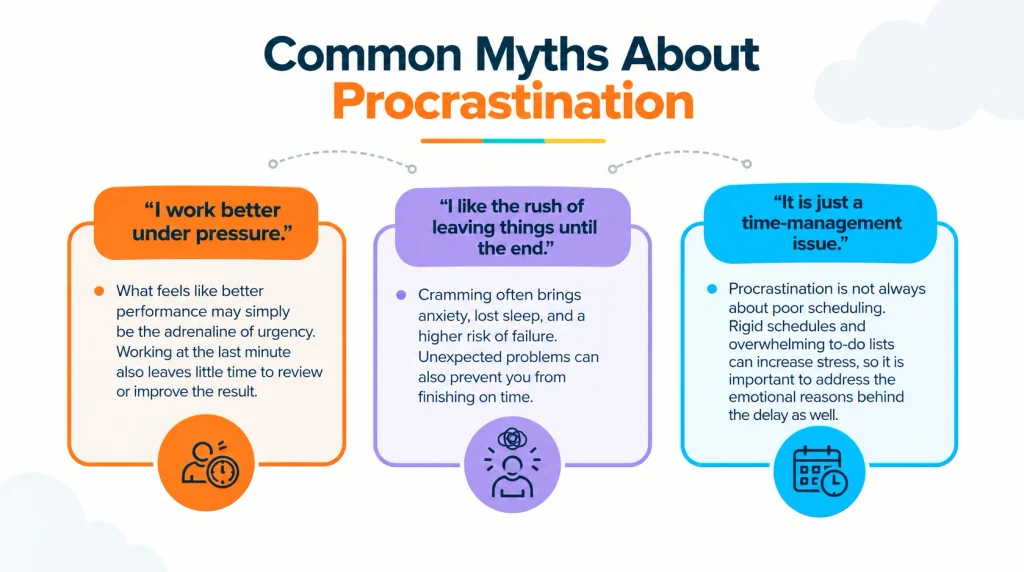
- “I work better under pressure.” What feels like better performance may simply be the adrenaline of urgency. Working at the last minute also leaves little time to review or improve the result.
- “I like the rush of leaving things until the end.” Cramming often brings anxiety, lost sleep, and a higher risk of failure. Unexpected problems can also prevent you from finishing on time.
- “It is just a time-management issue.” Procrastination is not always about poor scheduling. Rigid schedules and overwhelming to-do lists can increase stress, so it is important to address the emotional reasons behind the delay as well.
Why Do We Procrastinate?
Procrastination is often more than poor time management. It can act as a self-protection strategy. By delaying a task, you may protect your self-image: if you fail, you can blame the lack of time rather than your ability; if you succeed, you may feel capable of achieving more under pressure.
Common causes include fear of failure, fear of judgment, perfectionism, task aversion, decision fatigue, emotional exhaustion, and low self-confidence. Procrastination can also occur when a task feels disconnected from your goals or values. For students, academic pressure and fear of evaluation can make these challenges even stronger.
The Neuroscience of Procrastination
Procrastination can involve a conflict between different brain systems. The limbic system is associated with emotions, immediate rewards, and avoiding discomfort, while the prefrontal cortex supports planning, self-control, and long-term decision-making.
When a task feels unpleasant or overwhelming, the desire for immediate comfort can take over. This may lead you to scroll through your phone, snack, switch to an easier task, or find another way to avoid getting started.
Research published in Psychological Science in 2018 found that people who chronically procrastinate showed differences in the amygdala, a brain region involved in processing threats and negative emotions. The study also reported weaker connectivity between the amygdala and the dorsal anterior cingulate cortex, which is involved in regulating emotional responses and translating intentions into actions.
The encouraging part is that these patterns are not necessarily permanent. The brain is plastic, meaning it can adapt through repeated practice and behavioral change. Developing healthier habits, practicing mindfulness, and consistently taking action can help reduce procrastination over time.
Types of Procrastinators
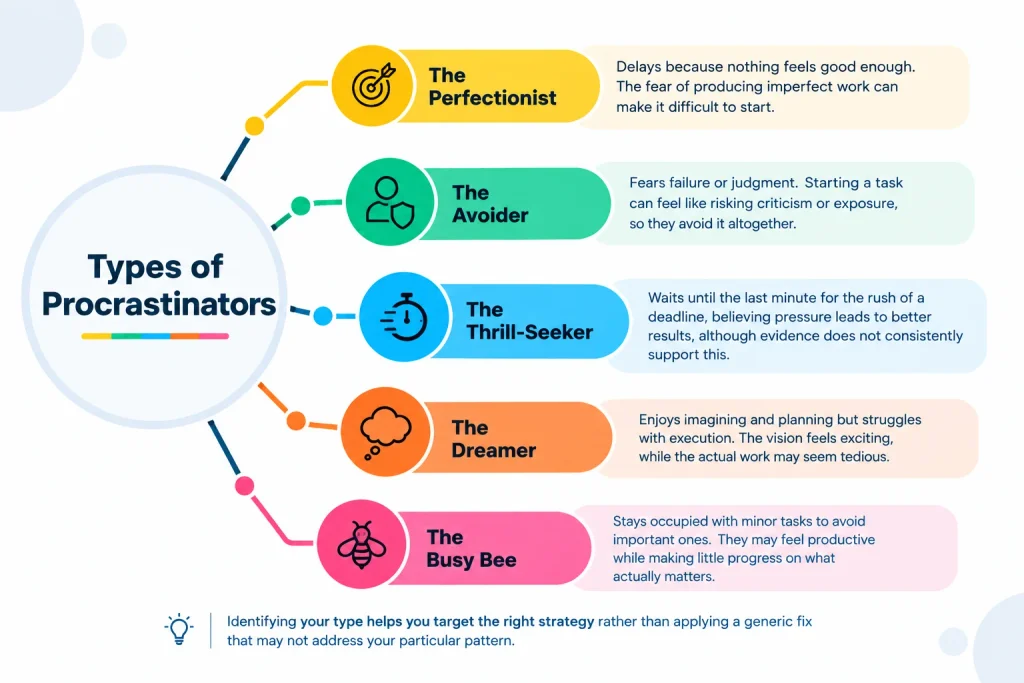
Not all procrastination looks the same. Research, including work by psychologist Dr. Joseph Ferrari, identifies distinct procrastination profiles:
The Perfectionist
Delays because nothing feels good enough. The fear of producing imperfect work can make it difficult to start.
The Avoider
Fears failure or judgment. Starting a task can feel like risking criticism or exposure, so they avoid it altogether.
The Thrill-Seeker
Waits until the last minute for the rush of a deadline, believing pressure leads to better results, although evidence does not consistently support this.
The Dreamer
Enjoys imagining and planning but struggles with execution. The vision feels exciting, while the actual work may seem tedious.
The Busy Bee
Stays occupied with minor tasks to avoid important ones. They may feel productive while making little progress on what actually matters.
Identifying your type helps you target the right strategy rather than applying a generic fix that may not address your particular pattern.
The Consequences of Procrastination
The effects of chronic procrastination extend across every dimension of life. Academically, research shows that procrastinating students average a GPA of 2.9 compared to 3.4 for non-procrastinators, and chronic procrastination reduces final grades by roughly half a point on average. Students who struggle with procrastination may benefit from academic advising to develop better study frameworks and address underlying challenges.
In the workplace, chronic procrastination results in missed deadlines, strained professional relationships, and reduced career advancement. A large-scale study found that each single-point increase on a five-point procrastination scale is associated with approximately a $15,000 drop in annual salary, and that procrastinators make up 57% of the unemployed.
Research by Beutel et al. (2016) found a consistent link between procrastination and increased depression, higher stress, greater anxiety, and reduced life satisfaction. Studies show that 74% of procrastinating students experience insomnia and chronic procrastinators report 28% higher depression symptoms. Beyond individual health, procrastination strains personal relationships, creating frustration for partners, colleagues, and family members affected by repeated delays.
Procrastination in the Digital Age
Technology has made procrastination easier than at any point in human history. Research shows that 50.7% of adults identify the internet as their primary procrastination tool, spending an average of 1.59 hours per day on procrastination-related online activities.
Social media platforms, push notifications, infinite scrolling, and algorithm-driven content feeds are engineered for instant gratification, the exact impulse that the limbic system craves when avoiding uncomfortable work. For students managing coursework through online learning environments, the challenge is even more pronounced because the distractions live on the same device as the work.
Overcoming procrastination in a digital environment requires deliberate design, phone in another room, website blockers during focused work, and clear boundaries between work and entertainment.
How to Overcome Procrastination: Practical Strategies
Start with Awareness
Before you can solve procrastination, you need to understand your specific version of it. Reflect on what emotions arise when you face a task you are avoiding, is it fear, boredom, confusion, or overwhelm? Psychologists Jane Burka and Lenora Yuen, authors of research on procrastination behavior, found that for many people, simply understanding the hidden psychological roots of procrastination weakens its grip.
Find Productive Motivation
Not all motivation is equal. Fear-based motivation, working to avoid punishment, embarrassment, or failure, often leads to more avoidance, not less. Instead, focus on learning-driven, growth-oriented reasons for engaging with a task. Write down your personal reasons for pursuing a goal or enrolling in a course, and refer back to them when motivation dips. Other people’s goals for you are obligations; your own goals are fuel.
Use Proven Techniques
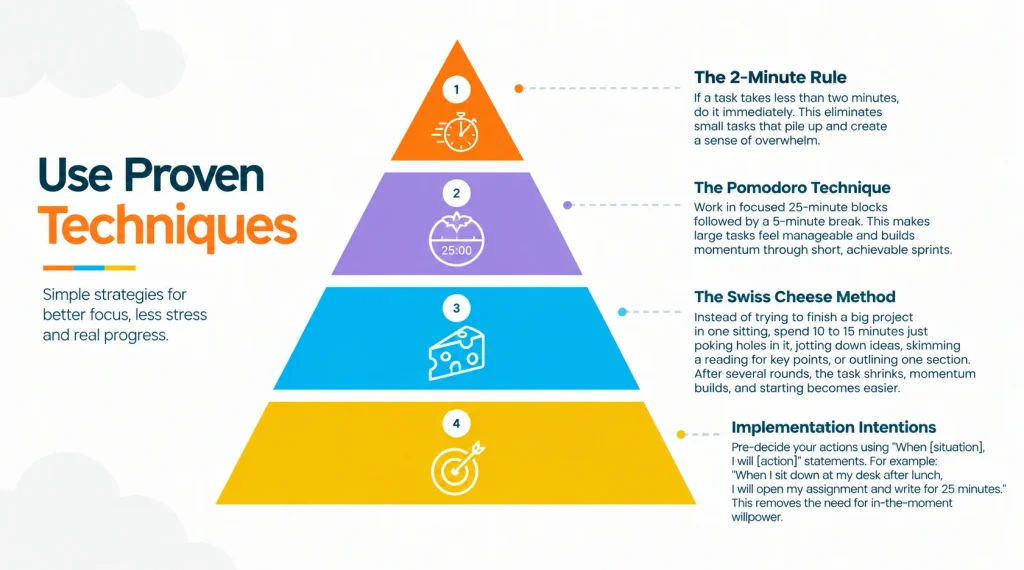
- The 2-Minute Rule: If a task takes less than two minutes, do it immediately. This eliminates small tasks that pile up and create a sense of overwhelm.
- The Pomodoro Technique: Work in focused 25-minute blocks followed by a 5-minute break. This makes large tasks feel manageable and builds momentum through short, achievable sprints.
- The Swiss Cheese Method: Instead of trying to finish a big project in one sitting, spend 10 to 15 minutes just poking holes in it, jotting down ideas, skimming a reading for key points, or outlining one section. After several rounds, the task shrinks, momentum builds, and starting becomes easier.
- Implementation Intentions: Pre-decide your actions using “When [situation], I will [action]” statements. For example: “When I sit down at my desk after lunch, I will open my assignment and write for 25 minutes.” This removes the need for in-the-moment willpower.
Design Your Environment
Choose where and with whom you work carefully. Repeatedly placing yourself in unproductive settings, studying in bed, working at a noisy café, or sitting next to distracted friends, is itself a form of procrastination. Create a dedicated workspace and use it consistently.
Stay Actively Engaged
Passive engagement kills motivation. If you are just going through the motions with your work or coursework, you are not connecting with the material, and that disconnection breeds procrastination. Fight this by seeking out what is genuinely interesting or relevant in every task, setting your own purpose for each reading or assignment, and asking yourself questions about what you are learning. Aim to understand, not just to finish.
Commit and Rebuild Trust
Write down only what you can fully commit to completing, and then follow through no matter what. Many chronic procrastinators have lost trust in their own commitments. Rebuilding that trust requires a track record of small, kept promises to yourself. Start small, deliver consistently, and reward your progress.
The Role of Self-Compassion
Research consistently shows that self-forgiveness after a bout of procrastination reduces the likelihood of procrastinating again. This is counterintuitive, many people believe they need to be harder on themselves, but harsh self-criticism creates a shame cycle that feeds more avoidance.
Treat setbacks as a normal part of the process, not a character failure. Mindfulness helps: instead of reflexively escaping discomfort, practice noticing the feeling, letting it exist without judgment, and choosing to act anyway. Over time, this builds the tolerance that breaks the avoidance loop.
When Procrastination Might Signal Something Deeper
In some cases, chronic procrastination overlaps with or masks a deeper issue. The symptoms of depression, difficulty concentrating, low motivation, fatigue, persistent guilt, closely mirror the experience of severe procrastination. Similarly, individuals with ADHD often struggle with executive function challenges that make initiating and sustaining tasks significantly harder.
If procrastination is persistent, causes significant distress, and does not improve with the strategies above, consulting a mental health professional is a practical step toward finding the right support. Charisma University’s School of Psychology programs explore these behavioral dynamics in depth for students interested in understanding the science behind human behavior.
Self-Assessment: Are You a Chronic Procrastinator?
Ask yourself these questions honestly:
- Do you regularly delay tasks despite knowing the consequences?
- Do you wait for the “right mood” before starting important work?
- Do you feel guilt or anxiety about unfinished tasks on a regular basis?
- Do you often rush to meet deadlines at the last possible moment?
- Do you avoid tasks because they feel overwhelming, boring, or unclear?
- Has procrastination affected your grades, work performance, or relationships?
If you answered yes to four or more, your procrastination has likely moved beyond occasional and into chronic territory — start with awareness, pick one technique, and build from there.
How Charisma University Supports Student Success
Overcoming procrastination is one part of a broader set of academic and professional skills that determine long-term success. Charisma University provides students with structured support systems, from academic advising and career services to resources like the Writing Center,designed to help students build productive habits, stay on track, and develop the self-management skills that carry through an entire career. Explore Charisma University’s degree programs to find the right path for your goals.
Frequently Asked Questions
Procrastination is primarily driven by emotional avoidance, the desire to escape discomfort, fear, boredom, or anxiety associated with a task. It is an emotional regulation problem, not a time management one.
Procrastination itself is not classified as a mental health disorder, but chronic procrastination is strongly linked to increased stress, anxiety, and depression. It can also overlap with conditions like ADHD and anxiety disorders.
Start with the smallest possible step. Use the 2-Minute Rule (do anything that takes under two minutes immediately) or commit to just 10 minutes of focused work on the task you are avoiding. Action often generates its own momentum.
Procrastination can be significantly reduced through awareness, behavioral strategies, and environmental design. Because it is rooted in normal brain functions, managing it is an ongoing practice rather than a one-time fix.
If a task takes less than two minutes to complete, do it immediately rather than adding it to a list. This prevents small tasks from piling up and creating the sense of overwhelm that fuels further procrastination.
Yes. People with ADHD often experience executive function challenges that make task initiation, sustained focus, and time estimation significantly harder. If procrastination is severe and persistent despite consistent effort, it may be worth exploring whether ADHD or another condition is a contributing factor.