First things first, STEM is an acronym that stands for science, technology, engineering, and mathematics. STEM combines all of these topics into one unit. These topics are not taught separately, they’re taught in a unified structure so you can develop the most in-demand skills.
According to the US Bureau of Labour Statistics, STEM jobs are projected to grow upto 10.4% from 2023 to 2033. The need for STEM education is also growing globally. From the United States to China, there are about 820,000 to 3.57 million STEM graduates annually.
By 2030, about 80% of the jobs globally will require STEM-related skills. To make sure you take full advantage of this opportunity, we’ll be going through the importance of STEM education, core components, its curriculum, and its career opportunities.
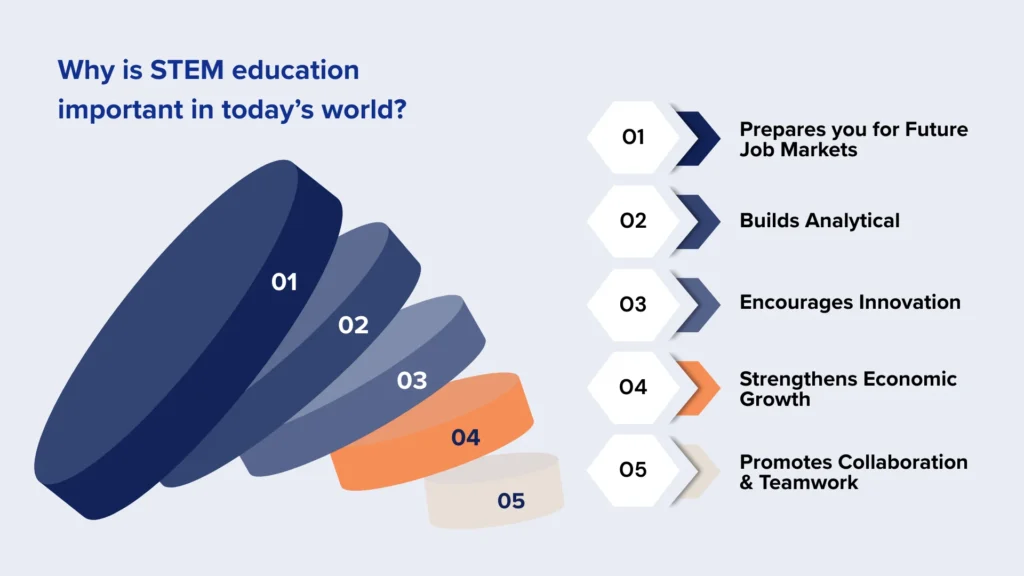
Why is STEM education important in today’s world?
Spare a few minutes and think about how the world progressed. From smartphones, online banking, electric vehicles, to AI. We’re already living in the future that’s powered by innovation. The way we work and communicate has been completely transformed, and all of it became possible due to its STEM foundation.
Prepares you for Future Job Markets
You will learn skills that are needed in areas like robotics, healthcare technology, IT, and cybersecurity. These areas are in demand, and that is why STEM education is important for the job market, which is always changing, and for jobs like robotics, healthcare technology, IT, and cybersecurity.
Builds Analytical/Critical Thinking Skills
Instead of telling you what to think, STEM education will teach you “How To Think”. You’ll be building such skills through experiments, challenges, and engineering tasks. Since learners analyze problems and test solutions logically. These skills will help you in both academic and corporate life.
Encourages Innovation
Behind every innovation, there’s curiosity, and STEM education prioritises such a desire. You’ll be encouraged to ask questions and design creative solutions to actual problems. Through trial and error, you’ll build a mindset that’s required to invent and improve the technologies of tomorrow.
Strengthens Economic Growth
Nations prioritising (like China) STEM education often lead in technological advancements and compete globally. Companies that are built on STEM drive create new industries and attract investment. When businesses expand, technologies evolve too.
Promotes Collaboration & Teamwork
You’ll rarely find scientific or technological breakthroughs happening because of one person, most are often because of teamwork. For more chances of such breakthroughs happening, STEM emphasises the importance of teamwork.
Core Components of STEM Education
This is the part where you’ll find out how the cogs operate in a STEM education. These four subjects aren’t just stuffed together like a standard school timetable. It’s a system where one subject gives power to the other, just like how cogs work. When one cog is turned, it gives power to the other cogs, and they all move in the same seamless motion. Here’s a visual breakdown:
| Component | Core Focus | Main Outcome |
| Science | To understand the world | Discoveries |
| Technology | For building & using tools | Innovations |
| Engineering | To build solutions | Problem Solving |
| Mathematics | For analysing & measuring | Perform complex calculations & make logical predictions |
Role of Science(S) in STEM learning
Science will be your first step in pursuing STEM education. This is the part where you’ll be encouraged to ask questions about the world and find the answers. You’ll force yourself to investigate and experiment based on your knowledge, instead of simply memorising facts.
- You’ll explore patterns not just in human biology. You’ll also cover other aspects like ecosystems, wildlife, etc., to understand how science impacts everyday life.
- You’ll experiment by following a step-by-step process to sort out mistakes and reach conclusions.
- These scientific principles will also help you in other areas of STEM.
Technology’s(T) Role in Modern Education
Those days when schools required a board and marker/chalk to write on will soon be gone. Screens and smart devices will replace them. Technology isn’t just limited to entertainment, it’s also compatible in schools and workplaces. In STEM education, you’ll be taught how to utilise technology instead of simply consuming it.
- You’ll learn how technology works behind the scenes in different aspects, from basic coding to cybersecurity.
- Technology will teach you how to break complex problems into simple and smaller steps.
- You won’t just be using websites & apps, you’ll be taught to create them as well.
Engineering(E) as a problem-solving discipline
This is where ideas stop being theories and start becoming actual solutions. In short, this side of STEM is all about the practical. The part where you’ll make full use of your knowledge and build something with it. Even if something goes wrong, you’ll say, “How can I improve this?” instead of “Is this correct?”
- You’ll use all the concepts from science and math to design solutions such as apps, bridges, and water-filtering systems.
- Based on your knowledge, you’ll experiment while keeping all the costs, safety, and efficiency in mind.
- In most cases, you won’t find the correct answer. So you’ll compare outcomes and modify your ideas for better results.
Maths(M) as the foundation
Maths might’ve given us nightmares in our schooldays, but it is the binding force that connects all of STEM’s existing branches. Math provides a structure that’ll test theories, build systems, and measure innovations. Without it, your practicals will lack precision.
- Maths will provide you with the formulas and quantitative tools to measure designs and test hypotheses.
- It’ll help you identify patterns and bring forth evidence based on your research and analysis.
- You’ll also be able to understand budgeting and cost estimation in real-world projects.
The 4Cs
This is the acronym for creativity, collaboration, communication, and critical thinking. These are essential 21st-century skills within STEM education that complement technical knowledge by enhancing how students think and interact. These skills are going to help you in both school/college and corporate settings.
Sidenote
The 4Cs are not just valuable in STEM companies, they’re valuable across all industries. Many modern STEM curricula are deliberately structured in such a way that you’ll develop such skills as you continue on your STEM journey.
STEM Curriculum
Unlike traditional textbook methods from schools, a well designed STEM curriculum focuses on real-world challenges and skill development. You’ll be encouraged to explore and experiment based on your knowledge, so you can hone your skills and always be prepared to work productively in your workplace.
Curriculum Based on Stage
The curriculum really depends on which level of education you’re at. The best thing about a STEM curriculum is that its concepts are based on the level of your understanding. Once you get through the initial stages, understanding complex topics becomes much easier. Just like in video games, where you start at level1, you beat enemies and get stronger for the next level.
| Stages | Based on | Outcome |
| Kindergarten | Play-based exploring & discovery | Builds curiosity and confidence when asking questions |
| Junior school | Coding platforms, basic math concepts, & simple robotic kits | Logical thinking, digital literacy & teamwork |
| Middle school | Lab experiments & basic programming | Enhances analytical thinking & technical skills |
| High school | AI concepts, advanced sciences, internship, research & coding languages | Polishes for STEM careers & future academic pathways |
Interdisciplinary Approach
Core concepts like math, science, and technology are not taught in separate classes, they’re blended. Suppose you just created a tsunami alert app, you’ll use science to understand climate, math to analyse, engineering to structure the system, and technology to code it. It all connects naturally.
Project Based learning
You won’t just be reading about concepts, you’ll work on actual problems, like building a small bridge model that can hold weight. You’ll brainstorm and test ideas. While your ideas may not succeed in the first go, you’ll learn from your mistakes and refine them for better results.
Technology Integration
Teaching about computers is just one part of it. You’ll also be using simulation software, robotics kits, or even 3D printers to bring ideas to life. This exposure builds digital confidence early and prepares you for a world where technology is part of almost every career.
Skill Based learning
You won’t just be evaluated based on how well you performed in exams. You’ll be assessed through presentations, teamwork, and real problem-solving tasks. It is done so they can find out how you can apply everything you learned so far and how you can improve after the feedback.
Career Opportunities in STEM
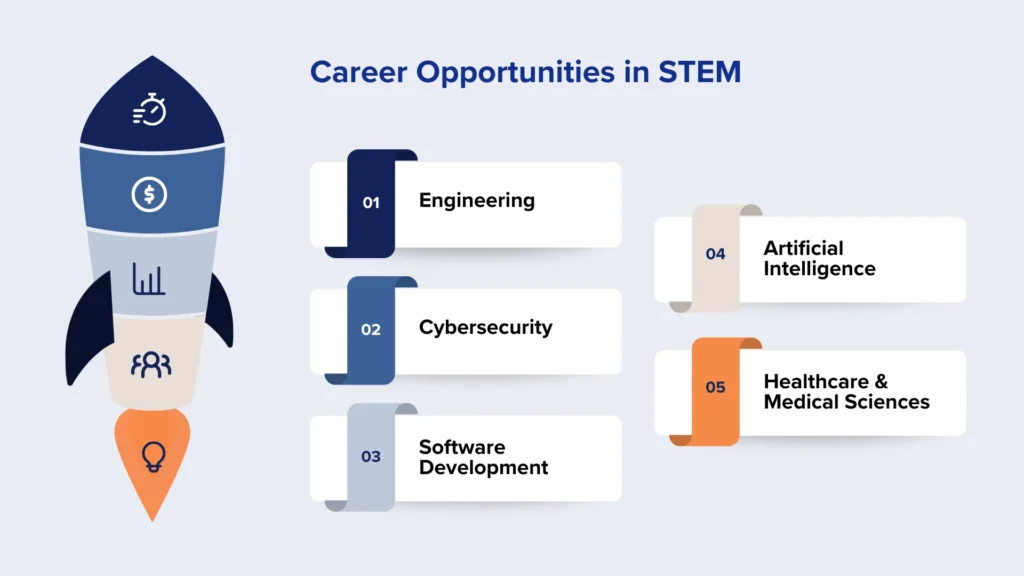
The world is already getting digitalised and technologically advanced a lot faster than most expect. You can be among the people who can take full advantage of this opportunity and shape the innovations of tomorrow.
Engineering
Even before technology, engineers were already making lives easier. From designing bridges and skyscrapers to creating electric cars or spacecraft. You’ll be identifying faults in buildings or other structures and suggesting smarter solutions.
Cybersecurity
A lot of things have shifted to the internet, so protecting the digital space is critical. As a cybersecurity expert, you’ll be tasked with defending companies, governments, and individuals from hacking and cyber threats. It requires quick learning because threats evolve daily and quickly.
Software Development
Software developers are like the engineers of the digital world. You’ll design mobile apps, websites, and video games that millions of people use daily. The essential skills required in this field are creativity and logic.
Artificial Intelligence
The future is already here thanks to AI. As an AI specialist, you’ll be tasked with handling massive amounts of information to predict trends and automate tasks. Whether it’s teaching a machine to recognise speech or helping hospitals predict disease patterns, this path is one of the fastest-growing and highest-paying areas within STEM today.
Healthcare & Medical Sciences
STEM is very crucial in modern medicine, from developing life-saving drugs to designing advanced medical equipment. In this path, you can work as a doctor, biomedical engineer or a laboratory scientist. So, you must be dedicated and study a lot since human lives are at stake.
FAQs
They’re about 95% the same, except that the “A” in STEAM stands for art. This is to encourage creativity besides the technical and analytical stuff.
Absolutely, STEM is all about developing problem-solving skills step-by-step naturally. You don’t necessarily have to be a math whiz for that.
Not really, it is interdisciplinary and can benefit anyone interested in problem-solving and technology-driven careers.
It is certainly challenging, but it is more focused on the practical concepts than on studying theories.
STEM is available for everyone, irrespective of their gender and educational background. In fact, it actively supports women to participate.