Simply put, constructivism is a learning theory that explains how you construct knowledge from your experience, reflection, and interactions with your environment, instead of simply receiving information from any source. In short, it’s all about meaningful learning where you’ll build your own understanding by connecting new ideas with what you already know.
According to the National Institutes of Health (NIH), students who adopted constructive educational methods became active learners and more confident. Another study in ScienceDirect reports that a group taught using constructive methods scored much higher than a group taught traditionally.
Just like how a 2-year-old learns to walk and stand on his feet. No matter how much he’s explained about it, he’ll only learn when he pushes himself, wobbles, and falls once or twice. Eventually, he’ll learn the balance and start running.
To get to the bottom of this, we’ll be going through the importance of constructivism, its background, stages & principles, and its pros & cons.
Importance of Constructivism in the Modern World
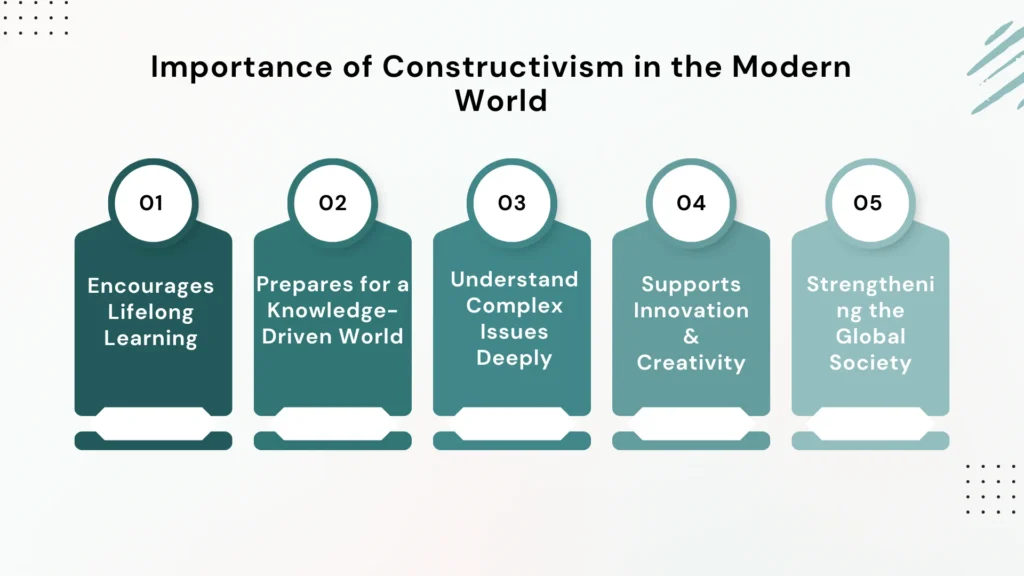
The world is moving faster than you can imagine, new problems require new solutions, and simple memorisation isn’t going to cut it. What truly matters is how you think and adapt, and this is exactly why constructivism becomes valuable.
Encourages Lifelong Learning
You shouldn’t stop learning at school or university. Rather, you should keep on learning till you’re 6 feet under. Constructivist learning will continue to encourage you to explore new ideas, skills, and perspectives long after formal education ends.
Prepares for a Knowledge-Driven World
Unlike before, information is all over the place (especially on the internet), and constructivism will help you understand how to interpret it. You’ll develop this ability by building your knowledge through experience and exploration.
Understand Complex Issues Deeply
Many complex challenges, such as climate change and social inequality, require thoughtful analysis. You’ll be analysing problems from different angles and reflecting on your understanding. This will help you make informed decisions and bring forth highly effective solutions.
Supports Innovation & Creativity
Nowadays, industries thrive on innovation, and constructivism plays a role in nurturing that. That’s why you’ll learn to question assumptions and experiment with ideas, they’ll build you a path to new possibilities.
Strengthening the Global Society
The modern world is more connected than ever, and people from different backgrounds work together. Constructivism prioritises teamwork and shared learning experiences to develop trust and strengthen communication. Communication is important if you work in a diverse environment.
Origins and Development of Constructivism
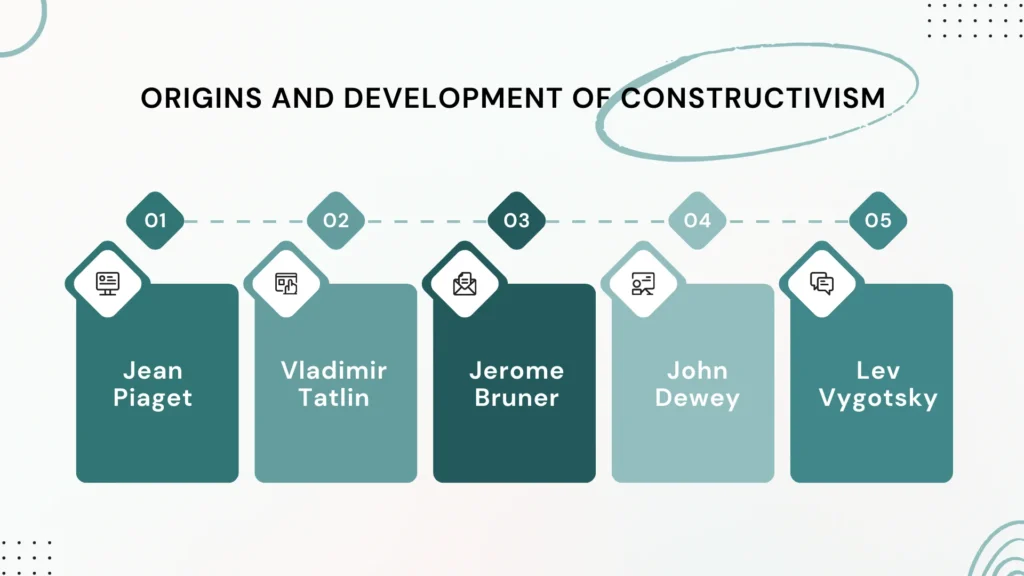
Constructivism evolved gradually through the ideas of several thinkers from different educational backgrounds. They were trying to understand how people learn and make sense of the world. They brought forth different perspectives that shaped constructivism into the learning theory we know today.
Jean Piaget
He is one of the most influential figures in constructivism, especially in understanding how children develop knowledge through cognitive growth. He believed learners actively construct understanding by interacting with their environment and organising experiences into mental frameworks called schemas.
Vladimir Tatlin
Constructivism also has a background in the arts and architecture. Vladimir Tatlin emphasised that art should be constructed using real materials and serve social purposes rather than purely decorative ones. Unlike Jean’s perspective, Tatlin states that meaning and knowledge are actively created through construction and interaction with the physical world.
Jerome Bruner
Jerome expands constructivism by introducing discovery learning, where you learn best by exploring information yourself. He also stated that teachers should provide temporary support until learners gain confidence and start working independently.
John Dewey
If you’re wondering about the philosophical background of constructivism, then all the credit goes to John Dewey. He believed that learning happens most effectively through experience and that education connected to real-life situations should be taught.
Lev Vygotsky
He introduced the concept of the Zone of Proximal Development (ZPD), which explains how you achieve a better understanding with guidance from teachers or peers. Vygotsky’s perspective became the foundation of social constructivism, which highlights that knowledge is often developed through communication and shared experiences.
Stages & Principles of Constructivism
Some lessons tend to stick with you for the rest of your life, while others disappear the very next day. Sometimes, “how” you learn concepts matters more than intelligence and effort. To really understand this, you need to pay attention to what’s happening below the surface.
Stages
It doesn’t happen at once, there’s a natural processing flow that needs to be followed. Sometimes, it can be messy or surprising, but it’s crucial to follow each step. Once you look at the pattern closely, you’ll learn how it all works. Here’s what it looks like:
| Stages | Function | Purpose |
| Engage | To introduce the topic in such a way that sparks curiosity in you. | To activate prior knowledge and create interest so you’re motivated to explore. |
| Explore | You’ll investigate the topic based on experiments & activities. | Encourages independent thinking so you can have a basic understanding based on experience. |
| Explain | Expressing yourself based on the understanding you’ve built. | To enhance your ideas and correct misconceptions. |
| Elaborate | To apply your understanding and solve new & complex situations. | Solve complex situations and share your experiences with new learners. |
| Evaluate | Assessing your understanding by reflecting, discussing, or using some form of assessment method. | To measure your progress and make sure that the concepts are properly understood. |
Principles
Understanding the stages is one thing, but knowing why they work is another. These stages are guided by a set of underlying principles that mould how learning actually sticks to your memory. Knowing about how they drive the process behind the scenes is when things start making more sense to you.
- Knowledge Construction Through Experience
Simply giving out instructions won’t work, you need to build knowledge through exposure & interaction. The moment you encounter a situation, understanding starts to form naturally. Sometimes, all it takes is a bit of experience to shape your knowledge more effectively than mere explanations.
- You’ll gain knowledge by directly dealing with realistic situations.
- Firsthand experiences will transform your idea into a clear understanding.
- Experimenting with your ideas will refine your knowledge over a course of time.
- Importance Of Prior Knowledge
As a learner, you won’t be starting from scratch, you’ll be using everything you have in store in your mind. Existing ideas and past experiences quietly influence how you’ll understand new information. What’s already known can either support or interfere with anything you’ll learn that’s new.
- New knowledge will be implied based on your past concepts & experiences.
- If knowledge is incorrect, it can lead to misunderstandings.
- If the connection between your old & new knowledge is strong, your retention is improved.
- Active Participation in Learning
Learning changes completely when you start actively involving yourself instead of just observing. Engagement turns information into something usable. Being part of the process makes understanding stronger and more lasting.
- Actively involving yourself will help you understand concepts deeply.
- Questioning anything that bothers you improves your critical thinking.
- Participating will make you develop an interest in the topic, even if you never liked it initially.
- Social Interaction In Knowledge Building
Understanding often grows stronger when you share your knowledge with others. Communication introduces new perspectives that can either challenge or expand your thought process. Regardless of the outcome, communication will reshape ideas in ways you thought were impossible.
- Group discussions will help you explore different perspectives.
- Explaining concepts to others will strengthen your knowledge while also giving clarity to others.
- Interacting with others develops cognitive skills like reasoning and argument.
- Reflection & Meaning-Making
Learning doesn’t end with action, it is solidified through thought. It takes time to reflect on how you connect ideas and extract meaning. This is where information starts to become truly personal.
- You’ll be questioning your own thought process, finding faults and refining your memory.
- Reflecting helps analysing everything you’ve learned so far, making it easy for you to recognise the patterns and reasons behind certain decisions.
- Your learning is stabilised when your ideas are strengthened after you’re finished with a certain activity.
Types Of Constructivism
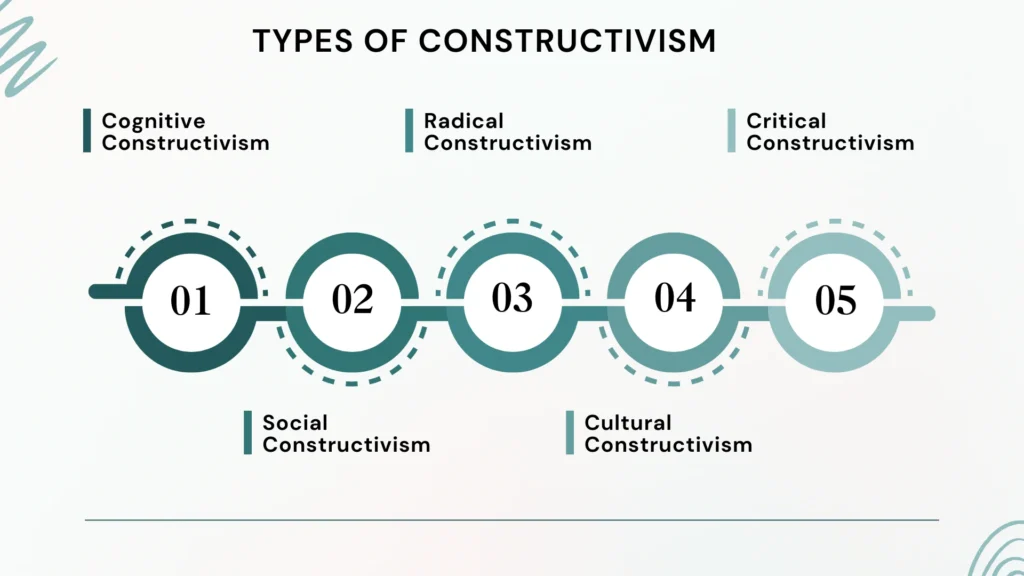
Constructivism isn’t just one big idea sitting on its own, it actually splits into different types, and each one looks at learning from a slightly different angle. Just like how five people played the same game, killed the final boss, but they all understood the story and the purpose of the game differently.
Cognitive Constructivism
This one is all about the mind, especially when you learn a new thing. It states that learning is a personal process where your brain actively organises and reshapes information based on your experiences. You’re not just storing facts, but also refining your understanding.
Social Constructivism
It believes that we learn best through interaction with people around us. Whether it’s a classroom discussion, a group project, or even a casual conversation, these social exchanges help us see things from different perspectives.
Radical Constructivism
This view of constructivism states that learning is deeply personal, and what feels true to you is shaped entirely by how you perceive and process the world around you. In short, you’ll be creating your own version of reality based on your experiences.
Cultural Constructivism
It suggests that learning is more than just about you or your social interactions, it’s also heavily influenced by culture. The language you speak, the traditions you grow up with, and the environment you live in all shape how you think and learn.
Critical Constructivism
This branch pushes you to think more deeply about society, power structures, and inequality. It turns learning into something active and thoughtful, where you’re not just absorbing information but also analysing and challenging it constantly. Scepticism is what keeps this going.
Constructivism In Different Disciplines
Constructivism isn’t limited to one field, it spreads across multiple disciplines, shaping how knowledge is created and understood in each of them. Whether it’s the human mind, society, or global politics, this concept adapts differently everywhere.
Psychology
Psychology explains how constructivism actively builds knowledge in your brain instead of just storing it. It focuses on your experiences, thoughts, and interactions that have shaped your understanding over time.
Philosophy
The philosophical perspective states that constructivism challenges the idea of absolute truth. It suggests that reality isn’t fixed but is shaped by your perspective based on your experience. In other words, what’s considered “normal” for you might not be the same for others.
Sociology
Sociology states constructivism looks at how society and culture influence what you believe and understand. Your ideas, values, and knowledge are shaped through social interactions and shared experiences within the place you grew up.
International Relations
Constructivism in international relations focuses on how countries behave based on ideas, identities, and beliefs rather than just power or economics. Nations act according to how they perceive themselves and others. So, geopolitics is shaped as much by mindset as it is by strategy.
Education
Education states that constructivism transforms learning into an active and engaging process. Students receive information, but they’re also encouraged to explore, question, and build their own understanding.
Constructivism In Modern Education
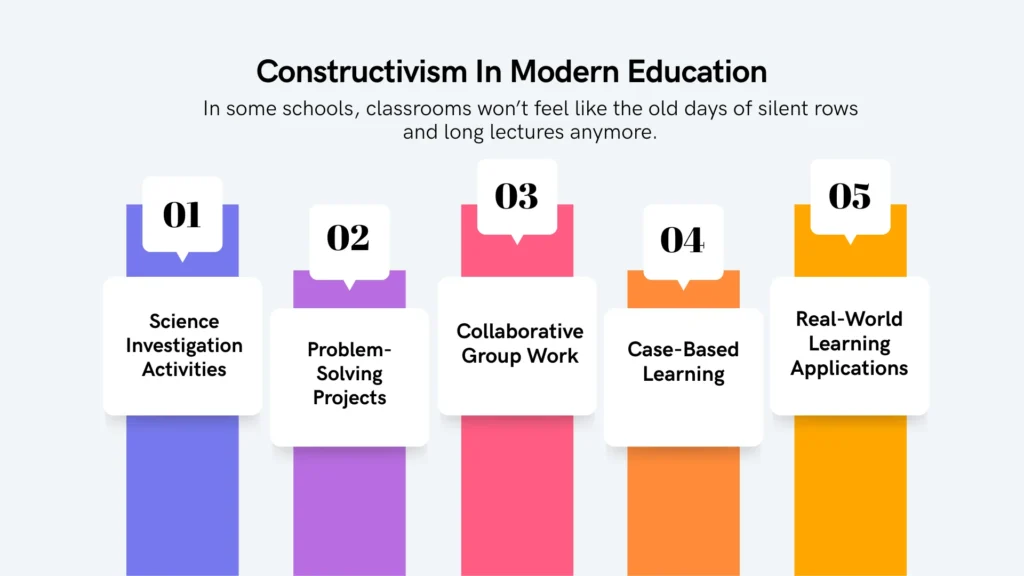
In some schools, classrooms won’t feel like the old days of silent rows and long lectures anymore. Instead, you’ll see students talking, experimenting, debating, and actually benefitting from the learning process. The credit for such a shift goes to constructivism.
Science Investigation Activities
Instead of just reading about scientific concepts, students will get their hands dirty and perform experiments. After that, they’ll draw conclusions on their own, which makes learning feel more like discovery than memorisation.
Problem Solving Projects
Students will definitely mess up their experiments while trying to figure things out step by step. It pushes them to think critically, try different solutions, and learn from mistakes, which is honestly how real-world learning works anyway.
Collaborative Group Work
Learning becomes a shared experience rather than a solo journey. Students work in groups, exchange ideas, challenge each other’s thinking, and build knowledge together.
Case-Based Learning
Instead of abstract theories, students dive into real-life scenario situations and analyse what’s happening. They’ll discuss possible solutions and make decisions based on their understanding.
Real-World Learning Applications
Students take what they’ve learned and apply it to everyday life, whether it’s solving a problem or making a decision. It turns learning into something useful and a lot more memorable. This is the moment when students notice how everything connects.
Pros & Cons Of Constructivism
Constructivism sounds like the perfect way to learn, but is it really all that ideal in practice? Like most teaching approaches, it comes with some powerful benefits and a few real challenges that can’t be ignored.
| Pros | Cons |
| Promotes a deeper understanding of certain topics. | Often time-consuming when it’s properly implemented. |
| Encourages critical thinking and problem-solving skills. | Very difficult to manage in large classrooms. |
| Increases student engagement. | Requires highly skilled & trained teachers. |
| Supports hands-on experience | Assessment can be complex |
| Builds teamwork and communication skills | Students might feel lost when the structure is unclear |
| Encourages independent thinking | Might lead to uneven outcomes |
FAQs
Yes, constructivism works very well for self-learning because it encourages exploration and independent thinking.
It works especially well for children because they naturally learn by exploring and asking questions. Activities like play and storytelling fit perfectly with this approach.
That’s because it lacks structure and can be time-consuming in classrooms. Others feel it may not work well for all learners or subjects without proper guidance.
Active learning is a method where students participate in activities, while constructivism is the theory behind why that participation helps learning. Simply put, active learning is the “how,” and constructivism is the “why.”
No, memorisation still has a place, but it’s not the main focus. Constructivism emphasises understanding first, and then comes “memorisation”.