In a nutshell, supply chain management (SCM) is all about coordinating goods and finances from raw materials to the desired customer. It combines all of its working components into one integrated system. The aim is to deliver the right product at the right time while controlling cost and efficiency.
According to Accenture, companies with a strong SCM system have generated about 23% increase in profit compared to their less optimised peers. Invesp states that 79% of the companies achieved revenue growth, which was higher than average in their industries.
The best part is, it’s very compatible with multiple industries, from e-commerce to retail.
To make sure you take full advantage of supply chain management, we’ll be going through its importance, the skills you need, a complete breakdown of SCM, and how other industries utilise it.
Why Supply Chain Management Matters for Modern Businesses
Modern businesses are starting to shift from their traditional way of operations. Products are now able to cross borders, and customers can expect them to be delivered in a single day. At the same time, you can observe your competitors in a single click. In this fast moving environment, SCM is more than necessary to keep a business competitive and stable.
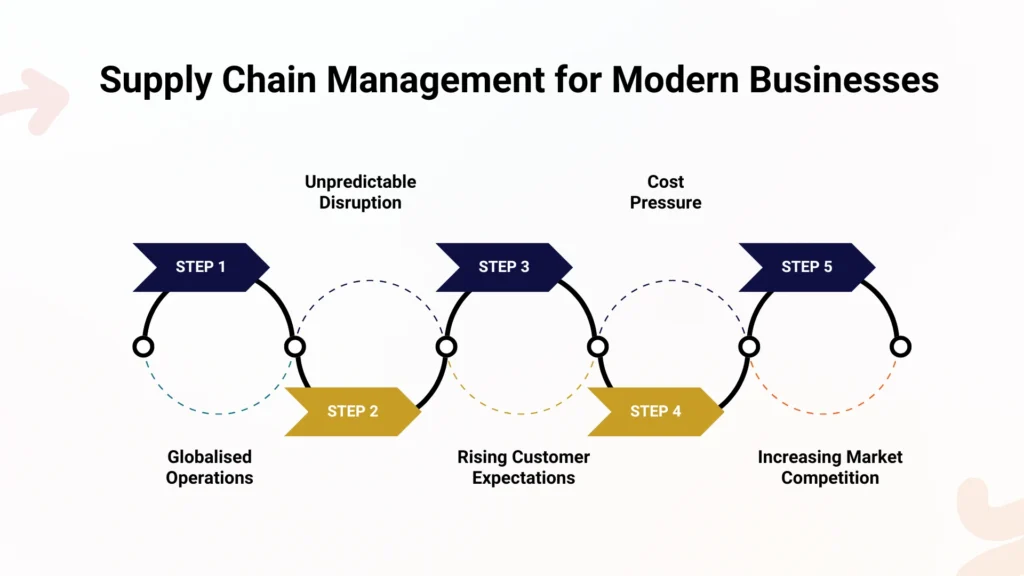
Globalised Operations
Most companies are starting to rely on international suppliers. Which means different time zones, currencies, and the overall risk of managing everything. A strong SCM is necessary to navigate these moving parts smoothly and prevent small issues from disrupting operations.
Unpredictable Disruption
Natural disasters or pandemics like COVID-19 can ruin the whole operation. SCM handles it by preparing businesses to adjust sourcing strategies and maintain operations even when unexpected challenges arise.
Rising Customer Expectations
Regardless of old age, customers usually get cranky and demand operations to be done instantly. Two day shipping is normal, the same day feels impressive, but they lose their minds over delays. SCM can help businesses meet their expectations, so you don’t have to hear customers complain all the time.
Cost Pressure
Operating costs like fuel, labour and materials don’t remain the same, they rise every year. Which can cause your expenses to spiral quickly. By relying on an effective SCM, you can control your spending and manage resources wisely, so you can remain financially sustainable.
Increasing Market Competition
It’s not just sports, competition is intense in every industry. If your product is overpriced or out of stock, then customers will just go and visit your competitor. SCM can keep you competitive by making sure your products are quickly delivered, their prices are controlled, and they are 247 available.
Skills & Technologies Used in Supply Chain Management
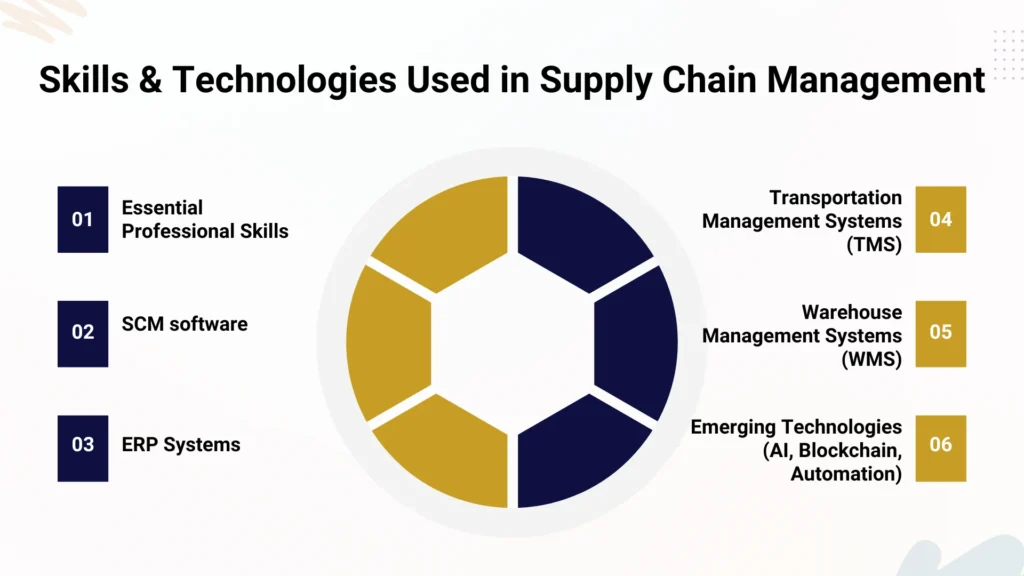
In short, you require both human skills and digital tools for your operations to run smoothly. SCM is more than just trucks moving on highways or boxes stacked in warehouses. It involves a smart workforce, powerful software, and technology working together behind the scenes.
Essential Professional Skills
Whether it involves labour work or technology, you must have a workforce to support you. They must have analytical and problem-solving skills. Communication is required as well for negotiations to build a strong supplier relationship.
SCM software
Without specialised software, it won’t take much time for modern supply chains to collapse. SCM software provides real-time visibility into order processing and shipment tracking. So you can monitor every stage of the process instead of random guessing.
ERP Systems
The Enterprise Resource Planning systems play the role of CNS in your company. Through ERP, you’ll be connecting supply chain operations with finance, sales, and procurement to make sure that every department works with the same data in real time. This eliminates information silos and reduces costly miscommunication.
Transportation Management Systems (TMS)
TMS focuses on the movement of goods. Additionally, it helps you to choose the most cost effective options and track shipments from departure to arrival. This will reduce your fuel costs and shorten delivery times.
Warehouse Management Systems (WMS)
WMS is like the digital brain of operations that uses software to track and optimise all warehouse activities in real time. From storing inventory to picking and shipping orders through RFID or barcode scanning.
Emerging Technologies (AI, Blockchain, Automation)
SCMs are getting smarter thanks to new technologies. AI focuses on potential disruptions before they escalate. Blockchain improves transparency and trust across supply chain transactions. Automation manages time by handling the warehouse’s speed and efficiency, leaving room for zero error.
What is Supply Chain Management (A complete breakdown)
Just like how there’s a whole film crew shooting a shot in behind-the-scenes. SCM is the BTS of supervising the movement of your products. To put it simply, SCM is the management of your goods being flown from your warehouse to your customer’s location.
Types of Supply Chain Models
SCM is certainly effective, but it also comes with its types. Every industry utilises different kinds of SCMs that are best suited for their specific operations. Below are some of the most common models used and for which industry they’re suitable.
| Model | Description | Suitable for |
| Continuous Flow Model | Stable production with constant demand | Goods & groceries |
| Agile Model | Very flexible for special items and quickly responds to demand changes | Fashion & Tech |
| Fast Model | A relatively new model, designed for products with short life cycles | E-commerce & electronics |
| Flexible Model | It can easily adjust itself during peak and off-season | Pharmaceuticals |
| Efficient Model | Reduces costs, very sufficient within super competitive industries | Automotive, food & beverages |
| Custom-Configured Model | A blend of agile & continuous flow model. The only addition is that a product requires extra customisation. | Aerospace & defense |
Advantages of Supply Chain Management
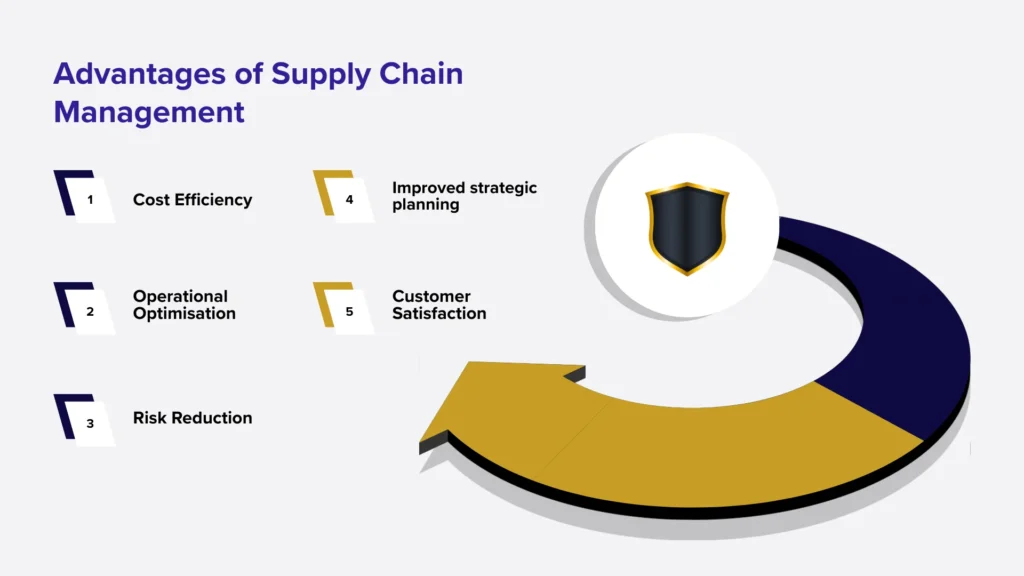
Once you notice your supply chain running smoothly, you’ll see how much of your business has been transformed. Your operations become more predictable, the team’s coordination is improved, and customers notice the reliability without even asking about it.
1. Cost Efficiency
A well-managed supply chain reduces unnecessary expenses before they even show up. It cuts down the storage costs and minimises emergency shipping. Over time, these small savings can be later preserved as profits.
2. Operational Optimisation
SCM helps everything run more smoothly. It improves teamwork between departments and keeps all of the processes organised. Optimised operations get the work done faster with fewer mistakes.
3. Risk Reduction
Every business faces risks, but how you handle them is what matters. SCM keeps you one step ahead of your problems. You’ll be prepared enough that you won’t have to rely on a single supplier. If something bad happens, you’ll be able to respond faster to avoid major losses later on.
4. Improved strategic planning
According to Unleashed software, data-driven insights from SCM tools can help your business predict demands more accurately and make smart purchasing decisions.
5. Customer Satisfaction
Customers emphasise fast and accurate deliveries a lot. SCM make sure that products are available at the right time and orders are fulfilled correctly. So make sure you keep improving your services and keep your customers loyal to you.
The 5 core stages of Supply Chain Management
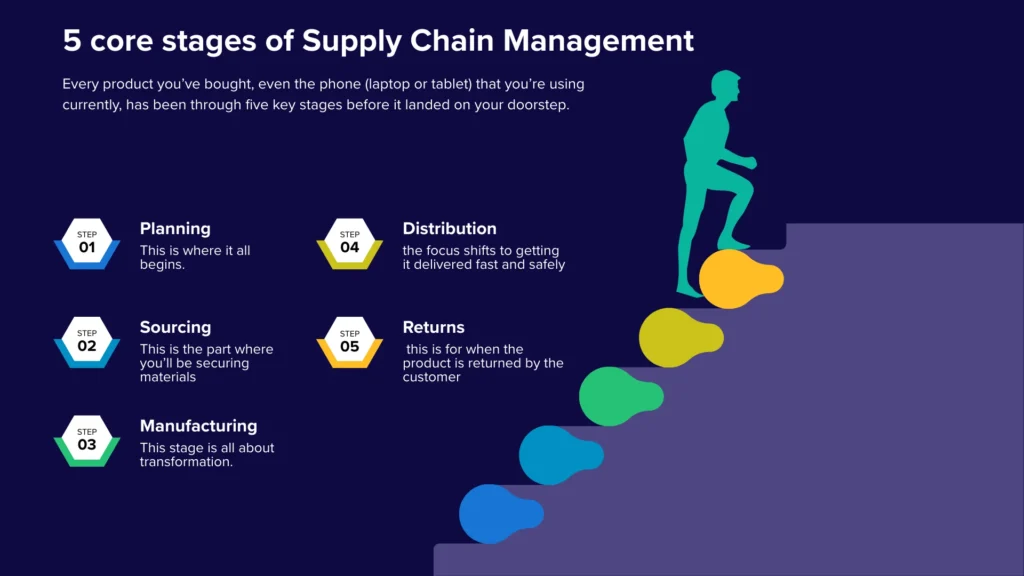
Every product you’ve bought, even the phone (laptop or tablet) that you’re using currently, has been through five key stages before it landed on your doorstep. These stages are like checkpoints that make sure your product moves smoothly from the warehouse to you.
1. Planning
This is where it all begins. This stage is all about strategy, where data driven predictions, developing new strategies, and calculating the necessary resources are used to make sure the supply chain aligns with your business goals. So what you’ll be doing is:
- Analyse the market trends and old data to predict customer demands
- Measure your stock level to see if it can meet their demands
- Figure out the potential risks and create a safety net, in case something bad happens
2. Sourcing
This is the part where you’ll be securing materials or goods needed for production through the right partner. In this stage, you’ll be more focused on negotiating contracts and managing supplier relationships to prioritise quality. So what you must do is:
- Choose your vendors based on their quality and cost
- Negotiate about the pricing, delivery schedules and payments
- Finalise your contract and monitor their performance.
3. Manufacturing
This stage is all about transformation, where your ideas can finally come to life. Coordination, timing, and quality standards are all combined into this. If you manage this properly, then this stage keeps your costs under control and your customers satisfied.
- Your raw materials are basically transformed into products.
- You can maintain its quality standards through inspection and compliance checks.
- Ensures efficiency by reducing waste and preventing slowdowns
4. Distribution
Once the product is finalised, the focus shifts to getting it delivered fast and safely. Timing and coordination are critical at this stage to meet customer expectations. A strong distribution system keeps businesses competitive.
- You’ll be storing products in your warehouses strategically
- Choose which transportation method is suitable (trucks or ships)
- Make sure the order is correct and is delivered on time
5. Returns
Also known as reverse logistics, this is for when the product is returned by the customer for any reason. On the bright side, you can see this as a chance to improve your product and adjust your system to make sure losses are minimal.
- Oversee the return requests and refunds in an efficient way
- Inspect goods to see if they require repair or disposal
- Analyse the returned products to spot issues
Supply Chain vs Logistics
People use these two terms interchangeably, as if they mean the same thing. They’re closely related to one another but operate differently. Once you understand their differences, you’ll realise how you can operate your business.
| Aspects | Supply Chain Management | Logistics |
| Scope | Focused on the whole process from raw materials to the customer | Simply focused on the movement and storage of goods |
| Coverage | It covers sourcing, planning, manufacturing, delivery and returns | Covers transportation, warehouse and distribution |
| Level | Wide, in an end-to-end system | Limited but crucial within the system |
| Purpose | Connects operations for efficiency and competition | Makes sure the correct product moves on time |
Examples of Supply Chain Management in Different Industries
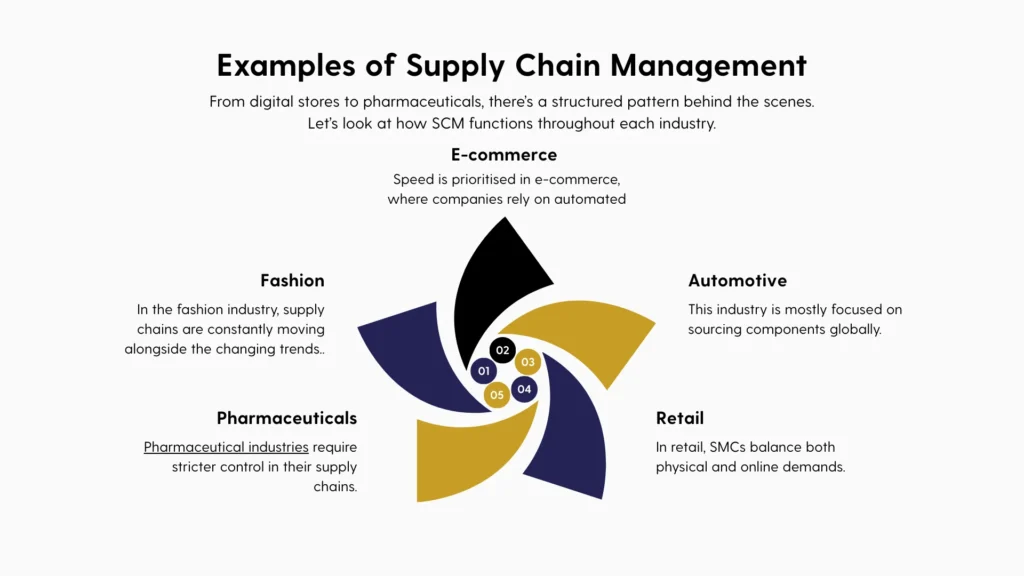
You won’t find any industry that doesn’t run on a supply chain, even if you can’t notice it on the surface. From digital stores to pharmaceuticals, there’s a structured pattern behind the scenes. Let’s look at how SCM functions throughout each industry.
E-commerce
Speed is prioritised in e-commerce, where companies rely on automated warehouses and real-time tracking to supervise hundreds of daily orders. Proper supplier coordination and effective logistics ensure that a customer receives products quickly. A return system also helps in maintaining trust.
Automotive
This industry is mostly focused on sourcing components globally. Manufacturers coordinate with multiple suppliers and manage production systems on time. Even a small disruption (like a missing microchip) can disrupt entire assembly lines, so planning and supplier relationships are very crucial.
Retail
In retail, SMCs balance both physical and online demands. Businesses predict their seasonal trends. Based on them, they maintain their stock levels to avoid shortages. The main point is to avoid overstocking while making sure that popular items are always available.
Pharmaceuticals
Pharmaceutical industries require stricter control in their supply chains. Medicines often require temperature-specific storage and secure transportation. Accuracy is crucial to make sure that the patient is safe and the product is reliable.
Fashion
In the fashion industry, supply chains are constantly moving alongside the changing trends. Brands purchase materials globally and form seasonal collections within a short time. Managing returns and unsold inventory is also a huge factor in staying profitable.
Major Challenges in Supply Chain Management
Supply chains are far from being perfect. They operate in a world that’s constantly changing. Because of this, even the best systems become vulnerable. These are the following obstacles you must take note of.
Demand Volatility
Unlike trends, a customer’s demand can change overnight. Your product might become popular at one point or lose demand just as quickly. If predictions turned out to be wrong, you might end up with excessive stock or empty shelves. You’ll be faced with pressure on your logistics network and storage.
Supplier Risk
Your company will depend on suppliers for raw materials. If your supplier fails, delays will follow. Such quality problems will damage your company’s reputation. Interruptions in the supply means that you’ll be faced with financial loss, and you won’t have any materials to create new products.
Transportation Disruptions
Products and materials are required to move from one place to another, but fuel prices can greatly affect the shipping cost, and traffic delays can slow down deliveries. Natural disasters can block important transport routes, and border restrictions can suddenly stop movement.
Inventory Imbalance
Having too many products drains your money and takes up unnecessary storage space. But having a few products isn’t a great idea either, as you’re going to end up losing lots of sales opportunities. This is the result of inaccurate predictions.
Global Uncertainties
Global events like the COVID-19 pandemic can affect supply chains instantly. This leads to shutting down factories and inactive transport. Trade restrictions can either increase the cost or limit your supply. Even currency changes affect international purchasing power.
FAQs
Inventory management takes control of your stock levels in order to avoid shortages or excess. It makes sure that products are available in an accurate amount.
This is where you choose and purchase services or raw materials. It focuses on cost, quality and supplier’s reliability.
Demand forecasting predicts the customer demands using data and trends. It’s very helpful for production and inventory in businesses.
The global supply chain consists of purchasing, manufacturing, and delivering products across different countries. It allows cost advantages, but it’s very complex and risky.
Supply chain visibility is all about tracking data, products and shipments in real time. It helps businesses to respond to any disruptions quickly.