At its simplest, liturgy is the structured way in which dozens of Christians gather at one place to worship God. There’s a pattern where a shared script guides believers through prayer, praise, and confession.
In the USA, around40% to 49.5% of catholics have attended liturgy in large numbers at least once a month. 19% of the population were in their early to late twenties, while 49% of them were 60 years of age or older.
The highest attendance was reported in Nigeria (94%), Kenya (73%) & Lebanon (69%). Whereas Europe and North America had lower levels. France was the lowest (9%), followed by Switzerland & Latvia (11%), alongside Germany and Canada (14%).
To fully understand the concept of liturgy, we will explore its origins, importance, principles, and some of the most common misconceptions about it.
Importance of Liturgy Today
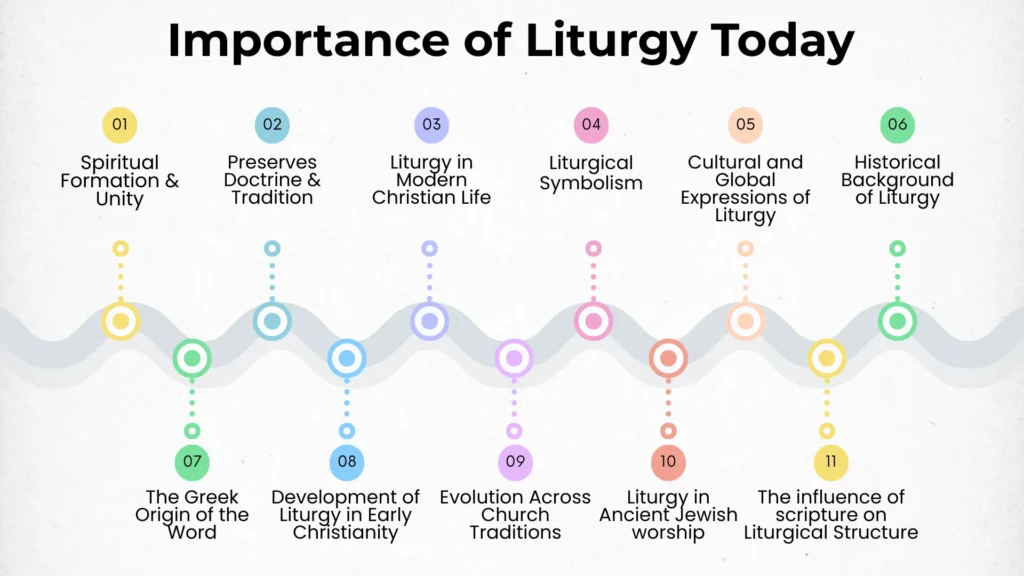
In today’s day and age, a lot of people emphasise freedom to do whatever they want, so structured worship might seem restrictive. However, liturgy doesn’t compete with modern faith, it strengthens it. Its steady rhythm offers spiritual depth and connection that many believers didn’t even realise they were missing.
Spiritual Formation & Unity
Just like how working out and cardio keep you in shape, liturgy will work the same by shaping your spirituality through repeated prayers and consistent scripture readings. It’ll create unity by giving through congregations and unite Christians belonging to different backgrounds.
Preserves Doctrine & Tradition
Liturgy ensures the preservation of its core beliefs regardless of how different cultures practice worshipping God. The prayers and readings summarise who God is and what Christ accomplished when he was alive. You’ll be reminded of what supports your faith whenever you attend congregations, as they repeat every week.
Liturgy in Modern Christian Life
Regardless of how ancient you believe this practice is, it’s adaptable to the modern world. Some churches (like evangelicals) have opening songs, whereas some use hymnals. There’s also a good number of churches that portray lyrics on screen, and people pray naturally.
Liturgical Symbolism
During a liturgy, communication takes place through symbols like water, bread, candles, and colours representing spiritual realities. These symbols engage with all of your senses and improve your understanding beyond mere words.
Cultural and Global Expressions of Liturgy
Liturgy isn’t just limited to the Western world, it reflects different backgrounds across all continents through its music, art and language. Congregations in all continents express structured worship in their own unique way.
Historical Background of Liturgy
The term “liturgy” definitely feels ancient, but not in a dusty, irrelevant way. It’s passed down, preserved, and protected throughout many centuries. To really understand this term, you’ll have to rewind and look back into the past. Even before something like “church” even existed.
The Greek Origin of the Word
“Liturgy” originated from the Greek word called leitourgia. In ancient Greek society, it wasn’t even considered a religious term, it meant “public service”. Where wealthy citizens would fund festivals and other public events. This act of public service was called leitourgia. Later on, Christians adopted this practice.
Development of Liturgy in Early Christianity
During the first century, Christianity was a new religion, and there was no such thing as the Church. So they used to quietly gather in homes to read scripture and pray because they feared execution. Soon, these gatherings developed patterns and preserved their teachings and unity. Such patterns lead to the foundation of what we today call “Liturgy”.
Evolution Across Church Traditions
As Christianity started gaining popularity across multiple regions, such as Rome and Constantinople. Each culture created its own style of worshipping God. Regardless of the difference, the central structure of Word, prayer, and sacrament remained an obligation.
The influence of scripture on Liturgical Structure
It is deeply rooted in biblical practice that reflects patterns found in both the Old and New Testaments. Early Christians modelled worship on synagogue readings, psalms, prayers, and the breaking of bread described in Acts. Many liturgical prayers are drawn directly from Scripture.
Liturgy in Ancient Jewish worship
Ancient Jewish worship included structured prayers, singing, and ritual blessings. Such patterns influenced early Christian gatherings. From then, Christian liturgy emerged from this foundation while focusing on the life, death and resurrection of Christ.
Principles Of Liturgy
Stepping into a church, you’ll notice services like music, prayers and readings. Liturgy follows certain guiding ideas that shape how worship takes place among Christians. The following principles explain why liturgy is structured the way it is and why these rituals have been repeated across centuries.
.
The principle of Trinitarian Structure
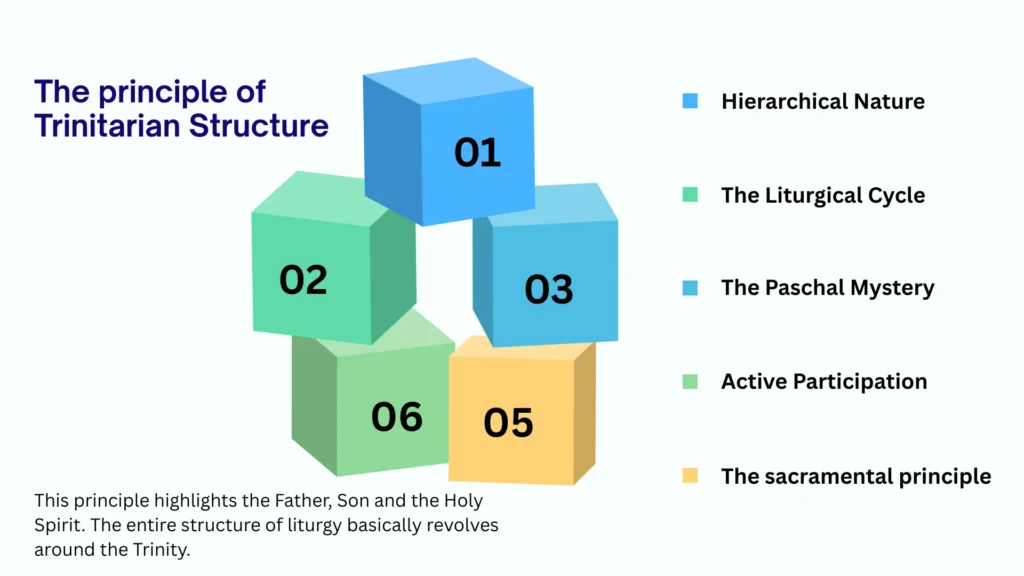
This principle highlights the Father, Son and the Holy Spirit. The entire structure of liturgy basically revolves around the Trinity. So when Christians gather to worship God, they’re also participating in His inner life.
- Prayers are directed to God, the Father and calling Him the source of life and death. It reflects that all worship ultimately flows towards Him.
- Christ is often seen as the mediator between humanity and God. A lot of liturgical prayers end with “through Jesus Christ our Lord”
- The Spirit is something that guides worship. In certain traditions, prayers often involve asking for help from the holy spirit.
Hierarchical Nature
Liturgy consists of a clear structure that allows everyone to play a meaningful role. Its hierarchical nature simply means that certain people have their own set of responsibilities during worship. This structure keeps liturgical worship organised and focused.
- Bishops, priests or pastors often lead the prayer and guide the congregation.
- Deacons play the supporting role, where they assist in proclaiming the gospel or support certain ceremonial parts.
- Choir members lead the congregation in hymns and chants that create an atmosphere which encourages prayer and reflection.
The Liturgical Cycle
Liturgy isn’t necessarily held on Sundays, it can be held in different seasons, where each season focuses on a different part of Christ’s story. So such stories are not taught at once; the church revisits them every year based on the season in order to make a significant emotional impact on the worshippers.
| Liturgical Seasons | Main Focus |
| Advent | A spiritual preparation before Christmas, focusing on hope and waiting for the day when Christ was born. |
| Christmas | Celebrating the birth of Christ and the belief that God entered the world in the form of a human. |
| Lent | The period of repentance, where you reflect on your spirituality for about forty days before Easter. |
| Holy Week | Commemorates the final days of Jesus’ life, including the Last Supper, crucifixion, and sacrifice. |
| Easter | Recalling the final days of Jesus’s life, from the last Supper to the crucifixion. |
| Pentecost | A major Christian festival that focuses on the Holy Spirit descending on the apostles of Jesus. |
The Paschal Mystery
If Trinity explains who God is, then the paschal mystery explains what Christ accomplished through his salvation for humanity. Basically, it’s all about the life of Jesus from his suffering to his resurrection.
- This event takes place during Friday or the holy week, where Christians talk about how Jesus accepted death for humanity.
- Then they talk about how Jesus is resurrected, gaining victory over sin and death and offer salvation in the hereafter.
- The message of a new life is the core element that’s repeated throughout the Christian prayer.
Active Participation
There’s basically no point in participating in a liturgy if you’re not going to focus. You and the rest of the participants need to be engaged. Worshipping becomes richer when all of the participants are actively involved.
- One of the simplest ways to respond to a prayer is to say “Amen”. You’ll contribute to the rhythm like this.
- Hymns and songs will encourage you to participate in expressing your faith.
- Other than singing and speaking, you should also actively listen to what’s being said.
The sacramental principle
It is very fascinating how Christian liturgy connects everyday physical things with deeper spiritual meaning. Liturgical worship brings them together in powerful and symbolic ways, reflecting that God can communicate through visible signs.
- Nothing fancy, just ordinary things like bread, oil and water are used to represent deeper spiritual meaning.
- Faith can be intellectual or theoretical, but it can also allow you to see, touch and taste the things that represent the blessings of God.
- These symbols connect you to the life of Jesus, just like how bread and wine refer to the “last supper”
Types of Liturgy Across Christian Denominations
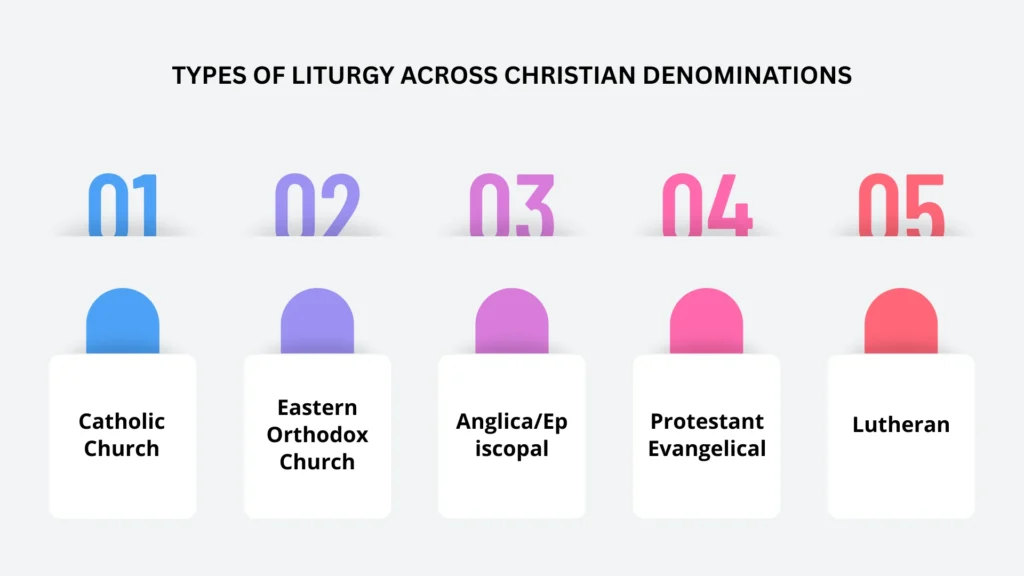
Based on cultural backgrounds, there exist different types of liturgy across the globe. They all have their own styles that are influenced by theology and history. Regardless of how they pray, the main goal is to guide the believers through worship and connect them with God.
Catholic Church
Liturgy is mostly organised in masses in catholic churches, which is divided into two main parts, the “Liturgy of the Word” and “the Liturgy of the Eucharist”. The first part is all about reading the bible to the masses and explaining it. The second part is all about the eucharist, where bread and wine are considered sacred to commemorate “the last supper”.
Eastern Orthodox Church
They’re also referred to as Divine Liturgy, their style of worship usually includes chanting rather than spoken prayers and visual symbolism while filling the whole church with incense. Their structure is mostly focused on prayers, scripture readings and the celebration of the Eucharist, while making the atmosphere immersive.
Anglica/Episcopal
Overall, their style is a blend of Catholic tradition with Protestant theology. Their worship usually includes scripture readings, responsive prayers, sermons, hymns, and communion, but in an organised manner.
Protestant/Evangelical
Their style is usually more flexible compared to their traditional counterparts. Even so, they still follow a recognisable pattern. An average service begins with music, followed by prayer, scripture readings and a sermon. But evangelicals emphasise emotional connection, followed by practical teaching from the Bible, while creating a warm & welcoming environment.
Lutheran
Their services also include traditional elements like scripture readings and prayers, but they also emphasise preaching and teaching from the Bible. In Lutheranism, God is viewed as someone who serves the congregation and provides forgiveness to mankind.
Common Misconceptions About Liturgy
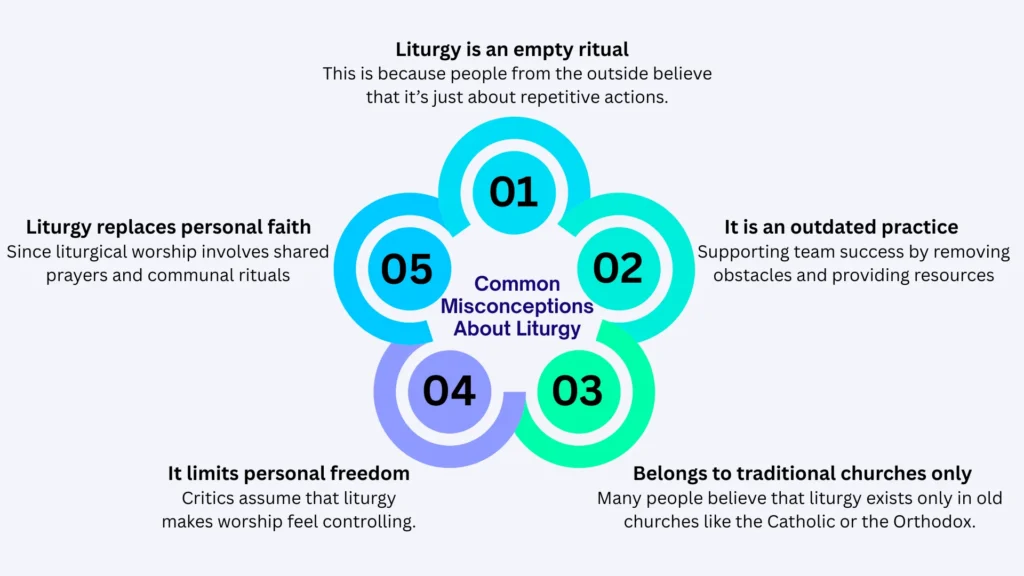
Liturgy is very misunderstood, especially by those who are unaware of the deeper meaning behind it. Since it includes rituals and repeated prayers, it is often assumed that it’s outdated. A lot of these misconceptions appeared because they don’t know how liturgy works.
Liturgy is an empty ritual
This is because people from the outside believe that it’s just about repetitive actions without having any meaning behind them. Which leads to a lot of people believing that worshippers are just following a script rather than engaging spiritually.
It is an outdated practice
Usually, things of the past are not favourable in modern times. A lot of liturgical traditions go way back, and because of this, people associate them with outdated customs that no longer have a place in modern society.
Belongs to traditional churches only
Many people believe that liturgy exists only in old churches like the Catholic or the Orthodox. They’re pretty well known for historic rituals, which is why liturgy is often seen as exclusive to them.
It limits personal freedom
Critics assume that liturgy makes worship feel controlling. Most liturgical services follow a structure based on order, with written prayers and responses. This leads people to believe that there’s little to no space for creativity.
Liturgy replaces personal faith
Since liturgical worship involves shared prayers and communal rituals, some assume it encourages people to rely solely on a formal set of rules instead of developing their own personal relationship with God. This makes liturgy appear as if it prioritises tradition over spiritual growth.
FAQs
The exact word “liturgy” isn’t mentioned anywhere in the bible but the concept of congregational prayer and organised prayer is mentioned throughout the Old and New Testaments.
Liturgy is the overall structure of how worship should be done, whereas ritual is a ceremony which usually involves baptism or communion.
It certainly does, but regardless, most church services naturally develop a pattern of worship. Even in informal services, there’s a sequence of songs, prayers, and teachings that makes it look like a liturgy.
This is because modern churches prefer flexibility in their style of worship. Believing that there is less structure allows more freedom in music and singing.
It depends, but usually it shouldn’t last longer than 45 minutes. However, it can last for more than an hour in traditional churches.