To make this easier for you, behaviourist theory (also known as behaviourism) defines the actions of humans and animals by solely focusing on apparent actions rather than internal thoughts. So this theory doesn’t focus on the mind, it focuses on the actions.
Think of it like this, you touch a cactus as a kid and it hurts you. You learned your lesson (the hard way) and won’t do it again. This is what behaviourist theory is all about, simple, isn’t it?
This theory was introduced way back in the 20th century in the United States, and later it went through a few experiments in laboratories for it to be perfected, becoming one of the most dominant theories in psychology.
In order to understand this theory without any complications, we will walk through its foundations, types, main principles and some realistic examples of where this theory can be applied.
Foundation of Behaviourist Theory
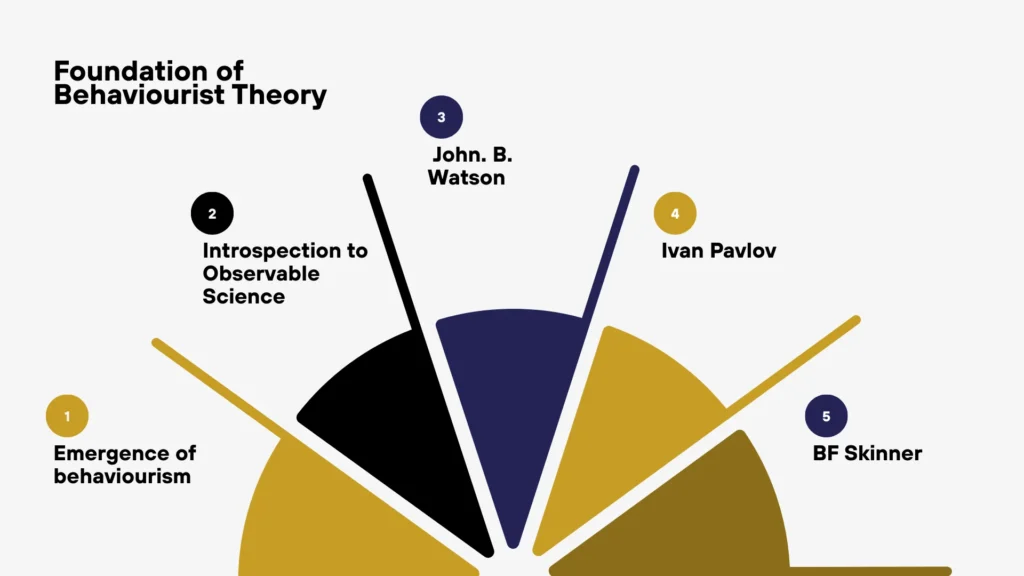
Psychology used to be a lot more chaotic before behaviourism became a thing. Researchers were too focused on internal thoughts, which weren’t easily measurable. Then came a sudden shift where researchers asked themselves, “What if we only focus on what we can actually see?” This is the moment where everything changed:
Emergence of behaviourism
In the early 20th century, psychology was trying hard to portray itself as a real science. Behaviourism emerged as a reaction against untestable & vague methods like introspection. It pushed for experiments through observable actions.
From Introspection to Observable Science
Introspection is the examination of one’s own thoughts and emotions. The problem was that thoughts can’t be measured with every single detail. That’s when Behaviourists switched everything and focused on actions.
John. B. Watson
He is widely regarded as the founder of behaviourism. He argued that psychology should study behaviour, not the mind. He also believed that the environment is a huge factor when shaping a person, even suggesting that a child can be trained to become anything through conditioning.
Ivan Pavlov
He was a Russian physiologist who founded classical conditioning. His experiments revealed that behaviour could be triggered by learned associations between stimuli. His work laid the scientific foundation for understanding how automatic responses can be conditioned through experience.
BF Skinner
He is another American psychologist who founded operant conditioning. Through controlled experiments, he showed that actions can be strengthened or weakened depending on the consequences.
Types of Behaviourist Theory
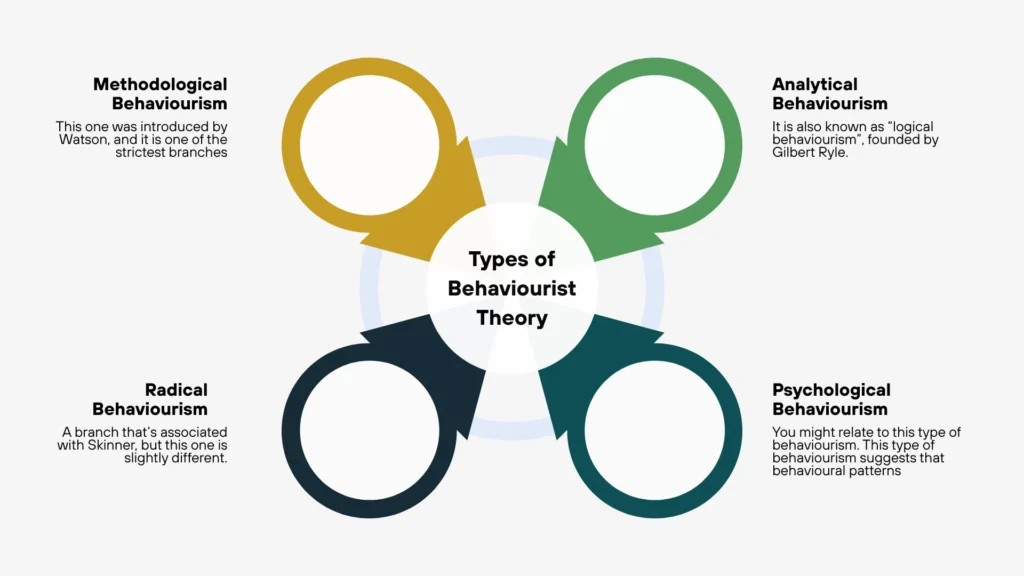
Behaviourism is the seed in psychology that sprouted and brought forth many different branches that explain how behaviour needs to be understood in its own way. Some branches remained strict while others became more flexible, allowing room for internal processes.
Methodological Behaviourism
This one was introduced by Watson, and it is one of the strictest branches, where it states that psychology should only focus on observable behaviour, not thoughts or emotions.
Example
A researcher observes how long it takes for a runner to tire out, without considering his thoughts or emotions.
Radical Behaviourism
A branch that’s associated with Skinner, but this one is slightly different. It still values observing behaviours but doesn’t disregard internal processes entirely. This branch believes that thoughts are also like behaviours that are affected by the environment.
Example
A person who was belittled his entire life gets nervous before he’s about give his presentation in class. The nervousness itself is a learned behaviour.
Analytical Behaviourism
It is also known as “logical behaviourism”, founded by Gilbert Ryle. This type of behaviour argues that your thoughts, desires and emotions are not internal processes. Rather, they’re external patterns that allow you to act in a certain way.
Example
If you’re anxious about your upcoming test, your anxiousness isn’t viewed as something internal. It means you’ve studied constantly and are avoiding distractions. Your anxiety is an external pattern allowing you to behave in a certain way.
Psychological Behaviourism
You might relate to this type of behaviourism. This type of behaviourism suggests that behavioural patterns that have been repeated for a long time are what you call a personality. It doesn’t see personality as something fixed when you’re born, it develops from long-term repeated actions.
Example
The best example is YOU, the person reading this article. The way you act alone or in public is the result of all the consequences and experiences you’ve been through in your life.
Main Principles of Behaviourist Theory
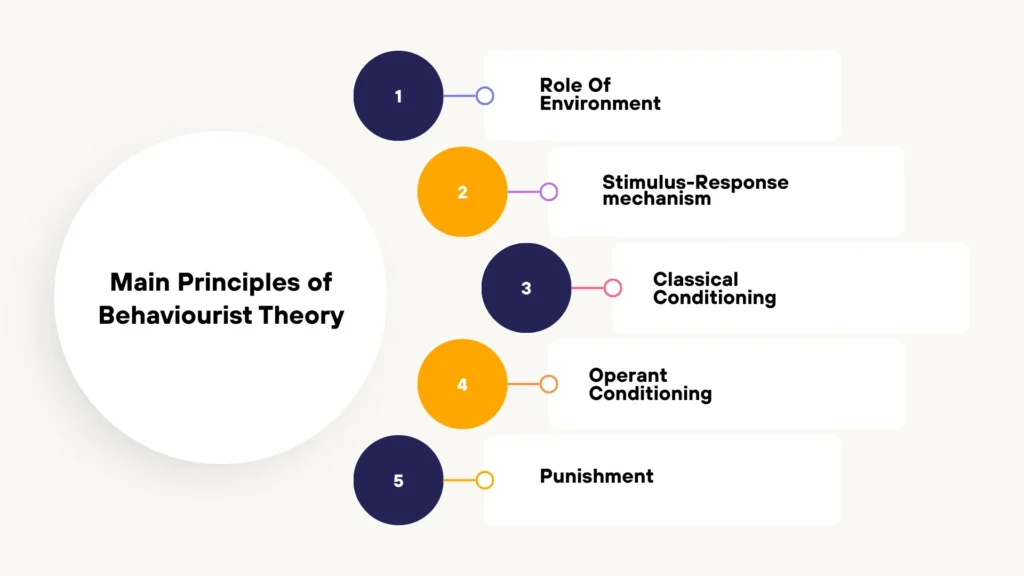
If you’ve ever walked out of the office or lecture and rewarded yourself with a cup of coffee, you’ve already used behaviourist theory without realising it. This theory states that the environment and the experiences a human has been through influence their behaviour.
Role Of Environment
You’re bound to act differently depending on where you are. At home, you’re relaxed, but at your workplace, you’re strictly focused on your task. This isn’t random, your environment signals you to do this. Some are noticeable, and some aren’t. This is how the environment shapes behaviour:
- Your actions receive a form of feedback (reward or punishment). You’ll notice which behaviours produce favourable outcomes and adjust accordingly.
- Structured systems silently affect your behaviour. Strict school policies trained you to be punctual, whereas your workplace trains you to be productive.
- Repeated exposure to certain behaviours also shapes your habits. If you grew up in a household where reading is common, then you’ll most likely value books.
The Stimulus-Response (S-R) mechanism
The S-R mechanism is built on the idea that every behaviour is triggered by something in the environment. A stimulus is received externally from signals or some sort of event. After that, a response is a reaction that follows it. If the S-R mechanism is constantly repeated, the connection becomes stronger.
Example
Pretend you’re back in school. You hear the school bell and run out of the class. The school bell is the stimulus you received, and the response is you running out. You’ve done this a lot to the point it’s now instinctive for you to do that.
Classical Conditioning
This is all about learning through connection. When two things repeatedly happen together, your brain connects them. Even if the connection between them seems unlikely at first. Ivan Pavlov brought forth this theory through a dog experiment. He noticed that:
- Dogs naturally salivate when food is in their mouth. It’s an innate biological reflex that doesn’t require learning.
- Pavlov brought forth a bell and rang it whenever the food was presented.
- After several repetitions, the dog is conditioned to learn that the sound of the bell means the food is here.
Operant Conditioning
This one focuses on learning through consequences. Behaviours that are showered with praise and rewards tend to increase, whereas behaviours that face hate tend to decrease. BF Skinner brought forth this theory through his Skinner Box experiment. He noticed that:
- A rat was placed inside the box that already had food and a dispenser connected to its system
- The rat found out that a lever could bring him food, he pressed it, and the food was delivered to him
- Once he figured out this mechanism, he kept on repeating it due to the rewarding outcome
Reinforcement
Reinforcement is all about repetition. This ensures that you repeat certain behavioural patterns so they can become a part of you permanently (or at least for a long time), regardless of how morally good or bad such patterns are. There exist two types of reinforcements, here’s how they work.
| Positive Reinforcement | Negative Reinforcement |
|---|---|
| Adds something pleasant after a behaviour | Removes something unpleasant after a behaviour |
| Encourages repetition by providing a reward | Encourages repetition by removing discomfort |
| Strengthens behaviour through gains | Strengthen behaviour relief |
| Example: A person works out in the gym because he likes attention | Example: A person works out in the gym because he doesn’t want to be weak anymore. |
Punishment
This part might make you a little uncomfortable. Previously, we covered what causes certain behaviours to originate and repeat, but this part will cover what reduces or completely erases them. Surprisingly, it can also be used for something positive as well.
- It marks certain patterns as red flags within a specific environment. This helps you realise the limitations that have been set.
- When it’s used repeatedly, it completely disintegrates your negative actions before they become a habit.
- If applied inconsistently, this will allow negative patterns to take over and make your learning weak.
Realistic examples of Behaviourist Theory
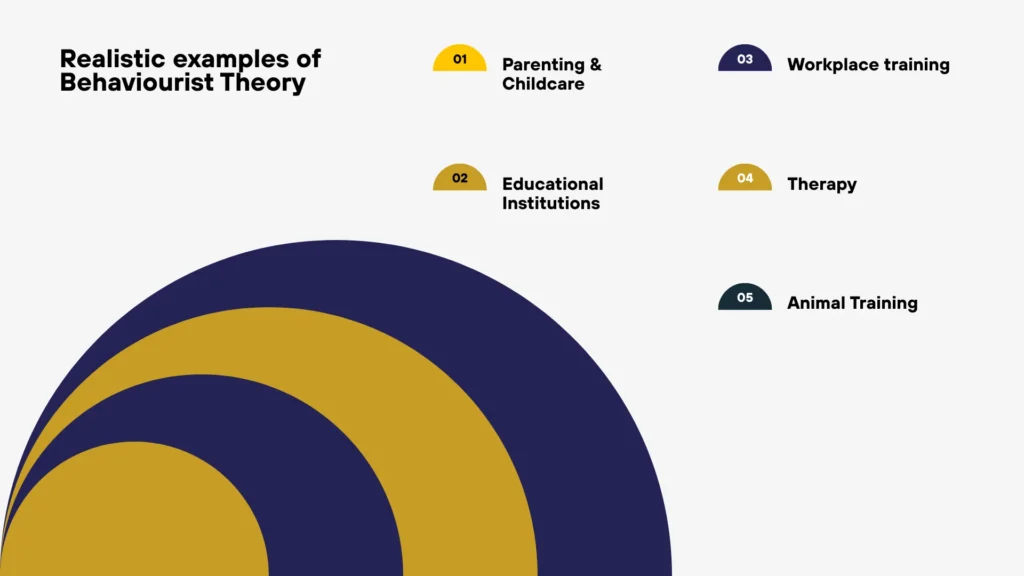
You don’t necessarily require a psychology degree to spot behaviourism, it’s part of your everyday life. From campuses to workplaces, people respond to rewards and repeated patterns all the time. Here are a few examples of real-life scenarios where behaviourism shows up.
Parenting & Childcare
Parents reinforce positive behaviour with praise and treats. Negative actions, on the other hand results in loss of rewards. After some time has passed, children learn which behaviours bring reward and which bring punishment.
Educational Institutions
Teachers use grades, praise, and classroom rules to shape student behaviour. Students who have performed better in both academics and have better discipline are recognised by everyone, which encourages them to keep performing this way.
Workplace training
Companies motivate their employees through promotions and bonuses. Productive behaviour is rewarded, which makes employees more dedicated towards their tasks. Policy violations or poor performance often lead to warnings, which discourage employees from repeating them.
Therapy
A therapist focuses on recognising harmful patterns through behaviourism. Talking about such patterns reduces fear in the patient and after that, they focus on how to control or get rid of them entirely.
Animal Training
This works really well with animals that are considered loyal (dogs or horses). Trainers reward desired actions with treats or affection. Unwanted behaviours are corrected consistently. Repeated reinforcement will help animals identify patterns whose outcomes are more beneficial for them.
Strengths & Limitations
Behaviourist theory might be one of the most dominant theories in psychology, but in the end, it’s just like any other theory that’s nowhere close to being perfect. To understand this, let’s look at both its advantages and disadvantages.
| Strengths | Limitations |
| It prioritises observatory behaviour | Completely disregards internal processes |
| Has a strong experimental & scientific foundation | Oversimplifies complex human behaviour |
| Very useful for education & training | Fails to properly explain creativity and imagination |
| Highly effective in modifying behaviour | Makes genetic and biological influences sound less important |
| Clear structure for rewards and consequences | Encourages over-reliance on rewards and punishments |
FAQs
It explains learning through how humans interact with their environment, which brings changes into their obsolete behaviour. It mainly happens when they respond to stimuli.
It absolutely is. In fact, it won’t ever stop being relevant as they’re widely used in different world settings like educational institutes and workplaces.
These schedules are designed to control how much reward needs to be given. As it influences how quickly a person learns.
Generalisation happens when similar stimuli trigger the same response. If a dog fetches a tennis ball being thrown, then he might fetch other balls too.
This is for when a response takes place because of one stimulus among the many. If a dog fetches a tennis ball only, he’ll ignore other balls.