To become a health information technician, follow four steps. Earn a diploma. Finish an accredited program. Pass the RHIT exam. Renew your certification every two years. This job mixes healthcare with technology. It centers on patient data. Use this guide to plan your path from classroom to job offer.
What Is a Health Information Technician?
A health information technician manages and protects digital patient records. The role goes by many names in job ads. You might see a medical records technician, medical coder, medical biller, or health information manager. Each title covers a slightly different task. But the core job stays the same. They turn raw medical data into records that hospitals, insurers, and doctors can trust.
These technicians work in many places. Common ones are hospitals, doctors’ offices, nursing homes, and insurance companies. Some work with public health agencies. Others help with legal or insurance record review. Lawyers and claims adjusters often need clean patient histories for injury or malpractice cases.
This role does not involve hands-on patient care. Instead, the technician handles the data behind that care. That means diagnoses, procedures, billing codes, and treatment outcomes.
The job blends three fields: computer science, medicine, and finance. That is why it counts as healthcare technology, not plain IT or nursing. A recent research review on artificial intelligence in health information management looked at AI’s effect on this field. It found that AI tools already shape coding, data rules, and privacy work. Today’s technicians work alongside automated systems more than ever.
Core Duties and Daily Responsibilities
A health information technician handles five core duties every day:
- Enters patient diagnoses, procedures, and treatments into electronic health record (EHR) systems
- Assigns clinical codes to diagnoses and procedures using standardized classification systems
- Reviews medical records for accuracy, completeness, and compliance
- Protects patient data privacy under HIPAA rules
- Analyzes clinical data to spot trends in cost, efficiency, and patient outcomes
These duties serve three groups: patients, healthcare providers, and insurers. Good data flow keeps billing accurate. It also keeps patient care on track.
Data quality is one of the field’s biggest challenges. Recent studies point to a common problem. Coding accuracy drops when HIM staff carry heavy workloads. This is one reason employers value attention to detail as much as tech skill.
Education Requirements for Health Information Technicians
Most employers want an associate degree. Good choices are health information technology, health information management, or health informatics. This path takes about two years. It mixes classroom study with hands-on training at a healthcare site.
Accredited programs cover eight core subjects:
- Medical terminology and anatomy
- Health information software and databases
- Medical coding systems (ICD, CPT, HCPCS)
- Data privacy and security rules
- Data analysis and revenue cycle work
- Healthcare rules and administration
- Health statistics and computer skills
- Legal and ethical record standards
A certificate can work for some entry-level jobs. It usually takes six months to two years. But a certificate will not qualify you for the RHIT exam. For that, you need an associate degree from a CAHIIM-accredited program. CAHIIM stands for the Commission on Accreditation for Health Informatics and Information Management Education.
Not sure which healthcare path fits you yet? A broader health sciences degree can help you explore first. Charisma University offers a BSc in Health Professions with tech-focused coursework. Before you enroll anywhere, compare tuition costs and admission requirements across a few schools, and confirm the program holds CAHIIM accreditation if your goal is the RHIT credential.
How Much Experience Do You Need?
You can build experience in a few ways. Try an internship during your degree. Take on a class project that uses real patient data. Or start in an entry-level job, like medical transcriptionist or data entry clerk. One to two years of hands-on work makes your job application stronger. It also meets what some certifications require.
Certifications for Health Information Technicians
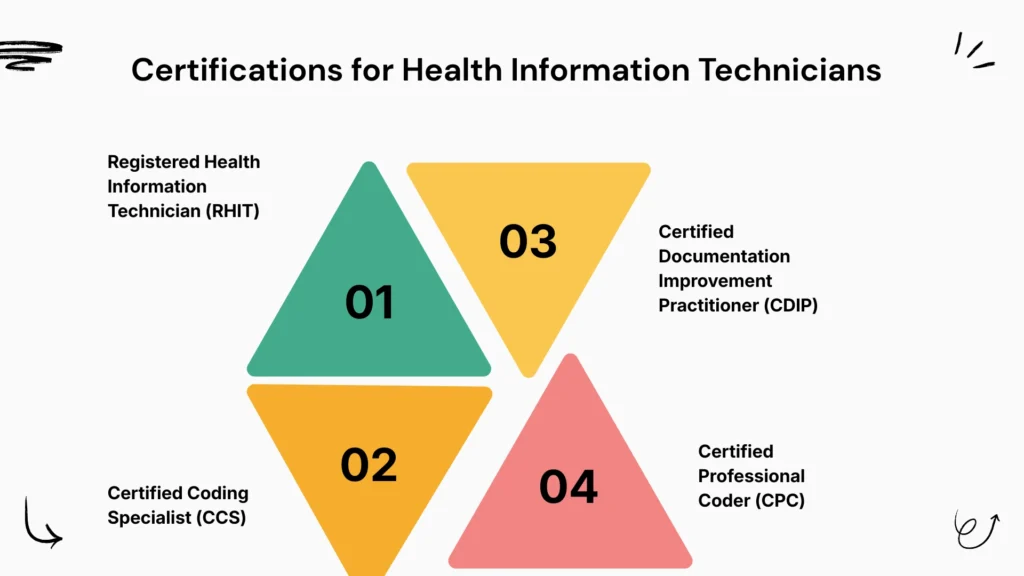
Certification proves your skill to employers. AHIMA issues the top credentials in this field. That stands for the American Health Information Management Association. AAPC offers a strong second path for coding roles. That stands for the American Academy of Professional Coders.
Registered Health Information Technician (RHIT)
This exam has 130 to 160 questions. They cover six areas: data content, information governance, privacy and security, data analysis, revenue cycle work, and compliance. The exam costs $299 for non-members. AHIMA members pay $229. It takes about 3.5 hours. Check AHIMA’s site before you sign up, since fees and format can change.
Certified Coding Specialist (CCS)
This four-hour exam tests inpatient and outpatient coding skills. It uses multiple-choice and scenario questions.
Certified Documentation Improvement Practitioner (CDIP)
This credential proves skill in reviewing clinical records. It requires about two years of related work plus an associate degree.
Certified Professional Coder (CPC)
AAPC issues this one, not AHIMA. It focuses on outpatient coding. Many technicians in doctor billing offices hold this credential.
Every AHIMA credential needs 20 continuing education credits every two years. At least 80 percent of those credits must relate to health information work.
Which Certification Should You Choose?
| Credential | Issuing Body | Education Required | Focus Area | Avg. Exam Cost | Best For |
| RHIT | AHIMA | Associate degree | General HIM operations | $229–$299 | Entry to mid-level technicians |
| RHIA | AHIMA | Bachelor’s degree | HIM department management | $229–$299 | Leadership/administrative roles |
| CCS | AHIMA | Coding experience recommended | Inpatient + outpatient coding | $299–$399 | Hospital coding specialists |
| CPC | AAPC | High school diploma + coding course | Outpatient/physician coding | $260–$399 | Billing office coders |
| CDIP | AHIMA | 2 yrs experience + associate degree | Clinical documentation review | $299–$399 | Documentation auditors |
The fastest entry point is CPC, not RHIT. CPC does not require a college degree only a coding course and passing score. RHIT takes longer but opens more doors, since hospitals and insurers weigh it higher in hiring filters than CPC alone.
Steps to Become a Health Information Technician
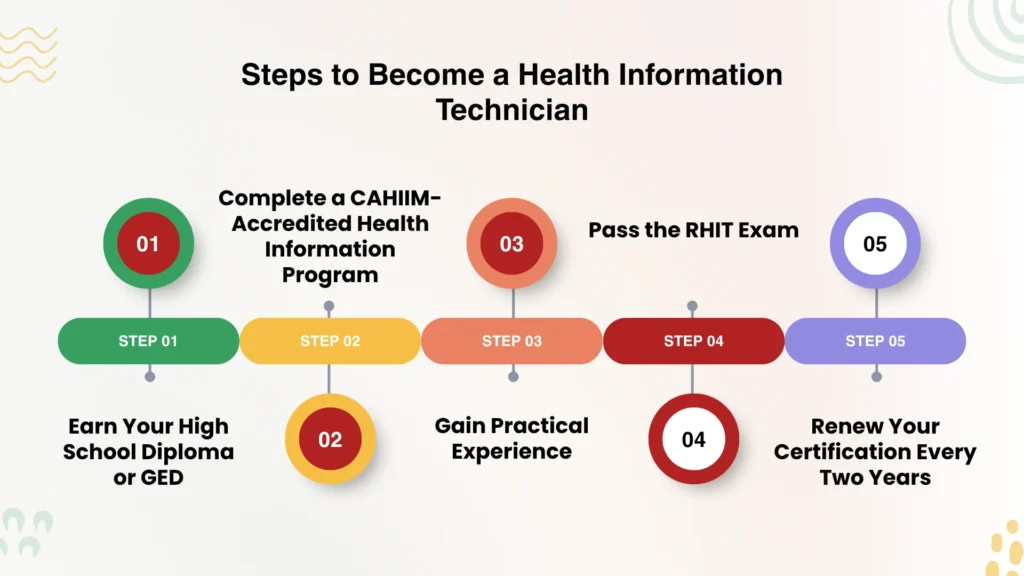
Step 1: Earn Your High School Diploma or GED
This is where you start. Most programs will not accept you without it. If you left school early or need a faster path, a GED works just as well as a diploma here.
Step 2: Complete a CAHIIM-Accredited Health Information Program
Pick an associate degree or a related bachelor’s degree. The associate path takes about two years and gets you exam-ready sooner. A bachelor’s degree takes longer. But it can open doors to higher roles, like RHIA, down the line. Either way, check that the program holds CAHIIM accreditation before you enroll. This step matters most if you plan to take the RHIT exam.
Step 3: Gain Practical Experience
Look for an internship, a class project, or an entry-level job while you study. Real practice with coding software and patient files makes the RHIT exam much easier. It also gives you something solid to talk about in job interviews.
Step 4: Pass the RHIT Exam
Apply through AHIMA once your program confirms you meet the requirements. Set aside real study time. Most people use practice tests and a coding manual to prepare. Plan for about 3.5 hours on exam day. Bring a valid photo ID.
Step 5: Renew Your Certification Every Two Years
Complete 20 continuing education credits to keep your RHIT credential active. Track your credits as you earn them. That way, renewal season will not catch you off guard. A lapsed certification can mean retaking parts of the exam. Set a calendar reminder ahead of your renewal date.
Skills You Need as a Healthcare Tech
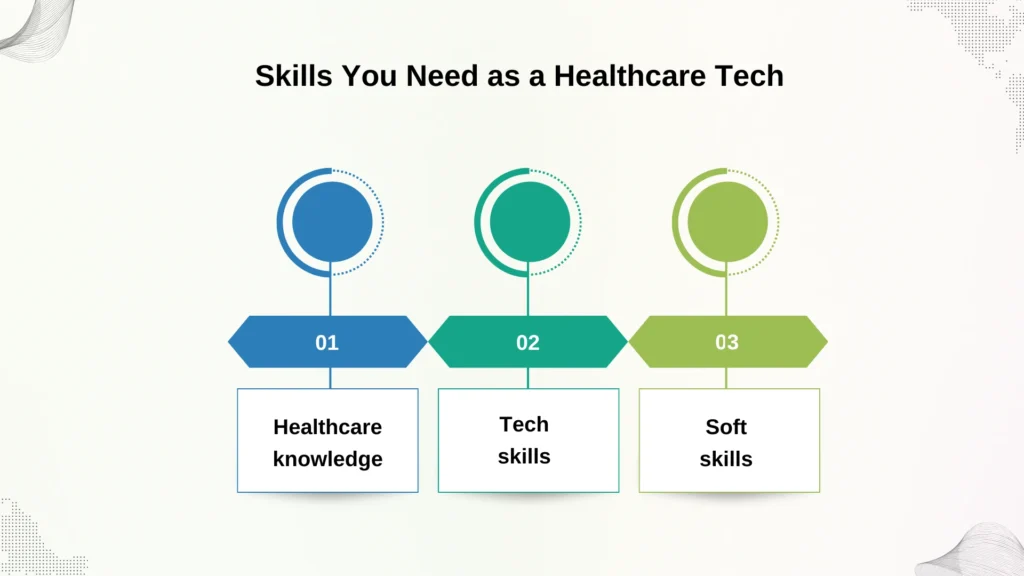
Three skill types matter most in this job.
Healthcare knowledge: You need to know insurance rules, medical terms, and diagnosis codes. This lets you read a patient’s chart the right way.
Tech skills: You need to work inside EHR systems and coding software. You also need to adapt fast when a facility upgrades its tools.
Soft skills: Attention to detail comes first. Clear writing and speaking come next. You also need good judgment under HIPAA rules and patience when patients ask about their records.
Salary and Job Outlook
National Salary Range
Health information technologists and medical registrars earn a median wage of $67,310 a year, according to the U.S. Bureau of Labor Statistics.
- Lowest 10 percent: less than $39,120
- Median: $67,310
- Top 10 percent: more than $112,130
Pay by Workplace
Pay depends on the workplace, highest to lowest:
- Company management roles
- Administrative support
- Scientific and technical services
- Hospitals
- Doctor’s offices
Pay by Location
- High-cost states (California, New Jersey, Massachusetts): salaries run 15–25 percent above the national median
- Lower-cost states (Alabama, Mississippi): salaries sit closer to the lowest 10 percent range
- Remote coding roles are narrowing this gap, since many employers now pay a flat national rate regardless of location.
Job Growth Outlook
- 15 percent projected job growth from 2024 to 2034
- About 3,200 openings expected each year
- Most openings come from retirements and job switching, not new demand
- Growth outpaces the average for all U.S. jobs.
One well-known study on the health IT workforce found that hospitals often lack solid data on how big this workforce is, or how to train it well — a gap that helps explain why job growth keeps outpacing workforce planning.
Career Paths Related to Healthcare Tech
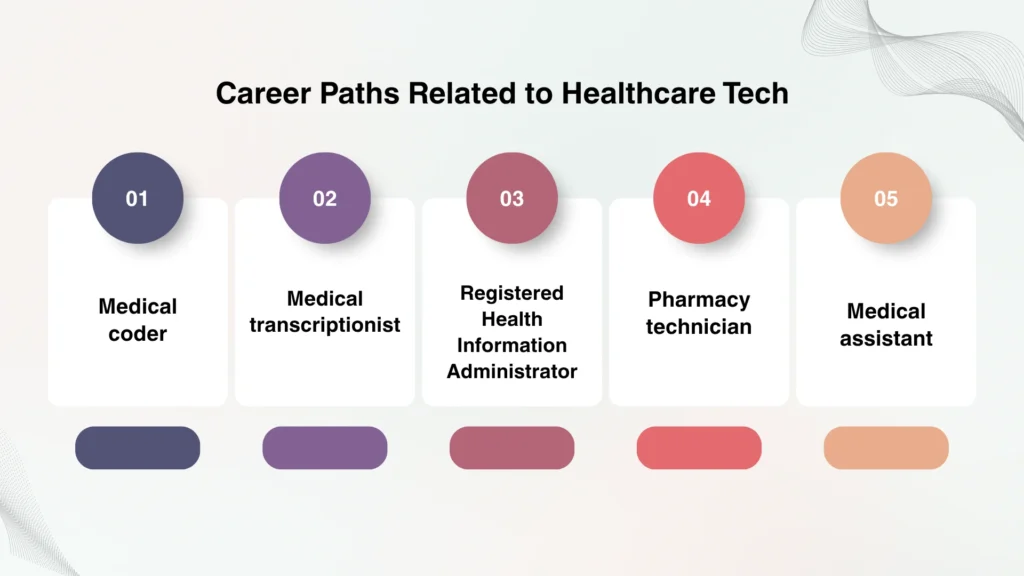
Health information technology connects to several related roles:
- Medical coder: Processes insurance claims by assigning standardized codes to diagnoses and procedures
- Medical transcriptionist: Converts physician dictation into written medical records
- Registered Health Information Administrator (RHIA): Manages health information departments and requires a bachelor’s degree
- Pharmacy technician: Supports prescription processing under a licensed pharmacist
- Medical assistant: Handles administrative and basic clinical support tasks in a medical office
Want to move into a leadership role? Look into an RHIA credential, a bachelor’s degree in health information management, or a graduate program in healthcare administration. If you already hold an undergraduate degree, check out graduate program options in healthcare administration as your next step.
Where to Find Healthcare Tech Jobs
Search for open roles through these resources:
- AHIMA Career Assist: Lists health information technology openings and gives access to the group’s annual job fair
- HIMSS Resource Center: Connects job seekers with global health IT and informatics openings
- Indeed: Lets you post a resume and filter openings by region and salary
- Glassdoor: Shows company reviews, salary data, and interview tips alongside job posts
- ZipRecruiter: Cross-posts job listings across many boards to reach more employers
Networking with mentors and going to job fairs can open doors before a role even gets posted. Treat certification as your starting line, not your finish line.
Frequently Asked Questions
About two years, through an associate degree program, followed by the RHIT exam.
Yes, in some cases. A certificate program, combined with experience and a passed exam, can qualify you for entry-level roles. Most employers still prefer a degree, though.
Yes, if you like working with healthcare data and want steady job growth. The field offers a 15 percent projected growth rate. You can also branch into coding, compliance, or data analysis.
No. The RHIT certification from AHIMA is the only credential most employers ask for. State licensure does not apply here. Extra credentials, like cancer registration certification, stay optional.
You need coding knowledge, data entry accuracy, EHR software skills, and a solid grasp of patient privacy law.