Improve concentration by combining brain training, mindfulness meditation, 7 to 8 hours of sleep, regular exercise, a distraction-free environment, and structured techniques like the Pomodoro Method. No single habit fixes focus on its own. Concentration improves when you stack 3 to 4 of these strategies together for at least 2 to 3 weeks.
Concentration is your brain’s ability to lock onto one task while blocking out everything else competing for its attention. It differs from attention span, which measures how long you can hold that focus before mental fatigue sets in. You can have sharp concentration for short bursts and still have a short attention span, since improving one usually strengthens the other.
This guide covers why focus fails, 15 methods to rebuild it, a self-assessment to find your weak points, and a comparison of the most popular focus techniques, so you can pick the right method for your situation.
Why Concentration Breaks Down: 7 Root Causes Behind Poor Focus
Focus doesn’t fade without a reason. Seven biological, environmental, and lifestyle factors are usually behind it.
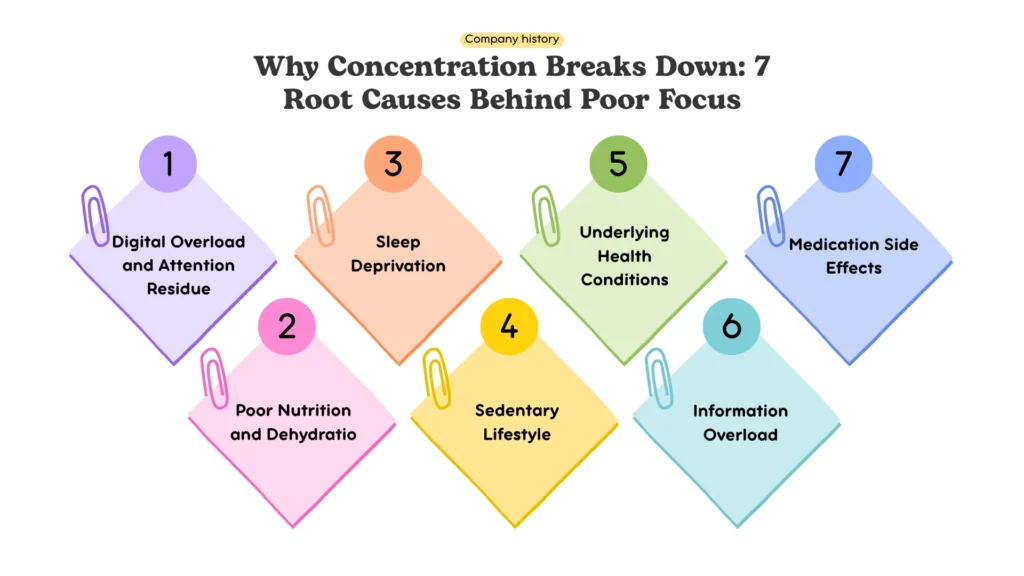
1. Digital Overload and Attention Residue
When you switch from a task to a notification, part of your mind stays anchored to the task you left behind. Organizational psychologist Sophie Leroy named this effect attention residue in a 2009 study published in Organizational Behavior and Human Decision Processes: people who switched to a new task before finishing the first one performed measurably worse on the second task, especially when the first task was left incomplete or interrupted under time pressure. Constant switching creates a state researchers call continuous partial attention, where no single task ever receives your full focus.
2. Sleep Deprivation
Sleeping under 7 hours weakens memory, slows reaction time, and hurts decision-making. During deep sleep, your brain clears out cellular waste and moves memories from short-term storage into long-term storage. Skip this process regularly, and you start each day already at a mental disadvantage.
3. Underlying Health Conditions
ADHD, depression, anxiety, sleep apnea, concussions, and untreated vision or hearing problems all force your brain to work harder on basic tasks, which leaves less energy available for sustained focus.
4. Medication Side Effects
Some medications slow processing speed and reduce mental clarity. Anticholinergics, often prescribed for incontinence, allergies, or depression, are a common example.
5. Poor Nutrition and Dehydration
Refined carbs and sugar spike blood glucose, and that spike is usually followed by a crash within the hour. Even mild dehydration weakens focus and makes it harder to recall information accurately.
6. Sedentary Lifestyle
Sitting too much reduces blood flow to the brain and lowers dopamine and norepinephrine, two chemicals that support attention and sustained focus.
7. Information Overload
Emails, social feeds, and messaging apps flood your brain’s filtering system, and when too much input competes for attention at once, none of it gets processed properly.
Focus Self-Assessment: Find Your Weak Point in 60 Seconds
Answer yes or no to these questions to see which category is hurting your focus the most, so you know which fix to try first.
- Do you check your phone within 10 minutes of starting a task? This points to an environmental problem (see strategy 6).
- Do you sleep less than 7 hours on weeknights? This points to a biological problem (see strategy 3).
- Do you skip breakfast or eat mostly processed food before focused work? This points to a nutrition problem (see strategy 11).
- Do you work on more than one task at a time to save time? This points to a habit problem (see strategy 14).
- Have you gone 90 minutes or more without a break in the past week? This points to a structure problem (see strategies 8 and 9).
Most people answer yes to 2 or 3 of these. Fix the category with the most yes answers first, since trying to fix all 15 strategies at once usually causes burnout within a few days.
How to Improve Concentration: 15 Strategies Backed by Research
1. Train Your Brain with Cognitive Games
Brain training builds concentration the same way lifting weights builds muscle, and the research base behind it is larger than most people assume. A 2015 randomized trial of 4,715 adults tested 15 minutes of cognitive exercise a day, five days a week, for 10 weeks, and found significant gains in processing speed, working memory, and problem-solving compared to a control group.
A separate 10-year trial of nearly 2,800 older adults, the ACTIVE study published in the Journal of the American Geriatrics Society, found that participants who completed structured cognitive training kept measurable gains in memory and reasoning, plus fewer reported difficulties with daily tasks, a full decade after training ended. Concentration training compounds over time instead of just producing a short-term boost.
Six effective brain-training activities to build into a weekly routine:
- Sudoku and crossword puzzles
- Chess and strategy board games
- 500-plus piece jigsaw puzzles
- Word searches and letter scrambles
- Memory-matching games
- Schulte tables for speed reading and peripheral attention
2. Practice Mindfulness and Meditation
Mindfulness meditation changes your brain’s physical structure. A 2024 systematic review found that regular practice increases cortical thickness in attention-related brain regions, calms the amygdala, which is your brain’s threat-detection center, and strengthens connections in the prefrontal cortex, the region responsible for planning and sustained focus.
Simple 4-step mindfulness routine:
- Sit comfortably and close your eyes.
- Focus on the physical sensation of your breathing.
- When your mind wanders, and it will, gently redirect your attention back to your breath.
- Start with 5 to 10 minutes a day and build up gradually over a few weeks.
3. Prioritize 7 to 8 Hours of Quality Sleep
Sleep is when your brain locks in new memories and clears out cellular waste that builds up during the day. Getting 7 to 8 hours supports peak mental performance, while sleeping under 6 hours for several nights in a row causes mental impairment similar to mild intoxication.
Five habits for better sleep quality:
- Keep a fixed sleep and wake schedule, even on weekends.
- Stop using screens 60 minutes before bed, since blue light blocks melatonin production.
- Keep your bedroom dark, quiet, and between 18 and 22 degrees Celsius.
- Wind down with reading or quiet music instead of your phone.
- Avoid heavy meals, caffeine, and alcohol close to bedtime.
4. Exercise Regularly to Boost Mental Focus
Physical activity increases blood flow to the brain and triggers the release of dopamine, norepinephrine, and serotonin, three chemicals tied directly to attention, motivation, and mood. A 2023 review linked regular exercise to higher levels of BDNF, a protein that helps grow new neurons in the hippocampus, the brain’s memory center.
Ways to fit exercise into a busy schedule:
- Walk briskly for 20 minutes before a focused work session.
- Take 5-minute stretch breaks between work blocks.
- Take the stairs instead of the elevator.
- Aim for 150 minutes of aerobic activity a week, like brisk walking, cycling, or swimming.
5. Spend Time in Nature
Green space lowers stress hormones and blood pressure while restoring your ability to concentrate, a phenomenon researchers call Attention Restoration Theory. Even brief exposure helps. One study followed children from birth to age 7 and linked nearby green space to better attention and brain development, while a review of ADHD symptoms found that outdoor time reduced how severe those symptoms were.
Small changes still count. Add a plant to your desk. Take breaks near a window with a view of trees. Studies show that indoor plants alone can improve attention and academic performance.
6. Eliminate Physical and Digital Distractions
Distractions fall into two categories, physical and digital, and each one needs a different fix.
To reduce physical distractions:
- Set up one space that you use only for focused work.
- Close curtains or blinds to block visual noise.
- Use earplugs or noise-cancelling headphones.
- Clear your desk so only what you need stays visible.
To reduce digital distractions:
- Turn off non-essential notifications during work blocks.
- Move your phone to another room, since studies show that having your phone nearby, even turned off, reduces available focus.
- Use blocking tools like Cold Turkey, Freedom, or StayFocusd for distracting sites.
- Try Forest, an app that grows a virtual tree during your focus session and kills it if you leave early.
International online students benefit from these tips the most, since they often study from home across different time zones.
7. Set Clear, Measurable Goals
Psychologists Edwin Locke and Gary Latham spent decades studying goal setting and found a consistent pattern: specific, difficult goals beat vague ones. In Locke’s original research, performance under difficult, specific goals ran well over double what participants achieved under the easiest goals, and later reviews found that specific, challenging targets outperformed “do your best” instructions in roughly 9 out of 10 studies.
The mechanism is simple. Clear targets remove guesswork and make it easier to enter a flow state, where you feel fully absorbed in a task.
Effective goals follow three rules:
- Make them specific. Write “complete Chapter 5 and answer 10 review questions,” not “study biology.”
- Make them time-bound. Add a deadline, like “finish by 8:30 PM.”
- Make them measurable. Track pages, problems, or modules completed.
Knowing how your brain processes information, explored in cognitive learning theory and Academic Advising can help you structure realistic, measurable study goals aligned with your degree plan.
8. Take Strategic Breaks to Recharge Focus
Your brain can hold intense focus for about 90 minutes before performance drops, a pattern tied to your body’s natural rest and activity cycle. Even a break of a few seconds has been shown to improve quiz scores, since it gives the prefrontal cortex a short window to recover.
During breaks:
- Step outside for fresh air and sunlight.
- Drink water or eat a light snack.
- Stretch or move for a few minutes.
- Avoid scrolling social media, since it creates new mental clutter instead of clearing the old kind.
9. Use the Pomodoro Technique and Time Blocking
The Pomodoro Technique splits work into 25-minute sprints with 5-minute breaks, followed by a longer break of 15 to 30 minutes after every 4 sprints.
Five steps to apply it:
- Pick a single task to work on.
- Set a timer for 25 minutes and work without stopping.
- Take a 5-minute break when the timer rings.
- After 4 cycles, take a 15 to 30 minute break.
- Repeat until the task is done.
Time blocking takes this further by scheduling tasks into fixed calendar slots, like “7:00 to 7:30 PM: Review Module 3,” which removes the mental effort of deciding what to do next.
10. Study During Your Peak Productivity Hours
Your circadian rhythm is your 24-hour body clock, and it controls your hormones, metabolism, and alertness levels throughout the day. Some people focus best in the morning, while others peak late at night.
To find your peak hours:
- Track your energy and focus levels every hour for 5 to 7 days.
- Look for patterns, noting when you feel sharpest and when your mind wanders most.
- Schedule your hardest tasks during your peak window.
- Save low-energy periods for lighter work, like reviewing notes.
Online learners who use flexible scheduling, one of the key benefits of distance learning, can match study sessions to their natural energy peaks.
11. Eat Brain-Boosting Foods and Stay Hydrated
Nutrient-dense foods give your brain steady fuel, while processed foods and sugar cause spikes followed by crashes.
Five food categories that support focus:
- Fatty fish like salmon, trout, and sardines, which are rich in omega-3s that support healthy brain cells.
- Eggs, which contain choline, a nutrient your brain uses to make a chemical tied to memory.
- Leafy greens like spinach, kale, and broccoli, loaded with vitamin K and other nutrients that support brain health.
- Berries like blueberries, strawberries, and blackberries, full of antioxidants that protect brain cells.
- Nuts and seeds like almonds, walnuts, and flaxseeds, rich in healthy fats and vitamin E.
Even mild dehydration weakens focus and short-term memory, so drinking water steadily through the day works better than catching up all at once.
12. Use Caffeine Strategically
Moderate caffeine intake improves processing speed, reaction time, and short-term attention by blocking a brain chemical that makes you feel tired.
To use caffeine well:
- Drink coffee or tea when your focus dips, not before it drops.
- Limit yourself to 2 to 3 cups a day to avoid jitters and sleep problems.
- Try dark chocolate with 70 percent cacao or higher as a gentler option that also provides antioxidants.
- Avoid caffeine after 2 PM, since it can stay in your system for 5 to 6 hours and disrupt sleep.
13. Listen to Focus-Enhancing Music or White Noise
Background sound affects focus differently depending on the type. Instrumental and classical music can make it easier to absorb new information, white noise has been shown to improve sustained focus, and nature sounds lower stress while you work.
Three rules for music while you work:
- Pick instrumental music, since lyrics compete with the part of your brain that processes language and make reading or writing harder.
- Keep the volume low, so it stays in the background rather than the foreground.
- Avoid songs you love or hate, since strong emotional reactions pull your attention away from the task.
14. Stop Multitasking
Your brain can’t handle two demanding tasks at the same time, so what feels like multitasking is actually fast task-switching, and each switch costs you time and accuracy. This is one of the most consistent findings in psychology research, and it’s a core concept covered in behavioral courses across the School of Psychology.
To break the habit:
- Work on one task at a time.
- Close every browser tab except the one you need.
- Batch similar tasks together, like answering all your emails in one block instead of checking them all day.
- Use the Pomodoro Technique to force single-task focus.
15. Optimize Your Physical Study Environment
Temperature, lighting, and layout all affect how well you focus. Workplace research found fewer errors at room temperatures between 20 and 25 degrees Celsius, with 22 degrees as a good target.
To optimize your space:
- Set the room temperature between 20 and 22 degrees Celsius.
- Use natural light where possible, and place your desk near a window.
- Get a comfortable chair that supports good posture, since physical discomfort drains focus too.
- Add a desk plant, since studies link indoor plants to better attention and task performance.
Focus Technique Comparison: Which Method Fits Your Situation
| Technique | Best For | Session Length | Learning Curve |
| Pomodoro Technique | Task-switchers, procrastinators | 25 min work, 5 min break | Low |
| Time Blocking | People with many small tasks | Custom, calendar-based | Medium |
| Deep Work Blocks | Complex, high-value single tasks | 90 to 120 min | High |
| Mindfulness Meditation | Long-term attention training | 10 to 20 min a day | Medium |
| Body Doubling | People who focus better with company | Flexible | Low |
Deep Work, a term coined by computer scientist Cal Newport, means working on a demanding task without distraction for a long stretch, usually 90 minutes or more. Unlike Pomodoro, it favors depth over frequent breaks, which makes it better suited to tasks like writing, coding, or complex analysis rather than routine review work.
Body doubling means working next to another person, in person or on a video call, without directly collaborating with them. It has become popular for building focus, especially among people with ADHD, since having someone else present makes it harder to put off a task.
6 Signs You May Have a Concentration Problem
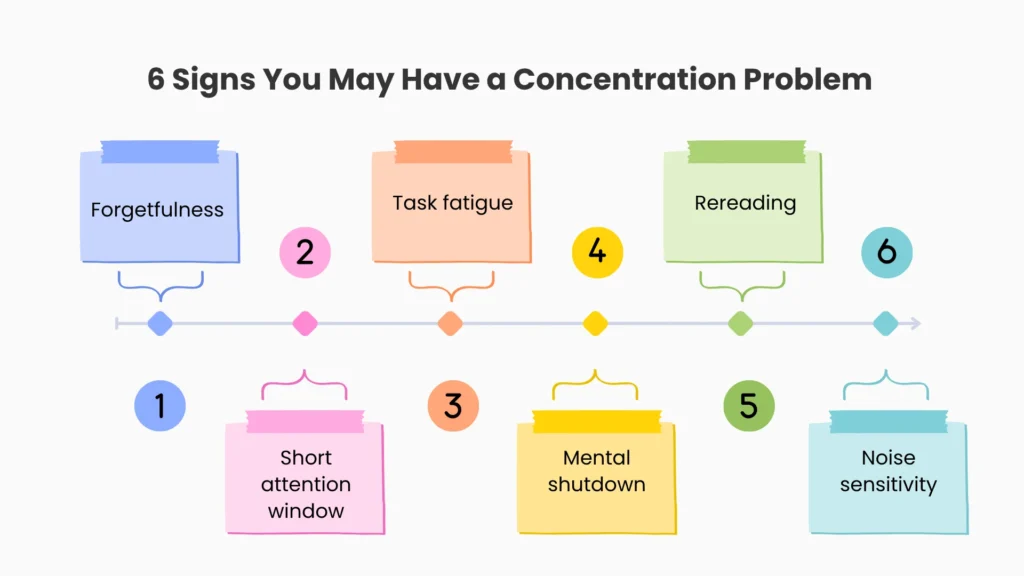
Getting distracted occasionally is normal, but ongoing trouble with focus can point to something bigger. Watch for these signs:
- Forgetfulness: Forgetting names, tasks, or things said just minutes ago.
- Task fatigue: Struggling to finish routine tasks you’ve done many times before.
- Rereading: Rereading the same passage over and over without absorbing it.
- Short attention window: Being unable to stay on one task for more than a few minutes.
- Mental shutdown: Feeling like your brain “shuts off” in the middle of a task.
- Noise sensitivity: Getting pulled away by small background noise.
Talk to a doctor if these symptoms persist and get in the way of daily life, since conditions like ADHD, depression, and sleep disorders directly hurt concentration and respond well to treatment.
5 Health Conditions That Weaken Concentration
- ADHD: Causes ongoing trouble with sustained attention and impulse control in both children and adults.
- Depression and anxiety: Drain mental energy, leaving less available for focus and memory.
- Brain fog: From infections, including lingering effects after viral illness and chronic sinus problems, causes lasting mental cloudiness.
- Concussions and head injuries: Even mild ones disrupt attention and processing speed for weeks at a time.
- Cognitive decline: From conditions like early-stage Alzheimer’s slowly weakens both concentration and memory.
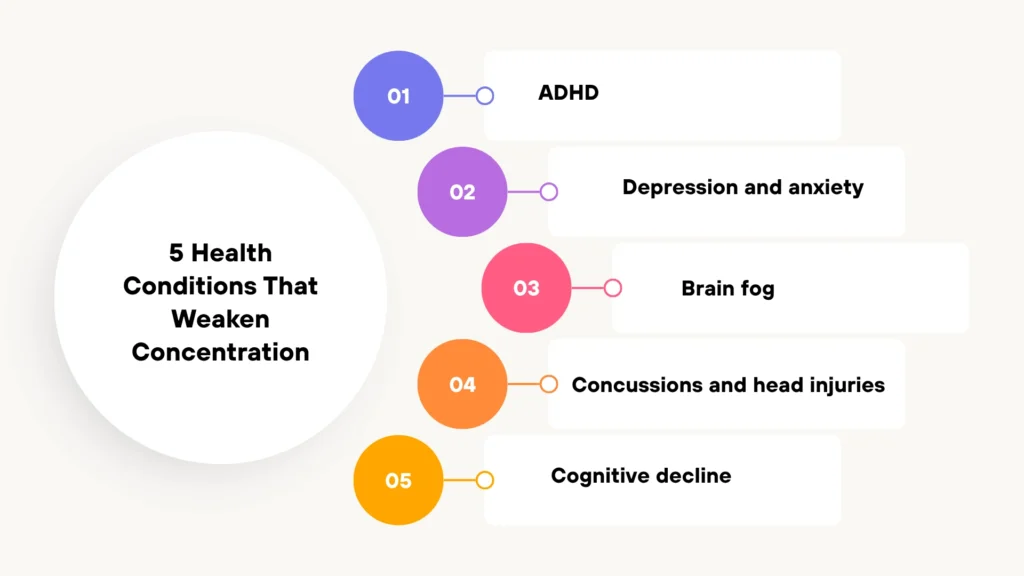
These conditions sit at the intersection of psychology and medicine, which is why students interested in treating them often pursue coursework through the School of Health Sciences.
How Learning Itself Strengthens Focus Over Time
Learning new material is one of the most powerful ways to build concentration. Every time you master a new concept, your brain forms and strengthens neural connections. This process is called neuroplasticity. A meta-analysis found that each extra year of education boosts intelligence by 1 to 5 IQ points. Stronger cognitive ability directly supports sustained attention.
Online learning builds concentration because it demands active self-regulation. Unlike passive classroom lectures, online coursework requires you to:
- Block out distractions on your own and give full mental energy to the material.
- Solve problems and complete assessments that exercise working memory.
- Practice delayed gratification by committing to long-term academic goals
Good teachers play a key role in building student focus. They structure lessons, give clear feedback, and create environments where deep thinking becomes a habit. The Writing Center also helps students strengthen sustained attention through structured feedback on academic writing.
Different educational theories explain how active mental engagement during structured learning builds cognitive endurance over months and years.
Start Strengthening Your Concentration Today
Concentration isn’t fixed. You can train it at any age, the same way you’d build physical fitness. Use the self-assessment above to find your weakest area, then commit to 2 or 3 matching strategies for the next 2 to 3 weeks before adding more. Fix your sleep first if it’s broken, since everything else builds on that foundation.
If you’re ready to put these habits to work in a structured academic setting, explore Charisma University’s undergraduate and graduate programs or speak with an advisor to see how focused study fits into your next step.
Frequently Asked Questions
Seven factors most often cause poor concentration in adults: digital overload, sleep deprivation, underlying health conditions, medication side effects, poor nutrition, a sedentary lifestyle, and information overload.
Focus feels hard because your brain can’t handle two demanding tasks at once. What feels like multitasking is really fast task-switching, and each switch drains mental energy and increases mistakes.
Yes. ADHD disrupts the brain’s attention-control system, which causes lost trains of thought, unfinished tasks, and quick distraction, though techniques like Pomodoro and body doubling can help significantly.
Brain fog usually traces back to four factors: sleep deprivation, poor nutrition, chronic stress, and health conditions like depression or anxiety. If it doesn’t go away, it’s worth talking to a doctor.
Most people notice small improvements within 1 to 2 weeks of using techniques like time blocking, mindfulness, or cutting screen time. Bigger, lasting change, where deep focus feels natural, usually takes 2 to 3 months of steady practice.
Yes. Use noise-cancelling headphones, set “do not disturb” hours with your family, and study during quiet periods like early mornings, late evenings, or nap times.
Older adults often find it harder to tune out irrelevant stimuli, which lowers focus efficiency. Cognitive training, regular exercise, good nutrition, and steady sleep all help slow this decline, and the 10-year ACTIVE trial found that older adults who completed structured cognitive training held onto daily functioning better than those who didn’t.
No single trick works for everyone, but three changes have the most research behind them: 7 to 8 hours of sleep, 150 minutes of weekly aerobic exercise, and 5 to 10 minutes of daily mindfulness meditation. Combining all three works better than relying on any one alone.
It prevents mental fatigue by breaking work into 25-minute sprints with 5-minute breaks, which matches your brain’s natural attention cycle. After 4 sprints, a longer break of 15 to 30 minutes lets your mind fully recover before the next round.
Concentration is how intensely you focus on a task, while attention span is how long you can hold that intensity before it fades. You can train both, but they respond to slightly different fixes, since concentration responds well to changes in your environment and technique, while attention span responds better to slow, steady training like meditation and cognitive exercise.