To stay motivated and productive, build small daily habits: a set morning routine, a short SMART priority list, the “eat the frog” method, the two-minute rule, Pomodoro-style time-blocking, a prioritization framework, digital boundaries, real breaks, protected sleep, daily movement, a stress-relief ritual, daily learning, small-win tracking, a support system, visualization, a weekly reset, and one tracking tool.
None of these habits take more than 15 minutes to practice on their own. Stacked together, they build the routine that keeps energy and focus steady, week after week. Whether you’re balancing a full-time job, a full course load in one of the university’s degree programs, or both at once, these motivation techniques and productivity tips are built for a real, imperfect schedule rather than a perfect one.
What Motivation Really Means
Psychologists split motivation into two forms.
- Intrinsic motivation drives you from the inside. It’s the pull to finish a task because it feels meaningful or enjoyable in itself.
- Extrinsic motivation comes from an outside reward, such as a grade, a bonus, or a deadline.
Both matter, and neither works alone. One influential model, self-determination theory, argues that intrinsic motivation grows out of three psychological needs: autonomy (having some choice in how you work), competence (feeling capable of the task), and relatedness (feeling connected to the people around you).
Decades of studies across schools, sports teams, and workplaces link these three needs to stronger motivation and lower burnout. It’s a useful lens for the habits below: each one builds a sense of choice, a sense of skill, or a connection to other people. Anyone drawn to this kind of research can dig deeper through the School of Psychology, which covers motivation theory in more depth.
Low motivation itself usually traces back to one of 5 causes:
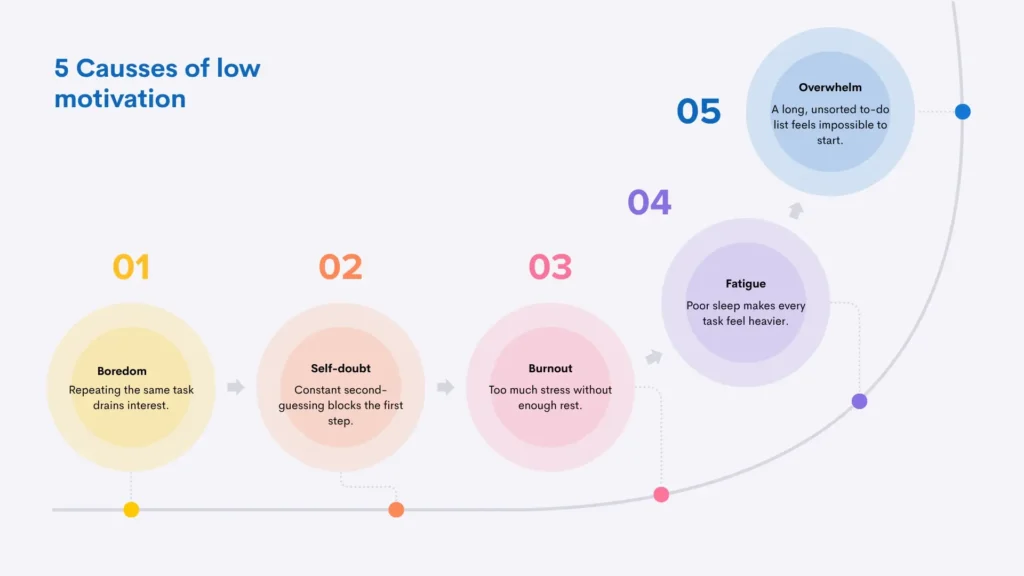
- Boredom: Repeating the same task drains interest.
- Self-doubt: Constant second-guessing blocks the first step.
- Burnout: Too much stress without enough rest.
- Fatigue: Poor sleep makes every task feel heavier.
- Overwhelm: A long, unsorted to-do list feels impossible to start.
Naming the cause first makes it much easier to pick the right fix from the list below.
How a New Habit Actually Forms
A habit is a behavior your brain repeats automatically, triggered by a cue in your environment rather than by conscious effort. In a well-known study, researchers at University College London tracked 96 adults who each picked one new daily behavior, such as a short run or a piece of fruit with lunch, and logged whether they performed it every day for 12 weeks (Lally et al., 2010). The time it took participants to turn the action into an automatic habit ranged from 18 to 254 days, with wide variation between people and behaviors. If a habit still feels effortful after two or three weeks, that’s normal, not a sign you’re doing it wrong.
There’s a reward mechanism behind this, too. Small, visible wins teach your brain to expect success, and that expectation is what keeps a habit running on its own. Author James Clear built an entire framework around this idea in Atomic Habits, describing “habit stacking,” where a new habit gets attached to an existing one, such as doing 10 push-ups while the coffee brews. Several habits on this list use exactly that structure.
18 Habits to Stay Motivated and Productive
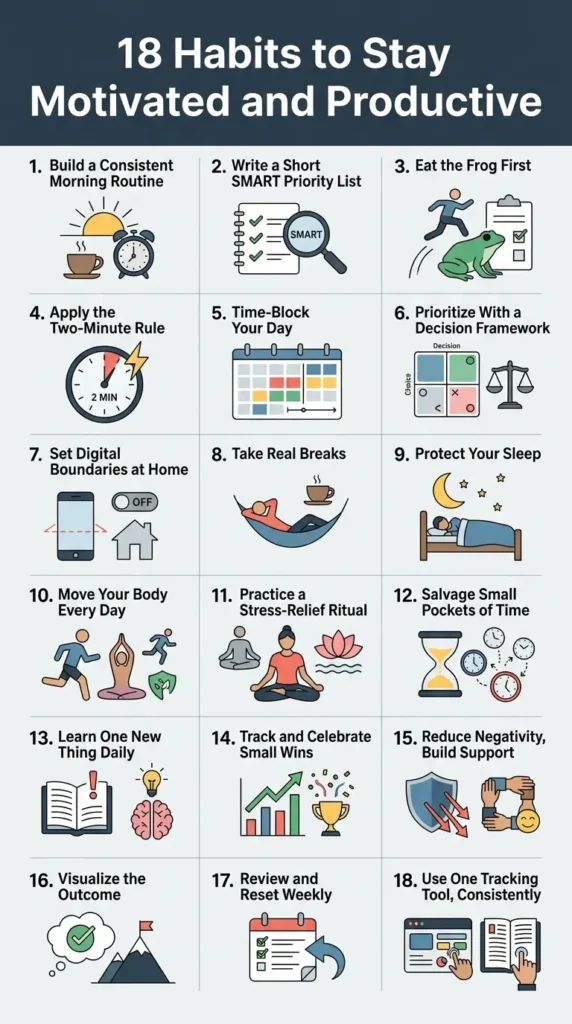
1. Build a Consistent Morning Routine
Start the day the same way, every day. Drink a full glass of water before coffee. Take 5 to 10 minutes for a task that isn’t email or social media, such as making your bed or writing three lines in a journal. Stack this onto something you already do without thinking, like brushing your teeth, and it needs far less willpower to stick.
2. Write a Short SMART Priority List
Each morning, write down 3 tasks that must get done, using the SMART framework: specific, measurable, achievable, relevant, and time-bound. “Work on the essay” is vague; “write 500 words of the essay introduction by 10 a.m.” is SMART. A short, specific list gets finished far more often than a long, vague one. If a heavy course load is what’s pulling focus in ten directions, it’s worth talking to an academic advisor about building a workable weekly schedule.
3. Eat the Frog First
Author Brian Tracy popularized this idea in his book Eat That Frog!: tackle your hardest or most disliked task first, before checking email or messages. Once the hardest task is out of the way, the rest of the day’s work tends to feel lighter by comparison, and procrastination has less room to creep in. If a writing assignment is the frog you keep avoiding, the Writing Center is a good place to get unstuck before the deadline gets closer.
4. Apply the Two-Minute Rule
If a task takes less than 2 minutes, do it immediately instead of adding it to a list. Replying to a short email, filing a document, or washing a cup all qualify. Small tasks left undone pile up into background stress; clearing them on sight keeps that pile from forming.
5. Time-Block Your Day
Assign a fixed block of time to each task instead of reacting to whatever comes up. The Pomodoro Technique, developed by Francesco Cirillo, is a simple version of this: work for 25 focused minutes, then take a 5-minute break. Protect at least one block each day for deep work with no notifications.
6. Prioritize With a Decision Framework
When everything on the list feels urgent, a framework cuts through the noise. The Eisenhower Matrix sorts tasks into four boxes: urgent and important (do it now), important but not urgent (schedule it), urgent but not important (delegate it), and neither (drop it). The Pareto Principle, or the 80/20 rule, adds a second lens: roughly 80% of your results usually come from about 20% of your tasks, so it’s worth auditing your week and doubling down on that smaller, higher-impact slice.
7. Set Digital Boundaries at Home
Turn your phone off, or leave it in another room, when you walk in the door at the end of the day. Keep it out of the bedroom at night too. Constant pings fragment attention during the hours meant for rest and connection, and both are just as important to motivation as anything you do during work hours.
8. Take Real Breaks
Step away from your desk for 10 to 15 minutes every 90 minutes or so. A short walk, a stretch, or a change of scenery does more for concentration than pushing through fatigue. Reward yourself after finishing a priority task, whether that’s a coffee, a short video, or 10 minutes outside.
9. Protect Your Sleep
Go to bed and wake up at roughly the same time every day, including weekends. Dim screens 1 to 2 hours before bed, since blue light disrupts your natural sleep signals. A body that sleeps well has more of the focus and patience that motivation runs on the next day.
10. Move Your Body Every Day
Fit in 20 to 30 minutes of movement daily, whether that’s a walk, a bike ride, a sport, or a home workout. A large research review of physical activity studies found some of the strongest cognitive gains for executive function, memory, and attention came from aerobic training (Physical Activity, Cognition, and Brain Outcomes, NIH). A gym membership isn’t required; a brisk walk after lunch counts.
11. Practice a Stress-Relief Ritual
Pick one calming activity and repeat it several times a week: guided meditation, deep breathing, journaling, or a hobby like gardening or painting. Even 5 to 10 minutes of quiet reflection lowers stress and clears the mental space that motivation needs to take root.
12. Salvage Small Pockets of Time
A 10-minute train wait or a gap between meetings doesn’t have to be wasted time. Keep a short list of small tasks, such as replying to one email or outlining one paragraph, that fit into those gaps. Over a week, these small pockets add up to real, finished work.
13. Learn One New Thing Daily
Read for 20 to 30 minutes, practice a skill, or listen to an instructive podcast every day. This taps directly into the “competence” need described earlier: feeling like you’re getting better at something is itself motivating.
14. Track and Celebrate Small Wins
At the end of each day, write down what you finished, no matter how small. This is the reward mechanism from earlier in action: a visible win, even a tiny one, teaches your brain to expect more of them. Confidence and motivation are closely tied to how you see your own worth, so this habit does double duty for both.
15. Reduce Negativity, Build Support
Cut back on gossip, complaints, and draining conversations; they eat up mental energy that could go toward meaningful work. In its place, tell someone you trust what you’re working on and ask them to check in weekly. This satisfies the “relatedness” need described earlier, and a short phone call or a walk with a friend often restores motivation more than people expect.
16. Visualize the Outcome
Picture the finished result before you start: the completed paper, the closed deal, the finished workout. Add real details, such as where you are and how it feels. Athletes have used this kind of mental rehearsal for decades to prime the brain for the steps that lead to a finished goal. If the picture you’re working toward is a finished degree, it’s worth taking a look at the full list of programs on offer, to keep that endpoint concrete.
17. Review and Reset Weekly
Spend 10 minutes at the end of each week reviewing what went well and what didn’t. Plan the coming week’s top priorities on Sunday night or Monday morning. A weekly reset stops small setbacks from quietly turning into a lost month.
18. Use One Tracking Tool, Consistently
Pick a single tool and stick with it instead of switching between several apps every month. Popular options include several task and habit trackers, including Todoist, Trello, and Habitica. Consistent daily use matters far more than which tool you pick.
Quick Reference: All 18 Habits at a Glance
| Habit | Solves | Time Needed |
| Consistent morning routine | Slow, distracted starts | 10–15 min |
| SMART priority list | Vague, unfinished goals | 5 min |
| Eat the frog first | Procrastination | Task-dependent |
| Two-minute rule | Small task pile-up | 2 min or less |
| Time-blocking (Pomodoro) | Constant interruptions | 25–30 min blocks |
| Eisenhower Matrix / Pareto | Unclear priorities | 10 min weekly |
| Digital boundaries at home | Evening burnout | Ongoing |
| Real breaks | Mental fatigue | 10–15 min |
| Protected sleep | Low next-day focus | Consistent schedule |
| Daily movement | Low energy, poor focus | 20–30 min |
| Stress-relief ritual | Chronic stress | 5–10 min |
| Salvaged small pockets of time | Wasted waiting time | 5–15 min |
| Daily learning | Boredom, stagnation | 20–30 min |
| Tracking small wins | Low confidence | 5 min |
| Reduced negativity, support | Isolation, drained energy | Ongoing |
| Visualization | Unclear sense of “why” | 5 min |
| Weekly review and reset | Small setbacks piling up | 10 min |
| One consistent tracking tool | Scattered effort | Ongoing |
What to Do When You Fall Off Track
Every routine breaks down sometimes. Life gets busy, sleep slips, or motivation fades for a few days. Respond with self-compassion instead of criticism; the habit-formation research above shows that a missed day or two barely dents the automaticity you’ve already built.
Ask yourself 3 questions:
- What single habit made the biggest difference when I felt motivated?
- Can I bring back just one of these habits today, even for 5 minutes?
- What was my original reason for starting this goal?
Restarting one small habit rebuilds momentum faster than trying to fix everything at once. If the slump is tied to something bigger than a rough week, such as a heavier workload or a personal setback, it’s worth reaching out and asking for support rather than waiting it out alone; the contact page is a quick way to find the right person to talk to.
Frequently Asked Questions
Yes. Meditation lowers stress and sharpens focus, which makes it easier to start a task. Even 5 minutes a day can build mental energy over time.
Motivation gets you started. Discipline keeps you going once the initial excitement fades. Building habits, rather than relying on willpower alone, is what makes both last.
Research on real-world habit formation found it takes 18 to 254 days on average, depending on the person and the behavior, so give a new habit at least 2 months before judging whether it has stuck.
Simplify your to-do list down to 3 items, ask someone to help break the rest into smaller steps, and finish just one task before reassessing the rest.
A total loss of motivation usually points to one or more of the 5 causes covered earlier: boredom, self-doubt, burnout, fatigue, or overwhelm. Fatigue and burnout are the two most common culprits, so check sleep and workload first before assuming the problem is a lack of willpower.
Set a fixed start time, get dressed as if you were leaving the house, and work from one dedicated spot instead of the couch or bed. Time-blocking and the two-minute rule both work especially well at home, where the boundary between “work” and “everything else” tends to blur.
Yes. Discipline and habit carry most of the day-to-day work; motivation is what makes a task feel good, not what makes it possible. Starting a task for just 5 minutes, without waiting to feel motivated first, is usually enough to build the momentum that follows.
Break study sessions into short, timed blocks using the Pomodoro Technique, study in the same location each time to build a strong cue-based habit, and reward yourself after each finished block. Studying with a friend or classmate also satisfies the “relatedness” need covered earlier, which keeps motivation steadier over a full semester.