The 4 steps of spiritual transformation are awakening, surrender, integration, and embodiment. Each step moves you away from an old, limited identity. Each step also builds a new sense of purpose, connection, and meaning. Pew Research Center’s 2023 survey of What 11,201 U.S. adults found that 70% of U.S. adults call themselves spiritual in some way. Of these, 22% are spiritual but not religious. This number shows spiritual growth is common, not rare. This guide breaks down all 4 stages. It also covers the signs of each stage and a practical exercise for each one.
What Is Spiritual Transformation?
Spiritual transformation is a lasting shift in what a person treats as sacred, meaningful, or central to life. Psychologist Kenneth Pargament is one of the most cited researchers in the psychology of religion. He frames it as a fundamental change in how a person values the sacred. The shift can center on God, a higher power, or your inner self. It can also center on a renewed sense of purpose. This depends on your worldview. This link between mind and meaning is exactly what Charisma University’s School of Psychology studies in depth.
The process rarely happens overnight. Researchers and spiritual teachers such as Kenneth Pargament, Richard Rohr, and Ken Wilber describe it the same way. Each one sees it as a gradual sequence of stages, not a single moment. That sequence is what the 4 steps below cover.
What Triggers Spiritual Transformation?
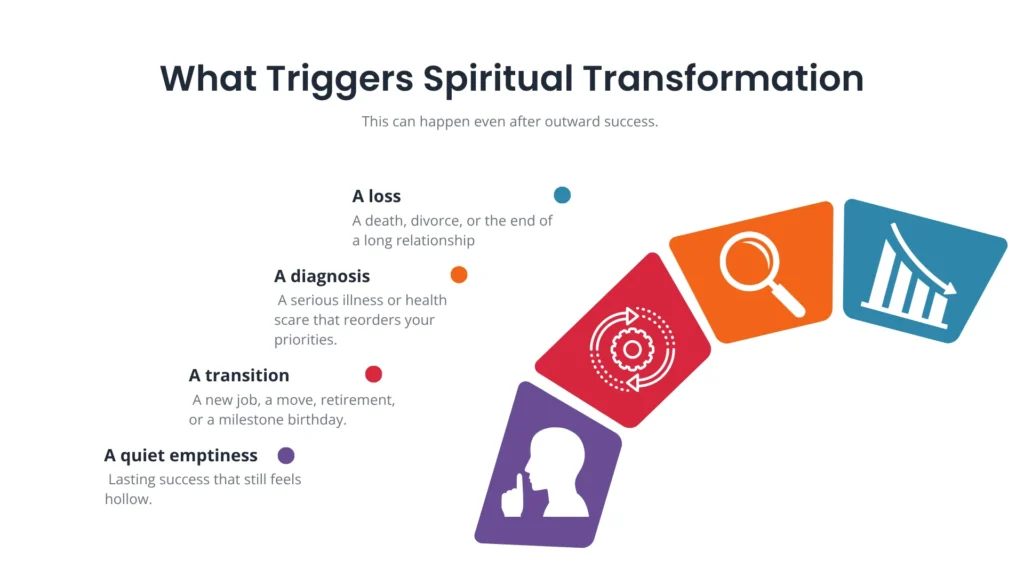
ef, illGriness, a major life transition, or a lasting feeling of emptiness most often triggers spiritual transformation. This can happen even after outward success. Pew Research also found that 43% of U.S. adults say their spirituality has grown over their lifetime. Only 11% say it has decreased. This suggests the shift tends to build, not fade, with age. Common triggers include:
- A loss: A death, divorce, or the end of a long relationship.
- A diagnosis: A serious illness or health scare that reorders your priorities.
- A transition: A new job, a move, retirement, or a milestone birthday.
- A quiet emptiness: Lasting success that still feels hollow.
The 4 Steps of Spiritual Transformation
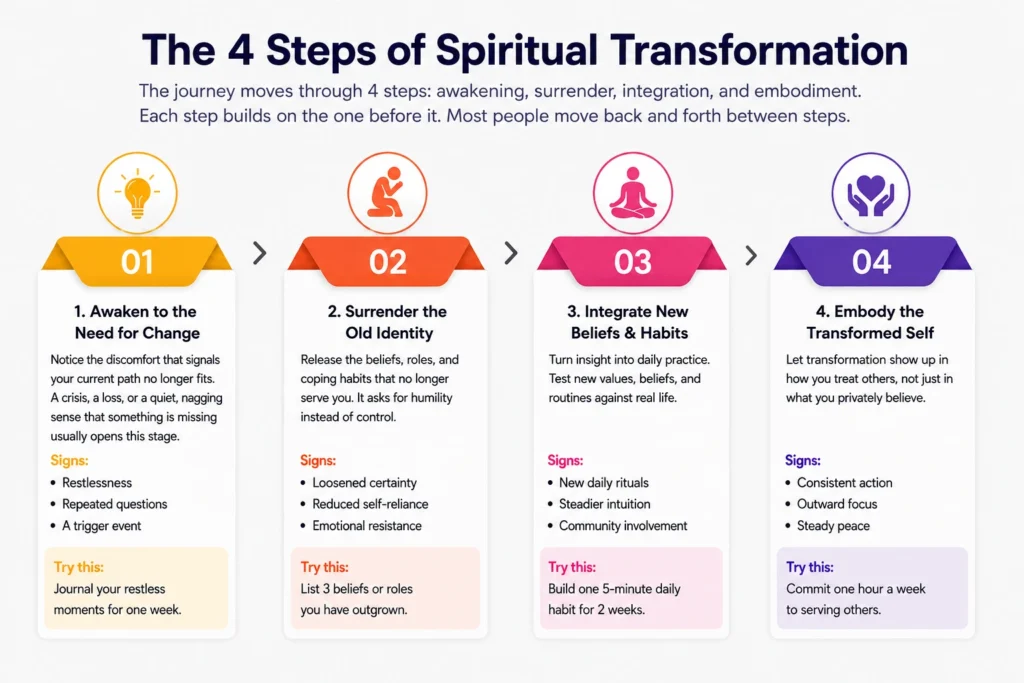
The journey moves through 4 steps: awakening, surrender, integration, and embodiment. Each step builds on the one before it. Most people move back and forth between steps. Few people move in a straight line.
Step 1: Awaken to the Need for Change
Notice the discomfort that signals your current path no longer fits. Awakening means you recognize that something needs to shift. This could be your life, your beliefs, or your relationship with the sacred. A crisis, a loss, or a quiet, nagging sense that something is missing usually opens this stage.
Signs of the awakening stage:
- Restlessness: Relationships, work, or routines that once felt fine now feel unsettled.
- Repeated questions: Questions about purpose, belief, or direction keep coming back.
- A trigger event: A new job, a loss, or a health scare often opens this stage.
Try this: Spend 10 minutes each night for one week. Write down the moment in your day when you felt most restless. Patterns in these notes usually point straight to what needs to change.
Step 2: Surrender the Old Identity
Release the beliefs, roles, and coping habits that no longer serve you. Most people resist this stage the longest. It asks for humility instead of control. Deep Spirituality’s Brian Nitta describes this point differently. He says it’s the moment a person admits their current relationship with the sacred is not enough. They need outside help to grow. The Leaderpath’s Caterina Kostoula calls the pattern before surrender the “victim” pattern. In this pattern, a person blames outside circumstances instead of owning their own growth.
Signs of the surrender stage:
- Loosened certainty: Old answers stop feeling complete. Gray areas replace black-and-white thinking.
- Reduced self-reliance: Prayer, mentorship, community, or reflection start to replace pure willpower.
- Emotional resistance: Frustration, doubt, or anger surface. Surrender challenges the ego directly.
Try this: List 3 beliefs or roles you have outgrown. Write one sentence for each on what you choose to trust instead. Release control gradually. Forcing a sudden change tends to trigger the same resistance it’s trying to overcome. Working through this stage alone is hard, and steady, outside guidance often makes the difference. Structured academic advising offers that same kind of support during other major transitions in life.
Step 3: Integrate New Beliefs and Habits
Turn insight into daily practice. This is the stage where you test new values, beliefs, and routines against real life. Ken Wilber’s integral framework describes a similar shift. He calls it “waking up.” In this shift, a person moves from an ego-driven identity toward a grounded sense of self. They start holding life’s contradictions with less anxiety.
Signs of the integration stage:
- New daily rituals: Meditation, prayer, journaling, and study become consistent instead of occasional. Pew Research found that 44% of these adults center or look inward. Another 26% spend time in nature, and 22% meditate as part of their routine.
- Steadier intuition: Decisions feel guided instead of forced.
- Community involvement: Mentors, teachers, or study groups replace navigating growth alone.
Try this: Pick one 5-minute practice, such as journaling, breathwork, or quiet reflection. Repeat it at the same time every day for 2 weeks before you add a second habit. Small, repeatable habits build faster than intense but occasional ones. Consistency compounds over time, which is the same principle behind academic programs, where reflection is paired with formal coursework.
Step 4: Embody the Transformed Self
Let transformation show up in how you treat others, not just in what you privately believe. Richard Rohr describes a similar turn in his own work on spiritual life. Growth moves through order, disorder, and reorder. It lands in a mature stage marked by service, compassion, and justice toward others. Embodiment is not a finish line. It is an ongoing practice that shapes your decisions, relationships, and daily conduct.
Signs of teady peace: Old triggers and fears carry less weight, even during difficult seasons.the embodiment stage:
- Consistent action: Daily choices reflect renewed values, not just private beliefs.
- Outward focus: You notice and answer the needs of family, community, or causes larger than yourself.
- S
Try this: Choose one person or cause outside your immediate circle. Commit a fixed amount of time, such as one hour a week, to serving it for a month. Growth that stays private tends to fade. Growth that reaches others tends to last.
Spiritual Transformation Stages at a Glance
Here is a quick side-by-side view of all 4 stages. It shows the core shift, common signs, and one practical step for each.
| Step | Core Shift | Common Signs | Practical Step |
| 1. Awakening | Recognizing the need for change | Restlessness, repeated questions, a trigger event | Journal your restless moments for one week |
| 2. Surrender | Releasing the old identity | Loosened certainty, reduced self-reliance, emotional resistance | List 3 beliefs or roles you have outgrown |
| 3. Integration | Turning insight into daily practice | New daily rituals, steadier intuition, community involvement | Build one 5-minute daily habit for 2 weeks |
| 4. Embodiment | Living the transformed self | Consistent action, outward focus, steady peace | Commit one hour a week to serving others |
Spiritual Transformation Duration and Timeline
Spiritual transformation does not follow a fixed timeline. Most people cycle through the 4 stages several times across a lifetime. Marriage, career changes, and loss often send you back through awakening, surrender, integration, and embodiment. This can happen even after you thought the work was finished. If progress feels slow, treat the stages as a spiral to revisit, not a ladder to climb once.
Can Someone Get Stuck in One Stage?
Yes, and the surrender and integration stages are where people get stuck most often. Fear, isolation, and a lack of guidance are the 3 most common reasons someone stalls mid-journey. Support from a mentor, a community, or structured academic study tends to move a stalled process forward again, and Charisma University’s team is one place to get in touch for that kind of support.
Spiritual Transformation vs. Religious Conversion
Spiritual transformation is broader than religious conversion. It does not require you to adopt an organized faith. Religious conversion usually means adopting a specific tradition’s beliefs and practices. Spiritual transformation can center on a higher power. It can also center on nature, community, or a renewed sense of personal purpose. This depends on your worldview. It can happen inside or outside organized religion.
Benefits of Going Through the 4 Steps
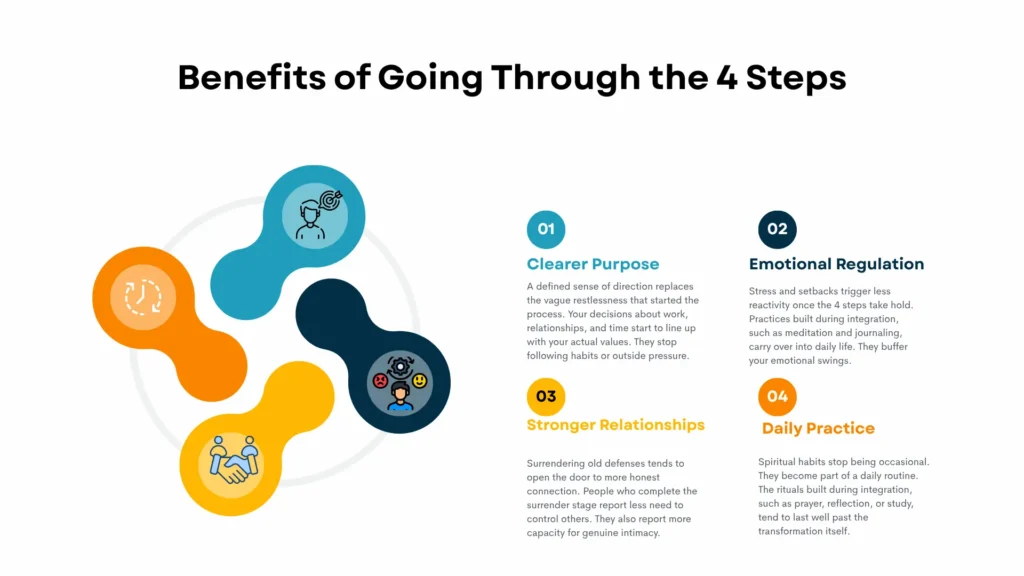
Working through the 4 steps builds 4 measurable outcomes: clearer purpose, steadier emotional regulation, stronger relationships, and a more consistent daily practice. Published research on spiritual conversion and transformation links this kind of lasting shift to better stress management. It also links to a stronger sense of meaning. This is true especially during major life transitions such as illness, grief, or career change.
Clearer Purpose
A defined sense of direction replaces the vague restlessness that started the process. Your decisions about work, relationships, and time start to line up with your actual values. They stop following habits or outside pressure.
Steadier Emotional Regulation
Stress and setbacks trigger less reactivity once the 4 steps take hold. Practices built during integration, such as meditation and journaling, carry over into daily life. They buffer your emotional swings.
Stronger Relationships
Surrendering old defenses tends to open the door to more honest connection. People who complete the surrender stage report less need to control others. They also report more capacity for genuine intimacy.
A More Consistent Daily Practice
Spiritual habits stop being occasional. They become part of a daily routine. The rituals built during integration, such as prayer, reflection, or study, tend to last well past the transformation itself.
How Charisma University Supports Spiritual and Psychological Growth
Charisma University supports personal transformation in 2 ways: spiritual reflection and structured academic study. Its School of Philosophy examines identity and belief at their foundation. Its School of Psychology studies behavior change and emotional patterns. Both schools connect directly to the 4 stages covered in this guide. Charisma University offers admissions details, mentorship programs, and student support services for readers who want to pursue this study formally.
Final Thoughts
Awakening, surrender, integration, and embodiment describe a pattern. Researchers and spiritual teachers have observed this pattern across traditions and disciplines for decades. If progress feels slow, revisit each stage with patience. Spiritual transformation rewards consistency more than speed. Readers who want a deeper, structured approach can explore graduate programs in philosophy, religion, and psychology at academic institutions such as Charisma University. These programs study the frameworks behind human and spiritual development in more depth.
Frequently Asked Questions
Grief, illness, a major life transition, or a lasting feeling of emptiness most commonly triggers it, even after outward success. Prayer, meditation, or a sudden moment of clarity can also open the process.
Yes. It can center on a higher power, nature, community, or a renewed sense of personal purpose, depending on a person’s worldview.
No, not always. Religious conversion usually means adopting a specific faith tradition, while spiritual transformation is broader and can happen inside or outside organized religion.
Surrender is the step most people find hardest. It asks you to release control and certainty instead of gaining something new.
Match your current mindset to the signs listed under each of the 4 steps above. Restlessness and repeated questioning point to awakening. Loosened certainty points to surrender. New daily rituals point to integration. Outward, consistent action points to embodiment.
No. Most people cycle through awakening, surrender, integration, and embodiment many times across a lifetime. A major life event usually resets the process.
There is no fixed length. The process depends on the person and the trigger behind it. Some people move through all 4 stages in months. Others revisit the stages for years, especially after a major life event.
Restlessness, loosened certainty, new daily rituals, and steadier outward action are the 4 clearest signs. Each sign lines up with one of the 4 stages: awakening, surrender, integration, and embodiment.
Yes, mild anxiety or fear is common, especially during the surrender stage. The discomfort usually fades as new beliefs and habits settle in during integration.
A spiritual awakening is the first step. Spiritual transformation is the full 4-step process. Awakening opens the door. Surrender, integration, and embodiment carry the change through.