The top coding languages for computer programming in 2026 are Python, JavaScript, TypeScript, Java, C, C++, C#, Go, Rust, Kotlin, Swift, PHP, SQL, HTML, and R. Python leads the TIOBE Index at 18.94% for July 2026, with C, C++, and a fast-rising Rust close behind. Each language does a different job: some build websites, some train AI models, some run banking systems. The right pick depends on your career path, not on which language sounds trendy.
Every banking app, ride-hailing platform, and hospital records system runs on code written in one of these languages. A Northeastern University study on GitHub’s programming languages found clear usage clusters across millions of repositories, and a separate analysis of language popularity and developer demand found that JavaScript, Python, and Java top both usage and job demand at once. A small core of languages runs most production software today.
This guide covers the 15 most useful coding languages, real 2026 ranking data from four independent sources, 3 lesser-known languages, salary numbers, and how AI tools are changing which languages matter.
Quick Answer: 2026 Language Rankings at a Glance
| Language | TIOBE Rank (Jul 2026) | Most Used By (Stack Overflow 2025) | Primary Domain |
| Python | #1 (18.94%) | 51%+ of developers | AI, data science, backend |
| C | #2 | Systems programming | OS, embedded, firmware |
| C++ | #3 | Game engines, HFT | Performance-critical software |
| Java | #4 | Enterprise backend | Banking, Android |
| C# | #5 | .NET, Unity | Enterprise apps, games |
| JavaScript | #6 | 66% of developers | Web interactivity |
| SQL | #8 | 54%+ of professionals | Database querying |
| R | Top 10 (rising) | Academic research | Statistics |
| Rust | #10 (new entrant) | Most admired, 72% | Systems, WebAssembly |
| TypeScript | #32 (TIOBE), #1 on GitHub by contributors | Enterprise frontend | Large-scale web apps |
TIOBE measures search volume, not code quality or lines written. Treat it as a demand signal, not a quality score.
What Is Coding, and Why Does It Matter?
Coding means writing instructions in a language a computer can run. Programmers use these instructions to build software, websites, mobile apps, and embedded systems. Traffic lights, smartphone apps, and hospital record systems all run on code written in one of the languages below.
Learning to code builds 4 skills that carry over into any career:
- Builds logical problem-solving ability
- Improves attention to detail
- Develops project-management discipline
- Increases earning potential across industries, not just tech
A coding bootcamp or degree program gives you a clear, step-by-step path if self-teaching feels overwhelming. Structured computer science and IT programs cover the fundamentals that self-taught learners often skip and later struggle without.
How TIOBE, PYPL, GitHub Octoverse, and Stack Overflow Differ
No single index tells the whole story. Each one measures something different.
- TIOBE Index counts search queries for phrases like “Python programming.” It shows tutorial demand, not code volume.
- PYPL Index tracks how often language tutorials get searched on Google. Python leads PYPL in the US, India, Germany, the UK, and France, each by more than 40% share.
- GitHub Octoverse counts real contributors and repositories. TypeScript passed Python here in August 2025 by about 42,000 contributors. That had never happened before.
- Stack Overflow Developer Survey asks working developers directly what they use and want to use. JavaScript stays the most-used language at 66% here, even though Python leads on TIOBE.
Use TIOBE and PYPL to judge learning demand. Use GitHub Octoverse and Stack Overflow to see what teams actually build with today. A language can rank differently across all four and still be a smart choice.
The 15 Most Useful Programming Languages to Learn
Python
Python is a general-purpose, beginner-friendly language with plain, readable syntax. It holds the #1 spot on the TIOBE Index at 18.94% as of July 2026. It also grew 7 percentage points year-over-year on Stack Overflow’s 2025 survey, the biggest jump of any major language.
- Why it matters: Python’s ecosystem, including PyTorch, TensorFlow, Django, Flask, and FastAPI, powers most production AI and machine-learning work today.
- Where it’s used: Netflix, Spotify, and Dropbox run Python in production.
- Who uses it: Data scientists, backend developers, and research analysts.
- How to learn it: A structured curriculum builds the statistics and logic foundation that Python-based AI work needs.
JavaScript
JavaScript is the scripting language that makes web pages interactive. It runs in every browser without a separate compiler. It remains the most-used language among professional developers at 66%, according to the 2025 Stack Overflow Developer Survey.
- Why it matters: Nearly every website depends on JavaScript. Its ecosystem, including Node.js, React, and Express, now covers both frontend and backend work.
- Where it’s used: Investment banks, media platforms, and e-commerce stores.
- Who uses it: Frontend developers, full-stack engineers, and web designers.
- How to learn it: Free coding bootcamps or self-paced online courses offer the fastest start.
TypeScript
TypeScript is a typed version of JavaScript that catches errors before code runs. It adds structure that keeps large codebases easy to maintain. It passed Python as the most-used language on GitHub by contributor count in August 2025, gaining over 1 million new contributors that year.
- Why it matters: A 2025 study found that 94% of code errors made by AI models were type-check failures. That makes TypeScript a strong fit for AI-assisted coding.
- Where it’s used: Enterprise web platforms, API services, and modern frameworks like Next.js and Angular, which now default to TypeScript.
- Who uses it: Senior frontend developers and teams building large-scale apps.
- How to learn it: Learn JavaScript basics first, then move to TypeScript’s type system.
Java
Java is an object-oriented language built to run unmodified on any device. This “write once, run anywhere” model has kept it central to enterprise software for three decades. It sits at #4 on the July 2026 TIOBE Index.
- Why it matters: Java still runs the core banking, insurance, and Android systems behind most consumer fintech apps.
- Where it’s used: Airbnb, Uber, and most large financial institutions.
- Who uses it: Backend developers, Android developers, and enterprise software engineers.
- How to learn it: A computer science degree pairs Java with the object-oriented concepts it depends on.
C
C is a low-level language that gives direct control over memory and hardware. It has a steep learning curve, but that effort makes later languages easier to pick up. It holds #2 on TIOBE as of July 2026.
- Why it matters: C still runs the operating systems and embedded controllers in cars, appliances, and industrial equipment.
- Where it’s used: Automotive manufacturers, Microsoft, and Apple.
- Who uses it: Systems programmers and embedded-software engineers.
- How to learn it: Pair it with formal coursework, since memory errors are hard to self-diagnose.
C++
C++ builds on C with object-oriented features for complex, high-performance software. Developers use it when speed and hardware control matter more than easy syntax. It ranks #3 on TIOBE in July 2026, swapping places with C from last year.
- Why it matters: C++ stays essential wherever performance is the limit, including high-frequency trading and game engines like Unreal Engine.
- Where it’s used: Video game studios, Adobe, and Microsoft.
- Who uses it: Game developers, robotics engineers, and performance-focused teams.
- How to learn it: Master C first, since C++ assumes that base before adding classes and templates.
C#
C# is Microsoft’s general-purpose, object-oriented language for apps, games, and web services. Most developers find it easier to learn than C++ while it still offers similar power. TIOBE named it Programming Language of the Year 2025 after the biggest year-over-year rating jump in the index.
- Why it matters: C# powers Unity, the engine behind a large share of mobile and console games.
- Where it’s used: Microsoft, Intuit, and Unity-based game studios.
- Who uses it: Game developers, Windows app developers, and cloud-service engineers.
- How to learn it: Microsoft’s own learning tracks pair well with a computer science curriculum.
Go
Go, also called Golang, is an open-source language built at Google for cloud-scale software. Its simple syntax and fast compile times suit large, distributed systems well.
- Why it matters: Go remains a core skill for cloud infrastructure and DevOps roles, even after falling from #7 to #13 on TIOBE this year.
- Where it’s used: Google, Netflix, and Medium.
- Who uses it: Cloud engineers, backend developers, and DevOps specialists.
- How to learn it: Go’s official docs and short online courses get you productive fast.
Rust
Rust is a systems language built to stop memory errors without slowing code down. It entered the TIOBE top 10 for the first time in history in July 2026, jumping from #18 a year earlier. It has also been Stack Overflow’s most-admired language for several years running, at 72% admiration in the 2025 survey.
- Why it matters: Rust enforces memory safety at compile time. This closes off whole categories of security bugs before software ships.
- Where it’s used: Dropbox, Firefox, and Cloudflare.
- Who uses it: Systems programmers and security-focused engineering teams.
- How to learn it: Learn C or C++ first. Rust’s syntax and memory rules build directly on both.
Kotlin
Kotlin is Google’s preferred language for Android app development. It runs on the same virtual machine as Java and works with existing Java code.
- Why it matters: New Android projects in 2026 default to Kotlin over Java almost every time.
- Where it’s used: Netflix and most modern Android app studios.
- Who uses it: Mobile developers and backend engineers working on the JVM.
- How to learn it: Learn Java basics first, since Kotlin was built around Java compatibility.
Swift
Swift is Apple’s language for iOS, iPadOS, macOS, and watchOS development. It replaced Objective-C as the default choice across the Apple ecosystem.
- Why it matters: Nearly every modern App Store release is written in Swift.
- Where it’s used: IBM, LinkedIn, and Airbnb’s mobile apps.
- Who uses it: iOS developers and mobile app engineers.
- How to learn it: Apple’s free learning resources pair well with a computer science degree.
PHP
PHP is a server-side scripting language built for web development. Despite its age, it still powers a large share of live websites through content management systems.
- Why it matters: PHP runs WordPress, which alone makes up a big share of the internet’s CMS-driven sites.
- Where it’s used: WordPress, Spotify, and Facebook’s early infrastructure.
- Who uses it: Web developers and full-stack engineers on CMS platforms.
- How to learn it: Web development bootcamps usually pair PHP with MySQL from day one.
SQL
SQL, or Structured Query Language, stores and retrieves data inside relational databases. It holds #8 on the July 2026 TIOBE Index and is used by 54%+ of professional developers, per Stack Overflow’s 2025 survey.
- Why it matters: SQL connects to nearly every other language on this list, from Python analytics scripts to Java enterprise systems. It’s a required second skill more than a standalone career language.
- Where it’s used: Oracle, Microsoft, and IBM.
- Who uses it: Database administrators, data analysts, and data engineers.
- How to learn it: Practice on real datasets instead of memorizing syntax alone.
HTML
HTML, or HyperText Markup Language, structures the content of every web page. It’s the most beginner-friendly way to start coding.
- Why it matters: HTML sits under every website, since browsers need it to render structure before any styling or scripting runs.
- Where it’s used: Google, YouTube, and virtually every website in existence.
- Who uses it: Frontend developers, web designers, and content teams.
- How to learn it: Free tutorials teach usable HTML skills in a single weekend.
R
R is an open-source language built for statistics, data analysis, and visualization. It has re-entered TIOBE’s top 10 for several months in a row, climbing from #15 a year earlier, driven partly by renewed academic demand.
- Why it matters: R stays the top choice in academia, epidemiology, and advanced statistical research, even as Python leads industry AI work.
- Where it’s used: Google, Meta, and fintech research teams.
- Who uses it: Data scientists, statisticians, and academic researchers.
- How to learn it: Data-analytics coursework is the fastest path, since R assumes some prior statistics background.
Lesser-Known Coding Languages Worth Considering
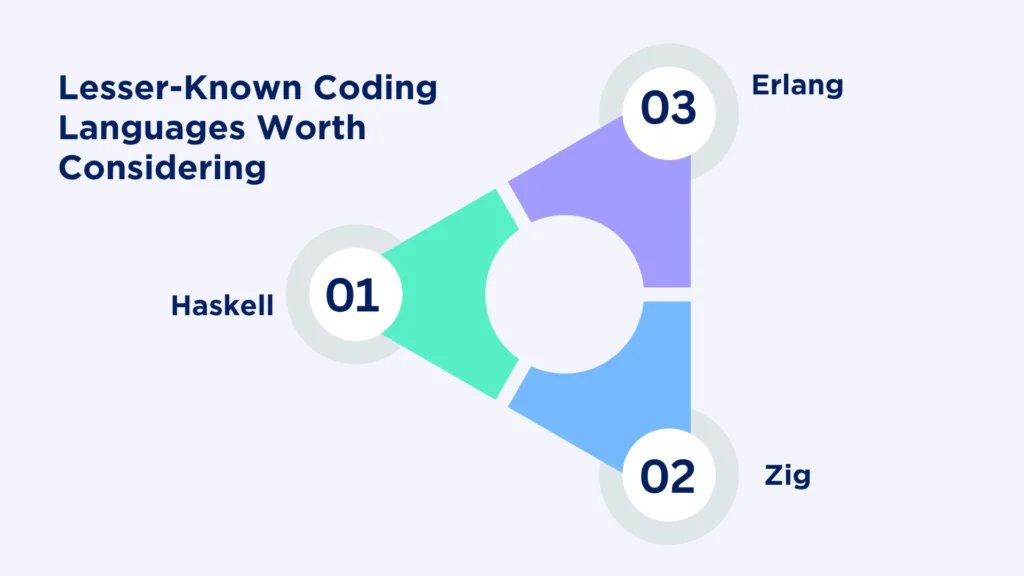
Learning a less common language can set your resume apart from hundreds of Python-only applications. Three worth watching in 2026:
- Haskell: a functional language used in machine-learning research and formal math modeling.
- Zig: climbed from rank #61 to #42 on TIOBE during 2025 and is tracking toward the top 30 as a lower-level alternative to C.
- Erlang: built in the 1980s for telecom systems, and still powers large-scale messaging systems like WhatsApp today.
Programming Language vs. Framework: Know the Difference
A programming language sets the rules for writing instructions. A framework is a pre-built toolkit, written in that language, that speeds up common tasks. Python is a language. Django and Flask are frameworks built with it. JavaScript is a language. React, Angular, and Node.js are frameworks and runtimes built with it. Job listings that say “React developer” or “Spring Boot developer” want language fluency plus framework experience, not a separate skill.
AI’s Impact on Programming Languages in 2026
AI coding tools now shape which languages get picked, not just how fast code gets written. Per the 2025 Stack Overflow Developer Survey, 84% of developers use or plan to use AI tools in their workflow, up from 76% the year before. Two patterns stand out:
- AI tools write cleaner code in languages with simple syntax and large training data, like Python and JavaScript.
- Complex, low-level syntax in languages like C++ gets measurably worse AI assistance, which keeps senior human skill valuable there.
This is also why TypeScript’s rise matters beyond GitHub numbers. Its static types catch AI-generated errors automatically before they reach production, which addresses that 94% type-check-failure rate in AI-written code.
Programming Language Salary Comparison (2026)
| Language | Approx. Salary Range (USD) | Demand Driver |
| Rust | $130,000 to $170,000 | Systems programming, WebAssembly |
| Go | Above median, 15 to 25% premium | Cloud infrastructure, DevOps |
| Python | Strong, AI-driven premium | Machine learning, backend APIs |
| Scala | Above median, 15 to 25% premium | Big data pipelines |
| Java / C# | Stable, enterprise-standard | Banking, enterprise software |
Figures are approximate ranges from 2025 to 2026 industry salary surveys. They vary by region, seniority, and specialty. Treat them as a guide, not a quote for any specific job.
For deeper context on what these roles pay day to day, entry-level information security analysts earn a national median of about $120,000, in a field set to grow 33% over the next decade.
How to Choose the Right Coding Language for Your Career
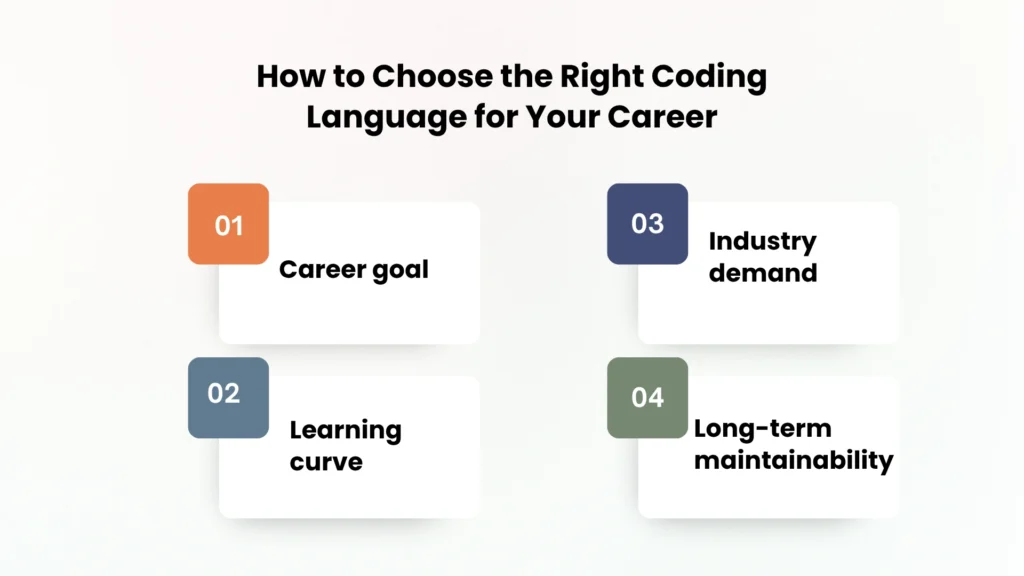
Match the language to your career goal first, then check these 4 factors before you commit time to any one language:
- Career goal: web development needs JavaScript and PHP. Data careers need Python, R, and SQL.
- Learning curve: HTML and Python suit first-time coders. C++ and Rust suit coders with prior experience.
- Industry demand: check current job postings directly, not just tutorial popularity. Demand shifts year to year, as Go’s drop from #7 to #13 on TIOBE shows.
- Long-term maintainability: typed languages like TypeScript and Java scale better for large teams and multi-year projects.
Pick a language tied to an existing interest, such as mobile apps, data work, or game design, if your path still feels unclear. Interest keeps you going through the hard early weeks better than a salary chart does, and a good career advising team can help match that interest to real job openings once you have a few projects built.
Common Mistakes Beginners Make When Picking a Language
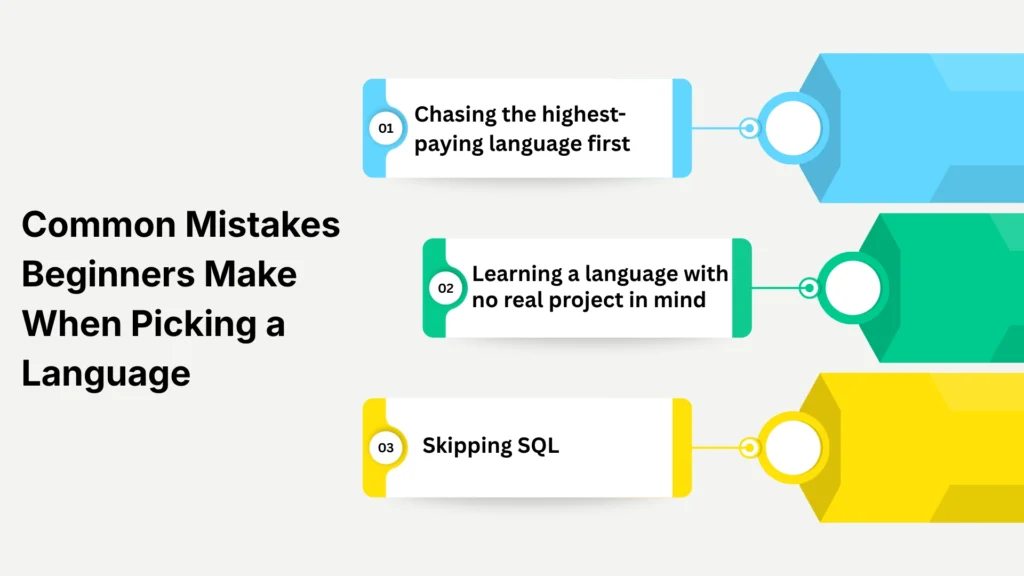
- Chasing the highest-paying language first: Rust pays well, but it has a steep curve. A beginner who starts there often quits before reaching job-ready skill, while a Python-first path gets hireable faster.
- Learning a language with no real project in mind: Tying each new concept to a small project, a script, a webpage, a dataset, builds retention that passive tutorials don’t.
- Skipping SQL: Almost every path on this list touches a database eventually. Skipping SQL creates a gap that shows up in interviews, no matter which language you learn first.
Programming Languages and Career Outcomes
Coding skills now shape business careers as much as tech careers, since analytics work runs through Python and SQL by default in most companies today.
Cybersecurity shows this overlap clearly. Security teams write detection and automation scripts in Python, C, and SQL, and that demand shows up directly in salary data, a trend broken down in this California cyber security salary report for 2026. Professionals who want to specialize further can study this territory in depth through a PhD in Cyber Security Administration, while those aiming for leadership rather than research often prefer an online MSc in IT Management instead.
Coding skills also shape long-term pay. Majors that combine technical and business skills tend to out-earn single-focus degrees, a pattern laid out in this 20 highest-paying bachelor’s degrees in 2026 breakdown, where computer science grads start above $100,000 in some markets.
H2: The Bottom Line
Learning any of these 15 languages opens doors in web development, data science, cybersecurity, and mobile apps. Python, JavaScript, and Java still run most real-world software, while Rust and TypeScript are gaining ground fastest in 2026. TIOBE, GitHub Octoverse, and Stack Overflow don’t always agree, and that gap is useful. It shows which languages lead in search interest versus which ones teams actually ship with.
If you want to build these skills through a structured program rather than piecing it together alone, graduate technology and business degrees cover this same ground with guided coursework and career support.
H2: Frequently Asked Questions
Python, JavaScript, and Java are the top 3 languages in coding as of 2026. Python leads data science and AI work. JavaScript runs the interactive layer of the web at 66% developer usage. Java still powers enterprise systems and Android apps.
Elon Musk first learned BASIC at age 10 from a programming book he bought himself. He later picked up Python, C, C++, and Java. At age 12, he sold his first program, a game called Blastar.
Python and HTML are the best programming languages for beginners. Both use plain, readable syntax. Both show results fast, which keeps new learners motivated through the first few weeks.
C++ is generally seen as the hardest mainstream language to learn, since it mixes low-level memory control with complex object-oriented features. Rust and C follow close behind for similar reasons.
Rust, Go, Scala, and Python rank among the highest-paying programming languages in 2026, with Rust developers earning an estimated $130,000 to $170,000. These languages power cloud computing, systems programming, and machine learning roles where skilled developers stay hard to find.
Most working developers know 3 to 5 programming languages well. This usually means one general-purpose language such as Python or Java, one web language such as JavaScript, and one database language such as SQL.
Yes. C ranks #2 on the July 2026 TIOBE Index, ahead of every language except Python. It stays essential for systems programming and embedded devices. Companies still actively maintain the enterprise infrastructure built on it.
No, TypeScript is not replacing JavaScript. It compiles down to JavaScript and adds static types on top. TypeScript passed Python on GitHub by contributor count in August 2025, but JavaScript still leads all languages in raw developer usage at 66%, per Stack Overflow’s 2025 survey.
Yes. Many developers learn through bootcamps, online courses, and self-study. A degree still helps for roles that need deep theory, such as AI research or systems engineering.