A brand manager protects and grows a company’s name. This name carries real value in the minds of customers. To do this job, a brand manager studies the market. This person sets brand strategy, picks a brand structure, manages budgets, tracks performance, and leads teams across marketing, sales, and creative work.
This guide covers 8 core duties. It covers how brand managers measure brand equity. It covers 4 types of brand structure, a 6-step brand audit, current salary data, top certifications, and the exact steps to enter this career.
What Is a Brand Manager?
A brand manager owns one outcome above all others. This person makes sure customers recognize, trust, and choose the brand over competitors. The role splits across 2 settings. Agency brand managers run brand accounts for outside clients. Corporate brand managers own one or more brands inside a single company, such as a beverage brand at a large food company.
The role blends 4 skill areas. These are market research, brand strategy, budget control, and cross-team leadership. A brand manager rarely writes the ad copy or designs the social post. Instead, this person sets the direction. Then this person checks that every team follows it.
Marketing scholar Kevin Lane Keller gave this discipline its modern foundation. In a widely cited 1993 study published in the Journal of Marketing, Keller defined brand equity as the added value a brand name gives to a product in the mind of the customer. In plain terms, brand equity is why a shopper pays more for a bottle labeled with a trusted name than for the same drink in a plain bottle. Every duty below exists to build or protect that gap.
Students who want this career often start with a Bachelor of Arts in Marketing. This degree covers strategy, research, and communication in one place.
Brand Manager vs. Marketing Manager vs. Product Marketer
Job titles overlap in real postings. It helps to separate the 3 roles employers compare most often.
| Role | Primary Focus | Time Horizon |
| Brand Manager | Owns the brand’s identity and equity | Long-term (1 to 5 years) |
| Marketing Manager | Runs the campaigns that promote the brand | Short-term (weeks to a quarter) |
| Product Marketing Manager | Positions and launches single products | Per launch |
A brand manager sets the “what” and “why” a brand stands for. A marketing manager handles the “how” through campaigns. A product marketing manager applies both ideas to one product line. In a small company, one person often plays all 3 roles. In a large company, these roles work side by side.
8 Core Responsibilities of a Brand Manager
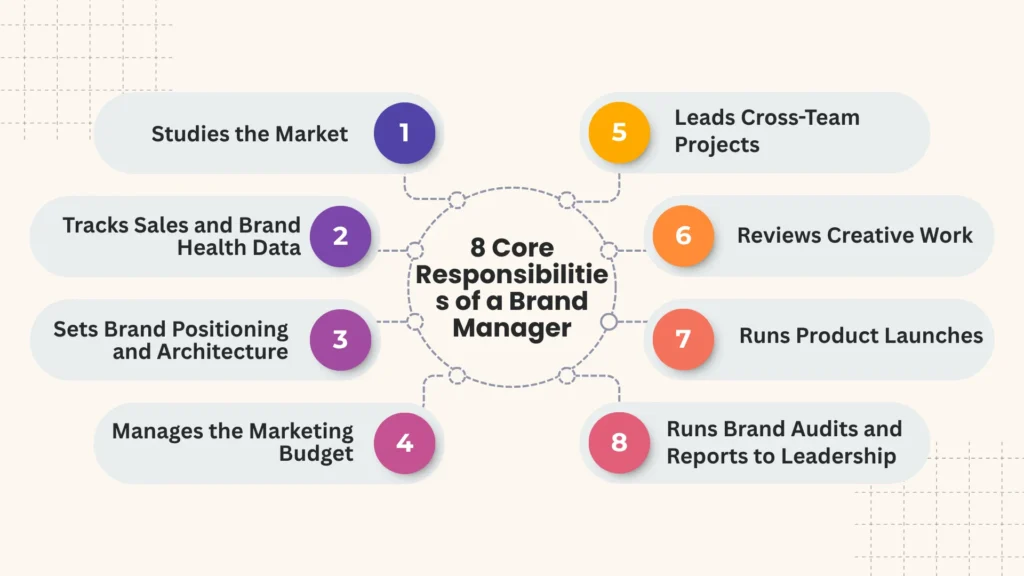
A brand manager handles 8 core duties. These duties cover research, strategy, structure, budgets, and teamwork.
1. Studies the Market
A brand manager studies the market to find gaps competitors have missed. This work means auditing rivals, talking to customers, and reading category reports from firms such as Nielsen, Statista, and Mintel.
2. Tracks Sales and Brand Health Data
A brand manager tracks sales, pricing, and brand health metrics. These include brand awareness rate, share of voice, and Net Promoter Score. Catching a shift early helps the brand act before it hits revenue.
3. Sets Brand Positioning and Architecture
A brand manager writes the brand’s positioning statement. This person also chooses how sub-brands relate to the parent brand, a decision called brand architecture. This choice shapes naming, logo design, and every other branding decision that follows.
4. Manages the Marketing Budget
A brand manager manages the marketing budget. This means tracking spend across ads, events, and creative production, then shifting funds toward what actually moves the numbers.
5. Leads Cross-Team Projects
A brand manager leads projects that span sales, finance, and operations. This work keeps every team aligned to one brand story instead of several competing ones.
6. Reviews Creative Work
A brand manager reviews ads, packaging, store signage, and social content against the brand’s voice and style guide. This step catches inconsistencies before customers see them.
7. Runs Product Launches
A brand manager runs product launches from the first concept to the store shelf. This person coordinates research, naming, packaging, pricing, and timing with the product and sales teams.
H3: 8. Runs Brand Audits and Reports to Leadership
A brand manager runs a brand audit on a regular schedule (see the step-by-step process below). This person then reports the findings to senior leaders to justify budget and strategy changes.
The 2 Brand Equity Models Every Brand Manager Should Know
Brand equity is not just a feeling. It is a model brand managers measure against. Two frameworks lead the field, and the right one depends on the brand’s category.
David Aaker’s Brand Equity Model
David Aaker’s Brand Equity Model breaks equity into 5 parts. These are brand loyalty, brand awareness, perceived quality, brand associations, and other assets such as patents or trademarks. Product-led B2B and industrial brands often favor this model. It weighs functional quality heavily.
A well-known 1994 study in the Journal of Marketing Research, co-authored by Aaker, found something useful. A rise in a brand’s perceived quality tracked with a rise in the company’s stock price. This is one reason brand managers treat quality scores as a real business metric, not just a marketing number.
Kevin Lane Keller’s Customer-Based Brand Equity (CBBE) Pyramid
Kevin Lane Keller’s Customer-Based Brand Equity Pyramid builds equity in 4 steps. First comes salience. This step asks if the customer even knows the brand exists. Next comes performance and imagery. This step covers what the brand delivers and represents. Then come judgments and feelings. This step covers what the customer thinks about the brand.
Last comes resonance, which is deep loyalty and a sense of community. Emotion-driven B2C and lifestyle brands often favor this model, since it climbs all the way to loyalty instead of stopping at quality. Most brand teams pick one framework and run every survey against it. Mixing models makes year-over-year tracking hard to trust.
Brand Architecture: 4 Types Every Brand Manager Must Choose Between
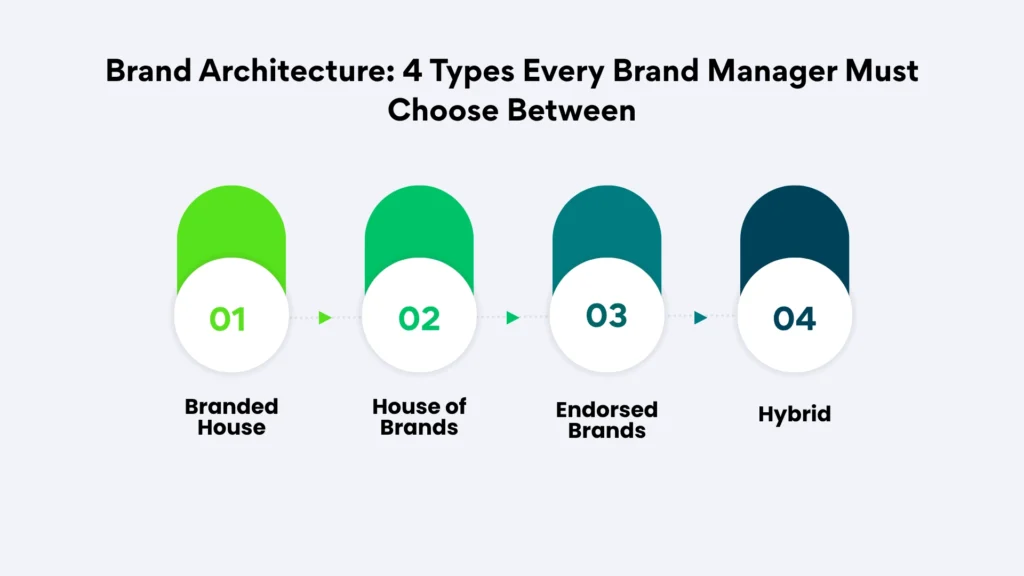
Brand architecture defines how a parent brand relates to its sub-brands. The choice drives naming, visual identity, and risk across the whole portfolio.
- Branded House: One master brand covers every product. Sub-names act as simple descriptors rather than separate identities. Apple and FedEx both use this model. It costs the least to run, but every sub-brand suffers if the master brand’s reputation takes a hit.
- House of Brands: Each brand runs its own fully independent identity, and most customers never learn the parent company’s name. Large consumer goods companies often run this model. It isolates risk, but it costs more since every brand needs its own budget.
- Endorsed Brands: Sub-brands keep a distinct identity while still carrying the parent’s name or seal of approval. A hotel group that sells different-tier hotel brands under one shared name is a classic example.
- Hybrid: A mix of the 3 models above, usually the result of a merger or acquisition. One core brand runs as a branded house while other brands beneath it run as a house of brands.
A brand manager usually inherits the existing architecture rather than choosing it from scratch. Reassessing it during a rebrand or acquisition is still a core part of the job.
How to Write a Brand Positioning Statement
Before a brand manager approves any campaign, the brand needs a positioning statement. This is a one-sentence internal anchor that keeps every team aligned. The standard format reads:
“For [target audience], [brand name] is the [category] that [key benefit], because [reason to believe].”
Customers never see this exact sentence. Every ad, landing page, and packaging decision should still trace back to it without contradiction.
Brand Manager Job Description: What Employers Look For
Real job postings from large companies repeat a consistent set of requirements. Across dozens of listings, 5 qualifications show up most often.
- A bachelor’s degree in business, marketing, or advertising.
- 3 to 6 years of relevant marketing or brand experience.
- Proven skill running cross-functional projects from start to finish.
- Comfort using data to justify decisions.
- Strong written and verbal communication for stakeholder meetings.
Employers also expect 6 personal qualities. These are analytical thinking, clear communication, creativity, sound decision-making, strong people skills, and tight organization. A brand manager talks to many groups at once. These groups include internal teams, outside agencies, and company leaders. These qualities matter every day.
How to Run a Brand Audit: 6 Steps
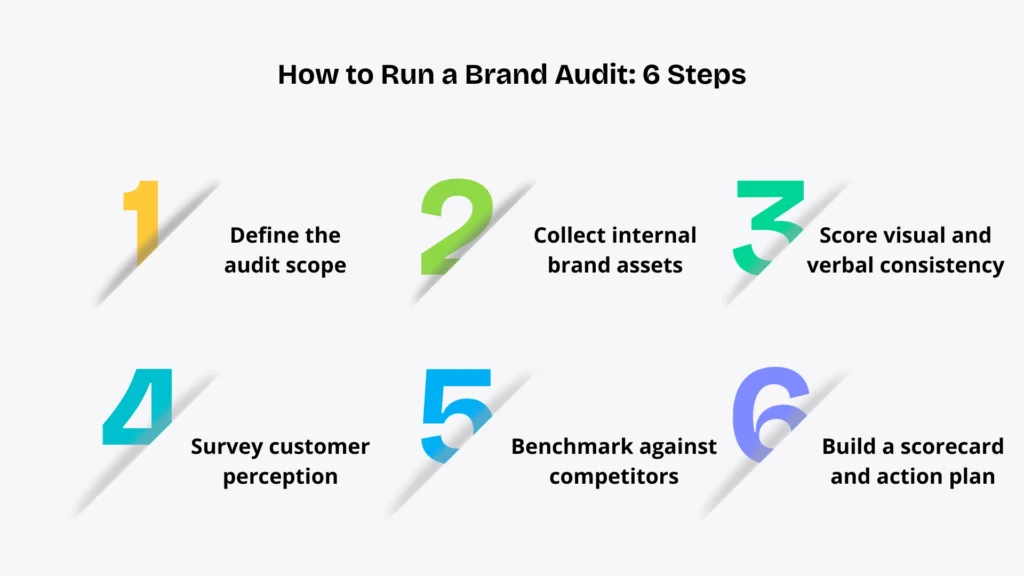
A brand audit measures whether brand-building spend is actually working. A brand manager typically runs one every year, or before any rebrand, using 6 steps.
- Define the audit scope: Decide whether the audit covers visual identity, market perception, or both.
- Collect internal brand assets: Pull every guideline, logo file, and messaging document currently in use.
- Score visual and verbal consistency: Check whether the logo, colors, tone, and taglines match across every channel.
- Survey customer perception: Measure aided and unaided brand recall, along with Net Promoter Score.
- Benchmark against competitors: Calculate share of voice and sentiment against the closest 3 rivals.
- Build a scorecard and action plan: Turn every finding into a ranked list of fixes, from quick wins to a multi-quarter rebrand.
KPIs a Brand Manager Tracks
A brand manager reports brand health using 5 core metrics. Each one has a clear formula.
| KPI | Formula | What It Signals |
| Brand Awareness Rate | People aware of the brand divided by total surveyed, times 100 | Top-of-funnel visibility |
| Share of Voice | Brand mentions divided by total category mentions, times 100 | Competitive market presence |
| Net Promoter Score | Percent promoters (score 9 to 10) minus percent detractors (score 0 to 6) | Loyalty and referral likelihood |
| Brand Sentiment Score | Positive mentions minus negative mentions, divided by total mentions | Reputation health |
| Branded Search Volume | Monthly searches for the brand name | Purchase-stage intent |
Tracking too many KPIs at once tends to backfire. Most brand teams keep the dashboard to these 5, plus 1 or 2 industry-specific metrics, so real trends stay visible instead of buried in data.
Tools Brand Managers Use
A brand manager relies on software across 4 categories. These tools help research markets, track performance, and manage relationships.
- Social listening tools, such as Hootsuite, Sprout Social, and Brandwatch.
- Customer relationship management (CRM) software, such as Salesforce, HubSpot, and Zoho.
- Data visualization tools, such as Tableau, Google Charts, and Datawrapper.
- Media monitoring platforms, such as Meltwater, Cision, and Muck Rack.
The right mix depends on company size, industry, and budget. Most brand managers touch all 4 categories at some point in their career.
Brand Manager Salary and Job Outlook (2026)
Brand manager pay varies by data source, since each site samples a different pool of job postings and self-reported salaries. Reading several sources together gives a more honest picture than any single number.
| Source | Average Annual Salary (2026) |
| ZipRecruiter | $84,160 |
| PayScale | $86,705 |
| Indeed | $91,783 |
| Built In | $104,836 (total pay: $119,478) |
| Salary.com | $125,186 |
| Glassdoor | $128,003 |
By experience level, entry-level brand managers with under 1 year of experience earn roughly $53,000 to $73,000 a year. Brand managers with 1 to 4 years of experience earn roughly $77,000 to $80,000. Senior brand managers with 5 or more years of experience earn $123,000 to $132,000.
By industry, Glassdoor reports the highest median pay in financial services ($176,262), pharmaceutical and biotech ($175,363), insurance ($155,874), manufacturing ($141,215), and information technology ($141,027).
Government wage data covers the broader marketing manager category, which brand management rolls into. The U.S. Bureau of Labor Statistics places the median annual wage for this group at $161,030 as of May 2024. The agency projects 6 percent employment growth from 2024 to 2034, faster than the average for all jobs, which works out to roughly 36,400 openings a year across the group.
How to Become a Brand Manager
Becoming a brand manager takes 3 steps. Earn the right degree, build relevant experience, then sharpen a specific set of skills.
Earn a Business or Marketing Degree
Most brand managers hold at least a bachelor’s degree. Common fields are business, marketing, or communications. A Bachelor of Arts in Marketing builds strategy, communication, and tech skills from day one. Some students want a broader start. They choose a Bachelor of Business Administration and specialize later. Some employers want a master’s degree for senior roles. This is common at large companies. Charisma University’s graduate programs offer that next step.
Build Marketing Experience
Brand manager roles rarely go to entry-level candidates. Most people spend 3 to 5 years in other roles first. These include market research analyst, content coordinator, or social media manager. Each role builds a different skill. One builds research skills. Another builds content instincts. Another builds audience insight.
Develop 7 Core Brand Management Skills
A strong brand manager develops these 7 skills over time.
- Writing: Shapes messaging that stays consistent across every channel.
- Communication: Aligns stakeholders around one brand vision.
- Strategic thinking: Positions the brand against the wider competitive set.
- Project management: Runs multiple campaigns without dropping deadlines.
- People management: Leads direct reports and outside partners toward one brand standard.
- Analytical thinking: Reads sales and market data to spot trends before they hit revenue.
- Decision-making: Picks a direction fast, even when the data is incomplete.
Certifications and Professional Associations
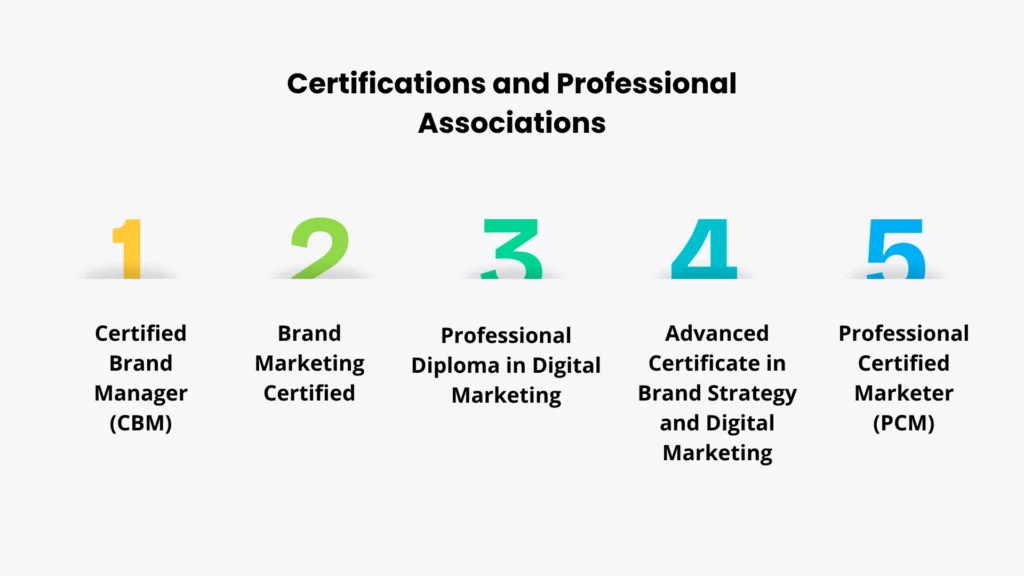
No single certification dominates brand management the way the CPA dominates accounting. Still, 5 credentials carry real weight with employers.
- Certified Brand Manager (CBM): Offered by the Association of International Product Marketing and Management, it covers brand identity, customer relations, and brand equity.
- Brand Marketing Certified: Offered by Product Marketing Alliance, built with brand leaders from companies including Dropbox and LinkedIn.
- Professional Diploma in Digital Marketing: Offered by the Digital Marketing Institute, it covers SEO, social media, and digital strategy alongside brand basics.
- Advanced Certificate in Brand Strategy and Digital Marketing: Offered by Kellogg Executive Education, it’s aimed at senior marketers moving into brand leadership.
- Professional Certified Marketer (PCM): Offered by the American Marketing Association, it validates broader strategic marketing skills.
Brand managers also gain from joining local marketing groups. Brand conferences help too, since they keep skills current.
Brand Manager Career Advancement
A brand manager can climb toward 4 senior roles over time. These are senior brand manager, brand director, product marketing manager, or director of marketing. Each step up brings a wider scope, moving from a single product line to an entire company’s brand portfolio.
How AI Is Changing Brand Management in 2026
AI tools now touch 3 parts of the brand manager’s job. They do not replace the strategic core of it. AI-powered social listening flags sentiment shifts and rival moves in near real time. This cuts down the manual research work from Duty 1 above. AI drafting tools speed up the first pass on creative briefs and ad copy. Every output still needs a human check, from Duty 6, since AI-written copy can drift off brand voice. AI dashboards blend social listening, CRM, and search data into one view. This makes the KPI tracking above faster to update.
One thing has not changed. A brand manager still owns the calls on positioning, architecture, and budget, because an AI model carries no accountability for a brand’s long-term name.
Start Your Brand Management Career the Right Way
A brand management career starts with the right foundation. A marketing education that covers strategy, communication, and technology together gives you that base. Charisma University’s School of Business builds it through real business challenges, not just theory. You can browse the full list of undergraduate programs, check tuition and fees, or read more career guides on the Insights page.
Ready to build these skills? Apply now. Or visit undergraduate admissions to plan your next step.
Frequently Asked Questions
Most brand managers hold a bachelor’s degree in marketing, business, or communications. Some senior roles prefer a master’s degree.
Entry into brand management typically takes 3 to 5 years of prior marketing experience, though smaller companies sometimes hire with less.
Brand equity is a perception. Brand value is a price tag. Brand equity measures how customers think and feel about a brand, using models such as Aaker’s 5 assets or Keller’s brand equity pyramid. Brand value turns that perception into a dollar figure, such as the amount a brand adds to a company’s balance sheet.
Brand architecture is the structure that defines how a parent brand relates to its sub-brands. It can be a branded house, a house of brands, an endorsed model, or a hybrid, and it shapes naming, visual identity, and risk across a company’s whole portfolio.
Average salaries range from $84,160 to $128,003 depending on the data source, with senior brand managers earning $123,000 to $132,000. The broader marketing manager category, tracked by the U.S. Bureau of Labor Statistics, reports a median of $161,030.
The 5 C’s of branding guide a brand manager’s market analysis. They are a company, the brand’s own strengths and goals. Customers, the people the brand serves. Competitors, the rival brands in the same space. Collaborators, the partners and suppliers that support the brand. Context, the wider market and economic conditions the brand operates in.
Brand management can be demanding, since a brand manager juggles budgets, deadlines, and multiple teams at once. Most brand managers manage this stress through strong organization and clear communication with stakeholders.
Most employers ask for a bachelor’s degree, but a small number of companies hire candidates with strong marketing experience instead of a degree. A degree still remains the most common path into the role.
Consumer goods, retail, tech, pharma, and hotel companies hire brand managers most often. Any company that needs to stand out in a crowded market needs this role.
Brand managers increasingly need working knowledge of AI-powered social listening, drafting, and analytics tools. The strategic decisions, such as positioning, architecture, and budget, still stay a human responsibility.
Brand manager roles offer strong pay, a clear path to senior marketing positions, and steady demand, since the Bureau of Labor Statistics projects 6 percent growth for the broader marketing manager category through 2034.