Coding means writing instructions in a programming language that tell a computer what to do. Every app, website, game, and smart device runs on code. A programmer writes that code in a language like Python, JavaScript, or Java. The computer reads each instruction and runs it, step by step, to create a working product.
This guide covers how coding works, where it shows up across industries, what tools coders use, how much they earn, and how to learn it.
What Is Coding?
Coding turns a human idea into a language a machine can read. A developer writes each instruction in order. The computer follows those instructions exactly as written. The result might be a login page or a mobile game. Programming languages fall into two broad groups. Each group handles this process in its own way.
How Does Coding Work?
Low-Level Programming Languages
Low-level languages talk directly to computer hardware. Binary and assembly are two examples. Binary code uses only 0s and 1s. Each digit flips a switch inside the machine. Thousands of these switches work together to run one simple command.
High-Level Programming Languages
High-level languages read closer to plain English. Python, Java, and JavaScript are common examples. A tool called a compiler or interpreter turns this code into the binary a computer chip can run. High-level languages save time and make coding easier for beginners.
What Is Coding Used For?
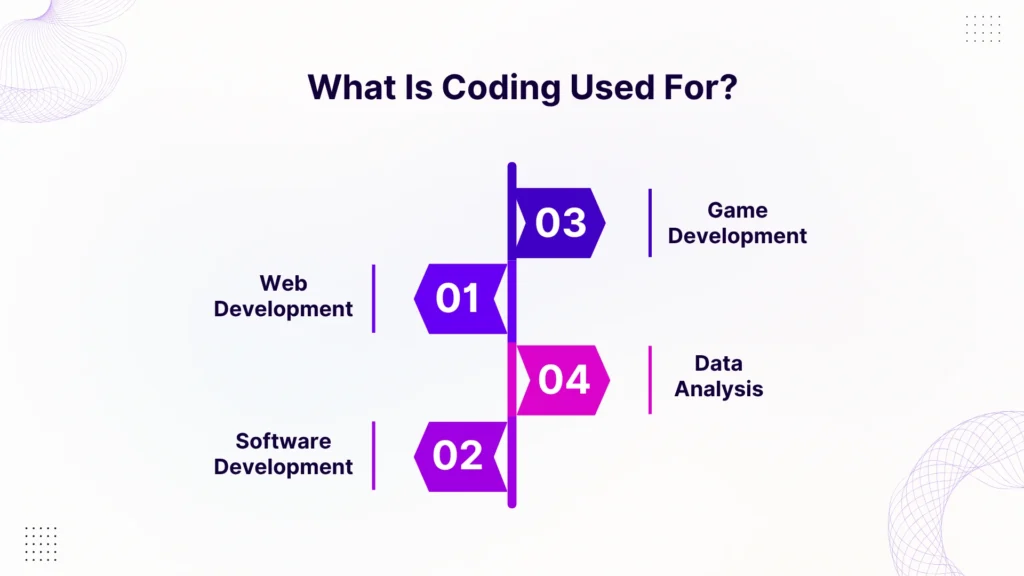
Four fields use coding the most: web development, software development, game development, and data analysis.
Web Development
Front-end developers build the part of a website you see. They use three languages to do it. HTML lays out the content, like headings and links. CSS controls the colors, layout, and fonts. JavaScript adds interactive features, like dropdown menus and live updates.
Back-end developers connect the site to a database instead. They often write this server-side code in Python, PHP, or SQL. Many also use frameworks like Node.js or Django to build faster.
Software Development
Building an app starts with defining the problem. Next comes designing a solution. Then comes writing the code, usually in Python, Java, or C++. Testing catches bugs before the app launches. Debugging then fixes those bugs, and ongoing maintenance keeps the app running as updates roll out.
Business skills matter here too. Most software solves one clear business problem for a company. A Bachelor of Business Administration program often covers that side of the work.
Game Development
Games run on C++, C#, and JavaScript. Developers pair these languages with engines like Unity or Unreal Engine. These engines handle graphics, physics, and sound. Building character behavior and real-time gameplay takes a strong grasp of algorithms.
Data Analysis
Python, R, and SQL lead this field. Analysts write code to clean messy data and spot trends. They use that code to build forecasts for finance, healthcare, and retail teams. A Bachelor of Science in Economics or a Bachelor of Science in Finance teaches these same analytical methods, just applied to markets instead of code.
Most In-Demand Programming Languages in 2026
Job-posting data tells a sharper hiring story than developer surveys alone:
- Python leads overall hiring demand. Python appears in 46% of U.S. job postings that require a programming language, driven by AI, automation, and data work, based on an analysis of over 800,000 listings.
- SQL is nearly tied with Python and actually outpaces it as the top requirement in 38 U.S. states — a detail most coding guides skip entirely.
- JavaScript/TypeScript remain the backbone of web hiring. Most postings that listed plain JavaScript in 2022 now list TypeScript instead, as companies require type safety once a codebase grows large.
- Go is the fastest-growing infrastructure language, tied to the tooling modern DevOps teams run daily, including Docker, Kubernetes, and Terraform.
- Java still anchors enterprise hiring, especially in finance and large regulated systems.
One overlooked signal: over half of U.S. job ads requiring a programming language now come from industries outside tech, such as healthcare, logistics, and retail. Coding has become a general career asset, not just a software-industry one.
Tools Every Beginner Coder Should Know
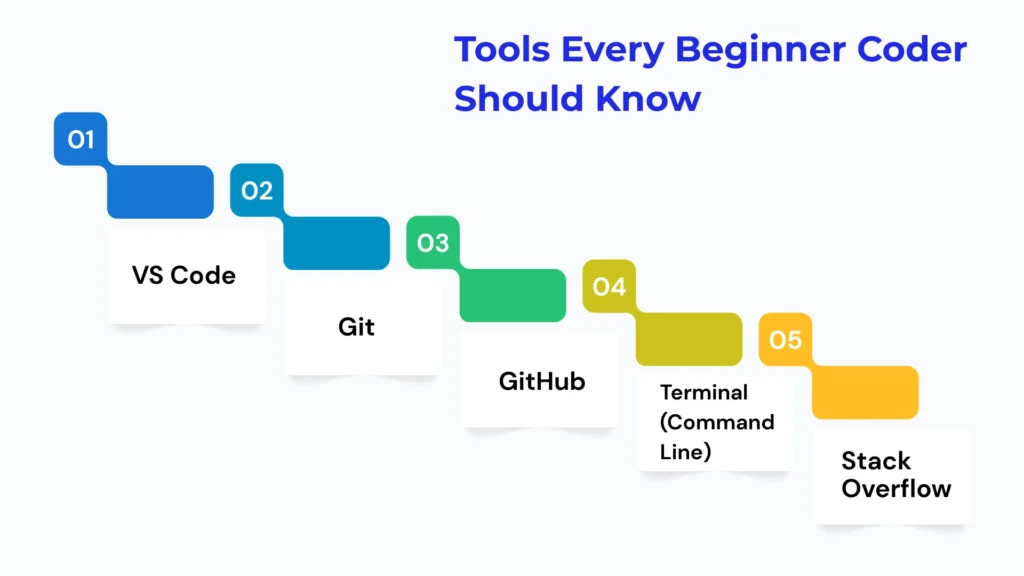
A programming language alone isn’t enough. Most working coders also rely on a small set of core tools:
- VS Code: The free code editor most beginners start with. It highlights syntax and flags errors while you type, so mistakes get caught early.
- Git: A version-control tool that tracks every change made to a project’s code. Nothing gets lost by accident, and old versions stay recoverable.
- GitHub: The online home for that code. It lets teams review, share, and build on the same project without overwriting each other’s work.
- Terminal (Command Line): The text-based tool that runs the commands to install software, launch programs, and manage files directly.
- Stack Overflow: A question-and-answer community where the exact error message a beginner is stuck on usually already has an answer, often on the first page of results.
Learning these tools alongside a language shortens the learning curve. A beginner who only memorizes Python but skips Git will struggle the moment a real team project starts.
Coding vs. Programming vs. Software Development
People often use these three terms the same way. But each one covers a different amount of work.
| Term | What It Covers |
| Coding | Writing lines of code in one language |
| Programming | Coding, plus designing logic, testing, and fixing bugs |
| Software Development | The full process: planning, coding, testing, launch, and upkeep |
Coding is the narrowest of the three terms. Software development is the broadest. It includes the business and project-management work that happens around the code.
The Cognitive Case for Learning to Code
Coding builds more than technical skill. A large study reviewed 432 comparisons in the journal Review of Educational Research. Students who had coding experience scored 16 percentile points higher on thinking-skills tests. This held true across different ages and languages.
A separate review in Frontiers in Psychology found similar results. It said coding likely improves problem-solving and logical reasoning, though more long-term research is still needed. The World Economic Forum’s Future of Jobs Report 2025 lists tech literacy as a critical skill today. It expects that skill to matter even more through 2030.
How AI Coding Tools Are Changing the Job in 2026
AI assistants are now standard. Most developers use one monthly, and GitHub Copilot alone has over 4 million paid users. But the results are more mixed than expected: large-scale data across 121,000 developers found productivity gains stuck near 10%, despite near-universal adoption. One controlled study even found experienced developers took 19% longer on tasks using AI, while still believing it had sped them up.
Seniority matters too. Senior engineers capture roughly 5x the productivity gains juniors see, and AI-written code carries 15–18% more security vulnerabilities on average.
The takeaway: AI speeds up routine tasks but doesn’t replace understanding fundamentals. A coder who can’t debug or review AI output still can’t ship safely on their own.
How to Learn to Code
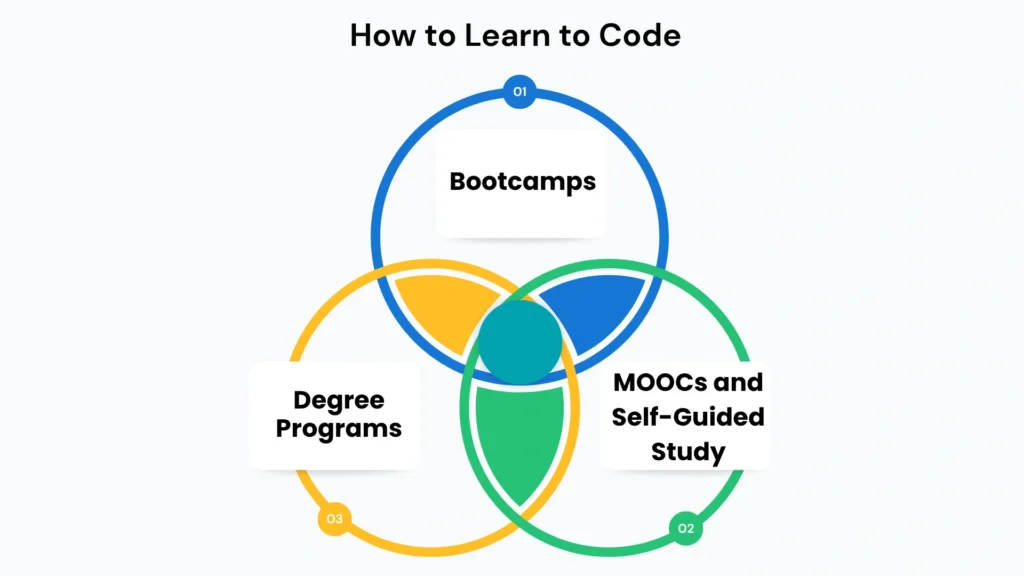
Four paths lead to coding skill: bootcamps, degree programs, MOOCs, and self-study.
| Path | Typical Length | Typical Cost | Best For |
| Bootcamp | 3–6 months | $10,000–$20,000 | Fast, job-focused training |
| Degree Program | 3–4 years | Varies by school | Deep theory plus long-term career support |
| MOOCs | Self-paced | Free to low-cost | Learners who want flexibility |
| Self-Guided Study | 6–12 months | Free to low-cost | Highly motivated, independent learners |
Bootcamps
Coding bootcamps teach job-ready skills fast, usually in 3 to 6 months. Providers like General Assembly, Flatiron School, and App Academy focus on real projects and job placement help.
Degree Programs
Degree programs build a deeper foundation over several years. They also connect students to internships and mentors. A university Career Center often coordinates that long-term support.
MOOCs and Self-Guided Study
MOOCs and self-guided platforms let learners study at their own pace, often for free. Coursera, edX, and freeCodeCamp are three of the most popular options. Short, daily practice builds skill faster than long, occasional study sessions.
A strong first project still needs a strong write-up. A university Writing Center can help turn a coding portfolio into something a hiring manager actually reads to the end.
Common Mistakes Beginners Make
New coders tend to trip over the same few habits:
- Chasing Perfection: Trying to write flawless code before finishing a single project. Build something rough first, then refine it. Momentum matters more than polish at the start.
- Skipping Git: Putting off version control until “later.” Beginners who wait to learn Git often lose hours of work they can’t get back.
- Copying Blindly: Pasting code from a tutorial without understanding what it does. Code you don’t understand is code you can’t fix when it breaks.
- Juggling Languages: Trying to learn three languages at once. One language, learned well, transfers faster to a second language than three learned poorly.
- Ignoring Errors: Closing the error message instead of reading it. The message usually names the exact line and the exact problem, so it’s the fastest path to a fix.
Coding Certifications Worth Getting
A certification can strengthen a resume, especially for self-taught coders without a degree. Three stand out to employers:
- Google IT Automation with Python: A Coursera certificate that proves scripting and automation skills, useful for IT support and junior developer roles.
- AWS Certified Developer – Associate: Proves the skills needed to build and deploy apps on Amazon’s cloud platform, one of the most requested cloud skills in job listings.
- Microsoft Certified: Azure Developer Associate: Proves the same kind of development skill on Microsoft’s cloud platform, a strong pair for teams that run on Azure instead of AWS.
A certification supports a portfolio. It does not replace one. Employers still value working projects more than a certificate alone.
Careers That Use Coding Skills and What They Pay
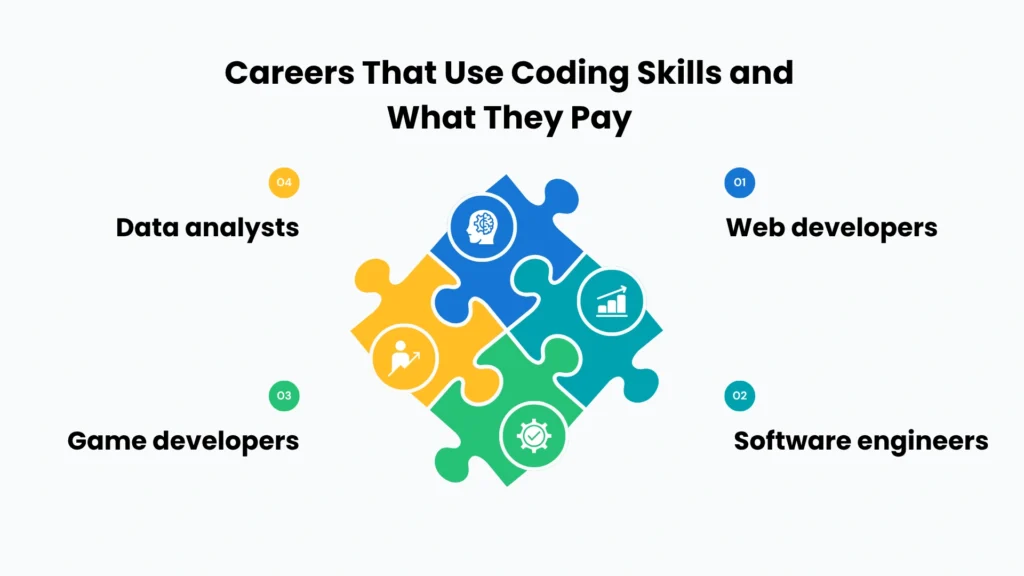
Coding skills open roles across tech, and well beyond it too:
- Web developers build and maintain websites.
- Software engineers design and build apps.
- Game developers program interactive entertainment.
- Data analysts write code to interpret business data.
Pay varies sharply by role, experience, and location. Computer and IT jobs overall had a median pay of $105,990 in May 2024, more than double the median for all U.S. jobs, per BLS data. Demand keeps climbing too: software developer jobs are set to grow 15% from 2024 to 2034, several times faster than the average job, according to the U.S. Bureau of Labor Statistics. Computer and IT jobs overall had a median pay of $105,990 in May 2024, more than double the median for all U.S. jobs, per BLS data.
| Country / Level | Typical Annual Pay (USD) |
| United States (entry-level) | $55,000–$75,000 |
| United States (experienced) | $120,000–$180,000 |
| United States (senior) | $180,000–$350,000+ |
| Switzerland | $133,000+ |
| United Kingdom | $96,000+ |
| Australia | ~$134,000 average |
| Singapore | $52,000–$67,000 |
| Eastern Europe (Poland, Ukraine, Romania) | $32,000–$55,000 |
| India (senior, Bangalore/Hyderabad) | $24,000–$30,000 (entry-level: $8,000–$12,000) |
Two trends are narrowing this gap. Remote work now often pays 70 to 90 percent of U.S. rates regardless of the developer’s location, and specialization moves pay more than geography alone. Senior AI/ML engineers earn roughly $200,000 to $312,000 in the U.S. versus $30,000 to $60,000 in India, making AI/ML the highest-paid specialty in every market studied.
Coding isn’t just for engineering titles either. A marketing analyst who knows basic SQL can pull her own campaign data instead of waiting on the data team. A Bachelor of Arts in Marketing now often includes basic analytics and digital tools alongside traditional strategy coursework.
Building a Foundation That Extends Beyond Code
Coding teaches logical thinking, data literacy, and disciplined problem-solving. Those same skills carry into finance, marketing, and general business work. At Charisma University, programs like the Bachelor of Science in Accounting or the wider undergraduate program catalog build on that same foundation, just applied to business problems instead of software ones.
Frequently Asked Questions
Coding rewards steady practice more than raw talent. Short, daily sessions build skill faster than long, rare ones. Most learners reach basic skill within a few months of regular study.
Python suits most beginners. It has simple syntax and wide use across web development, data analysis, and automation.
Yes. Bootcamps, MOOCs, and self-study all teach job-ready coding skills without a degree. A full degree program still builds a deeper technical base and stronger credentials.
No. Business, finance, and marketing professionals increasingly use coding for automation and data-driven decisions, even outside engineering roles.
Bootcamp graduates often reach entry-level skill in 3 to 6 months of full-time study. Self-taught learners usually take longer, often 6 to 12 months, since pacing varies without a set program.
Basic coding needs only arithmetic and logical thinking. Advanced fields like machine learning and game physics lean more on algebra, statistics, and linear algebra.
Coding means writing lines of code in a language. Programming is the wider discipline. It covers design, testing, debugging, and maintaining a full software system.
AI coding assistants speed up writing and fixing code. But they still need a human who understands the logic well enough to check the output. Research on programming education found that heavy AI use can weaken critical thinking skills. That keeps core coding knowledge useful even as these tools spread.