Emotional abuse is a repeated pattern of control, manipulation, or humiliation. One person uses it to dominate another. It does not rely on physical force. Instead, it relies on words, silence, and mixed signals that slowly wear a person down. This guide covers the definition, 10 warning signs, 8 core types, the psychology behind gaslighting, the health effects, and a 7-step recovery plan.
What Is Emotional Abuse?
Emotional abuse is a pattern that wears down a person’s confidence and sense of reality over time. Experts also call it psychological abuse or coercive control. The Centers for Disease Control and Prevention (CDC) groups it under intimate partner violence, alongside physical and sexual abuse.
Emotional abuse rarely looks like one big fight. Instead, it follows a cycle that repeats itself. Tension builds, an incident happens, and the abuser apologizes or turns extra kind soon afterward. Calm returns for a while, until the same cycle starts again. Over time, this cycle teaches the victim’s mind and body to link fear with love. Experts call this trauma bonding.
Emotional abuse is not limited to romantic partners, either. It shows up between parents and children, bosses and employees, coaches and athletes, and close friends. Every version does the same job: it hands one person control over another.
Learning social-emotional skills early helps people notice manipulation sooner and set boundaries before real damage sets in. Charisma University’s School of Education trains future teachers and counselors to build these skills in students, long before harmful patterns have a chance to take root.
Emotional Abuse vs. Verbal Abuse vs. Narcissistic Abuse
These three terms overlap, but they describe different things.
- Verbal abuse: Spoken abuse that includes insults, threats, and yelling. It is one part of the larger category of emotional abuse.
- Emotional abuse: The broader category, which also includes silent tactics like ignoring someone or shutting them out completely.
- Narcissistic abuse: Emotional abuse carried out by a partner with narcissistic traits. It often follows three stages: love bombing (over-the-top affection), devaluation (criticism and coldness), and discard (sudden abandonment).
How Common Is Emotional Abuse? The Data
Nearly 1 in 2 adults in the United States has faced psychological abuse from a partner at some point in life. According to the CDC’s National Intimate Partner and Sexual Violence Survey, about 47% of men and women will experience this kind of abuse in their lifetime. Later CDC survey rounds put the figure even closer to 48% to 49% for both genders.
A 2018 New York City health survey backs this pattern up. Adults who had experienced psychological abuse from a partner were 2.6 times more likely to report current depression than adults who had not.
Emotional abuse is also harder to track than physical abuse, because it leaves no visible mark behind. Some groups face this abuse more often and get heard less. A research review published by the National Academies of Sciences shows that women with disabilities report psychological abuse at nearly twice the rate of women without a disability, at 21.0% versus 12.2%.
A separate body of research from the American Psychological Association links childhood emotional abuse to anxiety, depression, PTSD, and suicidal thoughts. These effects can follow people well into adulthood. Without early support or therapy, they tend to grow heavier rather than fade on their own.
Healthy Relationship vs. Emotionally Abusive Relationship
| Situation | Healthy Pattern | Abusive Pattern |
| Disagreement | Both people express views and compromise | One person’s view always wins |
| Mistakes | Owned and repaired with an apology | Denied, minimized, or blamed on you |
| Friends and family | Encouraged and welcomed | Slowly discouraged or cut off |
| Money | Shared and discussed openly | Controlled by one partner |
| Affection | Steady and consistent | Hot and cold, unpredictable |
| Conflict | Resolved through calm discussion | Resolved through silence, threats, or guilt |
10 Warning Signs of Emotional Abuse
To spot emotional abuse, watch for these 10 signs:
- Constant criticism: Your partner picks apart your looks, choices, or intelligence on a regular basis.
- Public humiliation: They mock or embarrass you in front of other people.
- Isolation: They cut you off from friends and family, one relationship at a time.
- Financial control: They limit your access to money, accounts, or transportation.
- Hot and cold behavior: They swing between affection and coldness without warning, which keeps you chasing their approval.
- Gaslighting: They deny things you clearly remember, until you start to doubt your own mind.
- Blame-shifting: They blame you for their own anger or mistakes.
- Threats: They threaten to leave, hurt themselves, or hurt you during arguments.
- Property damage: They break your belongings or throw objects when they get angry.
- One-sided reassurance: They deny the behavior, attack you for bringing it up, then act like the real victim. Experts call this DARVO, which stands for Deny, Attack, and Reverse Victim and Offender.
8 Types of Emotional Abuse
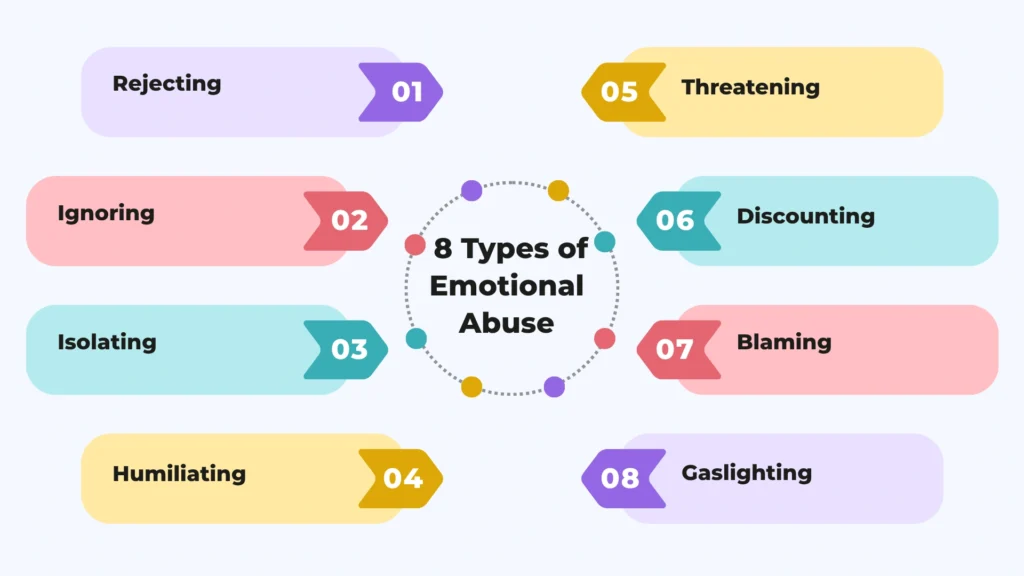
Emotional abuse rarely shows up as a single tactic, and most survivors experience several of these 8 patterns at once. This list traces back to the classic research of psychologist James Garbarino, whose typology still shapes the way clinicians classify emotional abuse today.
Rejecting
Rejecting tells someone they are worthless or unwanted. It often sounds like silence after a real achievement, or comments like “we never wanted you.” It attacks a person’s basic sense of belonging.
Ignoring
Ignoring means staying in the room while checking out emotionally. It shuts down conversation, avoids eye contact, and withholds affection on purpose. It punishes the other person without a single word.
Isolating
Isolating cuts a person off from outside support by slowly limiting contact with friends and family over time. Eventually, the victim comes to depend on the abuser alone.
Humiliating
Humiliating mocks or belittles someone in public or private through name-calling, sarcasm, or forced embarrassment. It tends to damage confidence quickly.
Threatening
Threatening uses fear to keep someone on edge, whether through punching walls, raising a fist, or threatening self-harm. It keeps the nervous system stuck in a constant state of alert.
Discounting
Discounting dismisses someone’s feelings as fake or exaggerated, often through phrases like “you’re overreacting.” Over time, it teaches victims to stop trusting their own emotions.
Blaming
Blaming shifts responsibility onto the victim directly. The abuser blames their partner for their own anger or mistakes and avoids any accountability for their behavior.
Gaslighting
Gaslighting denies facts or events in order to confuse the victim. It makes someone question their own memory and judgment until they no longer trust their own mind.
Why Do Victims Stay? The Psychology Explained
Trauma bonding is one of the biggest reasons survivors stay attached to someone who hurts them. The cycle of abuse and reconciliation confuses the brain’s reward system. Relief and affection keep getting paired with the very person who caused the pain. This mix of reward and punishment is called intermittent reinforcement. It is the same pattern that makes slot machines hard to walk away from. It can condition behavior more strongly than a steady, predictable pattern ever could.
Cognitive dissonance plays a role too. Believing “this person loves me” and “this person hurts me” at the same time creates real psychological discomfort. So the mind often shrinks the abuse down instead of leaving the relationship altogether.
How Emotional Abuse Affects Mental and Physical Health
Emotional abuse leaves marks that tend to outlast the relationship itself:
- Anxiety: Constant tension keeps the body on high alert, even long after the actual danger has passed.
- Depression: Long-term criticism and control gradually lower mood and motivation.
- Low self-esteem: Repeated put-downs chip away at a person’s overall sense of worth.
- PTSD and Complex PTSD (C-PTSD): Ongoing fear can trigger flashbacks and hypervigilance. Long-term abuse can develop into C-PTSD, which also disrupts emotional control and self-image.
- Trust issues: Gaslighting makes it harder to trust your own judgment in future relationships, even ones that are genuinely safe.
- Physical health decline: Chronic stress raises cortisol levels and disrupts sleep. It also weakens the immune system and raises the long-term risk of heart problems and chronic pain.
Basic Rights Every Healthy Relationship Should Give You
Every healthy relationship should guarantee you these rights:
- The right to goodwill and emotional support from your partner
- The right to be heard and treated with courtesy
- The right to hold your own opinions, even when your partner disagrees
- The right to have your feelings acknowledged as real
- The right to clear, honest answers to fair and reasonable questions
- The right to live free from blame and constant judgment
- The right to encouragement instead of nonstop correction
- The right to live free from threats and emotional intimidation
If your relationship breaks several of these rights again and again, that pattern deserves serious attention rather than another excuse.
What Should You Do If You’re Experiencing Emotional Abuse?
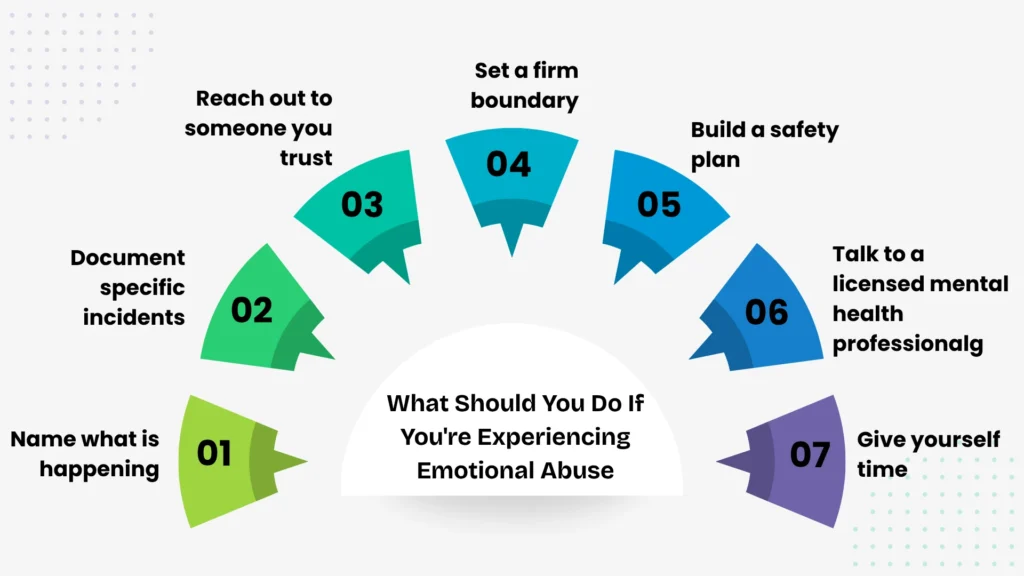
Follow these 7 steps to respond to emotional abuse in a way that protects you:
- Name what is happening: Emotional abuse is a real and serious problem, not an overreaction on your part.
- Document specific incidents: Write down dates and patterns to keep your perspective clear and to help counter gaslighting later.
- Reach out to someone you trust: A single trusted friend or family member can offer an outside perspective you may be missing.
- Set a firm boundary: Choose one specific behavior you will no longer accept, and hold that line consistently.
- Build a safety plan: Cover money, housing, and a safe place to go, especially if there is any risk of physical harm.
- Talk to a licensed mental health professional: Look for someone with real experience in coercive control and trauma recovery.
- Give yourself time: Recovery from abuse is rarely instant, and healing almost never moves in a straight line.
You are never responsible for someone else’s abusive behavior, no matter how they try to frame the situation. If full no-contact is not possible right away, many therapists recommend the gray rock method. Keep your answers flat and unremarkable. This reduces conflict while you quietly build your exit plan.
How to Support a Friend Who Is Experiencing Emotional Abuse
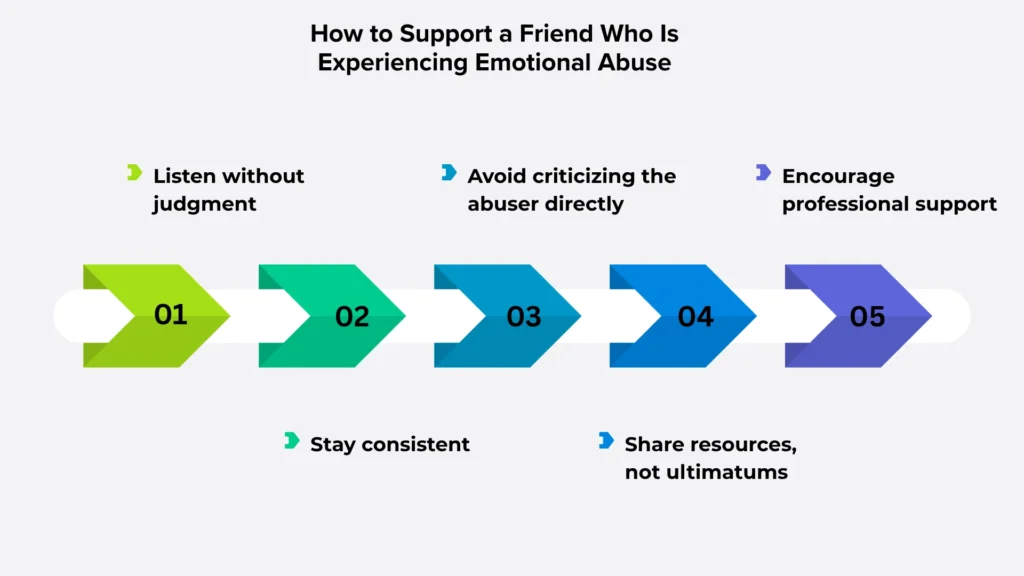
If someone you care about is going through this, your response matters:
- Listen without judgment: Avoid saying “just leave,” since it oversimplifies a situation that is rarely that simple.
- Stay consistent: Abusers often isolate victims on purpose, so a steady, reliable presence counts for a lot.
- Avoid criticizing the abuser directly: This can sometimes push the victim to defend the relationship instead of questioning it.
- Share resources, not ultimatums: Offer information calmly and let the person move at their own pace.
- Encourage professional support: A therapist or counselor can offer guidance that friends and family are not trained to give.
When to Seek Professional Support
A trained therapist can tell the difference between a difficult relationship and a genuinely abusive one. They can guide survivors through practical safety steps and long-term healing, one stage at a time. Many survivors later choose to study the mind and human behavior themselves. Charisma University’s School of Psychology offers a strong starting point for that path.
Different careers support survivors in different ways. Some students train to become licensed psychiatrists or clinical psychologists through Charisma University’s graduate psychology programs. These careers manage treatment for the anxiety, depression, and PTSD that often follow abuse. Others focus on physical recovery through the School of Health Sciences, since long-term abuse affects the whole body, not only the mind.
If you want to explore these paths further, you can review the admission requirements or speak with an advisor to find the program that fits your goals.
Frequently Asked Questions
No. Verbal abuse is one form of emotional abuse. Emotional abuse also includes isolation, financial control, and silent manipulation.
Yes. Emotional abuse often happens quietly. Silence, coldness, and subtle control cause real damage without raised voices.
Recovery time is different for everyone. Many survivors see real progress within 6 months to 2 years of steady therapy and support.
Yes. Some abusers learned these patterns growing up. They repeat them without full awareness. But lack of awareness does not remove responsibility for the harm caused.
Build a safety plan with a trusted person or professional. Cover finances, housing, and emotional support before any confrontation happens.
Trust your own record over the abuser’s version of events. State what you observed once, calmly. Then step back instead of arguing to “win.” Repeating facts rarely changes a gaslighter’s story.
Trauma bonding is the attachment that forms when relief and affection keep following fear and pain. It trains a victim to seek comfort from the same person who caused the harm. Breaking it usually takes no-contact or strict low-contact boundaries, a support system, and trauma-informed therapy.
Keep contact with necessary topics only. Communicate in writing when you can. Hold your boundaries and write down specific incidents. A therapist, or HR and an employment lawyer for workplace cases, can guide your safest next steps.
Emotional abuse is linked to anxiety, depression, low self-esteem, PTSD or C-PTSD, and lasting trust issues. These effects often build slowly and get worse without support. Long-term exposure also raises the risk of chronic physical illness.