Self-esteem is a person’s overall evaluation of their own worth and abilities. It has two parts. One part is confidence in your ability to think and act. This is called self-efficacy. The other part is a basic sense that you deserve respect and happiness. This is called self-worth. People with healthy self-esteem trust their own judgment. They handle setbacks well. They chase goals without constant self-doubt.
This guide covers the definition of self-esteem. It explains the 4 types. It shows how psychologists measure it, what shapes it, and how it differs from narcissism. It also covers how to have self-esteem that holds up under real pressure.
What Is Self-Esteem, Exactly?
Self-esteem is the internal rating of your own value. It is not arrogance. It is also not the same as skill level. A skilled person can still have low self-esteem. A beginner can have high self-esteem.
Self-esteem rests on 2 pillars:
- Self-efficacy: Confidence in your ability to think, decide, and act
- Self-worth: The belief that you deserve happiness and respect, no matter what you achieve
Sociologist Morris Rosenberg built the field’s standard measurement tool in 1965. He defined self-esteem as a person’s overall positive or negative attitude toward themselves. Psychologists see self-esteem as one part of a bigger picture called the self-concept. That bigger picture also includes self-efficacy and self-identity as separate, related pieces.
The 4 Types of Self-Esteem
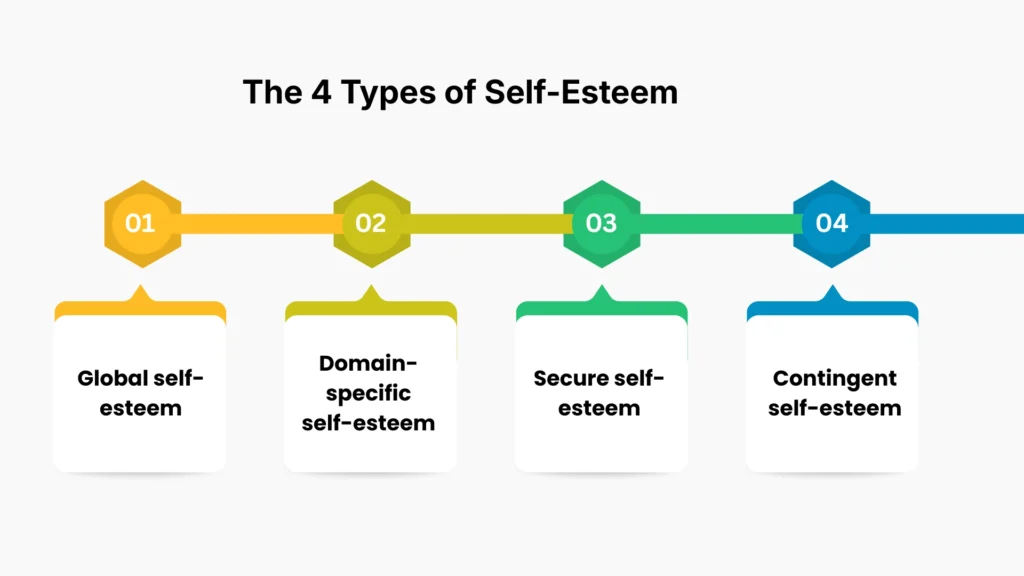
Not all self-esteem behaves the same way. Researchers generally sort it into 4 categories:
- Global self-esteem: Your overall sense of worth across your whole life, not tied to any single skill
- Domain-specific self-esteem: Confidence tied to one area, such as academics, appearance, or athletics, which can be high in one domain and low in another
- Secure self-esteem: Stable self-worth that holds up under criticism or failure because it isn’t tied to external proof
- Contingent self-esteem: Self-worth that rises and falls with outside validation, such as grades, praise, or social media likes
Contingent self-esteem is worth watching closely. It is often described in the research literature as a form of fragile high self-esteem, since it produces confident behavior on the surface while remaining highly reactive to setbacks underneath.
Self-Esteem vs. Narcissism: What’s the Difference?
People often confuse healthy self-esteem with narcissism. The two are actually very different, with almost no overlap.
| Self-Esteem | Narcissism |
| Built on real accomplishments and values | Often built on a fear of failure or inadequacy |
| Supports cooperation and compassion | Encourages rivalry and envy |
| Accepts criticism without collapsing | Reacts to criticism with defensiveness or hostility |
| Tends to decrease slightly, then stabilize with age | Peaks in adolescence, then declines across life |
A large research review looked at data from more than 4,700 people. Self-esteem predicted lower anxiety, lower depression, and less overall distress. Narcissism showed only a weak link to those same outcomes. Narcissism showed a much stronger link to aggression and substance misuse instead. The takeaway is simple: raising self-esteem does not raise the risk of narcissism. The two traits grow through different parenting patterns and different psychological paths.
Why Self-Esteem Matters
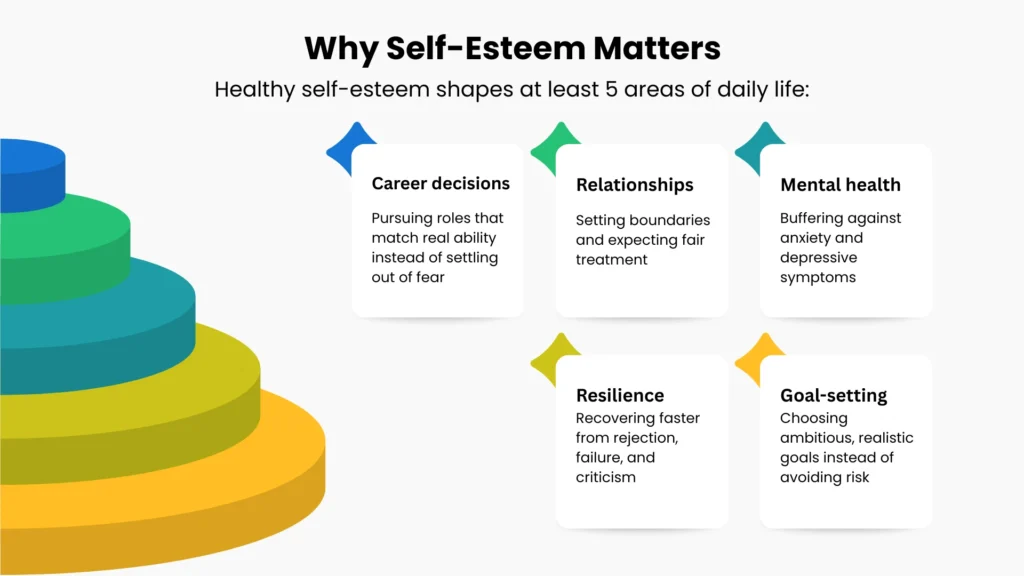
Healthy self-esteem shapes at least 5 areas of daily life:
- Career decisions: Pursuing roles that match real ability instead of settling out of fear
- Relationships: Setting boundaries and expecting fair treatment
- Mental health: Buffering against anxiety and depressive symptoms
- Resilience: Recovering faster from rejection, failure, and criticism
- Goal-setting: Choosing ambitious, realistic goals instead of avoiding risk
Low self-esteem does the opposite. It narrows ambition, invites self-criticism, and makes ordinary setbacks feel personal.
How Psychologists Measure Self-Esteem
Most clinics and researchers use the Rosenberg Self-Esteem Scale to measure self-esteem. It is a 10-item questionnaire built in 1965. It is still the most validated tool in the field. Researchers have used it in 53 countries. People rate statements like “On the whole, I am satisfied with myself” on a 4-point scale.
Scoring works like this:
- Total scores range from 0 to 30
- Scores between 15 and 25 sit in the typical range.
- Scores below 15 often signal low self-esteem, along with a higher risk of depression and anxiety.
The scale takes about 2 to 3 minutes to complete. It also shows strong test-retest reliability, with scores staying close to 0.82 to 0.88 across repeat testing. That reliability is one reason it still stands as the field standard, 6 decades after publication.
What High and Low Self-Esteem Look Like
Signs of High Self-Esteem
People with high self-esteem typically:
- Try new activities without needing a guaranteed win.
- Speak up for their own needs and opinions.
- Treat mistakes as isolated events, not proof of failure.
- Stay optimistic after a setback.
Signs of Low Self-Esteem
People with low self-esteem typically:
- Avoid unfamiliar situations
- Underestimate their own abilities.
- Turn one mistake into a global judgment, like “I always mess up”
- Stay quiet in social or work settings, even when they disagree.
What Influences Self-Esteem
Self-esteem forms through 4 core psychological processes:
- Reflected appraisals: Absorbing how others seem to see you, such as a parent, teacher, or close friend
- Social comparisons: Measuring yourself against classmates, coworkers, or siblings
- Self-attributions: The explanations you give yourself for success or failure
- Psychological centrality: How much weight you give one trait or role in your identity
Life circumstances add more pressure on top of these processes. Common barriers include:
- Unstable or critical home environments
- Unrealistic personal or academic expectations
- Chronic negative self-talk
- Anxiety and depression
- Constant comparison to curated social media images
Self-esteem stays fairly steady once it forms in adulthood. It usually shifts only if a major life event disrupts it.
How Self-Esteem Develops Across Life
Self-esteem does not form overnight. It also does not stay fixed at one number forever.
A large-scale German study tracked more than 2,500 people from age 14 to 89. Self-esteem rose through adolescence, young adulthood, and middle adulthood. It peaked around age 60. Then it declined in old age. The same research also tracked narcissism. Narcissism followed the opposite pattern. It peaked in adolescence, then dropped steadily. So the two traits move in mirror-image directions across a lifetime.
A separate meta-analysis of longitudinal studies covered tens of thousands of people. It found that self-esteem and social relationships predict each other over time. This forms a feedback loop across the whole lifespan. In simple terms, the relationships you build now shape your self-esteem years later. This applies to a classroom, a workplace, or a graduate program.
Self-Esteem in the Workplace
Self-esteem shapes 3 measurable outcomes at work. It affects how often someone volunteers for a stretch assignment. It affects how they respond to hard feedback. It affects how fast they recover from a missed target. Employees with higher self-esteem tend to negotiate more assertively.
They ask for feedback more often. They read performance reviews as useful information, not as a verdict on their worth. Employees with contingent, validation-based self-esteem behave differently. They lean too heavily on manager praise. They also show sharper motivation drops after criticism.
Common Myths About Self-Esteem
- Myth: Praising every effort builds self-esteem.
Reality: Studies show children praised for skills they haven’t actually mastered often feel emptier afterward. Real self-esteem builds from earned accomplishment, not unearned praise. - Myth: High self-esteem means high confidence in everything.
Reality: self-esteem can be domain-specific. Someone can feel very capable at work and still feel insecure in social settings. - Myth: Self-esteem is fixed at birth.
Reality: self-esteem grows through life experience and relationships. It shifts in measurable ways across decades. - Myth: Self-esteem and narcissism are the same trait.
Reality: they are different constructs. They follow different developmental paths. They also link to mental health in different ways.
How to Have Self-Esteem: 8 Steps That Work
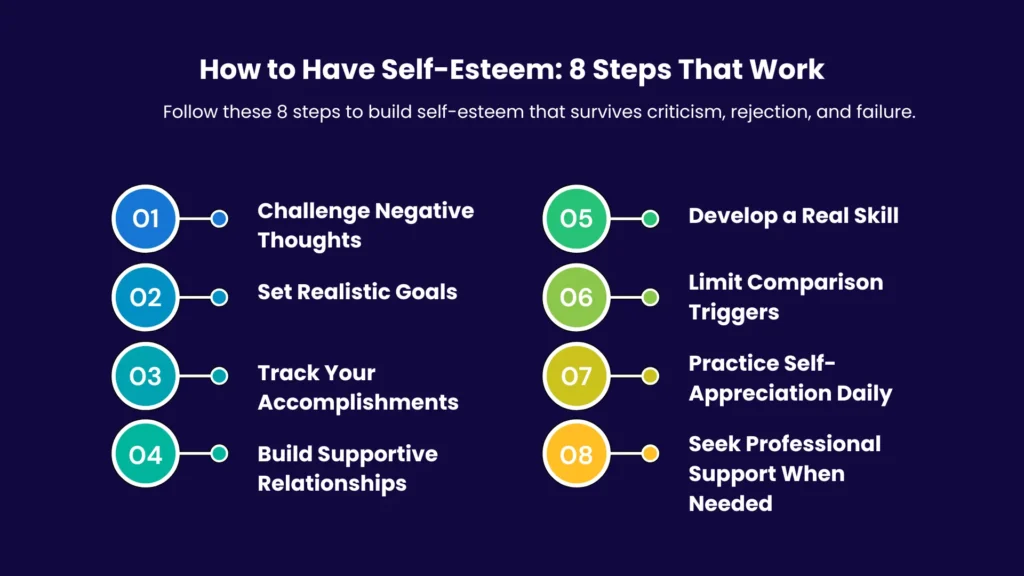
Follow these 8 steps to build self-esteem that survives criticism, rejection, and failure.
1. Challenge Negative Thoughts
Catch the thought “I always fail” before it settles in. Replace it with a specific, factual account of what actually happened. Facts calm the mind faster than broad judgments.
2. Set Realistic Goals
Break large goals into smaller pieces. Pick pieces you can actually measure. Small, clear wins build confidence step by step.
3. Track Your Accomplishments
Keep a running list of things you’ve done well. Low self-esteem tends to erase memory of past wins. A written list fights that memory gap.
4. Build Supportive Relationships
Spend time with people who are honest, kind, and non-judgmental. These relationships protect self-esteem during hard weeks. They also model healthy self-talk.
5. Develop a Real Skill
Pick one skill and practice it, such as writing, public speaking, or a technical craft. Real competence builds self-efficacy in a way that compliments cannot match.
6. Limit Comparison Triggers
Cut back on feeds or spaces built around constant ranking. Comparison culture quietly erodes self-worth over time. Less exposure means less erosion.
7. Practice Self-Appreciation Daily
Each day, name three specific things you did well. Keep the habit short, around two minutes. Small, repeated appreciation builds up over weeks.
8. Seek Professional Support When Needed
Talk to a counselor or therapist if low self-esteem lingers. A professional can help you spot patterns you can’t see on your own. Reach out sooner rather than later if it affects sleep, work, or relationships for more than a few weeks.
Where Self-Esteem Meets Academic and Career Growth
Self-esteem and competence build each other up. Students who sharpen their writing through a Writing Center often gain more confidence in their academic work. Visible skill growth builds self-efficacy directly. The same pattern shows up in career planning. Students who work with a Career Center to clarify their goals tend to make steadier, more confident decisions than those guessing alone.
Some students want to study the psychology behind self-esteem, self-concept, and self-efficacy in depth. Charisma University’s School of Psychology offers graduate programs in Clinical Psychology, Behavior Analysis, and Psychoanalysis. Charisma University also shares research and commentary through its Insights section.
Frequently Asked Questions
Track daily accomplishments. Challenge negative self-talk right after it happens. Small, steady wins rebuild self-efficacy faster than one big achievement.
Yes. It rises steadily from adolescence through middle age. It peaks around 60, then declines in later life.
No. Confidence often applies to one specific skill or task. Self-esteem is broader and more stable. It covers your overall sense of worth.
Genuine, secure self-esteem is not linked to more aggression or entitlement. What looks like “too much” self-esteem is usually narcissism, or fragile, contingent self-esteem. Both are separate traits.
Self-confidence is task-based, like confidence in public speaking. Self-esteem is broader and more evaluative. It covers how a person feels about their whole self.
For kids, self-esteem means how much a child likes and values themselves. A child with healthy self-esteem tries new things, bounces back after mistakes, and feels liked by friends and family. It grows through real praise and small daily wins, not constant compliments.
The 3 C’s of self-esteem are competence, confidence, and connection. Competence is feeling capable, confidence is trusting your own judgment, and connection is feeling accepted by others. Together, they build a stable sense of self-worth.