It’s time to change careers when your work drains your energy, blocks your growth, or clashes with your values for six months or more. A single bad Monday doesn’t count. A pattern does. This guide walks through the questions career advisors ask every day, the ones that separate a rough patch from a real exit signal.
First, Is This a Job Problem or a Career Problem?
Before you rewrite your entire path, rule out the simpler explanation. A job problem lives inside one company: a bad manager, a toxic team, a role that got worse after a reorg. A career problem lives inside the work itself, the tasks, the pace, the values it demands, no matter which company you’re at.
Ask yourself: if you swapped employers tomorrow but kept doing the same type of work, would the problem follow you? If yes, you likely have a career problem. If the same tasks at a healthier company sound appealing, you may just need a new job, not a new field.
12 Signs It’s Time for a Career Change
Workers change careers three or more times across a working life on average, so the question isn’t whether change is normal. It’s whether the timing is right for you. Here are the clearest signals.
1. You Dread Sundays, Not Just Mondays
A little pre-week tension is ordinary. A knot in your stomach every single Sunday night, week after week, is your nervous system telling you something your calendar can’t argue with. Notice when the dread starts, too: if it creeps in by Saturday afternoon, the problem has stopped being about one bad week and started shaping your entire weekend.
2. Burnout Has Become Your Baseline
Fatigue, insomnia, and forgetfulness that don’t lift after a weekend off point to something structural, not a rough sprint. A marketing coordinator who takes two “sick days” a month just to reset isn’t lazy; she’s out of runway. The tell is recovery time: a demanding but healthy job leaves you tired on Friday and mostly restored by Monday. Baseline burnout means even a full week off barely moves the needle.
3. You’ve Stopped Being Curious About the Work
Boredom that lingers past a few slow weeks usually means the role has stopped stretching you. You can do more, just not here. A useful test: think back to the last time you learned something genuinely new on the job. If you have to scroll back more than six months in your memory, the role has likely plateaued before you noticed.
4. Your Effort Keeps Going Unseen
Getting passed over for a raise once is bad luck. Getting passed over three review cycles in a row, while newer hires land the visible projects, is a pattern worth naming. Keep a simple record of what you shipped and what feedback it got; a written trail makes it much easier to tell whether you’re actually being overlooked or just feeling that way after a hard quarter.
5. You’ve Hit a Ceiling With No Next Rung
Ask your manager directly: “What would it take for me to move up from here?” A vague answer, or no real answer, tells you the ceiling is structural. If the same question gets a clear, specific answer with a rough timeline attached, you may just be early in a real growth path rather than stuck on a permanent one.
6. You Envy Specific Parts of Other People’s Jobs
Not the paycheck, the actual day: the creative freedom, the client contact, the flexibility. That’s a clue about what to look for next. Get specific about it. “I wish I had her job” doesn’t help you plan, but “I wish I got to present to clients instead of just writing reports for them” points straight at a role, or even a single skill, worth chasing.
7. Work Stress Shows Up in Your Body
Headaches, tension, a resting heart rate that’s crept up over the past year- these are data points. No salary is worth ignoring them long-term. These symptoms often show up weeks before you’re willing to admit the job itself is the cause, so if a doctor has ruled out other explanations, it’s worth asking honestly what changes on vacation and what doesn’t.
8. Your Daily Tasks Conflict With What You Believe In
A salesperson who no longer trusts the product she’s selling, or an analyst asked to spin numbers she knows are misleading, will feel this friction daily, even on a good day. This kind of mismatch is harder to fix with a raise or a new manager than the other signs on this list, because the discomfort comes from the work itself, not from the conditions around it.
9. You Keep Asking “What’s the Point of This?”
Occasionally, that’s normal cynicism. Weekly, it usually means you’ve drifted from the reason you took the job in the first place. Try writing down, in one sentence, why this role mattered to you when you started. If you can’t finish that sentence honestly anymore, that gap is usually where the purpose went missing.
10. Your Search History Has More Job Titles Than Your Actual Title
If you spend lunch breaks reading about other industries, that’s not procrastination. That’s your own research process starting without your permission. Pay attention to which fields keep coming back, since a scattered curiosity across many unrelated industries usually means you’re avoiding your current job. In contrast, a repeated pull toward one or two specific fields usually means you’re actually onto something.
11. You’re Staying Because Leaving Feels Riskier, Not Because You Believe in the Work
Fear-based loyalty and belief-based loyalty look similar from the outside. Only you know which one you’re operating on. A quick way to check: imagine your current offer showed up as a brand-new opportunity today. Would you take it? If the honest answer is no, fear, not conviction, is likely what’s keeping you in the seat.
12. You’ve Done What You Came Here to Do
Some roles have a natural finish line. Hitting it, even without a title change, can be the actual signal, not the job description staying the same. This is the sign people miss most often, because nothing is technically wrong. The work is fine, the team is fine, and yet the goal that pulled you in has quietly been met, and nothing new has replaced it.
A Gallup workplace survey found that only 34% of U.S. employees feel engaged at work. Most people are carrying at least a couple of these signs at once. The real question is whether three or more have become constant.
How Long Should You Stay Before You Change Careers?
Tenure data is a useful anchor, not a rule. The median U.S. worker stays in a job about 3.9 years, according to Bureau of Labor Statistics tenure data: 3.5 years in the private sector and 6.2 years in the public sector. Workers in their 20s typically stay just over two years; workers 55 and older often stay close to a decade.
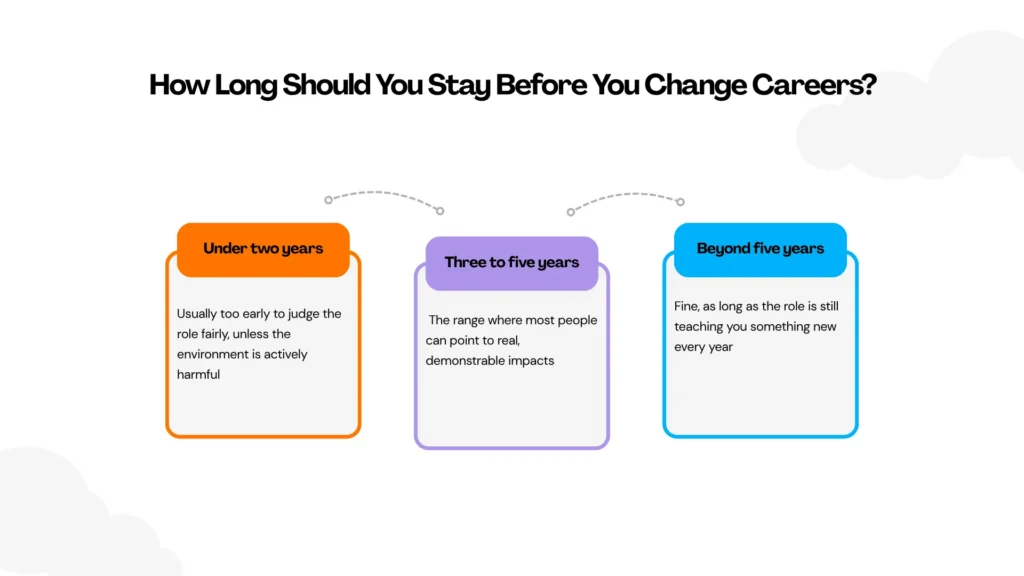
Three rough benchmarks help:
- Under two years: Usually too early to judge the role fairly, unless the environment is actively harmful.
- Three to five years: The range where most people can point to real, demonstrable impact.
- Beyond five years: Fine, as long as the role is still teaching you something new every year.
Recent labor data even shows workers who stay put are seeing slightly higher wage growth than job switchers, so leaving isn’t automatically the smarter financial move. Tenure length matters less than whether the role is still moving you forward.
What a Career Change Actually Costs
This is the part most advice skips. Before you plan the “what,” plan the “how you’ll afford it.”
| Cost Factor | What to Expect | Practical Tip |
| Emergency runway | 3–6 months of essential expenses, longer for lower-paying fields | Build this before you resign, not after |
| Retraining cost | A short certificate can run a few hundred dollars; a graduate degree is a multi-year investment | Get the real number in writing before you commit |
| Income dip | Many switchers take an entry-level salary in the new field for 1–2 years | Budget around your new starting pay, not your old one |
| Testing the waters | Freelance work, volunteering, or a short course | Validate interest on nights and weekends before touching savings |
If tuition is part of your plan, it’s worth checking what a program actually costs before you commit to a timeline.
Questions to Ask Yourself Before You Change Careers
Vague dissatisfaction turns into a real decision once you answer these honestly:
- What are you genuinely passionate about, separate from what sounds impressive?
- Which of your current skills would transfer, and which would you need to build from scratch?
- Could a lateral move or a new manager inside your current company solve this, without a full career change?
- Are you still learning here, or just repeating a loop you’ve already mastered?
- Is this the kind of professional you want to be known as in five years?
Write the answers down. A decision that lives only in your head is easy to talk yourself out of at 11 p.m. on a hard day.
How Life Stage Changes the Timing
Early-career professionals often use frequent moves to test industries, functions, and skills before anything is “locked in.” Mid-career professionals tend to weigh stability against a stretch role that could reset their trajectory. Later-career professionals more often prioritize flexibility, meaning, or a shorter commute over title. A detour on a resume increasingly reads as strategy rather than a red flag to hiring managers.
Changing Careers After 50
It’s genuinely not too late, but the calculus shifts. Health, caregiving responsibilities, and long-standing financial commitments carry more weight than they did at 25.
If you’d rather adjust your current role than leave it entirely, consider flexible or hybrid hours, a phased move into a new specialty inside the same company, or reasonable adjustments if a health condition is part of the picture. If you’re aiming for a full switch, a formal skills assessment helps translate two or three decades of experience into language a new industry actually understands.
A Practical Plan: Research, Skill Up, Apply, Adjust
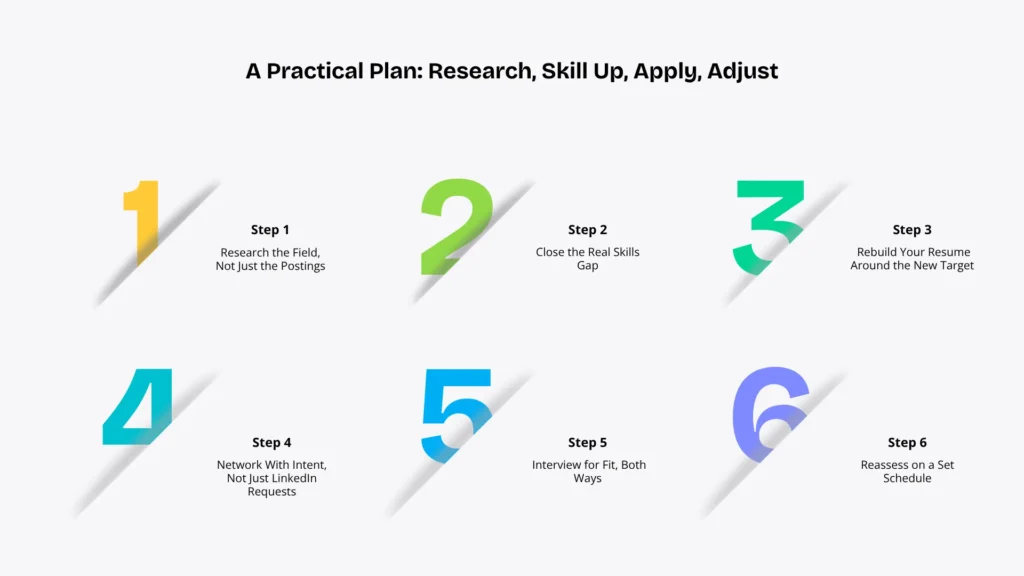
Step 1: Research the Field, Not Just the Postings
Talk to three people already doing the job you’re considering, not just job postings. Ask what a bad week looks like, not just a good one; postings rarely mention that part.
Step 2: Close the Real Skills Gap
Compare your resume against five job postings in the target field and circle every requirement you can’t currently check off. That list, not a general sense of “I need to learn more,” becomes your study plan. Depending on how wide the gap is, that might mean a short course or, for some fields, a full academic program. It’s worth checking admission requirements early if a formal credential looks likely.
Step 3: Rebuild Your Resume Around the New Target
Lead with transferable outcomes (“managed a $200K budget,” “led a team of six”) rather than industry jargon from your old field that won’t mean anything to a new hiring manager.
Step 4: Network With Intent, Not Just LinkedIn Requests
One genuine 20-minute conversation with someone in your target field usually teaches you more than ten job postings. Ask for a referral only after that conversation, not in the first message.
Step 5: Interview for Fit, Both Ways
Prepare a clear, honest answer for “why the switch,” since every interviewer will ask it. Practice it out loud until it sounds like a decision, not an apology.
Step 6: Reassess on a Set Schedule
A career change is rarely a single leap. It’s usually two or three smaller moves over one to three years. Revisit your plan every few months so drift doesn’t quietly replace direction.
When Formal Education Fits Into the Plan
Not every career change needs a degree, but some genuinely do, especially moves into regulated fields, senior HR and people leadership, or roles gated behind a specific credential. If your skills gap is wide rather than narrow, a structured graduate program can compress years of self-directed trial and error into a focused, credentialed timeline. Readers weighing that route at Charisma University can explore graduate program options or see what a business-focused path looks like through the School of Business.
A peer-reviewed study on career transitions found that people who voluntarily switch fields are typically chasing an improvement in job satisfaction or work-life balance, not just a bigger paycheck, which is worth remembering when you’re evaluating options that pay less but fit better.
Once you’re closer to a decision, it also helps to learn how a career center supports the job search side of things: resumes, interview prep, and connecting with employers in your target field.
The Bottom Line
A career change works best as a decision you build, not one you fall into after a bad week. Separate a job problem from a career problem, check your signs against your tenure, price out the real cost, and give yourself a plan with checkpoints instead of a single leap. If you’d like to talk through what a transition could look like for you, you can always get in touch with an advisor to start the conversation.
Frequently Asked Questions
Ask whether the problem would follow you to a new employer doing the same type of work. If yes, it’s likely a career problem. If a healthier workplace doing the same tasks sounds appealing, a new job may be enough.
Persistent burnout, boredom, feeling undervalued, no room to grow, and a values mismatch with your daily work are the signals that show up most often across career advice and workplace research alike.
No. Later-career changers bring judgment, networks, and steadiness that employers value, though the transition often benefits from a phased approach rather than a sudden jump.
Most transitions unfold over one to three years and involve several smaller moves rather than a single leap, especially when retraining or a new credential is involved.
Not always. Many switches only require a short course or certificate. Regulated fields, senior leadership roles, and some specialized professions are the main cases where a formal degree becomes necessary.
A common guideline is three to six months of essential living expenses, extended further if your target field typically pays less when you’re starting.
On average, workers change careers three or more times across their working life, not counting job changes within the same field.
Not if you frame it well. Leading with transferable outcomes rather than old industry jargon, and having a clear, confident answer for “why the switch,” turns a career change into a strength rather than a liability in an interview.