Most advice on time management reads like a recycled Wikipedia page: here are 10 techniques, pick one, good luck. That is not what this guide does.
This is a practical breakdown of 7 strategies that actually work, grounded in peer-reviewed research, paired with honest assessments of when each technique falls apart. Because the truth about managing your time is not that you need more tips, it is that you need to understand why your current system keeps failing, and pick a method that matches how your brain actually works.
A 2021 meta-analysis of 158 studies published in PLOS ONE found that people who practice structured time management report higher job performance, stronger academic achievement, and greater life satisfaction than those who do not. But here is the part most articles leave out: that same study found time management improves wellbeing more than it improves performance. In other words, getting organized does not just make you more productive. It makes you genuinely happier.
What is Time Management, Really?
On the surface, time management means planning how you spend your hours. But that definition misses the point.
You cannot actually manage time. It moves at the same speed regardless of what you do with it. What you manage is attention: where you direct your focus, how long you sustain it, and how quickly you recover it after a distraction pulls you away.
Gloria Mark, Chancellor’s Professor of Informatics at UC Irvine, has spent over two decades studying exactly this. Her research found that the average person now spends just 47 seconds on a single screen before switching to something else. In 2004, that number was two and a half minutes. Even more striking, her work shows it takes roughly 23 minutes to regain deep focus after a single interruption fully.
So when someone says “I need better time management,” what they usually mean is “I keep losing focus, and I do not know how to get it back.” That distinction matters because the solution is not always a new planner or a color-coded calendar. Sometimes it is redesigning your environment so interruptions cannot reach you in the first place.
Why Does Time Management Actually Matter?
Skip the motivational platitudes. Here is what the research says.
A 2025 review published in Frontiers in Education synthesized decades of time management research and found consistent positive correlations between structured time management and perceived control, job satisfaction, and health outcomes. The same review confirmed a negative correlation with stress, meaning the better you manage your time, the less chronic stress you carry.
But poor time management does not just cause stress. It compounds. Miss a deadline, and the task does not disappear. It stacks on top of tomorrow’s work. That creates a backlog. The backlog creates anxiety. The anxiety makes it harder to focus, which causes you to miss more deadlines. This is the cycle that turns “I had a bad week” into “I am always behind.”
The real cost shows up in 3 places:
- Quality of output: Rushed work lacks the depth that comes from sustained attention. Cal Newport calls this “deep work,” the cognitively demanding focus that produces your best thinking. When you are constantly task-switching, you never reach that level.
- Professional reputation: Consistently delivering late or incomplete work erodes the trust colleagues and supervisors place in you. Rebuilding that trust takes far longer than building it did originally.
- Physical and mental health: Chronic time pressure activates your stress response system. Over months and years, that translates into sleep problems, irritability, and burnout: not just feeling tired, but losing the capacity to care about work that used to matter to you.
7 Time Management Strategies That Actually Work (and When They Do Not)
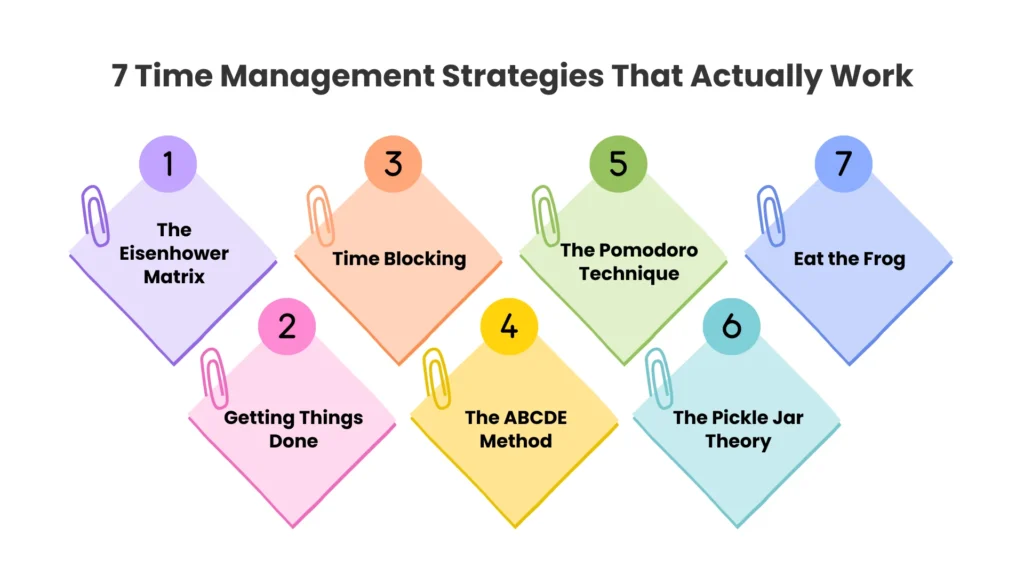
Every technique below works for certain people in certain situations. None of them works for everyone in every situation. Pay attention to the “when it fails” sections. They will save you from blaming yourself when the real problem is a mismatch between the method and your work style.
1. The Eisenhower Matrix
This framework sorts every task into 4 quadrants based on two questions: Is it urgent? Is it important?
- Quadrant 1- Urgent and important: Client emergencies, same-day deadlines, equipment failures. Handle these now.
- Quadrant 2- Important but not urgent: Strategic planning, skill development, relationship building, health. Schedule these deliberately. This is where career growth actually happens.
- Quadrant 3- Urgent but not important: Most emails, many meetings, routine admin requests. Delegate or batch these.
- Quadrant – Neither urgent nor important: Mindless scrolling, unnecessary meetings, busywork that feels productive but accomplishes nothing. Eliminate these.
The power of this matrix is not in the sorting itself. It is in the realization that most people spend 80% of their time bouncing between Quadrants 1 and 3, never touching Quadrant 2. And Quadrant 2 is where the work lives that prevents future crises, builds your skillset, and compounds over time.
When it fails:
The Eisenhower Matrix assumes you can accurately judge urgency and importance in the moment. But when everything feels urgent (which happens in high-pressure environments), every task lands in Quadrant 1, and the matrix becomes useless. Combine it with a daily limit: no more than 3 Quadrant 1 tasks per day, to force yourself into honest prioritization.
2. Time Blocking
Time blocking assigns specific chunks of your day to specific tasks. Instead of working from a to-do list and hoping you get to everything, you decide in advance when each task happens.
A marketing manager’s time-blocked morning might look like this: 8:00–9:30 for drafting the campaign strategy (deep work, no interruptions), 9:30–10:00 for email and Slack responses, 10:00–10:30 for a team standup, 10:30–12:00 for creative review. Each block has a defined start and end, which counteracts Parkinson’s Law, the observation by Cyril Northcote Parkinson that work expands to fill whatever time you give it.
Give yourself the entire afternoon to write a report, and it will take the entire afternoon. Give yourself 90 minutes, and you will likely finish in 90 minutes, often with better quality, because the constraint forces decision-making instead of endless revision.
When it fails:
Time blocking crumbles in environments with constant interruptions: open offices, customer-facing roles, or positions where urgent requests arrive unpredictably. Adapt by blocking only 60–70% of your day and leaving buffer space. Also, avoid blocks longer than 90 minutes. Research on deliberate practice consistently shows that sustained focus degrades after roughly 90 minutes, regardless of the task.
3. The Pomodoro Technique
Work for 25 minutes. Break for 5. After 4 cycles, take a longer 20–30 minute break. Francesco Cirillo developed this in the late 1980s using a tomato-shaped kitchen timer, and it has remained popular because it is dead simple.
The technique works because of what happens during those 5-minute breaks. Your brain does not stop processing. It shifts into what neuroscientists call the “default mode network,” where background consolidation of information happens. This aligns with what researchers describe in cognitive learning theory, meaning the brain actively organizes and restructures information during rest. Those breaks are not wasted time. They are when your brain connects dots and solidifies what you just learned or produced.
When it fails:
25 minutes is too short for cognitively complex work. Writing a research paper, debugging code, or analyzing financial models requires a ramp-up period before you reach peak focus. Interrupting that with a timer can break your momentum right when you are hitting your stride. For deep work, extend the interval to 50 or 90 minutes. Reserve the standard 25-minute pomodoros for administrative tasks, email processing, or studying material you already partially understand.
4. Eat the Frog
Brian Tracy popularized this idea: do your hardest, most dreaded task first thing in the morning. Everything else feels easier afterward.
This works because willpower and decision-making quality degrade throughout the day, a phenomenon that psychology researchers call decision fatigue. By tackling the most cognitively demanding task when your mental reserves are fullest, you protect your best thinking for your most important work.
A practical example: a student working on a thesis knows the literature review is the section they keep avoiding. Instead of starting the morning with easier tasks (checking email, organizing notes, reformatting citations), they open the literature review document immediately after sitting down and work on it for 60–90 minutes before touching anything else.
When it fails:
Not everyone peaks in the morning. Night owls who force themselves into early-morning deep work often produce worse output than they would at 10 PM. The real principle is not “mornings are best.” It is “do your hardest work during your biological peak.” Track your energy for a week to find yours.
5. Getting Things Done (GTD)
David Allen’s GTD system is built on one insight: your brain is terrible at storing information but excellent at processing it. When you try to remember tasks instead of recording them, you create a background anxiety that fragments your attention.
The system runs on 5 steps: capture everything in one trusted place (notebook, app, whatever), clarify whether each item requires action, organize actionable items by context and priority, reflect weekly to update your lists, and engage, then work through your organized system with confidence that nothing is slipping through.
GTD is the most comprehensive system on this list, and it works exceptionally well for people who manage complex, multi-domain responsibilities: project managers, academic researchers, or entrepreneurs juggling dozens of concurrent obligations.
When it fails:
GTD has a significant setup cost. The initial capture-and-organize phase can take an entire day, and maintaining the system requires a disciplined weekly review. People who skip the weekly review watch their system collapse within 2–3 weeks, and most do not restart it. GTD is a commitment. Treat it like one, or pick a simpler method.
6. The ABCDE Method
This is prioritization stripped to its bones. Label every task on your list:
- A: Serious consequences for non-completion. Do these first.
- B: Mild consequences for delay. Handle after A tasks.
- C: No consequences for skipping. Only touch when A and B are done.
- D: Delegable. Hand these off.
- E: Eliminable. Delete them.
The method forces a confrontation with a question most people avoid: “What actually happens if I do not do this?” If the honest answer is “nothing,” the task is a C or an E, and spending time on it while A tasks remain unfinished is self-sabotage disguised as productivity.
When it fails:
In team environments where others assign your priorities, labeling everything yourself creates conflict. Use this method for personal planning and combine it with team-level tools like shared Kanban boards for collaborative work.
7. The Pickle Jar Theory
Picture a jar. Rocks go in first (high-impact work), then pebbles (tasks that matter but are not urgent), then sand (distractions like notifications, social media, unnecessary browsing). If you pour the sand in first, the rocks will not fit.
This is a mental model, not a scheduling system. Its value is in the daily question it prompts: “Am I filling my jar with rocks, or with sand?” Most people start their workday with sand (checking email, responding to messages, organizing their desk), and by the time they reach the rocks, their energy is depleted.
When it fails:
The metaphor breaks down when you cannot clearly distinguish rocks from pebbles. In those situations, pair the Pickle Jar with the Eisenhower Matrix to classify tasks before sorting them into the jar.
3 More Techniques Worth Exploring
The Rapid Planning Method (RPM)
Tony Robbins developed the Rapid Planning Method to connect daily actions with long-term purpose. RPM stands for Results-oriented, Purpose-driven, Massive Action Plan.
Unlike task-focused methods that ask “what do I do next?”, RPM starts with 3 different questions: What result do I want? Why does it matter to me? What specific actions get me there? This purpose-first approach prevents you from spending weeks completing tasks efficiently while making zero progress toward your actual goals.
RPM pairs naturally with SMART goal setting (Specific, Measurable, Achievable, Relevant, Time-bound). A student who sets a vague goal like “do well this semester” will drift. A student who defines “raise my GPA from 3.2 to 3.5 by completing all assignments 48 hours before the deadline” has a result, a purpose, and a clear action plan.
When it fails:
RPM requires honest self-reflection about what you truly want, and many people struggle to define that clearly. It also works better for medium and long-term planning than for daily task management. Pair it with a daily technique like time blocking or the Pomodoro method for execution.
The Kanban Technique
Taiichi Ono implemented the Kanban system at Toyota in the 1960s to improve manufacturing workflow. It has since become one of the most widely used visual project management methods across industries.
To set up a Kanban board, divide your workspace (a whiteboard, sticky notes on a wall, or a digital tool like Trello) into 4 columns:
- Backlog: All tasks brainstormed and waiting to be prioritized.
- To Do: Tasks you plan to work on this week or sprint.
- In Progress: Tasks currently being worked on.
- Done: Completed tasks.
Each task lives on a card that moves from left to right as it progresses. The visual nature of Kanban makes overcommitment immediately obvious: too many cards in “In Progress” signals you are spreading yourself too thin.
When it fails:
Kanban excels for team-based and project-based work but adds unnecessary overhead for simple personal task lists. Use it when you manage 10+ concurrent tasks or collaborate with others; skip it when your daily list fits on an index card.
The Pareto Principle (80/20 Rule)
The Pareto Principle observes that roughly 80% of results come from 20% of efforts. Applied to how you manage time, this means a small number of tasks produce the majority of your meaningful output, and the rest is filler.
To apply the 80/20 rule, audit your weekly tasks and identify which activities consistently generate the highest impact. A sales professional might find that 80% of revenue comes from 20% of clients. A student might realize that 80% of exam performance comes from 20% of study material (core concepts, not trivia). Concentrate energy on that high-impact 20%, set realistic deadlines around it, and reduce time spent on everything else.
When it fails:
The 80/20 split is a pattern, not a universal law. In some roles, particularly compliance-heavy, healthcare, or legal work, the “low-impact” 80% includes tasks with serious consequences for non-completion. Do not ignore mandatory work just because it feels low-value.
Which Strategy Fits Your Work Style?
Not every technique works for every person. This comparison breaks down each method by the problem it solves, the effort it requires, and the work style it suits best.
| Strategy | Best For | Setup Effort | Ideal Work Style | Biggest Risk |
| Eisenhower Matrix | Prioritization confusion | Low | Anyone with competing deadlines | Over-classifying everything as urgent |
| Time Blocking | Focus and structure | Medium | Routine-based, calendar-driven workers | Inflexible in unpredictable environments |
| Pomodoro Technique | Procrastination and fatigue | Low | Students, writers, admin-heavy roles | Too short for deep, complex work |
| Eat the Frog | Avoidance of hard tasks | Low | Morning people, chronic procrastinators | Misfire for night owls who peak later |
| GTD | Overwhelm from volume | High | Project managers, multi-role professionals | Collapses without weekly reviews |
| ABCDE Method | Lack of clear priorities | Low | Solo workers, freelancers | Conflict in team-assigned environments |
| Pickle Jar Theory | Wasting time on distractions | Low | Visual thinkers, habit builders | Hard to classify without a second framework |
| RPM | Disconnection from purpose | Medium | Goal-driven planners, entrepreneurs | Requires deep self-reflection to define goals |
| Kanban | Complex multi-task projects | Medium | Teams, project managers, visual thinkers | Overkill for simple personal lists |
| Pareto Principle | Spreading energy too thin | Low | Sales, executives, students | Cannot ignore mandatory low-impact tasks |
Use this table as a starting point. Try the method that matches your primary struggle, not the one that sounds most impressive.
Parkinson’s Law: The Hidden Force Working Against You
Cyril Northcote Parkinson wrote in 1955 that work expands to fill the time available for its completion. He meant it as satire about bureaucratic inefficiency, but researchers have since confirmed it applies to individual behavior too.
Give yourself a week to prepare a 15-minute presentation, and you will spend the week on it, adjusting fonts, rewriting sentences that were already fine, adding slides you will end up cutting. Give yourself 3 hours, and you will make sharper decisions because the constraint eliminates overthinking.
This does not mean tighter deadlines are always better. Psychologists Robert Yerkes and John Dodson showed that performance follows an inverted-U curve: too little pressure produces laziness, optimal pressure produces peak performance. Too much pressure produces anxiety that tanks your output. The goal is to find the compression point where the deadline is tight enough to focus you but not so tight that it panics you.
Practical application: when estimating how long a task takes, cut your initial estimate by 25–30%. You will almost certainly still finish on time, and you will do it with fewer unnecessary detours.
The Deep Work Problem
Cal Newport, a computer science professor at Georgetown University, argues that the most valuable work in the modern economy requires sustained, distraction-free concentration, what he calls “deep work.” And the ability to do it is becoming increasingly rare precisely because our environments are designed to prevent it.
The numbers back this up. Research from 2026 analyzing over 500,000 hours of remote work found that only 51% of total work time qualifies as deep work—communication tools, meetings, and task-switching consume the rest. Gloria Mark’s finding that attention shifts every 47 seconds, combined with the 23-minute recovery cost per interruption, means that a single notification can destroy nearly half an hour of focused output.
For anyone trying to manage their time better, this creates a practical rule: protect at least 2 uninterrupted hours per day for your most cognitively demanding task. No email. No Slack. No phone. Those 2 hours will produce more meaningful output than 6 hours of fragmented, shallow work.
Students pursuing online degrees face this challenge acutely, since they study in the same environments where their distractions live: their personal computers, phones, and homes.
Tools Worth Using (and When to Stop Switching Between Them)
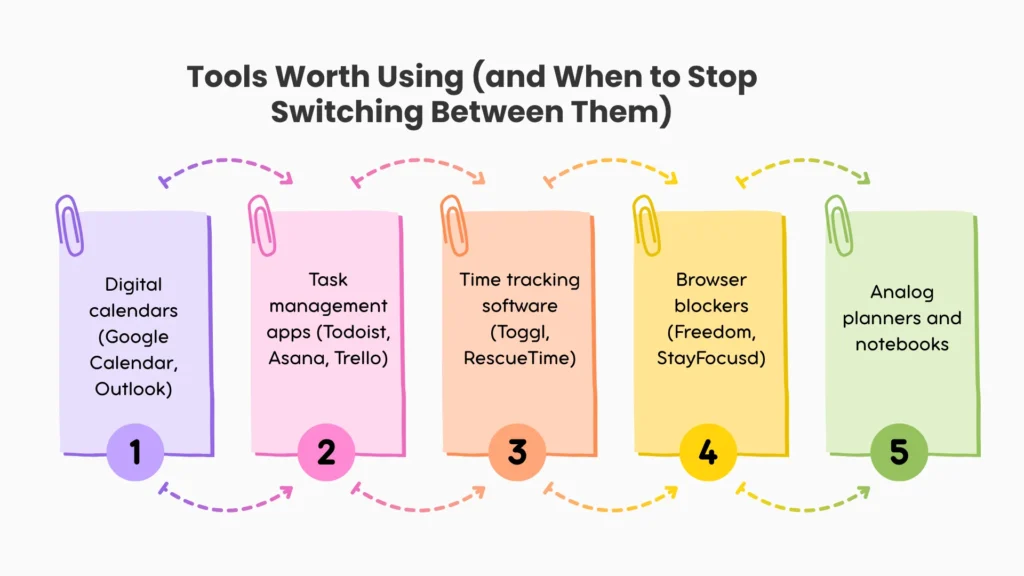
One of the most common time management mistakes is constantly adopting new tools. Every switch creates a learning curve, migration cost, and disruption to whatever system was already working. Pick one primary tool and commit to it for at least 90 days before evaluating.
That said, tools genuinely help when matched to the right use case:
- Digital calendars (Google Calendar, Outlook): Best for time blocking and meeting coordination. The visual layout makes overcommitment obvious. You can literally see when your day has no white space left.
- Task management apps (Todoist, Asana, Trello): Suit GTD and project-based workflows. Shared boards make delegation transparent, so nothing falls between team members.
- Time tracking software (Toggl, RescueTime): Reveal where your hours actually go. The gap between perceived and actual time use is usually shocking. Most people overestimate their productive hours by 2–3 hours daily.
- Browser blockers (Freedom, StayFocusd): Remove the option to self-interrupt during deep work sessions. This matters because Gloria Mark’s research shows we interrupt ourselves more often than others interrupt us.
- Analog planners and notebooks: Physical writing activates deeper memory encoding than typing. For people who struggle with digital distractions, a paper planner eliminates the temptation.
The tool is never the system. The system is your habits, routines, and decisions. The tool makes the system easier to execute.
How to Build the Habit: A Realistic 4-Week Plan
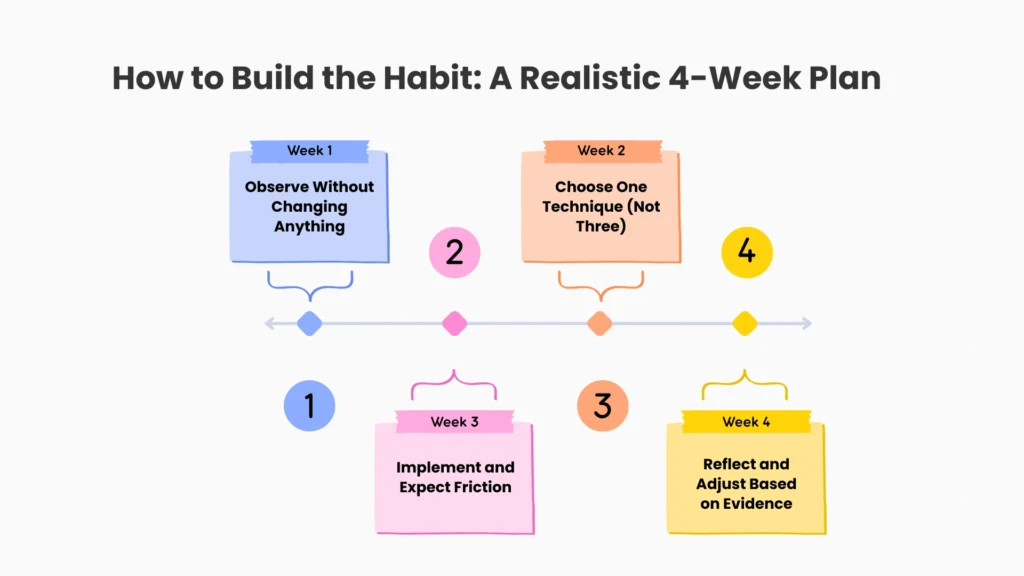
Week 1: Observe Without Changing Anything
Track how you spend every 30-minute block for 5 workdays. Use a simple spreadsheet, a notebook, or a tool like Toggl. Do not try to fix anything yet. Just record honestly. You will discover patterns you never noticed: which tasks consume disproportionate time, when your focus peaks and dips, and which distractions derail you most frequently. This data becomes the foundation for every decision in the next 3 weeks.
Week 2: Choose One Technique (Not Three)
Based on your Week 1 data, pick a single method from this guide. Resist the temptation to combine multiple techniques. Layering systems before mastering one is a recipe for abandoning all of them. Match the method to your core problem: the Eisenhower Matrix for prioritization struggles, time blocking for focus issues, Eat the Frog for procrastination on difficult tasks, or GTD for overwhelm from too many competing responsibilities.
Week 3: Implement and Expect Friction
Apply your chosen technique every workday for the full week. The first 5 days feel awkward. That friction is normal, not a sign the method is wrong. Do not judge effectiveness until you have used it for at least 10 working days. Keep a brief end-of-day note (2–3 sentences) on what felt natural and what felt forced. These notes become invaluable in Week 4.
Week 4: Reflect and Adjust Based on Evidence
Review your daily notes from Week 3. What worked consistently? Where did the system break down? Did you need more flexibility, more structure, or a fundamentally different approach? Adjust based on what the evidence shows, not how you feel in the moment. Monday-morning motivation and Friday-afternoon exhaustion give very different assessments of the same system. Trust the patterns across the full week instead.
Time Management for Students: What Nobody Tells You
The biggest time management problem for students is not poor planning. It is an illusion of available time. Semesters feel long at the beginning, and deadlines feel distant. That distance removes urgency, which activates Parkinson’s Law, which turns a 6-week project into a panicked all-nighter.
The fix is working backward and building study habits that actually stick rather than relying on bursts of last-minute panic. Take the final deadline, subtract the submission date, and divide the remaining work into weekly milestones. Then treat each weekly milestone as its own non-negotiable deadline. This transforms a distant, abstract due date into a series of immediate, concrete tasks.
At Charisma University, students develop these habits through structured academic advising and mentorship programs that build accountability into the learning process, something that matters especially in online and distance learning environments where external structure is minimal.
Time Management in the Workplace: What Separates Top Performers
Workplace time management is not about individual discipline alone. It is about how teams and organizations design their work environments.
A Kanban board, the visual system originally developed by Taiichi Ono at Toyota in the 1960s, transforms abstract project phases into visible, movable cards that track progress from “backlog” through “in progress” to “done.” This transparency reduces the cognitive load of remembering where everything stands and makes delegation intuitive.
Leaders who practice transformational leadership understand that delegation is not about offloading. It is about placing tasks with the person best equipped to handle them while freeing yourself for strategic decisions.
But the most underused workplace strategy is also the simplest: batching. Group similar tasks into dedicated time blocks: all emails between 10:00–10:30 and 3:00–3:30, all phone calls in one 45-minute block, all document reviews on Tuesday afternoon. Batching reduces the context-switching cost that Gloria Mark’s research shows is so destructive, because your brain stays in one mode instead of constantly shifting between different types of thinking.
The best teams also normalize saying “no” to low-value meetings. A 30-minute meeting with 6 people costs 3 hours of collective labor. That cost is real, even when it does not show up on a balance sheet.
Answering Time Management Interview Questions
Hiring managers ask about time management to gauge self-awareness, not to hear a technique name. When asked “How do you prioritize your tasks?” or “Tell me about a time you missed a deadline,” answer using the STAR framework: Situation, Task, Action, Result.
A strong answer describes a specific scenario, explains the competing priorities, walks through the decision-making process, and quantifies the outcome. “I had 3 client deliverables due the same week, so I mapped each one’s impact and deadline using a simple priority matrix. I completed the highest-stakes project first, delegated formatting on the second, and negotiated a 2-day extension on the third. All three shipped with positive client feedback.”
That kind of answer demonstrates a system, not a buzzword. Explore resources like Charisma University’s career services for guided interview preparation that builds this level of specificity into your responses.
Frequently Asked Questions
Start with time blocking. It requires no special tools, creates an immediate visual structure for your day, and gives you concrete data about how long tasks actually take versus how long you assumed they would.
Only when one task is automatic, like listening to a podcast while walking, and both tasks require focused thinking, are you not multitasking. You are rapidly switching between them, and each switch costs roughly 23 minutes of recovery according to Gloria Mark’s research at UC Irvine.
Batch your focused work into one protected block per day; even 60 minutes helps. Communicate that block to your team so they know when to hold non-urgent requests. Outside that block, work reactively and do not fight the interruptions. The goal is protecting a minimum viable window for deep work, not eliminating all shallow work.
Parkinson’s Law states that work expands to fill the time you give it. A report that genuinely requires 2 hours will consume an entire day when the deadline is a day away, because the excess time invites overthinking, unnecessary revisions, and distraction. Counter it by setting deadlines 25–30% tighter than your first instinct.
Behavioral research suggests anywhere from 21 to 66 days depending on complexity. But the honest answer is: the habit sticks when the system produces results you can feel: less stress, more free time, better output. That usually happens within 2–3 weeks of consistent use.